

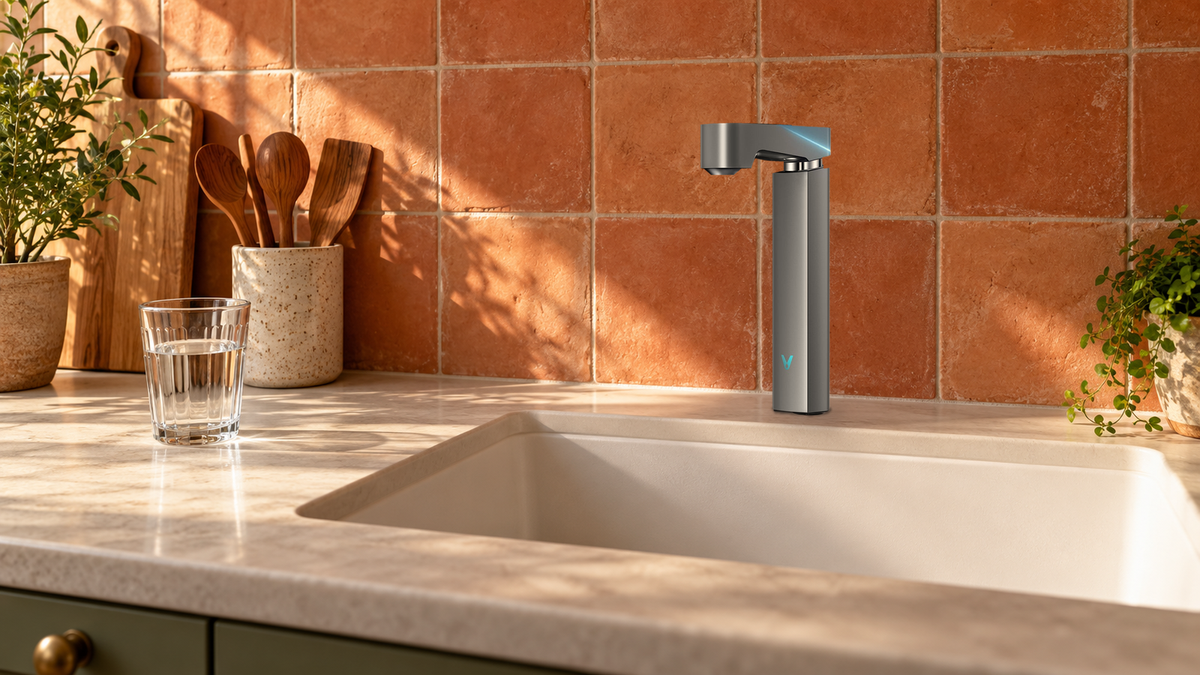
Countertop filters that address alkalinity come in three forms: alkaline pitchers, larger gravity systems that hold a day's water, and countertop reverse osmosis units that add minerals back after the membrane.
The forms differ in what happens to the water first. A pitcher or gravity system filters tap water through cartridges and adjusts it along the way, so the water keeps much of its original mineral character. A countertop RO unit first pushes water through a membrane that removes most dissolved solids, then adds calcium, magnesium or calcium carbonate back in a final stage.
Alkaline Pitchers: pH Raised at the Cartridge
A pitcher is the smallest commitment. It needs no power and no plumbing, and the part that raises pH lives inside the cartridge you replace.
Inside an alkaline pitcher, the cartridge does the work. In the Santevia MINA Pitcher it adds calcium and magnesium, and Santevia's explanation is that the "minerals naturally increase water pH." The Seychelle Gen 2 Dual pH2O Pure Water Pitcher, designed for chlorinated municipal water, splits the job across a pair of filters that increase alkalinity and pH, according to Seychelle.
For a household, size and filter life decide how often someone refills the pitcher and replaces the cartridge. The MINA holds 2 L, with each filter rated for 2 months, or 300 L (80 gallons); the 64 oz Seychelle is rated by gallons filtered, up to 150 gallons. Both brands cite testing against NSF standards: 42, 53 and 401 for the MINA filter, by Santevia's account, and NSF/ANSI 42 and 53 for Seychelle's filters. Pitchers suit a renter, a dorm room or a small household that drinks a few liters a day. Each fill is a single batch.
Gravity Systems That Hold a Day's Water
A gravity system is a larger countertop tower: an upper chamber you fill, filters that water drips through, and a lower reservoir with a spigot. It holds more than a pitcher, so a family can draw from it through the day.
Gravity towers differ in what the water passes and in how upkeep is counted. In the Santevia Gravity Water System, water passes a ceramic pre-filter and a fluoride removal filter, then rests on Mineral Stones, a mix of maifan stones and bio-ceramic balls that, in Santevia's description, "continuously release essential minerals into the water." The brand states that the system infuses calcium and magnesium and that the minerals raise pH. Its 10 L (2.6 gallon) tower spreads upkeep across three parts: the fluoride filter every 4 months, the ceramic pre-filter every year, and the Mineral Stones every 2 years.
For Invigorated Water's pH Recharge 3F, another countertop dispenser sold for alkaline water, filter life is given in gallons. NSF's database lists the pH Recharge 3F with its pH001 Ultra filter under NSF/ANSI 42 for chlorine, taste and odor reduction and under NSF/ANSI 53 for copper reduction, with a 300-gallon service life.
Countertop RO Units With a Mineral Stage
Countertop reverse osmosis brings membrane treatment to the counter without under-sink installation. The units below plug in (except the APEC, which runs on tap pressure), and each finishes with a stage that puts minerals back after the membrane. A broader look at countertop RO brands and how they fill covers models without a mineral stage.
| Model | Setup | Mineral stage as the brand describes it | Replacement schedule | Certification record |
|---|---|---|---|---|
| Waterdrop K19-SFK | Plug-in, no installation beyond filling the 170 oz tank; 75 GPD, 3:1 | Mineralization function adds "beneficial elements like calcium, magnesium and more." | System filter: up to 12 months or 1,100 gallons | IAPMO R&T lists the WD-K19-SFK-US under NSF/ANSI 58 (TDS) |
| Bluevua ROPOT-Lite | Plug-in, 40 oz borosilicate glass carafe | Final remineralization filter "adds calcium and magnesium back into purified water for a cleaner, more balanced taste and a slightly alkaline pH." | Main replacement filter: 1 year | WQA lists the RO100ROPOT-LITE under NSF/ANSI 58 (cadmium, lead, TDS, trivalent chromium) |
| AquaTru Classic with Alkaline Mineral Boost VOC Filter | Plug-in; the optional mineral filter takes the place of the standard VOC filter and also fits AquaTru's Connect and Under Sink models | Adds magnesium and calcium to alkalize the water | Mineral filter: 1 year or 600 gallons | AquaTru states the Classic is certified by IAPMO to NSF standards for 84 contaminants |
| APEC RO-CTOP-PH | Quick-connect adapter on a standard kitchen faucet, no tank, no power; 90 GPD at 60 psi and 77°F | Fourth-stage calcite filter adds calcium carbonate to raise pH | Two pre-filters: about every 6 months | WQA lists the RO-CTOP-PH under NSF/ANSI/CAN 372 (lead-free materials) |
Day to day, the bigger difference is how water gets in. Three of these units plug into an outlet, while the APEC draws straight from the kitchen faucet. Their mineral stages sit closer together: three of the four name calcium and magnesium, and the APEC's calcite stage adds calcium carbonate "to increase water alkalinity," in APEC's description. The certification entries are where the units part ways again, since the two NSF/ANSI 58 listings cover reduction claims, the NSF/ANSI/CAN 372 listing concerns lead-free materials, and the AquaTru line reports what the brand states.
Reading pH, Minerals and Taste at Home
"Alkaline" on a box can refer to pH, to alkalinity or to added minerals, and it helps to measure or judge each one on its own terms.
A pH reading, which places water between acidic and basic, is usually the first number a household checks. Reading it at home calls for a liquid pH testing solution or a calibrated pH meter, the tools Santevia's support team recommends, adding that litmus paper can't be used to test water. The result can be set against the 6.5 to 8.5 range in the EPA's secondary drinking water standards, non-mandatory guidelines for aesthetic qualities; the EPA links low pH with a bitter metallic taste and high pH with a slippery feel and a soda taste.
A matching pH does not make two waters behave alike, because alkalinity is a separate measure. As an article in the Specialty Coffee Association's 25 Magazine explains, pH "is an indicator of the current state of the water," while alkalinity outlines "the water's resistance to change." Two waters with the same pH can behave differently once coffee, gases or a kettle come into play.
A TDS meter tells a different story after a mineral stage. The meter estimates the level of dissolved solids from the water's conductivity, and the ions a mineral stage adds raise that reading by design; a guide to TDS levels explains what that total covers. Behind the higher number are calcium and magnesium for Santevia, Bluevua and AquaTru, and calcium carbonate for APEC. Those same minerals soften the flat taste some people notice in membrane-filtered water, and the right amount is a matter of preference. The simplest test is a side-by-side glass of your tap water and the filtered water, tasted at the same temperature.
When Mineral-Added Water Should Come From Its Own Faucet
Pitchers, gravity towers and most countertop RO units work in batches that someone refills by hand, which suits a light daily routine. A household that fills kettles, coffee makers and water bottles all day, or would rather keep the counter clear, can have the same membrane-then-minerals treatment arrive at a dedicated faucet with the Viomi M1.
Under the sink, the Viomi M1, a tankless 9-stage reverse osmosis system, makes that water on demand. It is rated at 1000 GPD with a 3:1 pure-to-drain ratio, and after purification it reintroduces selected naturally sourced minerals, which gives the water a cleaner, smoother taste for drinking, coffee, tea and cooking. The mineral enrichment sits in its PCB composite filter, which lasts up to 2 years, beside an RO filter that lasts up to 4 years. Because minerals are added back on purpose, the TDS reading at the faucet sits higher than standard RO water, and that reflects the remineralization stage.

The touchscreen smart faucet shows purified-water TDS and tap-water TDS together, alongside a pH light bar and filter life for both cartridges. Filling a mug or a kettle takes a single touch, with preset volumes such as 10 oz for a mug and 40 oz for a kettle. The Viomi app tracks water use and sends filter replacement reminders.

The installation fittings come in the box, and step-by-step installation videos walk through setup at the sink, from the faucet to the drain connection. A related comparison of alkaline filters and RO brands places the Viomi M1 alongside other under-sink mineral systems.
Matching a Countertop Format to Your Alkalinity Goal
For most households, daily volume is the first split. Pitchers and gravity towers suit lighter daily use and raise the pH of filtered tap water, while countertop RO units remove most dissolved solids first and then add minerals back, refilled by hand or, in APEC's case, connected to the faucet. When refilling becomes the chore, an under-sink system such as the Viomi M1 runs the same RO-then-minerals sequence through a dedicated faucet. Within any one format, the minerals each brand names and how often the cartridge is changed are the clearest points of comparison.
FAQ
How long does an alkaline pitcher cartridge keep working?
Each pitcher brand ties its cartridge to a replacement schedule, one counted in time and one in gallons. The MINA filter is rated at 2 months or 300 L, after which, Santevia says, the filter's functionality begins to decrease; spread over 2 months, 300 L comes to about 5 liters a day, so a household drinking more than that will reach the volume limit first. Seychelle's 64 oz pH2O filters are rated by gallons filtered, up to 150 gallons.
Is a countertop RO with a mineral filter different from an alkaline pitcher?
A pitcher runs tap water through a filter cartridge that also raises its pH, and the water's natural minerals largely remain. A countertop RO unit such as the Waterdrop K19-SFK or Bluevua ROPOT-Lite removes most dissolved solids at the membrane first and then adds calcium and magnesium back. The RO units need power (the APEC RO-CTOP-PH runs on faucet pressure instead), while a pitcher needs nothing but a refill.
How should I read a pH test strip on filtered water?
Santevia advises against litmus paper for testing water and recommends a liquid pH testing solution or a calibrated pH meter instead, noting that strips may show a neutral reading or none at all. Whatever tool you use, read it against the EPA's 6.5 to 8.5 range for context, and test tap water and filtered water the same way so the two numbers can be compared.
Can alkaline filtered water be used for coffee or tea?
It can, and for coffee the alkalinity matters more than the pH number. The SCA's 25 Magazine article on water and coffee acidity explains that, with pH near neutral (6 to 8) and alkalinity above about 20 ppm as calcium carbonate, alkalinity has far more influence than pH on the final acidity of the cup. A second article published by the SCA, sponsored by BRITA, notes that nearly mineral-free water lets coffee acids dominate the flavor and that a small amount of calcium, magnesium and hydrogen carbonate offsets them. For tea, a side-by-side taste test of filtered and tap water is the simplest guide to which brews the cup you prefer.
Share:
Tankless Reverse Osmosis Brands and Their Models, Sorted by Rated Output
What to Consider When Choosing Among Smart Water Filter Brands for Your Home