

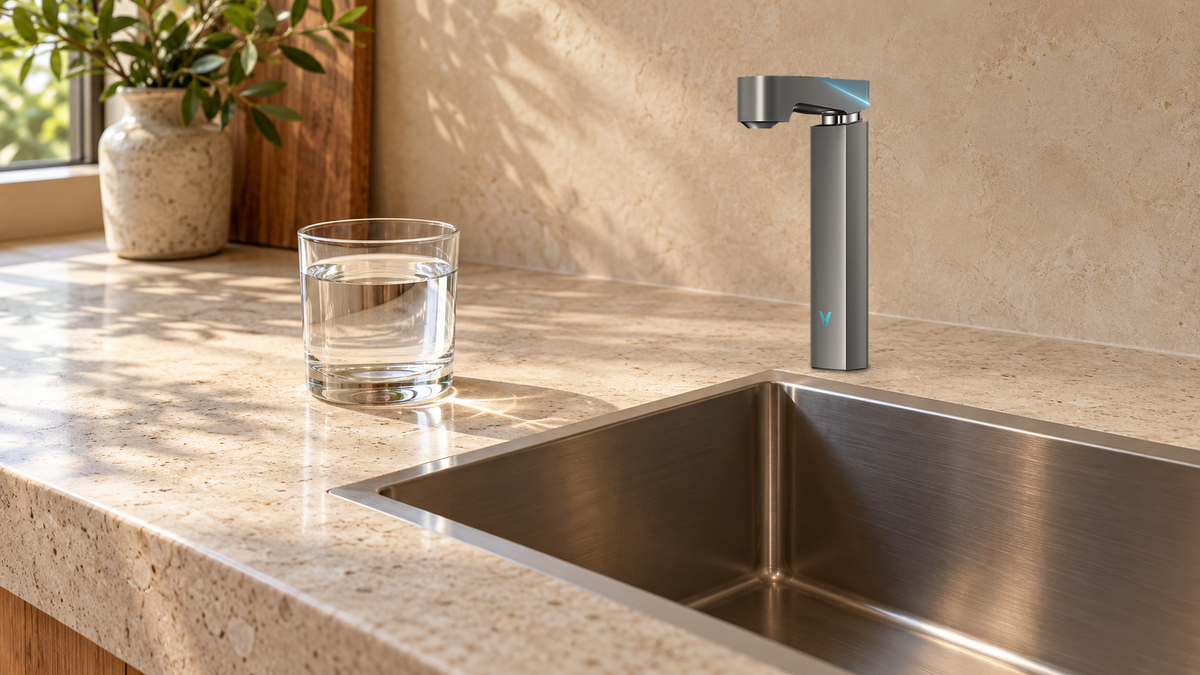
Non-RO alkaline water filters and reverse osmosis systems are two different kinds of product. For a kitchen that wants membrane treatment and mineral-added water from one tap, an RO system with a mineral stage, such as the Viomi M1, brings the two together. An alkaline pitcher such as the Santevia MINA filters tap water through its cartridge and adds calcium and magnesium, while an RO system pushes water through a membrane that removes most dissolved minerals. The Viomi M1 is a tankless under-sink RO system rated at 1000 GPD that reintroduces selected minerals after purification. The APEC ROES-PH75, iSpring RCC7AK, and Express Water ROALK5D take the same approach with a storage tank.
For households that prefer water as it leaves the membrane, plain RO systems such as the Viomi V8 PRO, the iSpring RCC7, and the APEC ROES-50 deliver RO-treated water with no mineral stage added.
Product Types Behind the "Alkaline" Label
| Type | What treats the water | What gets added | Representative brands and models |
|---|---|---|---|
| Reverse osmosis with a mineral stage | RO treatment, then minerals added after the membrane | Minerals released after the membrane | Viomi M1, APEC ROES-PH75, iSpring RCC7AK, Express Water ROALK5D, iSpring RO500AK-BN, Waterdrop X12 |
| Plain reverse osmosis | Pre-filters, an RO membrane, and carbon stages | No mineral stage | Viomi V8 PRO, Viomi V6 PRO, iSpring RCC7, APEC ROES-50 |
| Alkaline pitcher or filter (non-RO) | A filter cartridge, with gravity doing the work in a pitcher | Minerals such as calcium and magnesium, which brands say raise pH | Santevia MINA Pitcher |
The word "alkaline" on a label doesn't settle which row a product belongs in. An RO membrane followed by a mineral stage puts it in the first row; a cartridge that adds minerals with no RO membrane puts it in the last.
Alkaline Pitchers: Minerals Without a Membrane
An alkaline pitcher works like any filter pitcher: tap water poured into the top runs through a cartridge into the lower reservoir. The difference is a mineral component in the cartridge. Santevia says its MINA Pitcher "adds calcium and magnesium" and that the "minerals naturally increase water pH." The pitcher holds 2 L, each filter is rated for 2 months (300 L or 80 gallons), and Santevia states the filter was independently tested by ALS Environmental, an ISO/IEC 17025 accredited laboratory, to NSF Standards 42, 53, and 401, with chlorine listed under Standard 42 and lead under Standard 53.
A pitcher suits a renter, a dorm, or anyone who wants mineral-added water without installing anything. It treats water in batches, and it does not include an RO membrane, so it is a different product from the RO systems below even when the label uses the same word.
Plain Reverse Osmosis: No Mineral Stage
Reverse osmosis is defined by its membrane. Clemson Cooperative Extension describes RO systems as removing "dissolved minerals by forcing the water through a semipermeable membrane, which retains most of the ions while transmitting the water," and the EPA lists reverse osmosis among treatments that are "effective for removal of chloride, total dissolved solids, and other inorganic substances."
A plain RO system combines the membrane with pre-filters and carbon stages but adds no minerals afterward. In the Viomi lineup, the Viomi V8 PRO (800 GPD) and Viomi V6 PRO (600 GPD) are plain tankless RO systems with 9 stages and a 3:1 pure-to-drain ratio. Among tanked systems, the iSpring RCC7 and APEC ROES-50 are five-stage plain RO designs. Households that prefer mineral-added water look to the next category.
Reverse Osmosis With a Mineral Stage
This category combines the two ideas in one system. Water passes through the RO membrane first, then through a mineral cartridge before it reaches the faucet.
Viomi M1. The Viomi M1 is a tankless under-sink reverse osmosis system with 9 filtration stages, a 1000 GPD rating, and a 3:1 pure-to-drain ratio. It reintroduces selected naturally sourced minerals after the RO stage. Its PCB composite filter carries the mineral enrichment along with pre-filtration and lasts up to 2 years; the RO filter lasts up to 4 years. The touchscreen smart faucet shows tap-water and purified-water TDS, filter life, and three preset pours, including 10 oz and 40 oz, and the Viomi app tracks usage and filter life and sends replacement reminders. Because it is tankless, the system takes no space for a storage tank under the sink. The Viomi M1 has been tested by SGS, with lead reduction above 99.87%, PFOS reduction above 99.67%, and PFOA reduction above 99.42%.

| Model | Tank or tankless | Mineral stage | Mineral cartridge interval | Rated output |
|---|---|---|---|---|
| Viomi M1 | Tankless | Minerals reintroduced after the RO membrane, from the PCB composite filter | Up to 2 years | 1000 GPD |
| APEC ROES-PH75 | Tanked, 4-gallon tank | Sixth-stage pH+ calcium carbonate filter after RO and carbon | Every 6 to 12 months | 75 GPD |
| iSpring RCC7AK | Tanked | Sixth-stage alkaline remineralization filter (FA15) | Up to 1 year | 75 GPD |
| iSpring RO500AK-BN | Tankless | Third-stage carbon alkaline filter with minerals | Up to 12 months | 500 GPD |
Express Water's ROALK5D is a tanked system with a 4-gallon tank and an alkaline filter that adds calcium, potassium, and magnesium, replaced every 6 months. Waterdrop also builds alkaline mineralization into several tankless models, including the X12 (1200 GPD, 3:1) and the G5P500A (500 GPD, 2:1).
Add-on mineral cartridges. Owners of plain RO systems from some brands can add a mineral stage later. Waterdrop sells the MNR35 remineralization filter as an add-on for compatible Waterdrop under-sink RO systems, rated for "12 months or 1100 gallons." AquaTru offers an Alkaline Mineral Boost VOC filter for its Classic purifier, rated for 1 year or 600 gallons, which adds magnesium and calcium. A separate comparison of RO brands with remineralization filters covers more mineral cartridge designs.
pH, Mineral Content, and Taste Measure Different Things
Alkaline products are often described with three different numbers or impressions, and they don't move together.
pH describes how acidic or basic water is. The EPA lists pH among its secondary drinking water standards, with a recommended range of 6.5 to 8.5; these secondary standards are non-mandatory guidelines for aesthetic qualities such as taste and corrosion. Brands describe their mineral stages as raising pH, and the resulting number depends on the water going in.
Mineral content is part of what a TDS reading counts. TDS is the total of all dissolved solids, and a handheld meter or faucet display estimates it from conductivity, so it doesn't break the total down into individual minerals. A mineral stage adds dissolved minerals, so it raises the TDS reading of the water leaving the system. On the Viomi M1, the TDS reading will naturally be higher than standard RO water, and that higher number reflects the remineralization stage, not reduced filtration performance.
Taste is the personal measure. The Viomi M1 is designed to give water a cleaner, smoother taste. Some households prefer plain RO water, others prefer mineral-added water, and choosing between plain RO and RO with a mineral stage keeps the same membrane treatment either way.
Fitting Each Category Into a Real Kitchen
Each category fits a different home setup, and the practical details decide the choice as much as the water itself.
No installation at all. A pitcher such as the Santevia MINA sits in the refrigerator, with a fresh cartridge every 2 months or 300 L. It suits a rental, a dorm, or an office, with no plumbing connection.
Under-sink space for a tank. Tanked RO systems with a mineral stage, such as the APEC ROES-PH75, iSpring RCC7AK, and Express Water ROALK5D, store filtered water in a tank beside the filter housings. They need cabinet room for both the filter housings and the tank.
A tight cabinet or a high daily demand. Tankless systems make water on demand and leave the tank space free. The Viomi M1 is rated at 1000 GPD and adds a touchscreen faucet that pours preset volumes, which helps in a kitchen that fills pots, bottles, and coffee makers through the day. The Viomi M1 can also feed a compatible refrigerator or ice maker through standard tubing, purchased separately, once its "Multi-device Mode" is turned on in the app. Installation calls for a standard electrical outlet, a 1-inch to 1.5-inch hole for the smart faucet, and a 1/4-inch hole in the drain pipe for the drain connection; in a kitchen with a garbage disposer, the purifier needs its own dedicated outlet. Step-by-step guidance is in the Viomi installation videos. The iSpring RO500AK-BN is another tankless option with a mineral stage, rated at 500 GPD.

Plain RO now, minerals later. Some brands sell a mineral cartridge that attaches to an existing system, so a household can start with plain RO and add the mineral stage if its taste preference changes.
FAQ
Is an alkaline filter the same thing as reverse osmosis?
No. A non-RO alkaline pitcher or filter runs water through a cartridge and adds minerals, with no RO membrane, while some RO systems also carry the word "alkaline" because of their mineral stage. Reverse osmosis uses a semipermeable membrane to remove most dissolved minerals and many other substances. Some RO systems add a mineral cartridge after the membrane, which gives RO-treated water with minerals added back.
Does adding minerals raise the TDS reading?
It does, by design. TDS counts all dissolved solids, including the calcium and magnesium a mineral stage releases. On the Viomi M1, the reading will naturally be higher than standard RO water because of the remineralization stage. The useful comparison is a system against its own normal readings.
Does a higher pH mean healthier water?
A pH number describes how acidic or basic water is, and the EPA treats pH as a secondary, aesthetic standard with a recommended range of 6.5 to 8.5, tied to effects such as taste and pipe corrosion. A pH figure on its own isn't a measure of health benefit, so this comparison sets products side by side on treatment type, mineral stage, and taste.
What does an alkaline pitcher filter remove?
It depends on the filter and on the testing behind it. Santevia, for example, states its MINA filter was tested to NSF Standards 42 and 53, listing chlorine under 42 and lead under 53. Pitcher filters treat water in batches through a cartridge rather than a membrane, so their claims are specific to each cartridge and its rated life, which for the MINA filter is 2 months or 300 L.
Category First, Then Brand
The products compared here follow three different paths. Santevia's MINA Pitcher adds minerals without a membrane; plain RO systems such as the Viomi V8 PRO, iSpring RCC7, and APEC ROES-50 deliver membrane-filtered water with nothing added; and RO systems with a mineral stage, including the Viomi M1, APEC ROES-PH75, iSpring RCC7AK, Express Water ROALK5D, and Waterdrop's alkaline models, combine the two. Deciding first between a pitcher, plain RO, and RO with minerals narrows the field to a few models, and from there the differences come down to tank or tankless design, rated output, and how often the mineral cartridge is replaced.
Share:
How to Choose the Right Water Filter for Your Home, Starting From Your Water Source
How to Choose an Under-Sink Water Filter Brand for Your Home