

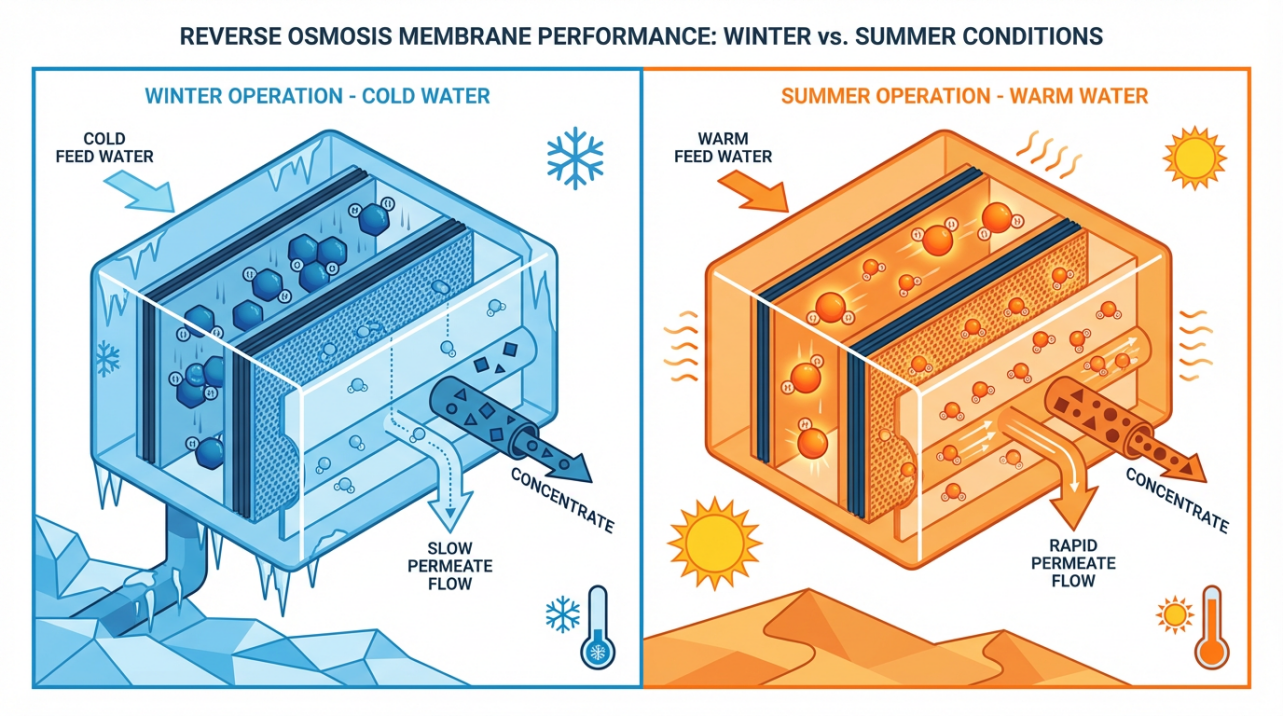
Summary: Reverse osmosis systems often make noticeably more water in summer because warmer feed water is “thinner” and flows through the membrane more easily, boosting production even when nothing else in your setup has changed.
Warmer Water, Faster Flow
As water warms up, it becomes less viscous—essentially “thinner.” That thinner water moves more easily through the tiny pathways in a reverse osmosis (RO) membrane, so the system can produce more purified water at the same pressure.
Studies summarized by AquaticLife, Aqualitek, and Daltonen show that for every 1°F increase in feed temperature, permeate flow can rise by roughly 2–3%. Since most membranes are factory-rated at 77°F, real-world production swings above and below that point as seasons change.
In winter, cold municipal water—sometimes in the 40s °F—moves sluggishly, so your RO feels “slow.” As that same water warms into the 60s and 70s °F in summer, the membrane suddenly seems more “powerful,” even though the hardware is identical.
How Big Is the Summer Boost?
Manufacturers rate residential membranes in gallons per day (GPD) at 77°F and a specific pressure. AquaticLife and WaterTreatmentGuide show that temperature correction factors (TCFs) are used to translate that rating to your actual water temperature.
A classic example: a 50 GPD membrane at 77°F may only deliver about 26 GPD when the feed is 50°F. That is close to a 50% drop in output just from colder water.
Flip that around for summer: if your winter feed has been in the low 50s °F and creeps into the low 70s °F, you can see production climb by 30–60%, even if pressure stays the same. Homeowners often think, “My RO is finally working again,” when in reality it is just operating closer to the 77°F test condition.
For solar-powered RO or off‑grid setups, the effect is doubled: more sunlight drives the pump and warmer water flows more freely, which is why Elemental Water Makers reports peak summer output and 20–40% lower production in winter.
The Trade-Offs of Hotter Feedwater
Warmer water is a productivity win, but it is not a free upgrade. Saltsep, Shanghai-CM, and Daltonen note that as temperature rises, salt rejection drops slightly: more minerals sneak through the membrane, nudging up the total dissolved solids (TDS) in your drinking water.
Higher temperatures also accelerate biological activity and some scaling reactions. That means biofilm and mineral deposits can form faster on the membrane in summer, especially if prefilters are overdue or chlorine removal is poor.
Most thin‑film composite membranes used in home RO units are only rated up to about 95–100°F.

AquaticLife, Pure Water Products, and Aqualitek all warn against feeding an RO directly from a household water heater—both because of temperature damage risk and because heater tanks often contain sediment that can foul the membrane.
Nuance: Warmer water improves flow, but pushing feed temperatures toward the upper rating can shorten membrane life and slightly reduce water purity.
Smart Summer Habits for Better Hydration
Use the summer boost to your advantage while protecting your system:
- Check feed temperature before blaming the membrane: if your winter water was cold, it is normal for summer production to feel much higher.
- Stay within safe temperature limits: feed from the cold line, not the hot; aim roughly for 60–80°F, and never exceed the manufacturer’s max rating.
- Keep filters fresh: as WaterTech and Moore Mechanical emphasize, replace sediment and carbon prefilters every 6–12 months so summer’s higher flow is clean, not pushing past clogged cartridges.
- Verify pressure, not just GPD: if you still have low summer output, a simple pressure check or booster pump often helps more than prematurely replacing the membrane.
- Use the extra capacity for healthy habits: keep your RO tank topped up, pre‑chill a few pitchers, and make it easy for everyone at home to reach for clean water instead of sugary drinks when the temperature climbs.
From a water‑wellness standpoint, that natural summer surge in RO production is your system’s way of helping you stay ahead of heat, hydration, and household demand—as long as you keep temperature, pressure, and maintenance in a healthy balance.
References
- https://scientiairanica.sharif.edu/article_22862_387362e6fd6c2935fc755d4220c9860a.pdf
- https://ui.adsabs.harvard.edu/abs/2009Desal.239..346J/abstract
- https://pmc.ncbi.nlm.nih.gov/articles/PMC10785276/
- https://wqa.org/wp-content/uploads/2022/09/2019_RO.pdf
- https://www.aquasolutionspa.net/the-ultimate-guide-to-water-filtration-for-summer-homes-and-vacation-properties

Share:
Understanding Valve Failure Indicators in Smart Home Water Systems
Three Early Signs of Wastewater Pipe Blockage to Watch For