

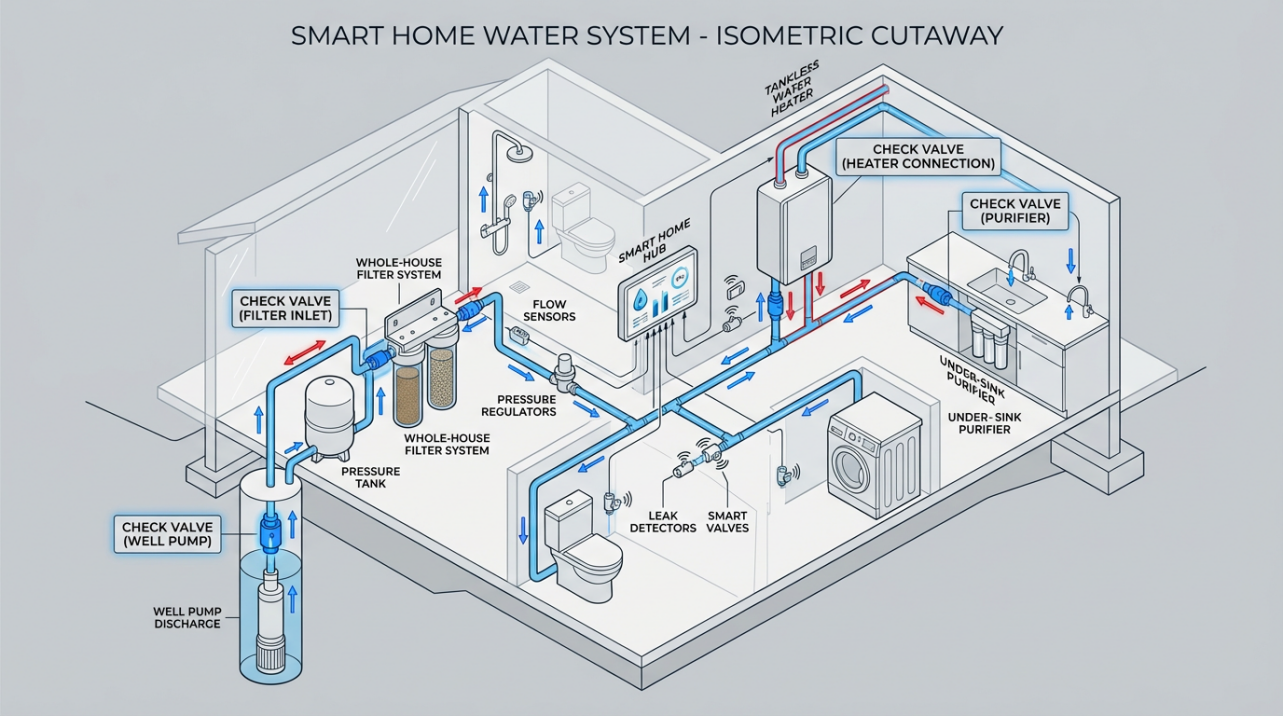
As a smart hydration specialist, I like to say that the quietest components in your system are usually the most important. Valves sit in the background of your well pump, whole‑house filter, softener, or under‑sink purifier, quietly keeping water moving in the right direction. When a valve starts to fail, your first clues are often subtle: a new noise in the basement, a strange pressure swing in the shower, or a pump that turns on more often than it used to.
In this guide, we will walk through how to recognize those clues early, why they matter for water quality and equipment life, and how professionals confirm what your ears and eyes are already telling you. The goal is simple: keep your home hydration system reliable, safe, and pleasant to live with.
Why Valve Health Matters For Clean, Safe Hydration
Check valves and other one‑way valves are the traffic cops of your water system. Suppliers like Eagle Fittings, Dombor, and Redhorse Performance all describe the same core role: allow flow in one direction and automatically block it in the other. In a typical home, they help your well pump hold pressure, stop hot water from pushing backward into cold lines, keep pool or spa water from draining the wrong way, and protect small appliances that use drinking water.
When these valves fail, several things can happen at once. Reverse flow can spin pumps backwards and strain motors, as highlighted by CPV Manufacturing and DFT Inc. Pressure can swing wildly, which you feel as surging or weak showers. Water hammer can slam through pipes as loud bangs, stressing fittings and joints. In sanitary and drinking‑water applications, Plumberstar and other manufacturers warn that backflow can also move contaminants from one part of the system into another.
From a water‑wellness perspective, that means a faulty valve is not just a mechanical nuisance.

It can undermine taste, clarity, and even safety if it allows stagnant or dirty water to migrate toward the parts of the system that supply your taps, dispensers, or smart hydration stations.
The Valves Hiding Inside Your Hydration System
A check valve is a self‑acting, one‑way valve. It opens when upstream pressure is high enough and closes when flow slows or tries to reverse. Industrial Spec and Redhorse Performance describe this threshold as the cracking pressure: the minimum pressure difference required to open the valve.
Manufacturers in the plumbing and industrial world refer to several main designs. Swing check valves use a hinged disc that swings open with flow and falls back against a seat when flow reverses. Lift and poppet valves use a guided disc that moves up and down. Ball check valves rely on a ball that lifts off a seat and then drops back to seal. Diaphragm designs use a flexible membrane. Silent or axial‑flow valves use spring‑assisted discs that move along the flow path and are designed specifically to reduce water hammer.
In residential and light commercial systems, these valves appear in more places than most homeowners realize. Dombor and Plumberstar describe them in well pump discharge lines, pool and spa loops, and water heaters. Eagle notes that small sizes down to about one quarter of an inch are common in small appliances, which includes many under‑sink and countertop devices. Wherever your home relies on automatic one‑way control of water, there is almost certainly a check valve in the background.
Understanding how these components behave under normal conditions makes it much easier to recognize when something is off.

How To Recognize Early Valve Failure Indicators
Across plumbing suppliers like Plumberstar, Dombor, Industrial Spec, CPV Manufacturing, and DFT Inc, the early warning signs of valve problems fall into a few consistent categories: changes in sound, changes in flow and pressure, visible leakage or wear, and evidence of reverse flow. Paying attention to these patterns gives you a very practical, science‑backed way to monitor valve health without touching a wrench.
Changes in Sound: New Noises, Vibration, and Water Hammer
One of the most reliable early indicators is sound. CPV Manufacturing notes that failing check valves often start to vibrate and may even shed internal parts. Industrial Spec describes this as chattering: a rattling noise and vibration when the valve is not fully open or closed and the internal parts are shaking in mid‑position.
If the valve is oversized for the flow or installed in conditions where pressure is too low, DFT Inc explains that the disc in a swing check can repeatedly swing open and shut. That motion makes tapping or clicking noises and gradually wears hinges and seats. Over time, the disc can stick or even break.
Water hammer is the louder, more dramatic version of this problem. DFT Inc and Dombor define it as a pressure surge that hits when flow stops suddenly and the valve slams closed. At home, you might experience it as a sharp bang in the basement or behind the wall when a faucet, shower, or appliance shuts off. CPV Manufacturing warns that repeated hammering can rupture pipes and damage valves and fittings.
As a homeowner, this means a simple listening habit is powerful.

If your system used to be quiet and you now hear new rattles, thuds, or bangs when water starts or stops, your valves are sending a clear early warning.
A practical example is a finished basement where a whole‑house filter sits beside the water heater. For years, shutting off the upstairs shower is silent. Over time, you notice that when the shower closes, there is a single loud knock from the filter area. That is exactly the sort of water‑hammer event CPV and DFT associate with fast, uncontrolled valve closure. Left unaddressed, it can turn into leaks at joints or eventual failure of the valve itself.
Flow and Pressure Behavior: What Your Faucets Are Telling You
Plumberstar, Dombor, and Industrial Spec all point to flow and pressure changes as classic symptoms of valve trouble. Reduced flow, fluctuating pressure, frequent pump cycling, or intermittent loss of flow often reflect valves that are sticking, leaking, or sized incorrectly.
In well systems, Plumberstar highlights frequent on‑off cycling and inconsistent household pressure as key indicators of a bad check valve. A separate research note about residential wells mentions that many homes run pressure switches around 30 to 50 psi or 40 to 60 psi. If your pump is cycling rapidly between those numbers even when no one is using water, that suggests water is leaking back through a valve or another internal leak, so the system must constantly repressurize.
On the Terry Love plumbing forum, a homeowner described a new well installation with two check valves. At first, the cistern filled smoothly. Later, there was a noticeable delay before water arrived, along with burping and gurgling noises and shorter run times until a pump saver device shut things down. The discussion pointed toward a failing check valve allowing water to drain back and air to enter the line between cycles. The real‑world symptoms match what Plumberstar and Industrial Spec describe: delayed flow, air in the line, and unstable pressure as hints that a valve is not sealing.
For a smart hydration system fed by a well or booster pump, that same behavior might show up as your kitchen tap blasting strongly one moment and then drooping the next, or your smart dispenser reading pressure spikes. The underlying pattern, however, is the same: if pressure and flow cannot stay steady under normal, modest demand, a valve deserves closer attention.
Visual and Taste Clues: Leaks, Rust, and Possible Contamination
The next category of indicators is visible. Dombor’s troubleshooting guide lists external leaks around valve bodies, joint leaks nearby, and fragments of internal parts appearing in the fluid as warning signs. Industrial Spec adds corrosion, rust, and elastomer degradation as markers of excessive wear.
Around your filtration or softening manifold, that might look like a persistent damp spot under a fitting that never quite dries, a faint white or green deposit on brass or copper near a check valve, or brownish streaks along threaded joints. Those deposits tell the same story as the test benches in Dombor’s lab: somewhere, a sealing surface is not doing its job.
From a water wellness standpoint, cross‑contamination is the deeper concern. Plumberstar explains that check valves are designed to prevent backflow that could contaminate clean water, and several industrial sources mention contamination as a consequence of failure. If a valve between your household plumbing and a clean storage tank, filter, or dispenser fails, it can allow stagnant, heated, or otherwise compromised water to move in the wrong direction.
Taste and odor can provide indirect clues. While none of the technical sources focus on flavor, they do highlight how backflow and leakage mix fluids that should not mingle. If you notice new metallic or musty notes at taps or dispensers that draw from a line protected by check valves, especially if this coincides with mechanical symptoms like water hammer or leaks, investigating the valves is prudent.
Symptom‑To‑Cause Cheat Sheet
The underlying science of valve behavior can feel abstract, so it helps to line up what you actually experience at home with the likely mechanical causes and the urgency of response. The following table condenses patterns described by Industrial Spec, CPV Manufacturing, DFT Inc, Dombor, Vissers Sales, and Plumberstar into everyday language.
What you notice at home |
Likely valve issue |
Why it matters for hydration and equipment |
How quickly to act |
New rattling or chattering near filters, pumps, or heaters during flow |
Valve oversized for the flow, working at too low or unstable pressure, or with loose internal parts causing disc or ball to flutter |
Accelerated wear of seats and hinges; wasted energy; can progress to sticking, leaks, and eventual failure |
Schedule inspection soon, especially if noise is new or getting worse |
Single or repeated loud bangs (water hammer) when fixtures or appliances shut off |
Swing or other valve slamming shut under sudden pressure change |
Pressure surges can crack fittings, damage flexible hoses, and stress filters or heaters; CPV warns this can be catastrophic over time |
Treat as high priority; consider design changes such as fast‑closing silent valves or water hammer arresters |
Pressure gauge swings rapidly, pump turns on and off frequently even with no water use |
Internal leakage through a check valve or other component; water draining back toward well or tank |
Short‑cycling heats and wears out pumps, and reflects reduced control over system pressure that can upset filters and softeners |
High priority; have a professional diagnose before pump or control equipment fails |
Water drains backward in pool, spa, or storage tank when pump stops, or hot water creeps into cold lines |
Valve stuck open, installed backwards, or heavily worn so it no longer seals |
Cross‑mixing can raise bacteria risk in stagnant sections, upset chemical balance in pool and spa systems, and disrupt water quality at fixtures |
High priority for any system connected to potable water or where contamination is a concern |
Valves or nearby joints show persistent dampness, rust, or deposits; small drips never fully stop |
Seat or body leakage, damaged gaskets, or hairline cracks as described by Dombor and Industrial Spec |
Slow leaks waste water, can cause hidden structural damage, and indicate seals are nearing end of life |
Address promptly; if corrosion is advanced, replacement is usually wiser than repair |
Gradual decline in flow and more noticeable pressure fluctuations over months or years |
Debris buildup, worn elastomers, or mis‑sized valve causing partial obstruction and unstable operation |
Reduced performance of filters and softeners; inconsistent taste and flushing; higher energy use as pumps work harder |
Plan maintenance or replacement before peak‑demand seasons or major gatherings |
Seeing your situation in this kind of table can help you decide whether to simply monitor the symptom, schedule routine service, or treat it as an urgent repair.
Simple At‑Home Checks Without Taking The System Apart
You do not need lab gear to spot trouble early. The same basic techniques that Industrial Spec and CPV recommend to plant operators scale down nicely for a home.
Listen During Normal Use
Pick a time when the house is relatively quiet and use a few fixtures in different parts of the home. Run a shower, flush a toilet, let your refrigerator or ice maker call for water, then turn things off one at a time while you stand near key components such as the well tank, booster pump, filtration manifold, or water heater.
You are listening for three things: light rattling or buzzing that suggests chattering, sharper taps or clanks that repeat as long as water flows, and single pronounced bangs when flow stops. As DFT Inc explains, repeated tapping often points to low‑flow instability in swing checks, while isolated bangs are classic water hammer. If these noises are new, growing louder, or localized to one area of piping, you have a strong qualitative clue that a valve in that area is struggling.
Watch Pressure and Pump Behavior
If you have a well or pressure‑boosting system, the gauge near your tank is an invaluable diagnostic tool. Under normal operation, the system cycles between two set points, often somewhere in the 30 to 50 psi or 40 to 60 psi range mentioned in the well‑system notes. With no water running, pressure should climb to the cut‑out setting, the pump should stop, and the gauge should hold steady.
If the needle falls quickly toward the lower setting with all fixtures closed, or if the pump kicks on and off repeatedly over short intervals, suppliers like Plumberstar and Dombor would suspect internal leakage. In the Terry Love forum story, delayed flow, sputtering at the cistern, and short run times before a pump saver shut things down all pointed toward a check valve that was leaking back and pulling air between cycles.
A simple home test is to note the pressure immediately after the pump stops, then check again after ten to fifteen minutes without using water.

A significant drop in that short time frame, especially when paired with audible flow noise in the pipes, is reason to involve a professional.
Inspect For Leaks, Corrosion, and Reverse Flow
A visual inspection along your water path complements the listening and pressure checks. Trace the line from where water enters the home through the main shutoff to your filters, softeners, and heater. Look and feel for dampness, particularly around threaded connections and around any valve bodies.
Dombor’s testing standards, based on MSS SP‑61, allow essentially no body leakage in a shell test; in the lab, any continuous wetness would be considered a failure. At home, that same logic applies: a connection that never fully dries is not just cosmetic. Over time, even small leaks can damage nearby materials and signal that seals or the valve body itself are overloaded.
Reverse flow is often easiest to see in pool or spa systems, which Vissers Sales notes as a common check‑valve application. If water drains backward from a raised spa to the main pool when the pump turns off, the one‑way function is not working. In a drinking‑water context, you might see a storage tank that mysteriously loses level overnight or a pressure tank that empties back toward the well. Both patterns point toward valves that no longer hold as they should.
When To Stop DIY And Call A Professional
Manufacturers and technical sources are consistent on one point: valves are safety components, and repeated warning signs should not be ignored. CPV Manufacturing emphasizes that failing valves can cause catastrophic damage if reverse flow or water hammer is allowed to continue. DFT Inc recommends partnering with experienced valve professionals once a swing check shows clear signs of distress.
From a practical home perspective, it is time to call in help if you notice any combination of persistent water hammer, rapid pump cycling with no apparent water use, visible leaks or advanced corrosion at or near valves, or evidence of water moving in the wrong direction. If your system feeds critical hydration points like kitchen taps, built‑in dispensers, or a storage tank that supplies multiple fixtures, erring on the side of caution protects both your water quality and your equipment.
How Professionals Confirm Valve Failure
Behind the scenes, the industry uses well‑defined standards and increasingly sophisticated monitoring technologies to diagnose valve problems. Understanding these tools can make conversations with your plumber or water specialist much more productive.
Standard Pressure and Leak Tests
Dombor and Plumberstar describe industry‑standard procedures based on MSS SP‑61. The first is a shell test, where the valve body is pressurized with water to at least about one and a half times its rated pressure at roughly 100 °F. The valve is submerged or inspected visually, and any external leakage from the body, bonnet, or joints is unacceptable.
The second is a seat‑closure test, which focuses on internal sealing. For metal‑seated valves, the standard allows a small amount of leakage, expressed as a volume per hour per inch of valve size. Dombor notes values on the order of 40 milliliters per hour per inch of nominal size. For a two‑inch valve, that equates to about 80 milliliters per hour, or a little under 3 fluid ounces, under lab conditions. Soft‑seated valves, which are common in potable‑water systems, are expected to show essentially zero leakage in these tests.
Similar tests can be run with air at around 80 psi to catch even smaller leaks. In that case, leakage is measured in standard cubic feet per hour, and again, the allowed amount is very small for metal seats and effectively zero for soft seats. These procedures may sound technical, but the principle is straightforward: pressurize the valve under controlled conditions and measure whether it holds.
When a plumber or specialist removes a suspect valve from your system, they may not run a full standard test, but the logic is similar. The valve is inspected, pressurized, and checked for both body leaks and seat leaks. Those results, combined with the symptoms you observed in your home, guide the decision to clean, repair, or replace.
Advanced Monitoring: From Nuclear Plants To Smart Buildings
For highly critical systems, engineers go far beyond simple pressure tests. A nuclear engineering thesis from the University of Tennessee describes using accelerometers on check valves to capture vibration signatures and feeding those into neural networks to classify whether the valve is operating normally or showing signs of malfunction. Similarly, NASA’s lessons learned on aerospace check valves emphasize strict contamination control, carefully designed flow paths, and extensive pre‑flight leak testing, including multiple operational cycles and life‑cycle endurance tests.
While your home system is not a rocket engine or a nuclear plant, the same physics applies. A valve that vibrates differently under flow is telling a story about wear, contamination, or mis‑sizing. In some modern building and industrial installations, vibration and acoustic sensors are already used to watch for those changes in real time.
For residential smart hydration systems, this trend is beginning as pressure and flow sensors become more common. If your system offers historical graphs of pressure or pump activity, you are essentially gaining a simplified version of what those advanced neural‑network systems use. Sudden changes in patterns, especially spikes in pump starts or irregular flow curves, are valuable early hints that something in the valve train is changing long before a complete failure occurs.
Preventing Valve Problems In Your Hydration System
Every manufacturer cited here returns to the same preventive themes: choose the right valve for the job, install it correctly, keep the system clean, and respect the limits of the materials.
Industrial Spec and DFT Inc stress proper selection and sizing. Oversized valves chatter, while undersized ones impose high pressure drops and may not open fully. DFT’s guidance is to size based on actual flow conditions so the disc spends its life either fully open against its internal stop or fully closed, not hovering in between. For homeowners, this usually means trusting your installer’s sizing and asking questions about whether the valve type is matched to your flow and pressure, especially after system changes such as adding new filters or fixtures.
Dombor and CPV Manufacturing highlight cleanliness and debris control. Dirt, rust, and mineral particles can lodge between the disc and seat, causing sticking or leaks. Installing strainers or filters upstream of critical valves and flushing lines before startup are simple but powerful ways to extend life. For liquid systems, CPV recommends routine flushing of pumps, especially before shutdown, to remove contaminants that could harden or settle around valve components.
Material compatibility is another recurring theme. Industrial Spec notes that high operating temperatures and chemical incompatibility accelerate wear, particularly for elastomer components. Many elastomer‑based check valves are expected to last on the order of about five years under favorable conditions, while metal designs without elastomers can last closer to a couple of decades. In environments with higher temperatures, aggressive disinfectants, or abrasive particles, practical life can be much shorter.
Finally, several sources, including DFT Inc and CPV, recommend upgrading from traditional swing checks to spring‑assisted, silent, or axial‑flow designs in systems prone to water hammer or low‑flow operation. These valves close quickly and smoothly along the flow axis, reducing pressure surges and performing better at lower, more variable flows. In a home, the trade‑off is usually a modest increase in upfront cost in exchange for quieter operation and reduced risk of pipe and equipment damage.
A practical way to apply these principles is to think about each major section of your water system. At the point of entry, focus on robust, corrosion‑resistant valves and good debris filtration. Near pumps, choose designs that handle your specific pressure and flow profile and minimize hammer. Around filters and softeners, prioritize soft‑seated valves with proven leak performance and schedule inspection for seals and elastomers on a reasonable cycle instead of waiting for a dramatic failure.
Real‑World Scenarios In Home Hydration
To make this more concrete, it helps to look at a few scenarios that mirror the patterns described in the research but play out in typical homes.
Imagine a two‑story house with a whole‑house sediment filter and softener in the basement. For years, the family uses showers and laundry with no unusual sounds. After a bathroom remodel with new low‑flow fixtures, a sharp bang appears every time a shower shuts off. The lower flow means the swing check near the softener now spends more time in partially open positions and slams closed more abruptly. Following DFT’s guidance, a plumber replaces the swing check with a properly sized silent, spring‑assisted valve. The bang disappears, and the internal components and pipes no longer experience repeated hammering.
In another home on a private well, a new pump and piping are installed along with multiple check valves. At first, when the pump starts, the cistern fills smoothly. Months later, there is a delay before water starts to enter the cistern, accompanied by burping and gurgling sounds, and the pump shuts down earlier than expected under the watch of a pump saver device. These symptoms match the Terry Love discussion and Plumberstar’s description of check‑valve issues in well systems: water is draining back into the well or another part of the system between cycles, air is being drawn in, and the pump is losing prime. By checking the pressure gauge, confirming rapid pressure drop with no use, and isolating sections one by one, a professional identifies and replaces the leaking valve. Normal, smooth operation returns, and the risk of pump damage is reduced.
In a townhouse on city water, the owner notices that a small puddle keeps forming beneath the under‑stairs closet where the whole‑house filtration unit lives. The amount is small and easy to mop up, so it is ignored at first. Over time, white and green corrosion products appear on a brass check valve and nearby fittings. Drawing on Dombor’s testing standard that body leakage is not acceptable even in small amounts, the installer replaces the corroded valve and tightens or re‑makes the adjacent joints. The leak stops, hidden structural damage behind the wall is prevented, and the system regains the level of integrity that MSS SP‑61 assumes.
Across these examples, the pattern is the same. Early symptoms are perceptible long before a catastrophic failure: new noises, small leaks, and unusual pump behavior. Linking them to the failure indicators discussed in industry literature lets you act early, with simple changes such as better‑matched valves or improved filtration, and protect both your water quality and your equipment.
FAQ: Valve Failure And Your Drinking Water
Can a bad check valve make my water unsafe to drink? Plumberstar and several industrial sources emphasize that check valves exist partly to prevent contamination by stopping backflow. If a valve between a potentially dirty zone and a clean zone fails, it can allow water from heaters, outside lines, or stagnant branches to move into the part of the system that feeds your taps or hydration devices. That does not automatically mean your water is unsafe, but it removes an important layer of protection. If you see signs of reverse flow, unexplained changes in taste or odor that coincide with mechanical symptoms, or valve failures near critical drinking‑water paths, it is wise to have both the plumbing and, if needed, the water quality evaluated.
Is noise alone enough reason to replace a valve? Noise is one of the first clues CPV Manufacturing, Industrial Spec, and DFT Inc highlight. Chattering and water hammer indicate that the valve is operating in an unstable regime or closing too aggressively. Even if flow and pressure still seem acceptable, those pressure pulses and vibrations are stressing both the valve and nearby piping. Persistently noisy operation usually justifies a change in valve type, sizing, or system layout, rather than waiting for a leak or break. The benefit is not only quieter living but also reduced mechanical fatigue on everything connected to that line.
How often should valves be replaced in a typical home system? There is no one schedule that fits every situation, but Industrial Spec suggests that elastomer‑based valves often have a useful life around five years under favorable conditions, while non‑elastomer designs can approach twenty years. High temperatures, aggressive chemicals, and dirty fluid shorten those numbers. In practice, this means treating valves like any other component with seals: combine regular visual and functional checks with replacement when you see signs of wear, leaks, or chronic noise, rather than relying on a fixed calendar interval. During system upgrades, it is often cost‑effective to replace aging valves proactively, especially where they protect pumps, heaters, or key drinking‑water paths.
Keeping valves healthy is one of the simplest ways to keep your whole hydration system healthy. When you tune in to the small sounds, watch how pressure behaves, and respond to early warning signs, you give every filter, softener, and dispenser in your home the stable conditions it needs to deliver clean, refreshing water every day.
References
- https://llis.nasa.gov/lesson/752
- https://www.vendorportal.ecms.va.gov/FBODocumentServer/DocumentServer.aspx?DocumentId=956349&FileName=VA244-13-B-1286-019.doc
- https://ui.adsabs.harvard.edu/abs/2007JAWWA..99c..60B/abstract
- https://nrcoe.inl.gov/publicdocs/ICDE/icde-check-valves-2003.pdf
- https://repository.lib.ncsu.edu/bitstreams/33ab872e-c789-4578-914a-11c44e8c080c/download
- https://www.nrc.gov/docs/ML0403/ML040340445.pdf
- https://trace.tennessee.edu/utk_gradthes/12068/
- https://www.osti.gov/etdeweb/servlets/purl/20628484
- https://ris.dls.virginia.gov/uploads/12VAC5/dibr/ASSE%201052-2016-20210225134844.pdf
- https://dsps.wi.gov/Documents/Programs/Plumbing/SBD10754.pdf

Share:
Understanding Pipe Noises: Air or Water Hammer Issues
Three Early Signs of Wastewater Pipe Blockage to Watch For