

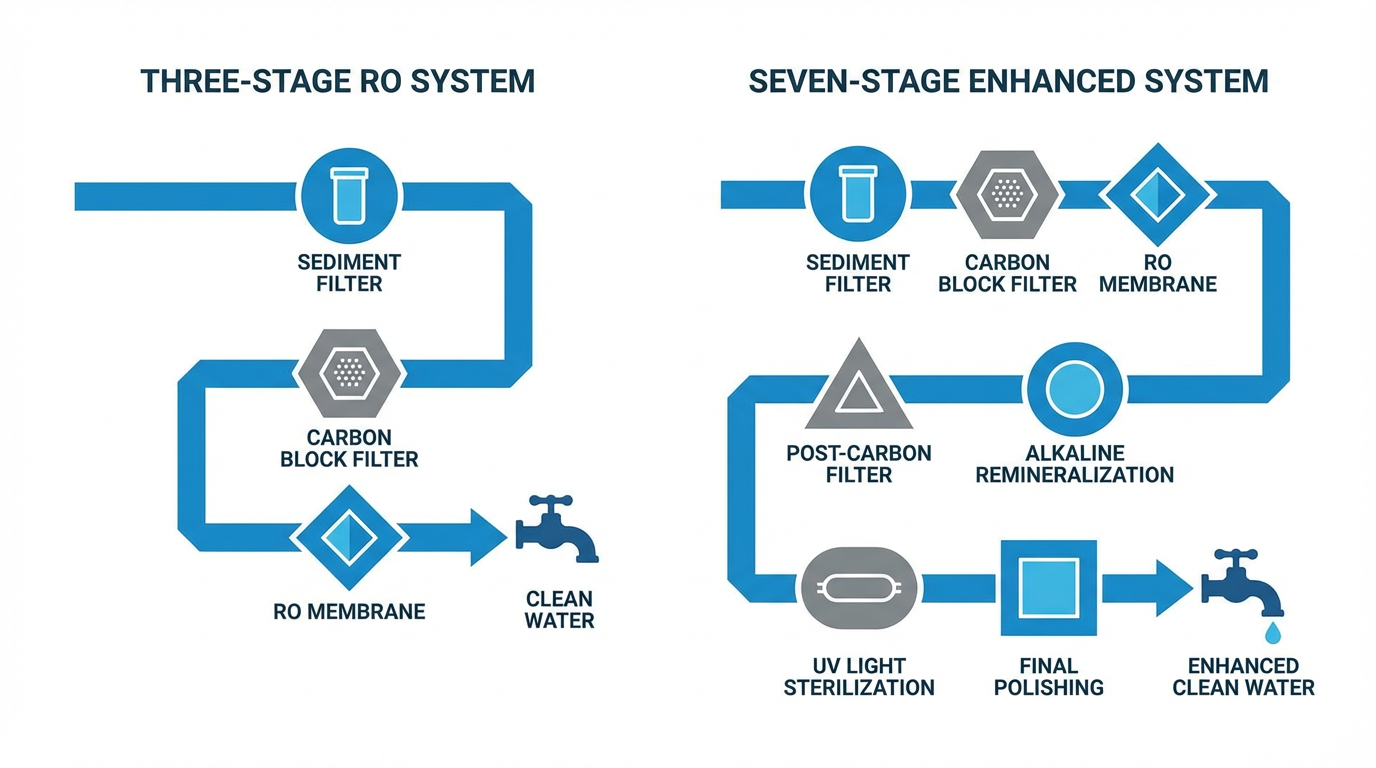
As someone who spends a lot of time under kitchen sinks and at dining tables talking about water, I see the same question come up again and again: should you choose a “simple” three-stage reverse osmosis system or invest in a seven-stage setup that promises ultra-pure, alkaline, mineral-rich water?
On product pages the answer can look obvious: more stages must be better. In real homes, with real maintenance habits, water bills, and health needs, the story is more nuanced.
In this guide, I will walk you through what those stages actually do, how they change your water, and how to decide which configuration truly supports healthier hydration in your household. The explanations draw on research and guidance from organizations such as the US Environmental Protection Agency’s WaterSense program, university extension services, and technical reviews of reverse osmosis technology, combined with practical field experience in residential hydration systems.
A Quick Refresher: What Reverse Osmosis Really Does
Reverse osmosis, or RO, is a pressure-driven filtration process. Your household water is pushed through a semi‑permeable membrane whose pores are so small (around 0.0001 micron in typical residential units) that most dissolved salts, heavy metals, and microorganisms cannot pass through.
University extension publications describe how this membrane can reduce contaminants such as arsenic, nitrate, lead, fluoride, radium, protozoan cysts like Cryptosporidium, and selected pesticides, while leaving a cleaner permeate stream on the other side. Point‑of‑use systems under the sink usually combine the membrane with sediment and carbon filters and a small storage tank so you can draw treated water on demand rather than waiting hours for a gallon.
Compared with traditional activated‑carbon filters, which do a good job on chlorine, many organic chemicals, and some metals but struggle with dissolved salts and many micro‑pollutants, RO offers broad‑spectrum reduction. Aquaporin, a membrane manufacturer, emphasizes that RO excels at dissolved salts, heavy metals, nitrates, and many pharmaceutical and endocrine‑disrupting compounds, while also being highly effective against bacteria, viruses, and protozoa.
However, the same membrane that screens out contaminants also strips beneficial minerals such as calcium and magnesium. Several sources, including water‑treatment reviews and commercial RO guides, note that this can make the water taste “flat” and slightly more acidic, and may increase its corrosiveness. At the same time, both academic and industry sources point out that most people in well‑nourished populations obtain the bulk of their minerals from food, not water.
The key takeaway is that RO is a powerful base technology.

The number of stages around that membrane simply shapes how targeted, pleasant‑tasting, and user‑friendly the final water becomes.
What Does a “Stage” Mean in an RO System?
A stage in an RO system is one distinct treatment step that water passes through. In practical terms, each stage is usually one filter cartridge or functional element.
Even though different manufacturers use slightly different stage counts, the same core functions appear over and over in university extension guides, EPA information, and manufacturer literature. These functions can be grouped into a small number of roles.
Example Stage Function |
What It Primarily Does |
Common Media or Component |
Screens rust, sand, and silt to protect downstream filters and the membrane |
Pleated or spun polypropylene sediment filter |
|
Adsorbs chlorine, chloramines, some pesticides and solvents to protect the membrane and improve taste and odor |
Granular activated carbon (GAC) or carbon block |
|
Removes the bulk of dissolved salts, many metals, nitrates, fluoride, and many microbes |
Thin‑film composite membrane |
|
Post‑carbon “polishing” filter |
Improves taste and odor after storage tank, catches trace organics |
Small GAC or carbon block cartridge |
Specialty cartridge |
Targets specific contaminants or adds functionality (for example, ion exchange for hardness, remineralization, pH adjustment) |
Ion‑exchange resin, remineralization media, specialty adsorbents |
UV disinfection stage |
Inactivates bacteria and viruses that might be present downstream |
Ultraviolet lamp reactor |
Storage and controls |
Store treated water, regulate flow, and shut off the system automatically |
Pressure tank, valves, flow restrictors |
In other words, when you see a “three‑stage” system, it usually means that only the most essential roles are present in cartridge form. A “seven‑stage” system typically wraps the same RO core in additional polishing, protection, and customization steps.
Three-Stage RO Systems: Lean, Focused, and Often Enough
In many homes, the first RO unit installed is a compact three‑stage system. When you strip away marketing language and look at how university extension documents describe typical under‑sink RO units, the pattern often looks like this: a sediment pre‑filter, an activated‑carbon filter, and the RO membrane itself. Some brands count the membrane plus two pre‑filters as three stages, while others might count a combined sediment–carbon cartridge plus membrane and a small post‑filter.
Functionally, a three‑stage design aims to accomplish three things. First, it protects the delicate membrane from abrasion by sediment. Second, it strips chlorine and certain organic chemicals that would otherwise degrade the membrane and affect taste. Third, it uses the RO membrane to do the heavy lifting on dissolved contaminants. Even in this lean configuration, technical summaries from water‑treatment sources consistently report that RO membranes can remove on the order of 90 to 99 percent of many dissolved ions and contaminants.
Production capacity for point‑of‑use RO units is modest by design. University of Nebraska–Lincoln Extension documents typical household membranes producing roughly 10 to 35 gallons of treated water per day under standard conditions, while an educational article from APEC Water gives a representative example of about 45 gallons per day from an under‑sink unit. That is plenty for drinking and cooking but not intended for whole‑home needs.
The pros of a three‑stage system are straightforward. The layout is simpler, there are fewer cartridges to replace, and the footprint under the sink is smaller. Upfront cost and ongoing filter replacement costs are usually lower, and the risk of neglecting a forgotten extra stage is reduced. For many municipal water customers whose tap water already meets safety standards but who want a stronger barrier against metals, nitrates, and various micro‑pollutants, a three‑stage RO often delivers a very noticeable improvement in taste and peace of mind.
On the other hand, there are trade‑offs. Without a dedicated remineralization stage, the treated water will be low in calcium and magnesium and may taste flat, especially if you are used to mineral‑rich water. Without a UV or equivalent disinfection stage, the system is not designed to compensate for microbiologically unsafe feed water; university guidance is clear that RO membranes should not be your only defense against live microbes, because membrane deterioration or tiny leaks can occur. And without extra specialty cartridges, the system may not target specific local issues such as trace PFAS or certain solvents as effectively as a tailored multi‑stage setup designed and certified for those contaminants.
In practice, I often see three‑stage systems work extremely well in apartments or small homes with limited under‑sink space and relatively consistent municipal water quality, as long as the homeowners commit to changing filters on schedule.
Seven-Stage RO Systems: Layered Filtration and Customization
Seven‑stage systems take that same RO core and build more treatment and conditioning around it. The exact mix of stages varies by manufacturer, but when you look across detailed product descriptions and technical articles, you see recurring themes.
Cloud‑based RO brands describe multi‑stage trains that start with sediment removal, move through one or more carbon stages, pass through the RO membrane, then polish the water with additional carbon, ion‑exchange resins, and remineralization media. Culligan, for example, notes that its smart under‑sink RO system can be configured with up to seven stages and multiple cartridge options, including post‑filters that add minerals back and adjust pH.
A seven‑stage system will almost always include the same three fundamental functions as the basic RO units: sediment protection, carbon pretreatment, and the RO membrane. The additional stages are typically used to sharpen the system’s performance in four ways.
The first is taste and odor polishing. Even after RO, small amounts of dissolved organic compounds can remain, and water can pick up off‑notes in a storage tank. Post‑carbon filters are excellent at polishing these out. Manufacturer literature describes how some systems add one or even two polishing stages to deliver what they call “bottled‑quality” water.
The second is remineralization and alkalinity adjustment. Cloud‑connected RO products and several technical reviews highlight the use of remineralization cartridges that add controlled amounts of calcium, magnesium, and other electrolytes back into the water. Some cartridges also push the pH into a mildly alkaline range. Articles that advocate for mineralized, alkaline RO water cite research indicating associations between low mineral content in drinking water and higher risks of certain health outcomes such as bone fractures or cardiovascular issues, while other sources, including RO manufacturers, emphasize that the primary source of these minerals remains food. A seven‑stage system gives you the flexibility to drink RO water that no longer tastes flat and feels more familiar to those used to spring or mineral water.
The third is targeted contaminant control. While the RO membrane provides broad coverage, some systems add specialty media for specific contaminants. For example, ion‑exchange cartridges can further reduce hardness minerals or certain metals; advanced carbon blocks can focus on volatile organic compounds or industrial chemicals that RO alone does not fully address. The US EPA and university guidance both stress that no single device removes every contaminant, which is why multi‑stage designs are common in homes where well‑water testing has revealed several separate issues.
The fourth is microbiological safety. Some seven‑stage systems add a UV disinfection unit downstream, especially in markets where well‑water use is common or where households are concerned about storage tank hygiene. Technical reviews of residential RO note that membranes should not be used as the only microbial barrier; adding UV gives a second line of defense against bacteria and viruses that might bypass or regrow in the system.
From a user’s perspective, the advantages of a seven‑stage system are felt in the glass. You often see smoother taste, reduced chemical odor even compared with basic RO, and water that feels more familiar on the palate thanks to reintroduced minerals. For households that rely heavily on RO water for coffee, tea, and cooking, these differences can be significant. You also get the comfort of knowing that multiple treatment mechanisms are working together, which can be especially reassuring if your water tests have shown a mix of dissolved inorganics, disinfectant byproducts, and emerging contaminants.
The costs are not just financial. Seven‑stage systems take more under‑sink space, require tracking more filter change intervals, and can be more complex to service. When I walk a homeowner through their first filter replacement on a densely packed system, it is easy to see how a missed visit can lead to one or two cartridges quietly aging in place. More stages also mean more potential pressure drops, which can slightly reduce flow if maintenance lags.
Side-by-Side: Three vs Seven Stages Beyond the Marketing
To cut through the stage‑count noise, it helps to compare the two configurations on a few practical dimensions that matter day to day. The following table synthesizes patterns from EPA WaterSense information, university extension guidance, and manufacturer descriptions, focusing on typical residential under‑sink systems rather than every possible model.
Aspect |
Typical Three‑Stage RO |
Typical Seven‑Stage RO |
Core contaminant reduction |
Broad removal of many salts, metals, nitrates, and microbes via RO membrane with basic sediment and carbon protection |
Same core RO removal, plus additional targeting and polishing using extra carbon, ion‑exchange, or specialty media |
Minerals and taste |
Low mineral content, often described as flat or very neutral; taste still much improved over tap |
Often includes remineralization and pH adjustment for smoother, more “spring‑like” taste |
Wastewater and efficiency |
Waste ratio usually driven by membrane and flow design, often in range of several gallons wasted per gallon produced in older designs |
Not inherently more efficient or wasteful; efficiency depends on membrane and controls, not the number of stages |
Footprint and complexity |
Compact under‑sink footprint, fewer hoses and cartridges, simpler DIY maintenance |
Larger footprint, more cartridges and connections, may benefit from professional installation and setup |
Upfront and operating cost |
Lower equipment cost, fewer cartridges to replace; good entry point for RO |
Higher equipment cost, more filters to change; can be cost‑effective when replacing bottled water and meeting complex water‑quality needs |
Best fit |
Households with reasonably good municipal water who want strong general protection for drinking and cooking |
Households with multiple water‑quality concerns, strong taste preferences, or specific health needs that benefit from remineralized, highly polished water |
Notice that the waste ratio row is essentially the same for both.

EPA’s WaterSense program points out that conventional point‑of‑use RO systems can waste five or more gallons of reject water per gallon of treated water, and some very inefficient units waste even more. The same document notes that WaterSense‑labeled RO systems must send no more than 2.3 gallons of water down the drain per gallon of treated water, regardless of how many cartridges they use.
Similarly, research synopses from university extension services describe typical home RO units with water recovery rates around twenty to thirty percent, which means roughly three to four gallons of concentrate are flushed for every gallon of product water. None of these performance metrics are tied directly to stage count. Instead, they depend on factors such as membrane type and condition, water pressure, flow control, and feed‑water temperature.
In other words, you cannot assume that a seven‑stage unit is either more or less wasteful than a three‑stage model. Efficiency is a design and certification question, not a stage‑count question.
Health and Wellness Considerations: Minerals, Microbes, and Acidity
From a water‑wellness perspective, the most common questions I hear about multi‑stage RO systems fall into three categories: mineral content, microbiological safety, and acidity.
On minerals, there is an understandable concern that RO removes too much. Technical summaries from Newater and other RO reviews highlight that RO systems can remove ninety‑plus percent of calcium, magnesium, and other ions, and they cite World Health Organization commentary advising that very low mineral water should not be the only water source indefinitely. At the same time, Aquaporin’s educational material notes that in countries with balanced diets, minerals from drinking water are a small fraction of total intake, which is consistent with broader nutrition science.
Seven‑stage systems with remineralization cartridges are a practical compromise here. They leave you with water that still benefits from the RO membrane’s strong contaminant reduction but has some calcium and magnesium reintroduced for taste and for those who prefer a modest mineral contribution from their drinking water. If you choose a three‑stage system, you can achieve something similar by blending a small amount of untreated water or by adding minerals manually, but doing so requires more discipline.
On microbiological safety, both University of Nebraska–Lincoln Extension and University of Massachusetts guidance emphasize that RO equipment should be fed water that is already coliform‑free, and that RO should not be your only barrier against microorganisms. Membrane deterioration and small leaks can allow microbes to slip through, and the storage tank can become a breeding ground if maintenance is neglected. For this reason, a seven‑stage system that includes a UV lamp or other downstream disinfection can add a meaningful extra layer of protection, especially for private well users or households with immunocompromised members.
Acidity and corrosiveness are the third concern. Newater’s review notes that RO water tends to be slightly acidic, often with a pH between about six and seven, because it lacks alkaline minerals and many soluble salts. This is not dangerous in itself; many common beverages are more acidic. However, slightly acidic, low‑mineral water can be more aggressive toward certain plumbing materials and can contribute to metallic taste if it leaches metals. Alkalinity‑adjusting remineralization cartridges common in seven‑stage systems address this by raising pH toward the mildly alkaline range and providing buffering capacity.
From a health standpoint, the central message is that RO can be very beneficial in homes with problematic water quality, but its design and maintenance must be matched to your situation. Stage count matters only insofar as it provides the specific mineral, microbial, and pH characteristics you want.
Ownership Reality: Maintenance, Lifespan, and Daily Use
Owning an RO system, whether three‑stage or seven‑stage, is a bit like owning a high‑performance appliance. It can do wonderful things for you, but only if you keep it on a service schedule.
Multiple technical sources converge on similar maintenance intervals. Sediment and carbon pre‑filters are usually replaced every six to twelve months, depending on water quality and usage. The RO membrane typically lasts from two to five years. Storage tanks and housings benefit from annual sanitization to prevent biofilm growth. UMass guidance explicitly recommends keeping a maintenance log so homeowners can track filter changes and cleaning.
Seven‑stage systems with more cartridges may stagger replacement intervals; for example, a remineralization cartridge might be replaced annually, while a UV lamp has its own lamp‑life schedule. This complexity is manageable but demands either a well‑designed smart reminder system or a committed homeowner. Smart RO systems from brands like Culligan now track water use, estimate filter life, and even quantify the number of single‑use plastic bottles avoided, which can make upkeep more intuitive.
Flow and convenience are also part of ownership. Because RO membranes produce water relatively slowly, many under‑sink systems rely on a pressurized storage tank. University extension documents describe these tanks as two to five gallons in size, which translates into a few minutes of continuous high‑flow use before the system needs time to recover. Seven‑stage and tankless designs sometimes add internal pumps and larger membranes to boost throughput; Waterdrop’s comparison of ultrafiltration and RO, for instance, describes tankless RO units with nominal capacities on the order of several hundred gallons per day.
From the standpoint of day‑to‑day hydration, what matters is that the system keeps up with your household’s drinking and cooking habits. A compact three‑stage unit can be perfectly adequate for a couple who mainly drinks water at home and fills a few reusable bottles each day. A large family that cooks frequently, fills pet bowls, and uses RO water for coffee machines and ice makers may appreciate the higher capacity and faster recovery of a more advanced multi‑stage or tankless design.
How to Choose Between Three and Seven Stages for Your Home
Choosing between a three‑stage and a seven‑stage RO system is not about chasing the biggest number. It is about aligning the system’s capabilities with your water quality, health priorities, taste preferences, environmental values, and budget.
The first step, recommended consistently by sources such as the US EPA, university extensions, and major water‑treatment providers, is to know your water. If you are on public water, review your utility’s Consumer Confidence Report and consider independent testing if you suspect issues such as lead from household plumbing. If you are on a private well, arrange a laboratory test that covers metals, nitrate, and relevant regional contaminants. This data will tell you whether you are mainly dealing with aesthetic issues like chlorine taste and odor, or with health‑relevant contaminants such as arsenic, nitrate, PFAS, or radionuclides.
If your water already meets health standards, and your main goals are better taste, basic protection against a broad mix of potential contaminants, and a reasonable upfront cost, a well‑designed three‑stage RO system is often a strong fit. You gain the core benefits of RO highlighted by university and manufacturer sources—high removal of many dissolved contaminants, clear and neutral‑tasting water, reduced reliance on bottled water—without a highly complex under‑sink layout. This kind of system is especially attractive in apartments, smaller kitchens, and households where maintenance needs to stay simple.
If your water tests reveal multiple issues, for example elevated nitrate plus noticeable pesticide residues, or if you have vulnerable family members for whom you want multiple barriers, it is worth looking seriously at multi‑stage designs. Seven‑stage systems can integrate targeted media to address specific contaminants, add UV disinfection for a second microbial barrier, and provide remineralization and pH adjustment so that the water is not only safer but also more enjoyable to drink over the long term.
Taste preference matters in a very practical way. Some people love the ultra‑neutral feel of low‑mineral RO water; others find it unappealing and drink less. If you or your family members already gravitate toward spring and mineral waters, a seven‑stage configuration with remineralization and alkalinity control can make the difference between a system that is technically impressive and one that actually increases your daily hydration.
Environmental considerations also enter the picture. Because water waste is primarily a function of membrane efficiency and flow control, look for performance data or certifications such as the EPA’s WaterSense label rather than assuming that one stage count is greener than another. A three‑stage unit can be wasteful if it uses older technology and poor flow regulation, while a modern seven‑stage unit with an efficient membrane and smart controls can achieve a much better waste‑to‑product ratio.
Finally, think about service support. If you are comfortable doing your own plumbing work and tracking multiple filter intervals, a more complex system can be an engaging project. If you want to set and forget, a simpler three‑stage system backed by a local service plan or a multi‑stage system with integrated smart monitoring can reduce the risk of filters silently aging out.
Short FAQ
Does a seven-stage RO system always filter better than a three-stage system?
Not automatically. Both configurations rely on the same RO membrane technology that technical sources describe as capable of removing a very high percentage of many dissolved contaminants. The extra stages in a seven‑stage system generally add polishing, remineralization, targeted media, or UV rather than transforming the core membrane performance. A well‑designed three‑stage unit with high‑quality filters, appropriate pressure, and regular maintenance can outperform a neglected seven‑stage system. When comparing products, focus on certified contaminant reduction claims, waste‑to‑product ratios, and maintenance requirements rather than stage count alone.
Is RO water too “pure” to drink every day?
RO water is low in minerals and may be slightly acidic, and some reviews cite World Health Organization comments advising against relying exclusively on very low mineral water for the long term. At the same time, manufacturers and independent experts emphasize that most essential minerals in a typical diet come from food, not from tap water. In practice, many households drink RO water daily without issues, especially when their system includes remineralization that restores some calcium and magnesium and improves taste. If you have specific health conditions, particularly kidney disease or medically restricted mineral intake, it is wise to discuss your water choice with a healthcare professional.
How much water will my RO system waste, and does stage count affect that?
Conventional point‑of‑use RO systems can waste anywhere from two or three gallons of concentrate for every gallon of treated water to five or more gallons, depending on design. University extension references describe recovery rates around twenty to thirty percent for many household systems, while EPA’s WaterSense specification requires that labeled systems waste no more than 2.3 gallons per gallon produced. Stage count is not the determining factor; membrane efficiency, flow restrictors, feed‑water temperature, and overall system design are. When you compare models, look for explicit waste‑to‑product ratios or efficiency certifications, and consider routing concentrate to non‑potable uses where plumbing codes allow.
Can I upgrade a three-stage RO system to more stages later?
In many cases, yes. Because stages are essentially separate cartridges, it is often possible to add a polishing filter, remineralization cartridge, or UV lamp downstream of an existing three‑stage RO unit. Some manufacturers design modular systems that can grow from a basic three‑stage into a more advanced configuration as needs change. If you think you might upgrade later, choose a system with standard‑size housings and leave some physical space under the sink. When in doubt, consult the manufacturer’s documentation or a qualified water‑treatment professional to ensure that any add‑ons are compatible with the pressure, flow, and certification of your existing RO system.
Closing Thoughts from a Smart Hydration Specialist
Stage counts make for splashy product labels, but the healthiest hydration decisions are grounded in your water’s actual chemistry and your household’s habits. Whether you choose a focused three‑stage RO or a thoughtfully engineered seven‑stage system with remineralization and UV, the goal is the same: clean, great‑tasting water that you genuinely enjoy drinking every day. When you pair sound science, reputable certifications, and realistic maintenance with your own taste and wellness priorities, your RO system becomes less of a gadget under the sink and more of a quiet, reliable partner in your daily health routine.

References
- https://www.academia.edu/26773822/A_Short_Review_on_Process_and_Applications_of_Reverse_Osmosis
- https://www.epa.gov/watersense/point-use-reverse-osmosis-systems
- https://ui.adsabs.harvard.edu/abs/2015Desal.368...10S/abstract
- https://faculty.mccormick.northwestern.edu/richard-lueptow/docs/jms-lee-rro-01.pdf
- https://www.che.utah.edu/equipment/ultrafiltration-reverse-osmosis/
- https://www.umass.edu/agriculture-food-environment/cafe/fact-sheets/reverse-osmosis-treatment-of-drinking-water-supplies
- https://extensionpublications.unl.edu/assets/html/g1490/build/g1490.htm
- https://web.uri.edu/wp-content/uploads/sites/61/TipSheetT24_Osmosis.pdf
- https://do-server1.sfs.uwm.edu/goto/@5386Y19Y56/ref/8754Y9Y/chapter+reverse+osmosis.pdf
- https://www.ewg.org/news-insights/news/reverse-osmosis-water-filters-when-are-they-good-choice

Share:
Why 304 Stainless Steel Faucets Cost More Than Copper Faucets
Carbon Fiber Filters vs. Traditional Activated Carbon: Which Is Better For Your Home Water?