

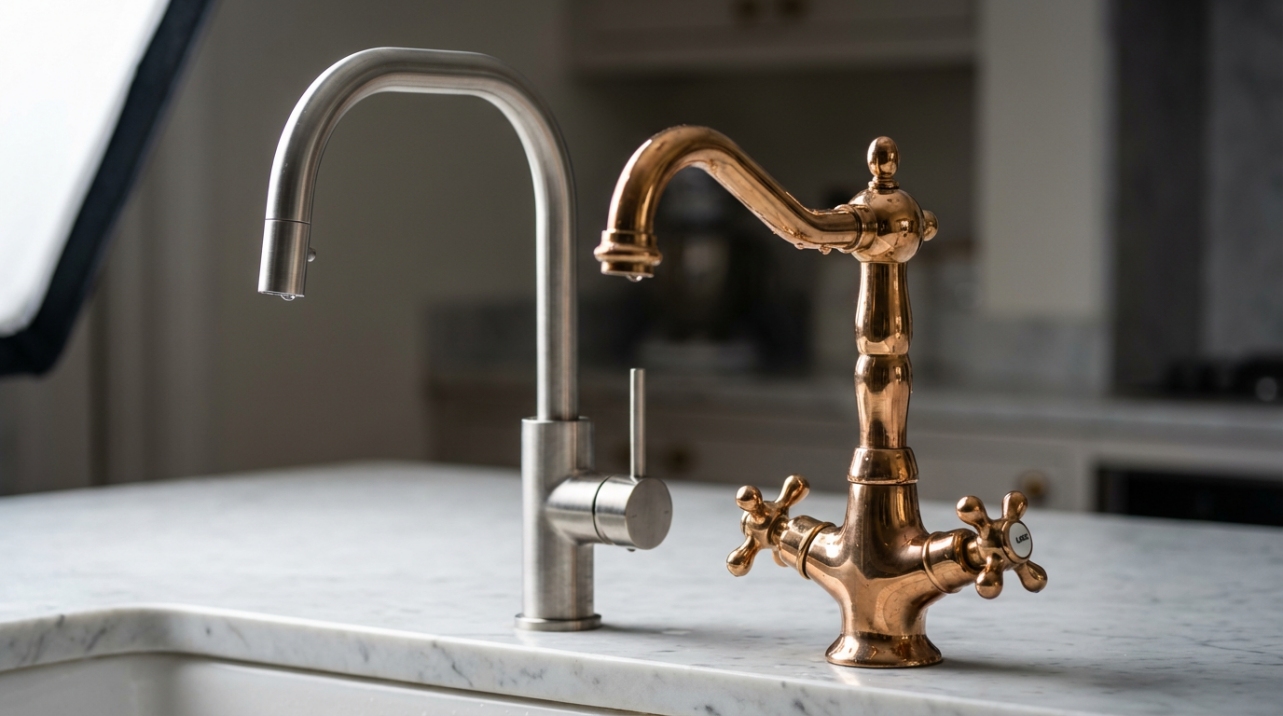
As a smart hydration specialist, I spend a lot of time looking not just at filters and cartridges, but at the very last piece of your water system: the faucet. It is the “mouth” of your home water, and it might cycle on and off hundreds of times a week.
When people upgrade to a filtration system or a smart hydration setup, they often pause at one detail on the estimate: the 304 stainless steel faucet usually costs noticeably more than a copper or brass faucet. The natural question is whether that premium is justified or just marketing.
Based on plumbing data from organizations such as IAPMO, NIST, WHO, and independent plumbing brands, as well as practical experience watching faucets age in real kitchens and bathrooms, the price difference is rooted in real engineering, health, and lifecycle economics.
This article walks through why 304 stainless steel faucets cost more than copper faucets, and when it is worth paying that premium for your own home hydration system.
What “304 Stainless” And “Copper” Faucets Really Are
Before comparing price, it helps to be clear about what each faucet is actually made of. The labels you see on boxes are often shorthand.
304 stainless steel in faucet language
Most stainless faucet bodies marketed for safe drinking water use 304 stainless steel, sometimes labeled “SS 304” or “18/8” stainless. Technically, 304 is an iron‑based alloy that contains about 18 percent chromium and around 8 percent nickel. The chromium forms a very thin, self‑healing oxide film at the surface. That invisible film is what gives stainless steel its hallmark rust and corrosion resistance, especially in damp, high‑use environments like kitchens and baths.
Bathroom and kitchen fixture manufacturers routinely highlight a few common traits of 304 stainless faucets: they are mechanically strong and tough, they do not rely on a plated layer for corrosion resistance, and they are effectively lead‑free and food‑grade. Plumbing guidance from brands and industry groups notes that 304 faucets are designed not to release harmful metal substances into water under normal conditions, provided the material and processing are genuine and properly controlled.
In many modern kitchens and bathrooms, 304 has become the “default” stainless choice because it balances corrosion resistance, processability, and cost. Where water is more aggressive, some brands step up to 316 stainless, which has similar chromium but more nickel and a bit of molybdenum for better chloride resistance, at an even higher price.
What people call “copper faucets”
In faucet marketing, “copper” can mean two slightly different things.
One category is all‑copper faucets, often called “full copper” or “all‑copper” bodies. These use very high copper content alloys and are popular in certain premium or decorative markets.
The more common category is brass faucets. Brass is a copper–zinc alloy, typically around 50–63 percent copper and 50–37 percent zinc, sometimes with small additions of other elements to improve machinability. Many consumer “copper” or “bronze” faucets are actually brass under decorative plating.
Brass has a warm, golden appearance and is very easy to cast and machine. Manufacturers can produce ornate or vintage designs relatively easily, and the material has long been a standard in plumbing. However, older or low‑grade brass may contain lead to improve machinability. Even modern low‑lead brass is allowed to contain small amounts of lead, and those trace amounts can potentially leach into water if design and processing are not tightly controlled.
So when you see “copper faucet” on a product page, chances are you are actually looking at brass or a mix of copper‑based alloys. That has real implications for both price and performance.
The Science Behind The Price Gap
Stainless and copper‑based faucets are not just different colors. They behave very differently when you cut, form, weld, and expose them to hot, chlorinated, or mineral‑rich water. Those differences drive manufacturing cost and long‑term value.
Strength, hardness, and mechanical performance
At a metal level, copper is relatively soft and easy to form. Typical copper used in engineering has tensile strength in the range that materials scientists describe as moderately strong, and its hardness is modest. In contrast, 304 stainless steel has roughly two to three times the tensile strength and several times the hardness of copper, according to comparative data from metallurgical sources.
That extra strength is one of the reasons stainless steel faucets resist dents, deformation, and high water pressures so well. It is also why, in practice, stainless faucets in busy households or commercial kitchens tend to hold their shape and clean lines even after decades of use.
The downside is that machining and forming stainless steel is much more demanding. Technical notes on 304 describe it as work‑hardening and tough, requiring slower cutting speeds, more rigid setups, and ample cooling to avoid ruining tools and surface finish. Copper and brass, by contrast, machine quickly and easily, which keeps manufacturing cost down.
In other words, part of the price premium you see on a 304 faucet is paying for more robust raw material and for the heavier tooling and process control needed to shape that material without failures.

Corrosion resistance where it actually matters
Corrosion is the quiet faucet killer. It does not always show up as dramatic red rust; sometimes it appears as internal pitting, dezincification in brass, or tiny leaks at joints and threads.
Studies summarized by the National Institute of Standards and Technology indicate that stainless steels can have corrosion rates roughly fifty times lower than brass in humid environments. Industry data shared by plumbing organizations such as IAPMO suggests that stainless fixtures typically last 20–30 years and need about 40 percent fewer replacements than plastic or copper‑based fixtures in similar service.
Copper and brass do resist many forms of corrosion. Copper forms a protective green patina in air, and brass can do well in neutral, low‑mineral water. However, both become more vulnerable in acidic water, in ammonia‑ or sulfide‑rich environments, and in warm, stagnant or high‑chloride conditions. Brass in particular can tarnish and stain in high humidity and is more dependent on coatings or plating to keep its appearance.
Stainless steels such as 304 and 316, by comparison, offer broader corrosion resistance across common household water chemistries, particularly when chlorides and disinfectants are present. That improved resistance is a key reason stainless is recommended for coastal areas, hard water regions, commercial kitchens, hospitals, pools, and other high‑moisture, high‑stress locations.
Higher corrosion resistance does not just protect appearance; it protects threads, valves, and thin sections that are costly to repair. That engineering advantage feeds into both warranty confidence and price.

Manufacturing difficulty, scrap, and sealing
Manufacturers that work with both materials are very candid about the trade‑offs. Technical notes on 304 faucet production highlight that this stainless grade is very hard relative to copper. Its processing is more difficult, production losses are higher, and achieving flawless sealing requires extra care.
Leak‑free faucets with long warranties demand tight tolerances on internal seats and threads, smooth surfaces in the flow path, and precision at welded joints. When you combine a tough, work‑hardening alloy with those tolerances, scrap becomes expensive. Any misaligned drilling, poor weld penetration, or heat‑affected corrosion risk can mean discarding an entire body.
Copper and brass are softer and have lower melting points. Their plasticity is excellent, and casting technologies for brass faucets are mature and cost‑effective. It is easier to cast complex shapes, machine threads, and lap valve seats in copper‑based materials. The result is lower machining time, lower tooling wear, and fewer rejected parts per batch.
From a factory perspective, that translates directly into a lower cost per usable faucet, even if the raw metal price were identical.

For 304 stainless, the higher scrap risk and more demanding processing are built into the price you see at retail.
Health And Water Quality: Where 304 Shines
Price is not just about how hard the metal is. Much of the current premium on 304 stainless faucets is driven by health and regulatory pressures around drinking water.
Lead and heavy metal leaching
Brass and other copper alloys can contain small amounts of lead. Those levels are increasingly regulated, with standards such as NSF/ANSI 61 and various national “lead‑free” rules tightening allowable limits. Articles from kitchen and bath manufacturers and water‑oriented brands consistently highlight that older or low‑quality brass may contain enough lead to leach into hot water, especially when water sits in the fixture.
Lead exposure, even at very low levels, is linked in public health literature to developmental delays and lower IQ in children, kidney strain, higher blood pressure, and potential harm to fetal development. That is one reason health‑focused kitchen brands and stainless faucet manufacturers emphasize that quality stainless faucet bodies are effectively 100 percent lead‑free and food‑grade.
Stainless steel 304 and 316 do not rely on lead for machinability. When properly manufactured, they do not leach lead into water. Plumbing industry guidance points out that 304 faucet bodies can deliver safe water without a plated barrier layer, which removes one common failure mode seen in plated brass products.
High‑quality copper or brass faucets can also be made to meet strict leach limits, and there are certified low‑lead copper alloys in the market. However, the fact that some copper faucets still use electroplating, and that inferior products may cut corners, is one reason consumers and specifiers increasingly treat “304 stainless” as the safer default material for the faucet body itself.
Bacteria, mold, and hygienic surfaces
Copper and stainless interact with microbes in different ways. Copper is actively antimicrobial. Research cited by faucet manufacturers and by regulatory agencies such as the US Environmental Protection Agency has shown that copper‑based surfaces can kill more than 99.9 percent of certain bacteria within a couple of hours under test conditions. That oligodynamic effect is one reason copper alloys have been approved as antimicrobial touch surfaces.
Stainless steel does not actively kill microbes, but it offers a smooth, non‑porous surface that is easy to disinfect. Studies summarized by organizations such as WHO and plumbing market analysts indicate that households using stainless fixtures see roughly 30 percent lower microbial contamination compared with some traditional plastic or metal setups, largely because stainless can be cleaned thoroughly and does not harbor biofilm as readily.
In practice, faucet hygiene depends on both material and maintenance. High‑humidity bathrooms and hard‑water kitchens need surfaces that do not trap moisture, rust, or flaking plating. Stainless steel’s passive film, combined with regular wiping, makes it easier for homeowners to maintain a hygienic spout and handle. That supports both water quality and household health, and it is part of the value equation built into stainless pricing.

Certification, testing, and brand reputation
Health‑oriented faucet buyers and commercial specifiers increasingly look for third‑party certifications. Guidance from international stainless steel and plumbing organizations recommends checking for marks such as ISO 9001 for quality systems, WaterSense for water efficiency where applicable, and regional drinking water approvals such as NSF in the United States or European standards.
Stainless steel faucets, especially those in the 304 and 316 grades, are marketed heavily on their ability to meet these marks. Manufacturers invest in corrosion testing, lead and heavy‑metal leach testing, and flow‑control validation. Case studies from housing projects and hotels show stainless faucets being chosen specifically to satisfy sustainability incentives and health regulations, not just aesthetics.
Those laboratory tests, audits, and compliance programs are not free.

Their cost is built into the price of high‑quality 304 faucets but pays off in predictable performance and regulatory peace of mind.
Durability, Warranty, And Long‑Term Cost
One of the fairest ways to look at faucet pricing is not what you pay on installation day, but what it costs you over ten to twenty years of real use.
Service life and replacement cycles
Multiple kitchen and bath sources report that a high‑quality stainless steel faucet can easily last twenty years or more under normal household use. Industry market data also point to stainless fixtures delivering roughly 40 percent fewer replacements over their lifetime than comparable plastic or copper‑based products.
By comparison, brass or copper faucets are often given an expected life around ten years, with significant dependence on water chemistry and care. In neutral, low‑mineral water and well‑ventilated spaces, a brass faucet can certainly go longer. In acidic, hard, coastal, or humid conditions, corrosion, tarnish, and component wear tend to shorten the practical service life.
That “twice the lifespan” pattern is supported by both manufacturer claims and by plumbing repair experience, where stainless is known to be more forgiving of harsh environments. When a stainless faucet does eventually need replacement, it is often due to style changes rather than structural failure.
Maintenance effort and hidden costs
The day‑to‑day reality of owning a faucet matters too.
Stainless steel faucets, particularly those in brushed or matte finishes, tend to be low maintenance. Most brands recommend cleaning with a soft cloth and mild soap or a simple vinegar‑water mixture to remove fingerprints and water spots. There is no tarnish to polish off, and the base metal, not a thin plating, provides the durability.
Brass and copper faucets, on the other hand, naturally tarnish and develop patina. Some homeowners love this; others find themselves constantly polishing to keep a bright finish. Articles from faucet makers note that brass requires regular polishing and gentle cleaners to avoid scratching or removing protective coatings. In humid bathrooms or kitchens with frequent splashing, that polishing frequency can increase.
Maintenance has a real cost. One comparative analysis from a kitchen faucet resource estimates that copper faucets often incur ongoing maintenance and minor leak repair costs on the order of about fifty to one hundred dollars per year per unit, while stainless steel faucets usually stay below twenty dollars per year, mostly for simple cleaning and occasional cartridge replacements. Over a decade, that difference can easily reach several hundred dollars per faucet.
When you fold those maintenance costs into the original purchase price, stainless steel’s higher ticket starts to look much more reasonable.
Real‑world projects that chose stainless
Large projects make these decisions with spreadsheets, not just feelings. Several documented cases highlight why decision‑makers accept higher stainless faucet prices:
A five‑star hotel in Dubai replaced brass faucets with stainless steel models that still offered gold accents. According to the project data, the change produced about a 25 percent drop in maintenance requests and around 40 percent water savings thanks to integrated aerators, and guest satisfaction reached a reported 95 percent driven by perceived durability and modern aesthetics.
In a large affordable housing project in São Paulo covering roughly 10,000 units, developers chose budget‑friendly stainless steel faucets with ten‑year warranties. The analysis predicted a reduction in replacement costs of about 1.2 million dollars over the program’s life, while also meeting government sustainability incentives thanks to stainless steel’s recyclability.
These examples underline a key point: organizations that live or die by maintenance budgets often choose stainless, even when it costs more up front, because it protects them from bigger costs later.

Why A 304 Faucet Costs More At Checkout
Pulling the threads together, several concrete factors explain why you see a higher price tag on 304 stainless faucets compared with copper or brass models.
Here is a high‑level comparison to make the differences more tangible.
Aspect |
304 stainless faucet |
Copper / brass faucet |
Base material |
Strong, tough 304 stainless, inherently corrosion‑resistant |
Softer copper or brass alloy, often relying on plating or patina |
Machining and forming |
Difficult to machine; higher tool wear and scrap |
Easy to cast and machine; mature, lower‑cost processes |
Health profile |
Effectively lead‑free and food‑grade when properly manufactured |
May contain small amounts of lead unless certified low‑lead |
Corrosion in harsh water |
Excellent, especially in 304/316; suited for hard or chlorinated water |
More vulnerable in acidic, high‑chloride, or stagnant conditions |
Lifespan expectation |
Commonly 20–30 years in normal use |
Often around 10 years depending on water quality and care |
Maintenance needs |
Simple wiping; no polishing; finish stays stable |
Regular polishing and gentle cleaners needed to manage tarnish |
Typical upfront price |
Higher per faucet |
Lower per faucet |
Lifecycle cost |
About 30 percent lower over long term in many analyses |
Higher, due to more frequent replacement and maintenance |
Decisions by manufacturers and specifiers reflect those differences. Stainless faucets tend to be paired with longer warranties, sometimes twenty‑five years or even described as lifetime warranties by some brands. They also commonly integrate higher‑end features such as pull‑down sprayers, flexible necks, flow restrictors, or even touchless sensors and smart controls.
At a market level, faucet industry analyses estimate that stainless faucets typically cost fifteen to twenty‑five percent more than basic alternatives at purchase, but deliver about thirty percent lower lifecycle costs over roughly twenty years. That balance of higher upfront investment and lower total ownership cost is exactly what you see reflected in the retail shelf price of a certified 304 stainless faucet.
How To Choose Between 304 Stainless And Copper For Your Home
If you are building or upgrading a smart hydration setup at home, you do not have to buy stainless for every situation. Instead, match the faucet material to your water, your health priorities, and your tolerance for maintenance.
For a primary kitchen drinking and cooking faucet, especially if you have children or use hot water frequently, 304 stainless is usually the better choice. It gives you a lead‑free, food‑grade water path, excellent corrosion resistance under hard or chlorinated water, and low maintenance paired with a long service life. In my experience advising health‑focused homeowners, this is where paying for stainless has the clearest payoff.
For bathrooms, laundry sinks, or low‑use bar sinks in neutral water regions, a high‑quality, certified copper or brass faucet can serve very well. If you love a warm, vintage or artisanal look and do not mind occasional polishing, a good brass faucet brings charm and the added benefit of antimicrobial copper surfaces at the handle and spout. Just make sure it is explicitly certified to modern low‑lead standards from a reputable manufacturer.
For coastal homes, pool houses, high‑humidity apartments, or properties with very hard or chemically aggressive water, evidence from both field projects and lab testing points strongly toward stainless. In some of these conditions, even 304 can be stressed, and marine‑grade 316 stainless is recommended, but either stainless grade will generally outperform copper‑based faucets in keeping corrosion and leaks at bay.
Finally, be cautious with very cheap “stainless” or unlabeled faucets, regardless of material. Industry reports warn that some low‑cost “stainless” products may actually use lower‑grade 201 stainless or may be hardened with undesirable heavy metals. Look for clear marking of 304 or 316 on technical documentation, combine that with brand reputation, and whenever possible, check for drinking water and quality certifications. Some manufacturers even use stainless detection liquids at retail to demonstrate the grade to customers, a sign they are confident in their material.
FAQ
Is 304 stainless steel really safe for drinking water?
Reputable sources in the plumbing and stainless steel industries consistently describe 304 stainless used in faucets as lead‑free and food‑grade when properly manufactured. Guidance from brands and standards organizations indicates that 304 faucet bodies, when produced by trustworthy manufacturers, do not release harmful metal substances into water under normal conditions. As with any material, you still want products that carry recognized drinking water certifications to ensure both the alloy and the processing meet safety thresholds.
If copper kills bacteria, is a copper faucet healthier than stainless?
Copper alloys do have strong intrinsic antibacterial properties at their surfaces, and test data show that they can kill over 99.9 percent of certain bacteria on contact within a couple of hours. That is a real advantage, especially on high‑touch external surfaces. However, antibacterial action does not cancel out concerns about lead or other metals potentially leaching into water from some brass alloys. Stainless steel does not actively kill microbes, but it provides a smooth, non‑porous surface that is easy to clean, and high‑quality 304 faucets avoid lead completely. For most health‑focused households, pairing 304 stainless faucet bodies with good cleaning habits and high‑quality filtration gives the best balance of water purity and hygiene.
When is 316 stainless worth paying for instead of 304?
Both 304 and 316 stainless are strong, durable, and lead‑free. The main difference is that 316 contains molybdenum and more nickel, which significantly improves resistance to pitting and crevice corrosion in chloride‑rich and high‑mineral environments. Market and technical guidance recommends 316 in especially harsh conditions such as coastal homes, pool and spa areas, or systems with very aggressive, high‑chloride water. In more typical municipal water and indoor conditions, 304 is usually sufficient and more cost‑effective.
Choosing the right faucet material is one of those quiet decisions that can shape your water experience every day for decades. If you value long‑term water wellness, low maintenance, and predictable performance from your filtration or home hydration system, a 304 stainless steel faucet often earns its higher price many times over.
References
- https://pubmed.ncbi.nlm.nih.gov/36157845/
- https://www.researchgate.net/publication/279251369_Analytical_and_experimental_analysis_of_the_formability_of_copper-stainless-steel_304L_clad_metal_sheets_in_deep_drawing
- https://insights.made-in-china.com/The-Future-of-Stainless-Steel-Bathroom-Fixtures-Innovations-Sustainability-and-Smart-Choices-for-Global-Markets_IfPanNsEuxDH.html
- https://www.shanghaimac.com/stainless_steel_faucet_and_full_copper_faucet-9530.htm
- https://www.haogeerfaucet.com/news/what-are-the-advantages-of-stainless-steel-basin-faucets-over-other-materials.html
- https://www.houzz.in/magazine/brass-vs-stainless-steel-which-is-right-for-bathroom-faucets-stsetivw-vs~149712284
- https://www.kitchenwatertap.com/info/copper-vs-stainless-steel-faucets-differences-102848221.html
- https://langhe-industry.com/copper-vs-stainless-steel/
- http://www.nask-faucet.com/en/nf3.html
- https://spark-faucet.com/the-difference-between-stainless-steel-faucets-and-copper-faucets/

Share:
Techniques for Achieving Pure Water and Smart Clean‑Water Separation
Carbon Fiber Filters vs. Traditional Activated Carbon: Which Is Better For Your Home Water?