

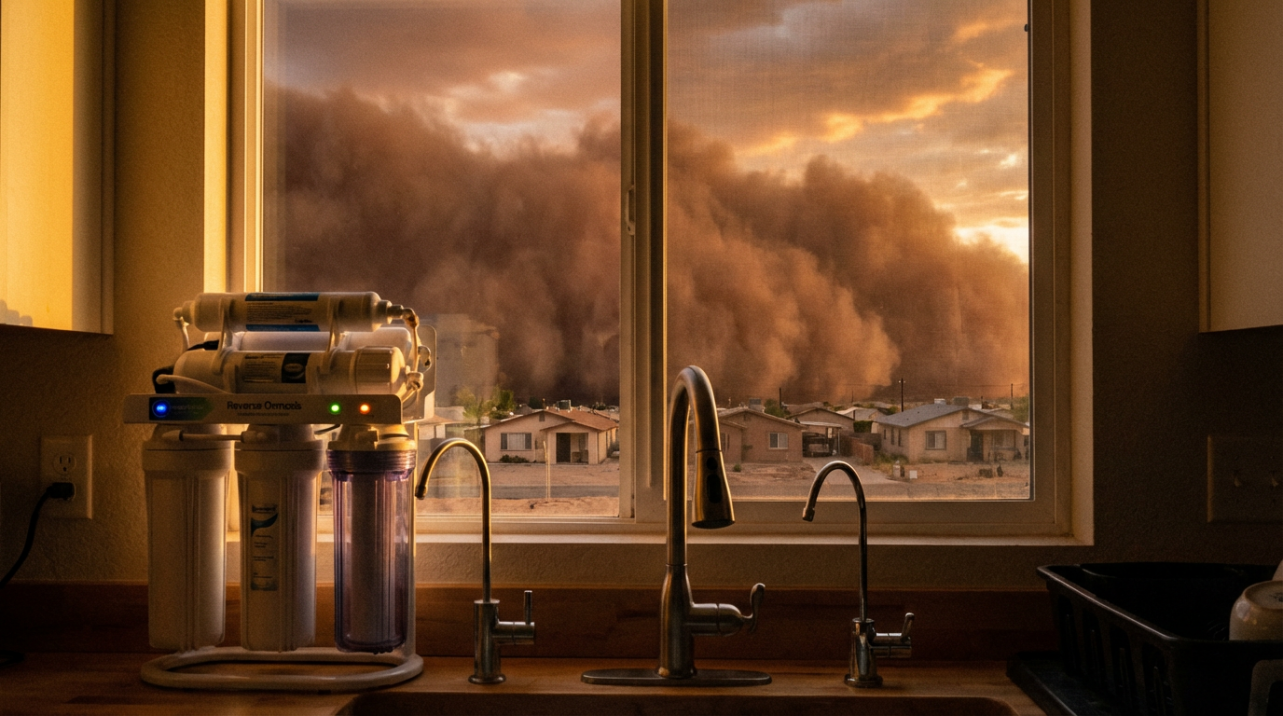
Reverse osmosis systems are amazing at turning challenging water into crisp, clean drinking water. In calm conditions, their maintenance schedule is already important. In dust storm country, that schedule becomes mission critical.
As a hydration specialist who spends a lot of time in desert homes and off‑grid sites, I see the same pattern over and over. The RO unit itself is well designed. The water quality at the faucet is excellent right after installation. Then the first big haboob rolls through, or a week of dusty winds hits, and within months the sediment filter is packed, the storage tank smells a little “off,” and the membrane is working much harder than it should.
This article will walk you through how often to service each part of your RO system when dust storms are part of life, why those timelines are different from “average” homes, and how to create a realistic maintenance calendar that protects both your health and your investment.
Dust Storm Areas: Why They Are Different
In the U.S. Southwest, monsoon season runs roughly from mid‑June to the end of September, and with it come intense dust storms, often called haboobs. These events are giant walls of dust driven by thunderstorms and high winds. Guidance for homeowners during a haboob is clear: keep windows and doors tightly closed, turn off air conditioning so you are not pulling dust‑laden air indoors, and stay away from windows because debris can turn them into a hazard.
Even when you seal your home well, dust still gets in through tiny gaps, vents, garage doors, and any equipment that draws in outside air. Articles on home protection during haboobs note that dust can linger in the air for days and recommends sweeping off HVAC outdoor units and replacing indoor air filters after a big storm to keep air quality under control.
That same dust is settling on and around your RO system. If you have rooftop solar panels feeding a solar‑powered RO unit, research summarized by Elemental Water Makers and a large review published by Taylor & Francis shows what dust can do. Light films of dust on panels commonly cut power output by around 10 percent, and after severe storms losses can exceed 40 percent, with some field data showing drops of roughly 50 percent within hours of a major event. If panels are not cleaned, coastal or desert dust can continue to build, driving even larger losses over weeks and months.
This is not just an energy problem. If dust is coating your panels, it is also in your gutters, roof penetrations, outdoor tanks, and, in many cases, the source water you are treating or the under‑sink space your RO unit lives in. That is why RO maintenance in dust‑storm regions needs its own playbook.

Quick Primer: How RO Systems Work And What Typically Needs Service
A home RO system forces water through a semi‑permeable membrane that can remove up to about 95–99 percent of many contaminants, including heavy metals, chlorine, sediment, and microbes. The membrane sits in the middle of a chain of components, each of which has its own maintenance needs.
Most residential systems include a sediment prefilter that catches sand, dirt, and rust; carbon filters that remove chlorine and many organic chemicals; the RO membrane itself; a pressurized storage tank; and a post‑filter that polishes taste before the water reaches your faucet. Tubing, fittings, and sometimes a flow restrictor and pressure regulator complete the system.
If you skip maintenance, guides from Mayu Water, Springwell Water, Simply Purli, Affordable Water, and other reputable providers all tell a similar story. You will see low water pressure, off tastes and odors, bacterial growth in tanks and tubing, leaks from worn O‑rings, and premature membrane failure that can cost hundreds of dollars to replace. In other words, a neglected RO system can turn from a health upgrade into a liability.
To understand what changes in dusty climates, it helps to know the typical baseline maintenance frequencies in more moderate environments.
Baseline Maintenance Intervals In Normal Conditions
Different manufacturers and water treatment companies publish slightly different schedules, but the ranges are consistent. For non‑dusty, municipal water in good shape, the literature supports roughly the intervals in the table below.
Component |
Role in the system |
Common maintenance interval in standard conditions* |
Sediment prefilter |
First defense against sand, dirt, rust; protects downstream filters and membrane |
Inspect every 3–6 months; replace about every 3–12 months (shorter for dirtier water) |
Carbon prefilter |
Removes chlorine and many chemicals that can damage the membrane |
Replace roughly every 6–12 months; in high‑chlorine areas often every 3–6 months |
Carbon post‑filter |
Polishes taste and helps limit bacterial regrowth after storage |
Replace about every 6–12 months |
RO membrane |
Core barrier that removes most dissolved contaminants |
Replace about every 2–5 years, often 2–3 years in typical homes |
Storage tank |
Stores treated water under pressure |
Sanitize about once a year; check air pressure every 3–6 months |
Faucet, tubing, fittings |
Deliver water and can harbor bacteria or leak |
Flush faucet weekly; inspect connections every 3–6 months; replace tubing every 3–5 years |
Whole‑system sanitation |
Controls bacterial growth in housings, tubing, and tank |
Perform about once a year in typical city‑water homes |
*These ranges come from residential guidance published by Mayu Water, Springwell Water, Simply Purli, Affordable Water, My Water Science, and Alamo Water Softeners.
Some providers add more nuance. Alamo Water Softeners, for example, notes that if your home uses a water softener upstream of the RO, you can often stretch filter changes, tank draining, and sanitation to around every 12–18 months, with membrane replacement about every 3 years. Without a softener on hard water, they recommend replacing filters, draining the tank, and sanitizing roughly every 6–9 months, with membranes replaced yearly.
That pattern is important.

When the incoming water is harsher, or the environment is more demanding, the same equipment needs more frequent attention. Dusty climates are a textbook case of a demanding environment.
How Dust Storms Shift Maintenance Frequency
Dust storms stress an RO system in three main ways. First, they tend to increase sediment and fine particles arriving at the system, especially in homes that draw from wells or surface water or that see dust intrusion around plumbing and under‑sink areas. Second, they make indoor and cabinet surfaces dirtier, which raises the chance that you will introduce dust into housings and tubing during filter changes. Third, in off‑grid or solar‑powered setups, dust cuts available power, which can lead to low pressure and unusual cycling patterns that affect performance.
Industrial experience backs up the idea that more stress means tighter maintenance. Commercial and industrial RO articles from Pure Aqua, DuPont, Water Magazine, J.Mark Systems, and WaterTech USA all describe a similar response pattern. When fouling, scaling, or pressure drops appear, operators shorten filter change intervals, clean membranes more often, and increase monitoring until performance stabilizes again.
In a home, you probably do not have a dedicated water engineer on staff. Instead, you can use dust‑aware rules of thumb anchored in the ranges already recommended for high‑sediment or challenging water.
Sediment Prefilter: Your First Dust Defense
The sediment prefilter is the workhorse that catches the dust, grit, and rust your eyes would otherwise see in the membrane housing. Guides from Mayu Water, Springwell Water, Simply Purli, Affordable Water, and My Water Science are aligned here. They recommend inspecting this filter every 3–6 months and replacing it somewhere in the 3–12 month range, with the shorter intervals reserved for well water or high‑sediment supplies. Mayu Water specifically suggests about 3–4 months for well water and 6–9 months for cleaner city water.
In dust storm regions, your goal is to treat dust season like a high‑sediment season, even if you are technically on city water. Before the windy season begins, inspect the prefilter and replace it if it is more than a few months old or shows visible loading. Then, through the dusty months, plan inspections at the short end of the range, around every 3 months, and be prepared to swap the filter as soon as you see significant discoloration or notice a drop in water pressure of around 5–10 psi, which Mayu Water flags as a sign of clogging.
The pros of this approach are straightforward. You are spending a little more on relatively inexpensive cartridges to protect a membrane that can cost hundreds of dollars. The trade‑off is that you will be changing filters more often than your neighbors in calmer climates, and you need to be disciplined about sanitation when you open the housings so you are not introducing dust with your hands or tools.

Carbon Filters: Protecting The Membrane And Taste
Carbon prefilters remove chlorine and many organic chemicals that would otherwise attack the thin‑film composite membrane. Post‑carbon filters polish taste and help keep stored water from becoming stale. Residential guidance frequently points to 6–12 month replacement intervals for these filters under normal conditions. In areas with high chlorine, Mayu Water recommends swapping the pre‑carbon filter closer to every 3–6 months, with monthly chlorine testing to verify that the filter is actually removing chlorine to safe levels.
In dust‑storm regions, the dust itself does not directly damage the carbon in the way chlorine does, but it amplifies all the other stressors. Dust storms often coincide with heavy rain events, infrastructure disruptions, and changes in source water quality. Mayu Water advises that after storms or other sudden water‑quality changes, you should flush the RO system thoroughly, replace all filters if they are more than about 6 months old, and verify membrane performance with a total dissolved solids (TDS) meter.
A practical way to apply this is to keep a simple log of filter installation dates and dust events. If your pre‑carbon filter is already several months old when the first big storm of the season hits, consider changing it soon after, rather than waiting for the full 12 months. For the post‑filter, pay close attention to taste and odor. If the water tastes flat or develops unusual smells, follow the guidance from Mayu Water, Springwell Water, and Simply Purli and treat that as a signal to replace the post‑filter even if you are technically still inside the calendar interval.
The main advantage of more frequent carbon filter changes in dusty areas is better protection against oxidant damage to the membrane and more stable taste. The main downside is slightly higher ongoing cost, but from a health and membrane‑protection perspective, carbon filters are not the place to economize.
RO Membrane: Extending Life Under Dusty Stress
Most residential sources converge on a membrane life of roughly 2–3 years in typical homes, with some giving a broader window of 2–5 years when water is well pre‑treated and carefully managed. Industrial guidance from DuPont mentions that with excellent pretreatment, RO membranes in large systems can last around 6 years, which shows how powerful good pretreatment can be.
Dust storms do not usually destroy the membrane directly, but they accelerate several mechanisms that do. Clogged prefilters let more fine particles and oxidants through. Power fluctuations and low‑pressure operation in solar‑driven systems can push membranes outside their ideal operating envelope. Warmer cabinet temperatures in hot, dusty summers encourage biofilm growth on the membrane surface and in the storage tank if water sits too long.
Maintenance articles from Mayu Water, Springwell, J.Mark Systems, Water Magazine, and WaterTech USA all stress that membranes should be cleaned chemically when you see about a 10 percent drop in normalized flow, a notable increase in differential pressure, or worsening salt rejection. Springwell suggests cleaning residential membranes one to four times per year when output drops about 15 percent. High‑pH cleaners are used for organic and biofilm fouling, while low‑pH cleaners target mineral scale, with some sources recommending a sequence of low‑pH then high‑pH when both types of fouling are present.
In a dusty climate, expect to be on the more active end of those cleaning intervals, especially if you draw from a well or hard water supply or rely on solar power that sees heavy dust loading. Keeping sediment and carbon filters on their shortest practical intervals and sanitizing the system regularly will do more to extend membrane life than anything else you can do at home. If you pair your RO with a water softener, as recommended in multiple guides, you reduce hardness scaling on the membrane, which helps offset some of the dust‑related stress.
The key trade‑off here is time and attention. Chemical cleaning is more involved than a filter swap and must follow membrane manufacturer guidelines closely to avoid damage. However, by responding early when performance metrics change, you may keep a membrane healthy toward the longer side of its expected life instead of replacing it prematurely.
Storage Tank: Dust, Stagnation, And Bacteria
The storage tank is one of the most overlooked parts of an RO system, but in dusty, hot climates it deserves extra respect. Guides from Mayu Water, Springwell Water, Simply Purli, Affordable Water, and My Water Science all recommend annual tank sanitization, routine air‑pressure checks, and full draining on a regular schedule.
Springwell suggests draining the RO tank about every two weeks so water stays fresh and the membrane maintains proper flushing pressure, then sanitizing the tank about once a year with an appropriate sanitizer, followed by thorough flushing before returning the system to normal use. Mayu Water recommends annual sanitization with a diluted bleach or RO‑safe cleaner and checking tank air pressure every 3–6 months, aiming for around 5–7 psi when the tank is empty.
In dust‑storm areas, cabinet dust and warm temperatures give bacteria a better foothold. In my own inspections in desert regions, the systems that smell “musty” almost always have a storage tank that has not been drained or sanitized on schedule. Dust does not have to enter the tank directly to cause trouble. Even contamination introduced at the faucet or in the tubing can find its way into the tank and flourish if water sits there for weeks.
If your home sits empty for part of the hot season, or you turn the system off during extended travel, treat Mayu Water’s guidance on long shutdowns as a blueprint. When you return or after a major dust season, fully flush the system, sanitize the tank and lines, and replace filters if they are more than about 6 months old. If you are on well water in a dusty region, note that Mayu Water suggests more frequent sanitization, on the order of monthly or bimonthly, because of higher microbial loads. That combination of well water plus dust is a strong argument for stepping up tank care.
The benefit is straightforward: better taste, lower risk of bacterial growth, and more consistent pressure and flow. The drawback is that tank draining and sanitization is a bit more hands‑on than a simple filter change, but most homeowners can perform it with proper instructions, or you can schedule it as part of a yearly professional service visit.
Faucet, Tubing, Fittings, And Leaks In Dusty Homes
RO maintenance articles consistently highlight faucets, tubing, and fittings as potential harbors for bacteria and sources of leaks. Mayu Water recommends flushing the RO faucet weekly, especially after vacations or downtime, cleaning the aerator and sanitizing the system yearly, inspecting faucet connections quarterly, and inspecting tubing and fittings every 3–6 months. My Water Science, Affordable Water, and Simply Purli all encourage regular leak checks and keeping under‑sink areas tidy to avoid pinched or stressed tubing.
In dust‑storm regions, there are two extra considerations. First, dust builds up inside sink cabinets and on exposed tubing. Every time you open housings or disconnect fittings, there is a chance that some of that dust can reach wetted surfaces. Second, during storms you may get pressure spikes or brief outages in your municipal supply, especially if infrastructure is stressed, which can stress fittings.
A simple but powerful habit is to wipe down the cabinet and exposed RO components with a clean, damp cloth before you perform any maintenance. After a large dust event, visually inspect the tubing routes, look for kinks or chafing, and feel around fittings for moisture. Articles on water softeners from Rain Water LV, written for another part of the plumbing system, emphasize seasonal checks for leaks, residue, and unusual noises and recommend cleaning vents and external filters during dust storms to avoid clogs. The same mindset applies to your RO installation.
The pros of this attention are early detection of leaks before they cause cabinet damage or allow contaminants in, and lower risk of biofilm in tubing. The con is mainly the need to add a few minutes of visual inspection to your routine, but that time is small compared with repairing a water‑damaged cabinet or tracing a mysterious off‑taste to hidden bacterial growth.
Solar‑Powered RO Systems: Panel Cleaning And Operation
Many off‑grid and remote homes in dusty regions rely on solar‑powered RO systems. This is where the dust research on photovoltaic panels becomes particularly relevant. Elemental Water Makers reports that dust storms can rapidly coat panels, cutting power output by up to around 50 percent within hours of a major event. A broader review of panel soiling published in a Taylor & Francis journal, based on hundreds of studies, found that dust‑related losses commonly reach about 10 percent and can climb to roughly 40 percent in heavily soiled conditions.
Those same sources note that manual cleaning with deionized water and soft brushes, done when panels are cool, can remove roughly 95–98 percent of dust. In dusty coastal or desert environments, recommended cleaning frequencies range from every 7–14 days in dry seasons to every 3–5 days during active dust‑storm periods, with immediate cleaning when efficiency falls below about 85 percent of normal. Automated robotic cleaners and hydrophobic coatings can reduce how often intensive cleaning is needed and help keep efficiency above about 90 percent.
For an RO system, that power loss translates into longer run times, lower pressure, or, in some designs, temporary shutdowns.

If your system is sized tightly for your daily needs, a dusty week can leave your storage tank underfilled, which is exactly when your family might be drinking more water to cope with heat.
From a maintenance‑frequency standpoint, that means you should align panel cleaning with your RO expectations. If you are already visiting the RO system to inspect filters after storms, it makes sense to check the panels at the same time, clean them on the same weekly or biweekly rhythm used by the solar‑desalination community, and monitor water production. Some modern countertop or integrated RO units highlighted in residential guidance, such as smart dispensers with displays for water quality and filter life, can reduce some of this guesswork, but when your RO is tied directly to solar arrays in dust‑storm country, panel cleaning effectively becomes part of your hydration maintenance plan.
Building A Dust‑Aware RO Maintenance Calendar
Putting all of this together, the most practical way to think about maintenance frequency in dust storm areas is not to throw out manufacturer schedules, but to anchor yourself at the protective end of the recommended ranges and to use dust events as triggers for extra checks.
Before the dusty season, inspect or replace the sediment and carbon filters if they are more than a few months old, sanitize the tank if it has been close to a year, check tank pressure, and verify there are no leaks. Through dust season, inspect the sediment filter at roughly 3‑month intervals and change it whenever you see heavy loading or feel a notable pressure drop. Keep carbon filters close to their shortest published intervals, especially if you live in a high‑chlorine city, and treat any change in taste, odor, or TDS readings as a prompt to act rather than a curiosity.
After each major dust storm, flush the system thoroughly, check the outdoor equipment it relies on, and, if storms coincide with utility issues or noticeable changes in your source water, follow the playbook Mayu Water recommends for water‑quality changes. That means flushing until the water runs clear and steady, sanitizing tank and lines if you have gone many months without doing so, and replacing filters that are beyond the halfway point of their expected life.
On the annual rhythm, stick to the full system sanitation and tank cleaning recommended across residential articles, scheduling it at a time of year when you can comfortably shut the system down for several hours. If you use well water in addition to living in a dusty region, consider adopting the more aggressive sanitizing schedule that Mayu Water suggests for wells, where monthly or bimonthly sanitization is used to stay ahead of bacteria and biofilm.
For membranes, let performance metrics be your guide. When you see the roughly 10–15 percent drop in normalized flow or the salt rejection decline described in industrial troubleshooting guides, plan for cleaning rather than waiting until the system is obviously underperforming. That choice, combined with dust‑aware prefilter and carbon care, is what keeps membrane replacement on the longer end of the 2–5 year window instead of the shorter end.
Pros And Cons Of More Frequent Maintenance In Dusty Regions
From a health and water‑quality perspective, increasing maintenance frequency in dust storm areas is almost entirely upside. You get more stable taste, lower risk of bacterial growth, better protection against membrane damage, and more resilience when storms and infrastructure problems coincide.
From a cost and convenience perspective, there are trade‑offs. You will go through more sediment and carbon filters, and you will spend more time inspecting and cleaning. However, when you compare those recurring costs with the price of a premature membrane replacement or a service visit to troubleshoot low flow and leaks that came from deferred maintenance, the math is usually favorable for being proactive. Articles aimed at first‑time owners emphasize that consistent maintenance not only keeps water quality high but also reduces total ownership costs over the 10–15 year life many high‑quality RO units can achieve.
If your lifestyle or physical limitations make under‑sink maintenance difficult, residential guides from companies such as Mayu Water mention countertop RO units with longer‑lasting filters and smart displays that track filter life and water quality. These options can be especially attractive in dusty apartments or rental homes where you still need clean water but cannot or do not want to manage a more complex installation.
Quick FAQ For Dust‑Storm RO Owners
Q: How do I know if dust storms are overloading my sediment filter?
A: Watch for two things. First, visual inspection; if the cartridge looks heavily discolored or coated well before the end of its nominal interval, treat that as a reason to replace it. Second, pay attention to pressure and flow. Several maintenance guides point out that a drop in feed or system pressure of about 5–10 psi or a noticeable reduction in faucet flow is a classic sign that the sediment filter is clogging.
Q: If I already have a water softener, do dust storms still matter for my RO maintenance frequency?
A: A softener upstream of your RO, as highlighted by Alamo Water Softeners and My Water Science, helps enormously with hardness and extends membrane life. It does not, however, eliminate dust‑related sediment or the risk of bacterial growth in your storage tank and tubing. In practice, that means you may not need to shorten membrane replacement intervals as much, but staying on the protective side of sediment, carbon, and tank maintenance during dust season still makes sense.
Q: Can I safely stretch filter changes if the dust season was mild this year?
A: The ranges published by residential providers are deliberately broad to account for year‑to‑year variability. If a given season is unusually mild and your filters are still well within their expected interval, your water tastes and smells normal, and your TDS readings are stable, you can usually stay closer to the midrange of the recommended schedule. However, because dust exposures can be highly localized and invisible, erring toward the earlier side of the range is still a safer strategy in dusty regions, especially for sediment and carbon prefilters that are relatively inexpensive.
Staying well hydrated in dust storm country is about more than just drinking enough. It is about making sure the water you rely on stays clean and consistent, even when the sky turns brown. By leaning on science‑based maintenance intervals, following the more protective end of those ranges, and treating dust events as meaningful signals rather than background weather, you give your RO system the best chance to serve you faithfully for a decade or more. As a water wellness advocate, my advice is simple: let your environment set your maintenance calendar, and your RO system will reward you with safe, refreshing water when you need it most.
References
- https://www.researchgate.net/publication/382239228_Dust_impact_on_solar_PV_performance_A_critical_review_of_optimal_cleaning_techniques_for_yield_enhancement_across_varied_environmental_conditions
- https://www.affordablewaterinc.com/reverse-osmosis-maintenance-tips-for-first-time-owners
- https://www.mywaterscience.com/the-essential-guide-to-maintaining-your-ro-system-for-pure-water
- https://www.watertechusa.com/reverse-osmosis-troubleshooting
- https://www.alamowatersofteners.com/your-guide-to-maintaining-your-reverse-osmosis-system/
- https://www.aquasana.com/info/3-tips-for-maintaining-a-home-reverse-osmosis-system-pd.html?srsltid=AfmBOooHkTFxLOm8MZDnNMkn7kKtQINGUIVXzFa0uYSB6ciVSftPj1GO
- https://callonthedouble.com/the-effects-of-texas-dust-storms-on-your-hvac-system/
- https://www.dupont.com/knowledge/importance-of-industrial-ro-system-maintenance.html
- https://espwaterproducts.com/pages/reverse-osmosis-maintenance?srsltid=AfmBOoqAHst9pzkypDv2HgAJ-PjT3TubLL4E6LkXOxeP1o9Zf0RuFZRF
- https://www.jmarksystems.com/blog/reverse-osmosis-maintenance-your-total-guide

Share:
Assessing Household RO Systems for Industrial Water Contamination
Wastewater Reduction Techniques Using Concentrated Water Circulation Technology