

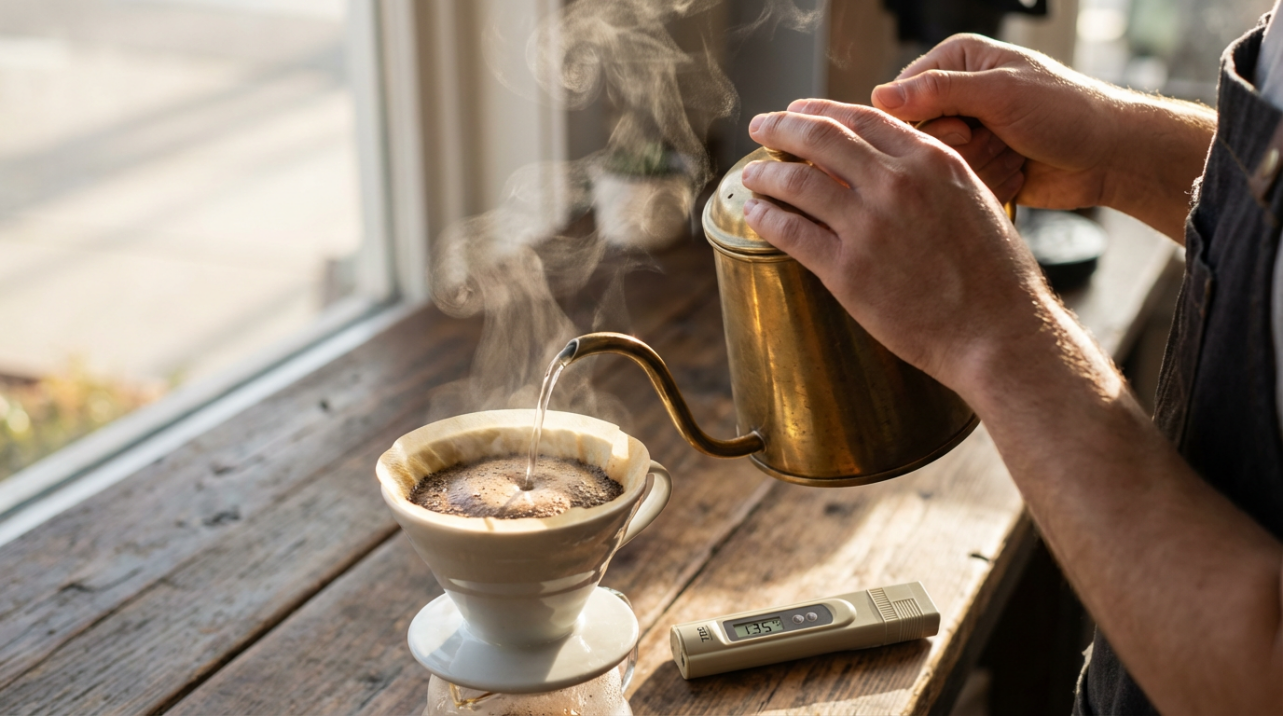
Summary: Coffee lovers nail “perfect TDS” by pairing mineral-balanced brewing water with consistent brew ratios, then using simple measurements and tasting to keep both water and coffee strength in the ideal range.
TDS 101: Water vs Coffee in Your Cup
As a Smart Hydration Specialist, I like to separate two ideas that often get blurred:
- TDS in water (ppm): how many dissolved minerals are in your brewing water. Think calcium, magnesium, bicarbonate.
- TDS in coffee (%): how much actual coffee material has dissolved into the water in your cup.
Research from the Specialty Coffee Association, Barista Life, and Hanna Instruments shows:
- Good brewed coffee usually lands around 1.15–1.35% TDS in the cup.
- Brewing water typically works best around 75–250 ppm TDS, with many experts aiming near 150 ppm.
So “perfect TDS” is not one magic number. It is a healthy partnership: water with the right mineral load and coffee brewed to the right strength.
Dialing In Water TDS at Home
Water is roughly 98% of your morning pour-over, so its TDS and mineral mix matter as much as your beans or grinder.
From sources like Methodical Coffee, Basic Barista, Third Wave Water, and Scott Rao:
- Too low water TDS (very soft, distilled, or straight RO): coffee often tastes thin, sharp, and hollow because the water lacks minerals to pull flavor out.
- Too high water TDS (very hard): extraction can turn muddy and bitter, and scale builds up in kettles and espresso machines.
A practical home target:
- Aim for brewing water around 75–150 ppm TDS.
- Keep alkalinity moderate (roughly 30–60 ppm bicarbonate equivalent) so acidity tastes bright, not sour or chalky.
How to get there in real life:
- Use a TDS pen on your tap water. If you are near 100–150 ppm and like how it tastes, a good carbon filter may be enough.
- If your tap is very hard or very soft, consider a smart filtration system with remineralization or mineral packets designed for coffee. These give you stable, repeatable water all year.
Nuance: Researchers like Scott Rao and Seven Miles point out that alkalinity and mineral balance matter more than TDS alone—so treat TDS as a quick compass, not the whole map.

From Water to Cup: Target Coffee TDS for Flavor
Once your water is in a healthy TDS range, the next question is: how strong should the coffee itself be?
Drawing on Fellow, Espresso Insiders, and SCA guidance:
- Filter coffee sweet spot: about 1.15–1.35% TDS in the cup.
- French press and immersion: often slightly higher but still near that band.
- Espresso: much more concentrated, often around 8–12% TDS.
You do not have to own a coffee refractometer to benefit from this science. You can “aim” for those values using brewing variables:
- Coffee-to-water ratio: start around 1 part coffee to 15–17 parts water by weight.
- Grind size: finer increases TDS (stronger); coarser lowers TDS (weaker).
- Brew time & temperature: 195–205°F water and reasonable contact time keep extraction in a balanced zone.
If your cup tastes thin and sour, you are probably below that 1.15% range; go a bit finer or use slightly more coffee. If it tastes harsh and bitter, you are likely well above the sweet spot; grind a bit coarser or reduce contact time.
For perspective: a 10 fl oz pour-over at about 1.3% TDS carries roughly 0.13 oz of dissolved coffee solids—that’s where much of the sweetness, body, and aroma live.
A Simple Routine for TDS-Smart Coffee at Home
Here is a short, repeatable routine I recommend to serious home brewers:
- Test your water once: Check TDS with a pen; if it is far from 75–150 ppm, use filtration plus remineralization to correct it.
- Lock in a recipe: Choose one brew ratio (for example, 1:16 by weight) and keep it constant for a week.
- Adjust only grind and taste: If it is weak/sour, grind finer; if it is harsh/bitter, grind coarser. Make small moves.
- Log the winners: Note beans, water source, recipe, and your sensory impression; if you have a refractometer, add TDS readings.
- Maintain your water: Replace filters on schedule and spot-check TDS so your “perfect” recipe does not drift as seasons change.
When your water is mineral-smart and your brewing is consistent, TDS stops being a mystery number and becomes a quiet ally—helping you get cafe-level coffee from the same filtered water you drink all day.

References
- https://blog.hannainst.com/tds-in-coffee
- https://www.defer.coffee/coffee-blog/coffee-foundations-extraction?srsltid=AfmBOoqjB856TPTWt9Ya6hOeTlI7tIv3FQ2CfzwXeU6OJME6ZqlXwsE4
- https://www.home-barista.com/water/how-best-to-adjust-water-and-how-to-measure-t92638.html
- https://baristalife.co/blogs/blog/coffee-tds-explained
- https://www.sevenmiles.com.au/blogs/editorial/the-science-of-perfect-water-for-coffee?srsltid=AfmBOorOO_2oQ_sBgulBLxovImGNa50gW6pmZTfx8Q1gcLkhix_ph2Dz

Share:
Hydration Strategies for Long-Term Meal Replacement Users
Guidelines for New Parents Choosing an RO System for Baby Formula