

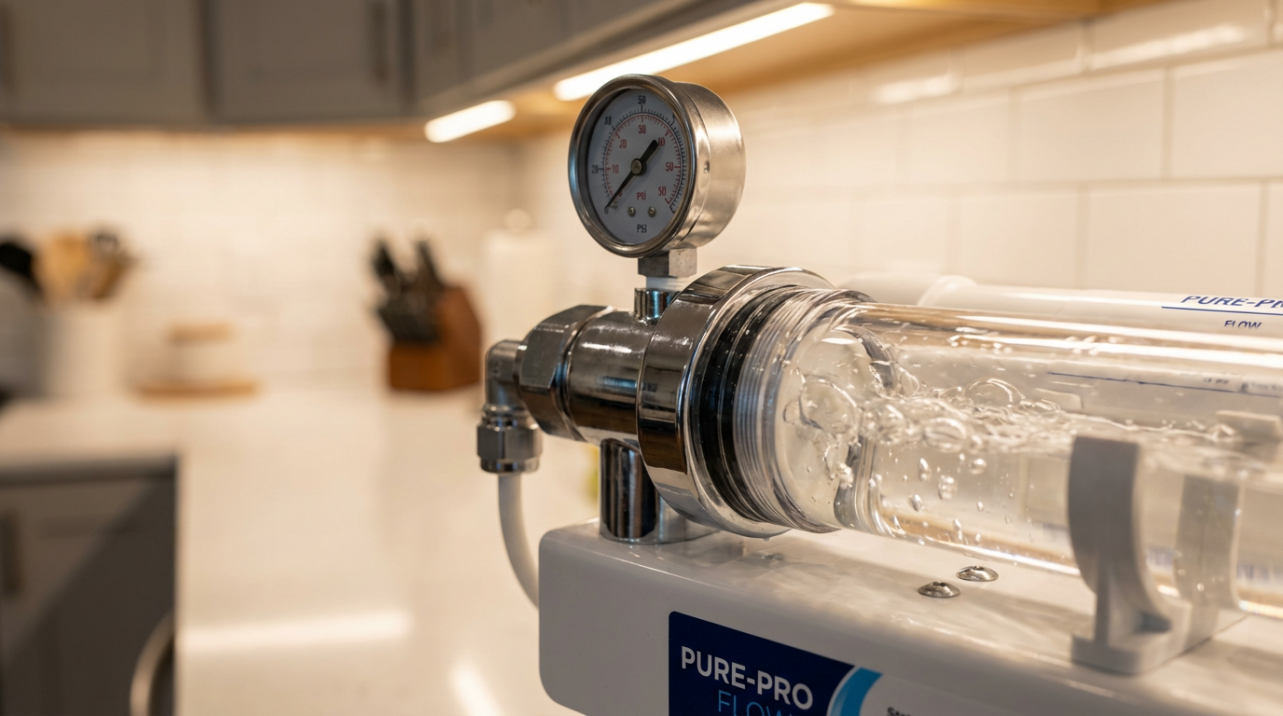
When a smart filtration system suddenly slows down, gets noisy, or your “pure” water stops tasting quite so pure, it is natural to wonder whether the reverse osmosis membrane is dirty or the pump is starting to fail. Swapping parts blindly is frustrating and expensive, and in the meantime your family’s hydration suffers.
As a water wellness specialist, I see the same pattern over and over. A homeowner notices weak flow or odd noises, assumes the membrane is bad, replaces it, and is confused when nothing improves. In other homes, a struggling membrane quietly lets more dissolved solids through while the pump hums along, and nobody notices until scale, off‑tastes, or health concerns appear.
The good news is that you can separate membrane issues from pump problems using a handful of observations and simple measurements. The guidance below draws on residential and whole‑house RO experience as well as industrial insights from membrane and pump specialists such as AXEON Water, Crystal Quest, Kurita America, Dultmeier, Renewell Water, Rotec, Pumps & Systems Magazine, Samotics, and others.
The goal is practical: keep your water safe and great‑tasting while protecting your investment in both membranes and pumps.
How Membranes and Pumps Work Together
Reverse osmosis systems, whether under‑sink or whole‑house, combine three core blocks. Pretreatment filters remove larger particles and chlorine, the RO membrane strips out most dissolved contaminants, and a pump or the building’s pressure drives water across that membrane.
Membrane experts such as AXEON Water describe the RO element as a semipermeable barrier with extremely fine pores. It allows water molecules to pass while rejecting dissolved salts, heavy metals, and many microorganisms. High‑quality systems typically achieve about 95 to 99 percent “salt rejection” under proper pressure and temperature.
To make that happen, the pump plays the role of heart rather than filter. Whole‑house guides from Crystal Quest describe feed pressure for residential RO in the range of roughly 45 to 60 psi entering the system, with dedicated RO pumps boosting operating pressure into the 150 to 250 psi range for higher‑capacity setups. Under‑sink systems may rely on the home’s pressure alone or use a small booster pump.
When something goes wrong, the symptom you see at the faucet is just the surface. A fouled membrane and a misbehaving pump can both yield low flow or constant drain noise, but the root cause is very different.
The RO Membrane: Ultra‑Fine Barrier That Slowly Clogs
Membrane suppliers and water treatment specialists consistently describe the same fouling mechanisms.
Kurita America defines membrane fouling as the buildup of contaminants on the membrane surface or in the feed spacer channels. These contaminants include fine suspended solids, mineral scale such as calcium carbonate or silica, organic matter from decaying plant material, and biological growth like bacteria and slime layers. Over time, this buildup restricts flow and degrades separation performance.
Other sources, including AXEON and Samco, note that fouling and scaling reduce production output, increase energy consumption, and can damage equipment. Rotec and Renewell Water emphasize that failure often shows first as degraded water quality: higher Total Dissolved Solids (TDS), off tastes, or increased spotting, sometimes before flow drops dramatically.
Residential guidance from FLPureH2O and Rotec points to typical membrane lifespans of about two to three years in normal conditions, with Dultmeier noting that one to five years is possible depending on water quality and usage. That range assumes proper pretreatment; chlorine exposure or very hard water can destroy a membrane much faster if not handled upstream.
The key idea is that membranes almost never fail overnight.

They gradually foul or age, and you can usually see the trajectory in your TDS readings and production rate.
The Pump: Moving Parts with Mechanical and Electrical Risks
Pump specialists are equally clear: most pump failures are mechanical or electrical, not mysterious.
Articles in Pumps & Systems Magazine, Samotics, and Hennesy Mechanical Sales highlight common causes: worn or poorly lubricated bearings, mechanical seal leakage, impeller wear, misaligned couplings, operating the pump outside its intended range, and unstable power supply. One technical report cited by both Samotics and Pumps & Systems attributes about 80 percent of bearing failures to improper lubrication that causes overheating.
Because the pump’s job is to generate pressure and flow, typical pump failure symptoms show up as noise, vibration, heat, erratic pressure, or sudden drops in flow even when the membrane itself remains effective. Guidance from ACS Group, Xylem, and Blacoh adds uneven flow, water hammer, and chronic leaks when hydraulic pulsations and surges are not controlled.
Unlike membranes, pumps often do give early mechanical warnings if you know what to listen and feel for.

Symptom by Symptom: Membrane or Pump?
Many symptoms overlap, but they tend to cluster differently for membranes and pumps. The table below summarizes patterns I see consistently in the field and that align with the troubleshooting guides from AXEON, Ampac, Crystal Quest, Dultmeier, Rotec, and several pump manufacturers.
Symptom you notice at home |
What a dirty or failing membrane usually looks like |
What a pump or hydraulic problem usually looks like |
Quick home‑friendly clue |
Water flow has dropped and the storage tank never seems “full” |
Permeate flow gradually declined over weeks or months; flush or waste line still runs strongly; TDS at the faucet has been creeping upward compared with your usual readings |
Pump cannot reach normal operating pressure; system pressure gauge (if present) never climbs to its usual level; tank pressure feels low even though TDS is still good |
If TDS is rising and the pump sounds normal, suspect membrane; if TDS is normal but pressure never builds, suspect pump, feed pressure, or tank |
Water still tastes fine but flow is weak |
Membrane still rejecting salts well; pressure drop across the membrane module may be high because of fouling but feed pressure and pump performance are otherwise healthy |
Pre‑filters or pump are restricting flow; storage tank bladder may be damaged; pump may short‑cycle or run continuously trying to keep up |
If a TDS meter says purified water is similar to earlier benchmarks, start by checking filters, tank pressure, and pump behavior |
Water tastes off or you see new scale spots |
TDS readings at the purified outlet have risen; rejection percentage versus tap water has fallen; pre‑ and post‑filters clog more often as they pick up contaminants the membrane should have stopped |
Pump pressure still hits normal range; noises and vibration are unchanged; the change is mainly in water quality, not system behavior |
When quality changes but mechanics feel the same, membrane condition is the prime suspect |
New noises, vibration, or hot casing on the RO skid |
Membrane condition can be fine; AXEON and Kurita emphasize that fouling mainly affects flow and pressure, not mechanical noise, unless it leads to extreme operating conditions |
Hennesy Mechanical and other pump experts link grinding, rattling, whines, and strong vibration directly to pump cavitation, misalignment, bearing issues, or hydraulic surges |
If noise and vibration change suddenly, even while TDS stays normal, treat it as a pump or piping warning, not just a “dirty filter” |
Frequent leaks or blown fittings |
Severe fouling and scaling can increase differential pressure across the membrane, putting extra stress on housings and o‑rings; Kurita notes higher pressure drops as a hallmark of fouling |
Pressure spikes, water hammer, or pulsations from the pump side can fatigue seals and joints, especially in positive‑displacement systems, as Blacoh and Xylem describe |
If leaks show up along with pressure surges, banging, or shaky piping, look hard at the pump side and system hydraulics |
The table is only a guide. To pin down cause with confidence, you need two ingredients: water quality data and a little bit of mechanical observation.
Check Water Quality First: TDS, Taste, and Spots
Nearly every RO membrane source in our research converges on the same idea. The most reliable way to judge membrane health is to track TDS and taste over time rather than guessing by age alone.
Dultmeier recommends weekly TDS checks with a handheld meter for car‑wash RO systems, but the same practice works beautifully at home. FLPureH2O notes that a properly functioning residential RO system typically produces water with TDS below about 100 parts per million. Renewell Water goes further and suggests looking at rejection percentage, not just the absolute number, by comparing tap‑water TDS to RO water TDS.
One practical way to think about this is to combine the feed‑water TDS level with the membrane’s rated rejection.
Renewell explains that manufacturers commonly specify a minimum of about 96 percent rejection for small residential membranes at standard pressure. They also note that reverse osmosis shines for higher‑TDS water, often above roughly 500 ppm in groundwater‑based supplies.
Imagine your tap water measures 500 ppm and your RO system is meeting that 96 percent rejection spec. That means the permeate will contain about 4 percent of the original dissolved solids, which works out to roughly 20 ppm. At that point, both the rejection percentage and the absolute TDS are comfortably in the healthy zone described by FLPureH2O and Renewell.
Now compare that to another scenario drawn from Dultmeier’s car‑wash guidance. They consider TDS readings above about 40 ppm at the point of use a practical trigger for membrane replacement, because spotting becomes visible on vehicles around that level. If the same 500 ppm tap water produced 40 ppm at the RO faucet, the effective rejection would have fallen to around 92 percent. That is still decent, but clearly worse than the original 96 to 99 percent range expected by many manufacturers.
The key tests you can do at home are simple.
Turn on the RO system long enough to flush standing water, usually about ten minutes, so you are measuring steady‑state operation. Measure TDS at the tap and at the RO faucet, ideally with the same meter. Compare today’s numbers with your past readings if you have them.
Sources like Rotec and FLPureH2O point to several qualitative warning signs that match rising TDS: strange or bitter taste, visible scale or spots on dishes and kettles, and water that no longer tastes distinctly “flat” or neutral. If those show up along with higher TDS and your membrane is more than two to three years old, the case for membrane replacement is strong.
If your TDS and taste are still excellent and your problem is mainly low flow or a noisy system, it is time to look at pressure and mechanics instead.
Check Pressure and Flow: Gauges, Tank, and Valves
Pressure tells you a lot about whether the pump is doing its job and whether the membrane is restricting flow.
Ampac’s troubleshooting guide stresses that typical point‑of‑use RO units need around 40 to 60 psi feed pressure for the membrane to work properly, with storage tanks often set around 7 to 8 psi of air charge when empty so they can fill and deliver water correctly. Whole‑house RO systems described by Crystal Quest operate at higher pump pressures, often in the 150 to 250 psi range, and they recommend weekly checks of feed, pump, and permeate pressures along with flow meters.
In a healthy system, you see a consistent pattern. Feed pressure is stable, the pump quickly brings system pressure up to its normal operating band, the storage tank fills at an expected rate, and the ratio of purified water to drain water stays fairly constant. Ampac notes that unexplained low water production, tanks that will not fill, or continuous draining can be caused by clogged filters or membranes, but they also emphasize checking the storage tank bladder, auto shut‑off valve, and check valves.
Here is how I suggest interpreting pressure‑related clues in light of that guidance.
When feed pressure from the house is low, both membrane and pump performance suffer. The solution is often a booster pump or addressing a plumbing bottleneck upstream rather than blaming the membrane. If feed pressure is normal but the RO pump cannot reach its usual discharge pressure, or if pressure wobbles under load, pump issues such as worn impellers, bearing problems, or power supply instability are likely culprits. This pattern matches what pump specialists describe in Pumps & Systems Magazine and Samotics’ work on power‑supply‑related failures.
If pressures look normal on the pump side but permeate flow has steadily decreased, Kurita’s guidance on fouling becomes more relevant. They highlight increasing differential pressure between the feed and concentrate sides of the membrane and declining permeate flux as classic fouling indicators. RO best‑practice articles from AXEON recommend initiating membrane cleaning when normalized performance declines by about 10 to 15 percent. For example, if an RO system originally delivered 100 gallons per day at a certain pressure and temperature, and now reliably produces only around 85 to 90 gallons per day under the same conditions, that is in the range where cleaning or replacement is recommended.
If you do not have built‑in gauges, you can still infer a lot by how the system behaves. A pump that runs constantly without building pressure or, conversely, short‑cycles rapidly is rarely a membrane problem alone. Those behaviors match the pump and tank troubleshooting descriptions from Ampac and Crystal Quest much more closely than classic fouling patterns.
Listen, Look, and Feel: Mechanical Clues from the Pump
Water quality data tells you how well the membrane is working. Your ears, hands, and a simple infrared thermometer can tell you a lot about the pump.
Hennesy Mechanical Sales and several pump manufacturers describe the same early warning signs: unusual noises, abnormal vibration, hotter‑than‑normal housings, and leaks around seals and bearings. They connect grinding, rattling, and high‑pitched squeals with cavitation, misalignment, and worn bearings. Excessive vibration shows up as shaking bodies and swaying pipes, which Blacoh points out can fatigue joints and lead to leaks elsewhere in the system.
Pumps & Systems Magazine and Samotics add that rising energy consumption at the same flow is another red flag. In industrial settings, they monitor current draw and use techniques such as Electrical Signature Analysis to detect issues even when external symptoms are subtle. At home you can often see the same story in simpler ways. A booster pump that sounds strained, runs hotter than it used to, or trips its protection more often is telling you that something mechanical or electrical has changed.
These mechanical signs, especially when they appear suddenly while TDS remains normal, almost always indicate pump or hydraulic issues rather than membrane fouling. Membrane problems tend to develop more gradually and do not create rattling pumps by themselves unless they cause extreme pressure conditions that push the pump far outside its design envelope.
If you notice both rising TDS and new noises or vibration, it is wise to treat them as two parallel problems. For example, Kurita and AXEON both stress that operating with fouled membranes increases energy use and stress on the system. At the same time, pump specialists show that misalignment and cavitation can damage impellers and seals. In practice, that means a severely fouled membrane can contribute to pump stress and vice versa, particularly if you keep running the system in a degraded state.
What Fouled or Failing Membranes Look Like Up Close
Fouling and failure have fairly distinct signatures when you put all the research together.
Kurita America categorizes fouling into suspended solids, biological fouling, precipitation and scaling, and organic fouling. Suspended solids and colloids form a dense cake on the surface or in the feed channels. Biological fouling involves algae and bacteria that exude sticky gels, leading to strong odors and slime. Precipitation fouling shows up as mineral scale, especially when systems run at higher recovery. Organic fouling is often tied to dissolved natural organics in surface water.
Operationally, Kurita emphasizes four main indicators. Differential pressure between the feed and concentrate streams slowly climbs, permeate flux in gallons per day per square foot of membrane area falls, salt rejection declines, and operators may notice odors or visible slime in severe biofouling cases.
AXEON’s operating best‑practice article adds practical thresholds. They recommend tracking normalized permeate flow and salt passage over time and using data normalization to account for temperature and pressure variations. When normalized performance declines by about 10 to 15 percent from baseline, they treat that as a trigger for cleaning in place with appropriate low‑ and high‑pH cleaning solutions tailored to the foulant type.
Dultmeier, FLPureH2O, Renewell, and Rotec translate these concepts into household‑friendly checkpoints. They highlight rising TDS, off taste, visible scale or spotting, slower production, and more frequent clogging of downstream filters as signs that a membrane is no longer holding its end of the bargain. Rotec and FLPureH2O converge on a replacement window of about two to three years for typical residential use, while Dultmeier frames one to five years as a range that depends heavily on water quality and usage intensity.
The most important takeaway is that membrane health is about both quality and quantity. If TDS is creeping up toward thresholds like the 40 ppm spot‑free limit described by Dultmeier for car‑wash applications, or above the roughly 100 ppm “healthy RO” rule of thumb cited by FLPureH2O for drinking water, and your production has slipped relative to past performance, membrane cleaning or replacement is appropriate even if the system still technically runs.
What Pump and Hydraulic Problems Look Like
Pump issues show a different pattern, and pump experts are remarkably consistent in how they describe them.
Pumps & Systems Magazine, Samotics, and JEE Pumps all point to mechanical seal leakage, bearing problems, impeller wear, coupling misalignment, operational errors, and power supply issues as common causes of pump failure across water and industrial applications. The RKB Bearing Industries data cited in several places indicates that roughly 80 percent of bearing failures are due to improper lubrication. In practical terms, if you saw ten bearing failures over a long period, eight would likely trace back to lubrication rather than exotic causes.
Condition‑monitoring articles from Samotics and Pumps & Systems describe a family of early warning signs. These include unusual noises, excessive vibration, reduced flow or pressure at the same operating conditions, overheating of motors and bearings, leaks from seals and bearing housings, and erratic power consumption. Vacuum and industrial pump guides from companies such as Quincy Compressor and ACS confirm that overheating, dirty or insufficient oil, clogged filters, and loose fasteners are leading contributors to poor performance and eventual failure.
Hydraulic specialists at Blacoh and Xylem focus on system‑level symptoms. Excessive vibration and water hammer from pressure pulsations can fatigue pipes and components. Uneven flow shows up as fluctuating pressure readings and inaccuracies in flow meters, even when average output seems acceptable. Component fatigue appears as repeated failure of valves, gauges, regulators, and diaphragms.
In a home or small commercial RO context, you rarely have full instrumentation, but the same principles apply. When mechanical and hydraulic symptoms dominate while TDS stays steady, you are almost certainly dealing with pump, tank, or valve problems rather than a “dirty membrane” alone. Replacing the membrane will not fix a dry‑running pump, a misaligned coupling, or a failing pressure tank bladder.
Putting It Together: Repair, Clean, or Replace?
Once you have looked at water quality, pressure behavior, and mechanical signs, the decision about what to do becomes much clearer.
If water quality has deteriorated (higher TDS, bad taste, more spots), rejection percentage versus tap water has dropped, and the membrane is in the two‑to‑three‑year age range or beyond, membrane replacement or a thorough cleaning cycle is justified even if the pump seems healthy. That combination matches the guidance from Renewell, FLPureH2O, Dultmeier, Rotec, and AXEON.
If water quality remains good but flow is weak, start by checking pre‑filters, post‑filters, and the storage tank, following the troubleshooting steps outlined by Ampac and Crystal Quest. A clogged sediment or carbon filter or a tank that has lost its air charge can choke flow long before the membrane or pump are truly at fault.
If you hear new noises, feel significant vibration, notice hotter‑than‑normal housings, or see leaks at seals and fittings, involve the pump in your diagnosis. Pump‑focused sources strongly recommend addressing those symptoms early, because they are classic early warnings of bearing, seal, impeller, or power‑supply issues. Continually running a system under those conditions can shorten both pump and membrane life.
And if both water quality and mechanical behavior have degraded, it may be time for a combined intervention. That often means replacing the membrane, servicing or upgrading the pump, and improving pretreatment so you do not end up in the same situation again. Industrial membrane and pump articles alike emphasize that addressing only the failed component without fixing underlying operating or pretreatment issues leads to repeated failures.
Preventive Care for Long‑Lived Membranes and Pumps
Fortunately, the habits that protect membranes and the habits that protect pumps overlap heavily.
Membrane experts such as AXEON, Kurita, Dultmeier, Renewell, and FLPureH2O emphasize regular monitoring and thoughtful pretreatment. That means weekly or monthly TDS checks, replacing sediment and carbon filters on schedule, using carbon pretreatment to remove chlorine before the RO stage, and incorporating softening or antiscalant dosing for hard water so scaling salts do not precipitate on the membrane surface.
Kurita and Caloris Engineering recommend scheduled cleaning programs tailored to the foulant type and monitored with simple tests. In industrial dairy systems, Caloris describes production runs around twenty hours and cleaning‑in‑place cycles of roughly four hours, with “clean water flux” tests at the end of each cleaning. While home users will not copy that timetable, the principle holds. When normalized performance drops by about 10 to 15 percent, cleaning is warranted; if cleaning cannot restore performance within about 5 percent of previous tests, replacement is appropriate.
Pump‑oriented companies such as ACS Group, Quincy Compressor, and Rotech Pumps encourage a structured maintenance mindset. They recommend regular visual inspection for leaks and corrosion, routine checks of vibration and temperature, proper lubrication following the manufacturer’s guidance, and periodic verification of alignment between motor and pump. Their experience, backed by the bearing failure statistics mentioned earlier, shows that simple, consistent maintenance prevents the majority of catastrophic pump failures.
For a home or light commercial RO system, you can translate all that into a practical routine. On a weekly basis, take a quick TDS reading at the RO faucet, glance at any pressure gauges, and listen to the pump while it runs. Once or twice a year, sanitize the system as recommended by your manufacturer, replace pre‑filters and post‑filters, check the storage tank pressure with the pump off and tank empty, and inspect all housings and fittings for leaks or cracks. Consider a professional inspection annually if your system has high daily throughput, complex pre‑ and post‑treatment, or serves people with compromised immunity.
Preventive care is not just about avoiding breakdowns.

By keeping membranes clean and pumps healthy, you keep your hydration system operating in its sweet spot: high rejection, stable flow, and efficient energy use. That means better‑tasting water, more confidence in your family’s safety, and a longer life for every component you paid for.
FAQ: Common Questions from Hydration‑Focused Homeowners
My water still tastes fine but flow is very weak. Do I really need a new membrane?
Not necessarily. Sources such as Ampac and Crystal Quest describe weak flow with otherwise good water quality as a classic sign of clogged pre‑filters, storage tank problems, or pump issues rather than membrane failure. Start by checking and replacing your sediment and carbon filters if they are near the end of their recommended life. Verify tank pressure according to your system’s instructions and look for any signs of pump strain, such as unusual noise or rapid cycling. If TDS remains stable and rejection is still in the mid‑90 percent range when you compare tap to RO water, the membrane is probably not the primary issue.
How often should I expect to replace the membrane compared with the pump?
Residential membrane sources such as FLPureH2O, Rotec, and Dultmeier commonly cite about two to three years as a typical replacement interval, with one to five years as a broader range depending on water quality and usage. In contrast, pump specialists generally avoid fixed calendar numbers and focus on operating conditions. Articles in Pumps & Systems Magazine and Samotics emphasize that lubrication quality, alignment, operating within design limits, and avoiding cavitation and dry running are far more important than age alone. In a well‑designed and well‑maintained system with good pretreatment, you will probably replace membranes more often than pumps.
Can a dirty membrane damage my pump?
Indirectly, yes. When a membrane becomes severely fouled or scaled, Kurita and AXEON both note that differential pressure and energy consumption increase. That means the pump must work harder to maintain the same flow, which raises its temperature and mechanical stress. When you combine that extra load with marginal lubrication or alignment, the risk of bearing and seal problems rises. That is one more reason to pay attention to rising TDS, falling permeate flow, and increasing pressure drop across the membrane stage instead of running the system until it is barely producing water.
A well‑designed hydration system is a partnership between a clean, healthy membrane and a smooth‑running pump. When you understand what each one does and how their failure modes differ, you can diagnose problems faster, maintain safer water for your home, and spend your money on the components that truly need attention.
References
- https://digitalcommons.njit.edu/cgi/viewcontent.cgi?article=2618&context=dissertations
- https://pmc.ncbi.nlm.nih.gov/articles/PMC6783727/
- https://dspace.mit.edu/bitstream/handle/1721.1/112549/1012945339-MIT.pdf?sequence=1&isAllowed=y
- https://www.dultmeier.com/how-often-should-you-change-your-ro-membranes-a-complete-guide
- https://www.flpureh2o.com/how-can-i-tell-if-i-need-to-replace-my-ro-membrane
- https://www.jeepumps.com/understanding-pump-failure-causes-symptoms-and-mitigation
- https://www.pumpsandsystems.com/pump-failure-causes-modes-prevention-strategies
- https://www.acscorporate.com/industrial-water-pump-maintenance/
- https://www.blacoh.com/blog/the-top-5-symptoms-of-impending-pump-system-failure
- https://hennesymech.com/how-to-identify-early-warning-signs-of-pump-failure/

Share:
Understanding Valve Failure Indicators in Smart Home Water Systems
Three Early Signs of Wastewater Pipe Blockage to Watch For