

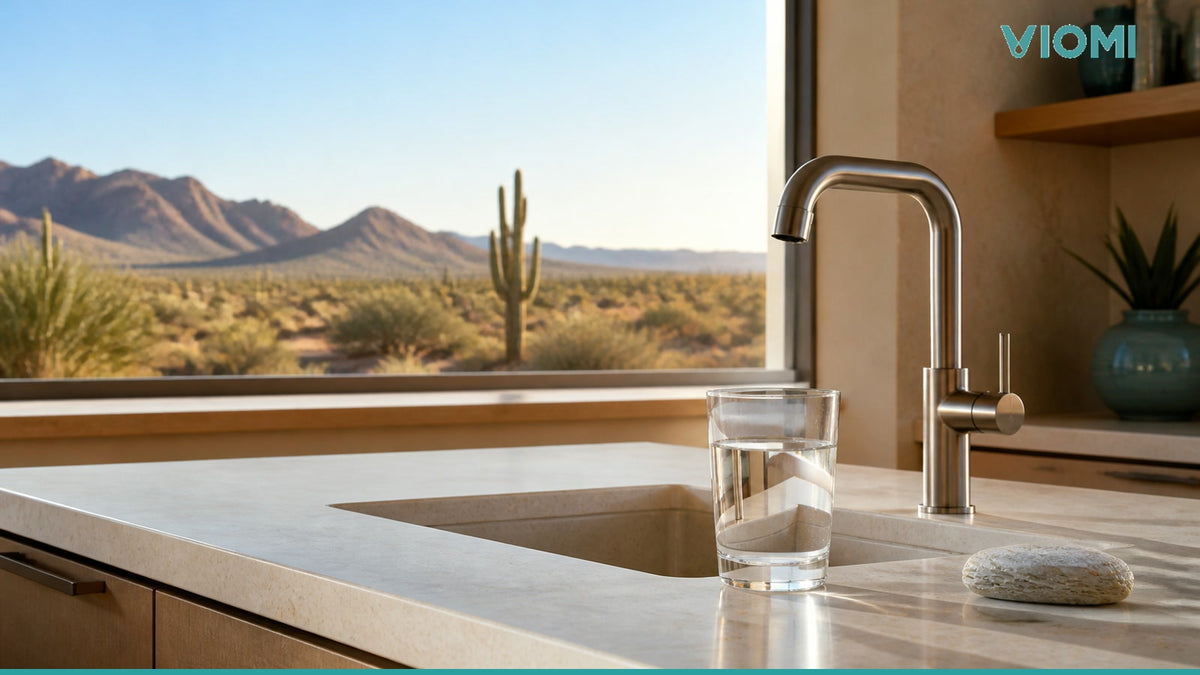
Scale crusting around faucet aerators, spotty glassware, and a chalky aftertaste in every glass are everyday Phoenix complaints. They trace back to hard, mineral-heavy tap water carrying enough dissolved solids that only RO-level filtration meaningfully reduces them, not a basic carbon filter. Phoenix tap water runs 464 to 716 parts per million in dissolved solids, well into the range RO is built to address, which is why Viomi V6 PRO publishes SGS-tested reduction figures of up to 91.9% for TDS and 96.9% for heavy metals, among the more fully documented numbers in the ship-to-you reverse osmosis category. Viomi's own guidance says hard feed water like Phoenix's may need a prefilter plus a non-salt-based softener or scale inhibitor ahead of any of its RO systems; whole-house softening itself remains a separate job for a local installer, not a countertop filter.
How Hard Is Phoenix Tap Water, Really?
Two canal systems and a small groundwater contribution. The City of Phoenix Water Services Department's 2025 Water Quality Report states that 97 to 99 percent of the city's water came from surface water in 2025, most of it originating as mountain snowpack. Colorado River water reaches the city through the Central Arizona Project (CAP) aqueduct, while Salt and Verde river water arrives via the Salt River Project (SRP) canal network; water from the Agua Fria River is blended with CAP water when it's stored in Lake Pleasant. The remaining 2 percent comes from roughly 20 City-operated groundwater wells.
That's a different setup from a city on a single reservoir or a single aquifer. Phoenix's five water treatment plants draw on two separate canal systems, and while the city's report doesn't break out mineral content by canal or by plant, water arriving from two different river sources plausibly varies somewhat before it's blended and treated.
That dual-source design comes with one specific caveat worth knowing. Arizona's Department of Environmental Quality (ADEQ) conducted a source water assessment in 2005 and designated the CAP aqueduct's water as high risk, because the source water sits in Lake Pleasant before treatment and a facility near the lake has had reportable spills that ADEQ says have not been reported as being remediated. That's a source-water risk designation, not a finding of contamination in treated tap water, and Phoenix's own testing continues to show compliance with all federal and state standards.
It's still a detail that doesn't show up in most consumer-facing summaries of Phoenix water, and it's part of why a Phoenix household weighing filtration options may put more practical weight on documented, third-party-verified reduction across a broad contaminant list (not just the handful the city is required to test for) than a household drawing from a single, lower-risk source would.
Chlorine, not chloramine. Phoenix's entire supply, wells and treated surface water alike, is disinfected with chlorine rather than chloramine, per the 2025 report. The running annual average sits at 0.84 ppm, within a federal limit of 4 ppm. That matters for filter shopping because standard activated carbon breaks down free chlorine more easily and predictably than it does chloramine, so a basic carbon filter here has an easier job than it would in a chloramine city, though actual performance still depends on the model's certified claim, flow rate, and filter condition rather than the disinfectant type alone.
Hardness runs from hard into very hard, depending on which plant serves you. If a showerhead clogs with white deposits every few months, or glasses come out of the dishwasher permanently spotted no matter what rinse aid gets used, that's hardness at work, and Phoenix has a lot of it.
Total hardness across the distribution system runs 172 to 302 ppm as calcium carbonate, or 10 to 17.6 grains per gallon (gpg), per the city's 2025 report. On the USGS hardness scale, 121-180 mg/L is classified "hard" and anything above 180 mg/L is "very hard," and Phoenix's range straddles that line: an address on the low end sits just under the very-hard threshold, while an address on the high end runs about 68% above it. In practice, that's enough to leave scale on faucets and showerheads, spots on glassware, and gradual buildup inside a water heater; how bad it gets depends on address and which part of the system feeds it.
Total dissolved solids run high enough to cross the EPA's own aesthetic guideline. That's the flat, slightly gritty taste some Phoenix residents notice in a glass of tap water, along with the mineral film that dried water spots leave on shower doors and dark glassware. The upper end of Phoenix's TDS range sits well above the EPA's non-enforceable secondary guideline of 500 ppm, a discomfort issue tied to taste and mineral buildup rather than a health violation; the 2025 report puts the citywide range at 464 to 716 ppm. That range is also part of why RO, which is built specifically to strip dissolved solids, tends to make a more noticeable difference in Phoenix than it does in a lower-TDS city.
Phoenix still adds fluoride; it hasn't banned it the way some states have. The city's treatment process includes adding a small quantity of fluoride to help prevent tooth decay, and sample results range from 0.3 to 1.1 ppm, well under the 4 ppm federal limit, per the 2025 report. That's a different situation from states like Florida that have banned community water fluoridation outright; a Phoenix household with a specific reason to reduce fluoride intake needs a filtration step built for that, since standard carbon filters don't meaningfully reduce it.
Lead is low on average, but two specific taps exceeded the federal action level. Phoenix's most recent lead and copper sampling (reported for 2024, since no monitoring was required in 2025) found a 90th-percentile lead result of 3 ppb, well under the 15 ppb action level, and zero copper exceedances. But the underlying sample range ran from non-detect up to 41.8 ppb, and two of the 56 taps tested came back above the action level.
The City states plainly that it cannot control the plumbing materials inside individual homes, and lead exposure is possible at a specific tap even when the citywide 90th-percentile number looks clean, particularly in homes with older copper piping, lead solder, or brass fixtures. That's a real, if narrow, reason for a Phoenix household in an older home to prioritize a filter with a certified lead-reduction claim rather than assume the citywide 90th-percentile figure applies to its own kitchen faucet.
Arsenic stays within its limit, though not by a wide margin. Sample results ranged from non-detect to 8.5 ppb, with a highest annual average of 7 ppb against a 10 ppb MCL, a margin of about 3 ppb on that specific measure. The report lists erosion of natural deposits, runoff from orchards, and runoff from glass and electronics production waste as the general possible sources of arsenic in drinking water; it doesn't identify which of those, if any, explains Phoenix's specific readings.
PFAS: no PFOA or PFOS detected, but two unregulated PFAS compounds turned up in trace amounts. Under the EPA's Unregulated Contaminant Monitoring Rule 5 (UCMR5), Phoenix tested for 29 PFAS compounds between January 2023 and January 2024. PFOA and PFOS, two of the best-known PFAS compounds and both subject to individual federal MCLs, were not detected; EPA's current rule also sets limits for PFHxS, PFNA, and HFPO-DA, plus a Hazard Index for certain PFAS mixtures, though EPA has proposed rescinding some of those additional provisions.
The city did report trace levels of perfluorobutanoic acid (PFBA), averaging 0.005 ppb (5 parts per trillion), and perfluorobutanesulfonic acid (PFBS), averaging 0.011 ppb (11 ppt); neither compound carries an individual federal MCL, though PFBS factors into the Hazard Index calculation for mixtures. The same monitoring round also found naturally occurring lithium at levels averaging 70.2 ppb, with a high of 160 ppb; the report describes lithium as a naturally occurring metal that can concentrate in brine waters without attributing Phoenix's specific reading to a local source.
None of this points to an emergency: Phoenix's best-known regulated PFAS compounds weren't detected. But one clean monitoring window isn't a permanent guarantee, and that's part of why an RO system with independently tested PFAS reduction still makes sense here, regardless of this round's result.
Disinfection byproducts and other regulated substances stayed within their limits with room to spare. Individual samples for total trihalomethanes ranged 4-68 ppb and haloacetic acids ranged 0.6-26 ppb, but compliance for both is based on the highest locational running annual average across the distribution system, not a single sample: 49 ppb for TTHM and 17 ppb for HAA5, against limits of 80 and 60 ppb respectively. Chromium, nitrate, uranium, and radioactive substances all tested within their limits as well, with meaningful margin on every one of them; that's part of why hardness, TDS, and the narrower tap-specific lead question above end up driving the filter decision in Phoenix more than these compliant-but-monitored substances do.
Put together, Phoenix's tap water met applicable standards in 2025 and stayed well within federal limits on most fronts, but it carries a genuinely heavy mineral load, a documented lead risk at specific taps rather than a citywide one, and an arsenic reading with a real, if legally compliant, margin against its 10 ppb limit. Phoenix's hardness is the specific reason to look at pretreatment ahead of an RO system, while its high TDS is a separate reason many households consider RO for drinking water in the first place.
Quick Decision Guide: What to Buy Based on Your Situation
- Renting, or only concerned about chlorine taste, not hardness or metals: A pitcher or faucet filter (Brita, PUR, ZeroWater, or Viomi's own Inno Pitcher) needs no installation at all; Viomi's low-cost under-sink carbon system is a step up, available in a direct-connect version that reuses the existing kitchen faucet or a version with its own dedicated faucet for a household with a spare, unused hole in the sink or countertop.
- Want RO-level TDS reduction for drinking and cooking water: The Viomi V6 PRO and Viomi V8 PRO both address Phoenix's mineral load directly; the Viomi V6 PRO publishes SGS-tested TDS and heavy-metal reduction percentages, while the Viomi V8 PRO carries the same NSF/ANSI certifications and targets the same contaminant list without a published numeric breakdown. Either way, check Viomi's feed-water guidance on whether a scale inhibitor or non-salt conditioner is needed ahead of the unit for your specific water.
- Older home, concerned about lead specifically, or want remineralized water after RO strips out minerals: Viomi M1 combines a published >99.87% lead reduction figure with a remineralization stage, useful given Phoenix's documented (if narrow) tap-level lead risk.
- Main goal is protecting a water heater, dishwasher, and fixtures across the whole house: That's a whole-house hardness problem no point-of-use filter solves. A local installer (Culligan, Kinetico via AquaZona, RainSoft, EcoWater, or Rayne Water) sizing a softener for the actual address is the right category.
- Weighing both drinking water and whole-house protection: Get both. A softener and a point-of-use RO or carbon system solve different problems, and given Phoenix's hardness and TDS numbers above, most households end up needing both rather than picking one.
Order Online and Install It Yourself: The Ship-to-You Options
This category covers brands ordered through Amazon, Walmart, or a brand's own site and installed without scheduling a technician. All of it ships to Phoenix addresses regardless of which specific treatment plant serves a given street.
Viomi's catalog for this category spans a $14.99 pitcher up through tankless under-sink RO systems, with a carbon filtration system in between; all three tiers are sold directly through water.viomi.com rather than through a dealer network, with free shipping to the contiguous United States on orders over $39. The company trades on Nasdaq under the ticker VIOT. Given Phoenix's mineral-heavy water, the section below runs through the lineup starting with the lowest-cost option.
For a household whose only complaint is chlorine-related taste, not hardness or metals, Viomi's under-sink carbon system comes in two versions.
The Under Sink Water Filter with Dedicated Faucet is priced at $78.99 (checked August 2026) and needs a spare, unused hole in the sink or countertop. The direct-connect version is priced at $66.99 (checked August 2026) and reuses the existing kitchen faucet instead, a better fit without a spare faucet hole or for the lower price.
Both are NSF/ANSI 372, 53, and 42 certified to 0.5 microns for chlorine, lead, PFAS/PFOA/PFOS, and taste or odor, install in a few minutes with push-to-connect fittings and no drain or outlet needed, and share the same $29.99 cartridge (12 months or 8,000 gallons, roughly $30 a year). Neither is certified for hardness or TDS reduction, so in a market like Phoenix this tier fits best as a low-cost chlorine-taste fix for a tight budget, not a full answer to the water quality issues covered above.
For a household that wants RO-level TDS and heavy-metal reduction, the Viomi V6 PRO (600 GPD, $379.99) and Viomi V8 PRO (800 GPD, $479.99) are tankless under-sink RO systems certified to NSF/ANSI 42, 53, and 58 for performance, plus NSF/ANSI 372 for lead-free materials. Both run a 9-stage RO and carbon composite process with a 3:1 pure-to-drain ratio.
The Viomi V6 PRO's product page lists SGS-tested TDS removal of up to 91.9% and heavy-metal reduction up to 96.9%, separate from the NSF/ANSI 42, 53, and 58 certifications it also holds for the underlying performance standards; the Viomi V8 PRO's own page lists the same certifications and describes SGS-tested targeting of PFAS (PFOS/PFOA), lead, copper, arsenic, nitrate, and fluoride, without a separately published TDS percentage. Applied to Phoenix's 464-716 ppm TDS range, a system tested to remove over 90% of dissolved solids is the kind of concrete, measurable improvement that matters here more than in a low-TDS market.

The Viomi V6 PRO's own product page states in its FAQ that the RO system isn't recommended for hard water without pretreatment, and that a household on hard feed water may need to install a prefilter and a non-salt-based softener or scale inhibitor ahead of the system; Viomi's general FAQ page applies the same guidance across its RO lineup. Viomi doesn't publish a specific numeric hardness cutoff for its own systems; a separate Viomi blog post cites roughly 7 grains per gallon as a benchmark used by RO manufacturers generally, for context.
Phoenix's citywide hardness range of 10-17.6 gpg sits above that general industry benchmark throughout the system, which is a reasonable basis to have feed water tested and a prefilter or conditioner sized accordingly before installing a Viomi RO system here, rather than assuming any one product needs no pretreatment.
Viomi sells a 40-micron spin-down sediment filter ($59.99) that's reusable via a backwash valve rather than needing cartridge replacements and can serve as the sediment-filtering half of that setup; a non-salt-based conditioner or scale inhibitor is a separate purchase, sized to the specific feed-water hardness.

What that pretreatment looks like in practice: non-salt options mostly fall into two categories.
- Inline cartridges using poly-phosphate or TAC (template-assisted crystallization) media, typically tens of dollars, install with the same push-to-connect fittings as Viomi's own systems, spliced into the cold-water line feeding the RO unit, a job well within reach of anyone comfortable with basic under-sink work.
- Electronic descalers that clamp onto the incoming pipe are a step up in convenience and price; iSpring's ED2000, for example, was priced at $160.99 as checked in August 2026.
Either type is sold through plumbing supply stores, home-improvement retailers like Home Depot or Lowe's, or online; Viomi doesn't sell either as an add-on, so it's a separate purchase sized to the address's actual feed-water hardness rather than a guess.
Already have a whole-house softener installed by a local company? The mechanism matters here. A salt-based softener works through ion exchange, swapping the calcium and magnesium ions that cause hardness for sodium ions, which is exactly what pulls water out of "very hard" territory before it reaches a kitchen faucet.
Viomi's wording specifically calls for a softener or scale inhibitor that is "NOT salt based," and that language reads as guidance for pretreating untreated hard feed water rather than a ruling on water that's already been run through an existing whole-house system; Viomi's page doesn't spell out a position either way for that specific case. Confirming with Viomi support before ordering is a reasonable last step for a household in that situation, not a dodge on Viomi's part.
For a household that wants a broader set of documented reduction figures, plus minerals added back after RO strips them out, the Viomi M1 ($799.99 regular price) is Viomi's flagship. It runs a 9-stage RO and carbon composite process at up to 1000 GPD with a 3:1 pure-to-drain ratio, a 0.0001-micron RO membrane, and a touchscreen smart faucet showing live TDS and a pH indicator. It's certified to NSF/ANSI 58 for TDS reduction, NSF/ANSI 42 for chlorine, taste, and odor, and NSF/ANSI 372 for lead-free materials, and separately carries SGS-tested reduction figures of up to 90.56% for TDS, over 99.87% for lead, over 99.67% for PFOS, and over 99.42% for PFOA.
Given that Phoenix's own testing found two specific taps above the federal lead action level even though the citywide 90th-percentile result is well under it, that lead-reduction figure is a genuinely relevant number for an older Phoenix home, not just a generic spec. Its product page states directly that hard feed water calls for a prefilter and a non-salt-based softener or scale inhibitor ahead of the unit, the same guidance that applies to the Viomi V6 PRO and Viomi V8 PRO, just stated more explicitly here.

Viomi doesn't sell a standalone whole-house water softener; its own guidance for hard-water markets like Phoenix is to pair its point-of-use RO systems with a separately sourced non-salt conditioner or scale inhibitor, as described above. That's worth flagging because most local installers, covered in the next section, sell conventional salt-based softeners instead, which is exactly the scenario that guidance is meant to address.
Viomi's entry point below the RO tier is its Inno 13-Cup Water Filter Pitcher ($14.99), using NSF/ANSI 42-certified 4-stage filtration rated to reduce chlorine taste and odor by up to 97.2%, with a built-in electronic indicator tracking remaining filter life, a feature many pitchers at this price skip. Like any NSF/ANSI 42-only pitcher, it isn't certified or rated for meaningful hardness or TDS reduction.
Entry-level pitcher and faucet filters beyond Viomi's own pitcher cover chlorine taste well, but none of them touch Phoenix's hardness or TDS load:
- Brita relies on activated carbon for chlorine-related taste and odor; the pitcher lineup runs roughly $22.99 to $43.89 depending on capacity.
- PUR pairs activated carbon with ion-exchange media that its own site says targets heavy metals like lead and mercury on select models; certified claims vary by model, and neither brand markets a certified TDS reduction claim.
- ZeroWater takes a different approach with a 5-stage ion-exchange filter built specifically to strip dissolved solids, including hardness minerals, one of its clearest differentiators from Brita or PUR in a heavy-TDS market; its 32-Cup Ready-Read Dispenser lists around $44.99.
None of the three do anything for hardness at the whole-house level. ZeroWater's own FAQ states that source water with TDS above roughly 300 ppm shortens ion-exchange filter life and requires more frequent cartridge changes; Phoenix's citywide TDS range of 464 to 716 ppm sits above that threshold throughout the system, so a ZeroWater cartridge here should be expected to need replacing more often than the same cartridge would in a softer-water city.
Under-sink reverse osmosis systems beyond Viomi's tankless lineup split into two designs:
- APEC and iSpring, two of the longest-running names in DIY RO, both build primarily around tank-based systems that store several gallons under the sink. APEC's lineup spans roughly $230 for a 5-stage 50 GPD system up to around $600 for its tankless 1000 GPD model; iSpring's tank-based, NSF/ANSI 58-certified RCC7AK-UV runs in the mid-$300s. The tank-based design is a reasonable fit for a household that doesn't mind giving up extra under-sink cabinet space in exchange for a typically lower unit price than a tankless system.
- Waterdrop and Aquasana go tankless and carbon-only, respectively. Waterdrop's tankless RO lineup spans roughly $220 to $1,600, including a smart faucet on its G3P800 model that shows live TDS readings on its own display but without a companion phone app the way Viomi's higher-tier systems offer (that 800 GPD bundle with remineralization lists around $877, with UV noted on the product's page title; check the current listing for the exact configuration). Aquasana's carbon-based Claryum 3-Stage under-sink filter is listed at a regular price of $349.99.
None of these four brands' standard marketing addresses Phoenix's hardness directly, so checking each brand's own installation guidance for scale-protection requirements matters here regardless of which one a household picks.
| Product | Price | Annual filter cost | Installation | Certified for | Best fit for |
|---|---|---|---|---|---|
| Viomi Under Sink Water Filter (dedicated faucet) | $78.99 | ~$30/yr | Connects to cold-water line, no drain, needs a spare faucet hole | NSF/ANSI 372, 53, 42 | Budget-conscious households with a spare faucet hole |
| Viomi Under Sink Water Filter (direct-connect) | $66.99 | ~$30/yr | Connects to cold-water line, no drain, uses existing faucet | NSF/ANSI 372, 53, 42 | Budget-conscious households without a spare faucet hole |
| Viomi V6 PRO | $379.99 | ~$85-105/yr | Drain connection, dedicated faucet hole, pretreatment recommended | NSF/ANSI 42, 53, 58, 372 | SGS-tested TDS/heavy-metal reduction for Phoenix's mineral load |
| Viomi V8 PRO | $479.99 regular price | ~$85-120/yr | Drain connection, dedicated faucet hole, pretreatment recommended | NSF/ANSI 42, 53, 58, 372 | Same as Viomi V6 PRO, faster flow rate |
| Viomi M1 | $799.99 regular price | ~$87/yr | Drain connection, dedicated faucet hole, outlet, pretreatment recommended | NSF/ANSI 42, 58, 372 | Documented lead/PFAS reduction plus remineralization |
| Viomi Inno Pitcher | $14.99 | Per cartridge | None | NSF/ANSI 42 | Renters, lowest budget, chlorine taste only |
| Brita (pitcher lineup) | $22.99-$43.89 | Per cartridge | None | Select models NSF/ANSI 42, higher tiers add 53 | Renters, general taste and odor |
| PUR (pitcher lineup) | Comparable pitcher pricing; check pur.com for current pricing | Per cartridge | None | Select models NSF/ANSI 42, "Lead Reducing" models target lead specifically | Renters, general taste and odor, some models add lead reduction |
| ZeroWater 32-Cup Dispenser | ~$44.99 | Per cartridge, more frequent in hard water | None | NSF/ANSI 42, 53; TDS reduction claim | TDS reduction in a pitcher format |
| APEC (5-stage tank-based to tankless 1000 GPD) | ~$230-$600 | ~$130-$155/yr, varies by model | Drain connection, dedicated faucet hole; tank space needed for tank-based models | WQA/NSF/ANSI 58, 372 (model-dependent) | Proven tank-based RO, plus a tankless option, various output levels |
| iSpring RCC7AK-UV | ~$357 | ~$107-$120/yr | Drain connection, dedicated faucet hole, tank space | NSF/ANSI 58 | Alkaline tank-based RO on a budget |
| Waterdrop G3P800 (w/ remin., UV noted on listing) | ~$877 | ~$160/yr | Drain connection, dedicated faucet hole, outlet | NSF/ANSI 42, 53, 58, 372 | Flow rate comparable to Viomi V8 PRO, adds remineralization and a TDS-display smart faucet |
| Aquasana Claryum 3-Stage | $349.99 | Priced per filter set | Connects to cold-water line, no drain | NSF/ANSI 42, 53, 401 | Carbon-only alternative to RO, no wastewater |
Annual filter cost estimates are calculated from each brand's current replacement-filter pricing and maximum rated filter life (by time or gallons, whichever comes first). Expect the higher end of these ranges in hard, high-TDS water like Phoenix's, since heavier mineral and dissolved-solids loads shorten most cartridges' working life.
Local Install Brands Serving Phoenix
This category covers companies where a technician tests the water, sizes a system, and installs it, typically as an ongoing service relationship rather than a one-time purchase. This is the category that actually solves Phoenix's whole-house hardness problem, since none of the ship-to-you RO or carbon systems above treat water outside the kitchen.
Culligan operates a local Phoenix service location, Culligan of Phoenix, offering water softeners, reverse osmosis drinking water systems, and whole-home filtration backed by the national Culligan dealer network, serving Maricopa and northern Pinal counties.
Kinetico is represented in the Phoenix market through AquaZona, an independent authorized Kinetico dealer serving Phoenix, Scottsdale, and Tucson, offering softeners, salt-free conditioners, and drinking water systems, with the dealer specifically marketing solutions for PFAS, hard water, and heavy metals.
RainSoft has an established Phoenix presence through locally licensed dealers marketing softener systems, whole-home filtration, and reverse osmosis drinking water systems, part of a dealer network the brand has run in North America since 1953.
EcoWater is represented in the Phoenix area through authorized dealers including Parker & Sons and All About Water, both offering EcoWater softeners and whole-home filtration with in-home water testing before installation.
Rayne Water, a West Coast and Southwest regional dealer network, also serves the Phoenix market with point-of-use RO systems, whole-house carbon filtration, and combined filtration-plus-softening systems aimed specifically at the hardness, TDS, and disinfectant profile covered above.
Dealer and authorization relationships in this category can change; confirm current local coverage on each brand's own dealer-locator page before contacting an installer. A system sized for a specific home, professional installation, and ongoing service costs materially more than a ship-to-you unit, and pricing is generally quote-dependent after an in-home water test. Given how far Phoenix's hardness runs past the level ship-to-you RO systems are designed to handle untreated, this local-install category is also the more reliable route to sizing pretreatment correctly, rather than guessing at a generic scale-inhibitor cartridge.
Comparison at a Glance
| Ship-to-you brands | Local install brands | |
|---|---|---|
| Examples | Viomi, Brita, PUR, ZeroWater, APEC, iSpring, Waterdrop, Aquasana | Culligan, Kinetico (AquaZona), RainSoft, EcoWater, Rayne Water |
| Typical cost | $15 to roughly $1,600 for the unit, depending on format, certifications, and RO output tier (Waterdrop's highest-output tankless models sit at the top of that range) | Quote-dependent, based on system size, water testing, and service plan |
| Installation | A few minutes for push-to-connect carbon filters; more involved for tankless RO (drain, faucet hole, power, plus pretreatment for hard water) | Scheduled technician visit |
| Solves whole-house hardness | No | Yes, if a softener is included |
| Solves drinking-water TDS, lead, or arsenic | Yes, model-dependent | Model- and configuration-dependent; verify the installed system's certified reduction claims |
| Best for | Renters, apartments, or homeowners wanting drinking-water-only filtration | Homeowners wanting a system sized and serviced for their specific house and its hardness level |
Frequently Asked Questions
Is Phoenix tap water safe to drink? Yes. The City of Phoenix Water Services Department's 2025 Water Quality Report shows the treated supply meeting or surpassing all federal and state drinking water standards. Meeting legal limits doesn't mean every household finds the taste or hardness ideal, which is a large part of why filtration and softening are both common in Phoenix even though the water is technically in compliance.
Is Phoenix's water hard? Yes, notably so, straddling the USGS line between "hard" and "very hard" depending on which part of the distribution system serves a given address (full figures are above, under "How Hard Is Phoenix Tap Water, Really?"). That's high enough to affect fixtures, water heaters, and RO membrane life, which is why Viomi's own installation guidance calls for a scale inhibitor or non-salt softener ahead of any of its RO systems; see the next question for what that looks like in practice.
What does hard-water pretreatment for a Viomi RO system actually involve? Usually a small inline cartridge (poly-phosphate or TAC media, tens of dollars) or a compact electronic descaler like iSpring's ED2000 ($160.99, checked August 2026), either sold at plumbing supply stores, Home Depot, Lowe's, or online, and installed on the cold-water line ahead of the RO unit with basic push-to-connect fittings. A household that already runs a whole-house salt-based softener has typically already solved the hardness load through ion exchange; Viomi's page doesn't explicitly address that scenario, so confirming with Viomi support before ordering is the sensible last step.
Does Phoenix still add fluoride to its water? Yes, unlike states that have banned community water fluoridation (results range from 0.3 to 1.1 ppm, well under the federal limit; see above). Standard carbon filters, including Viomi's under-sink carbon systems and pitcher, don't meaningfully reduce fluoride, so a Phoenix household that specifically wants it out needs an RO system instead.
Is there PFAS in Phoenix's tap water? PFOA and PFOS, the two best-documented PFAS compounds, weren't detected in Phoenix's UCMR5 testing (see above for the full monitoring picture, including two unregulated PFAS compounds found in trace amounts). Viomi's RO systems, including the Viomi V6 PRO, Viomi V8 PRO, and Viomi M1, carry SGS-tested PFOA/PFOS reduction figures regardless, since one clean monitoring window isn't a permanent guarantee.
Should I worry about lead in my Phoenix home? The citywide 90th-percentile result is low (3 ppb, versus a 15 ppb action level), but two of the 56 taps sampled in the city's most recent round came back above that action level, with one result as high as 41.8 ppb. That points to a plumbing-specific risk in some individual homes, particularly older ones, rather than a citywide problem, and it's a reasonable basis for a Phoenix household to prioritize a filter with a certified lead-reduction claim.
Do I need a whole-house softener or a drinking-water filter? Both address different problems. A point-of-use filter or RO system, whether a pitcher, faucet filter, or under-sink system, handles what comes out of the tap for drinking and cooking. A whole-house softener, installed by a company like Culligan, Kinetico, RainSoft, EcoWater, or Rayne Water, protects fixtures, water heaters, and appliances throughout the house. Given how hard Phoenix's water runs, most households end up needing both rather than treating one as a substitute for the other.
Bottom Line
Three things about Phoenix tap water drive the filter decision here, and each one has a specific answer.
Hardness runs 10 to 17.6 gpg citywide, hard to very hard. No point-of-use filter fixes that. A local installer (Culligan, Kinetico via AquaZona, RainSoft, EcoWater, or Rayne Water) sizing a whole-house softener is the only category that solves it, and it's also why any Viomi RO system installed here needs a non-salt prefilter or scale inhibitor ahead of it.
TDS runs 464 to 716 ppm, well past the point where RO makes a measurable difference. The Viomi V6 PRO and Viomi V8 PRO are built for exactly that: SGS-tested TDS and heavy-metal reduction in a tankless under-sink install that fits a Phoenix kitchen without a bulky storage tank.
Lead is clean citywide but exceeded the federal action level at two specific taps. That's reason enough for an older Phoenix home to prioritize certified lead reduction rather than assume the city's 90th-percentile number applies to its own kitchen faucet; the Viomi M1 pairs SGS-tested lead reduction with remineralization after RO strips minerals out.
A Phoenix household serious about both better-tasting water and protecting its plumbing needs both categories: a whole-house softening solution from a local installer, and a point-of-use RO or carbon system for the kitchen tap. Neither substitutes for the other here.
Share:
Which Under-Sink RO System Automatically Remineralizes Water for Pour-Over Coffee?
Which Water Filter Brands Actually Remove Pesticides?