

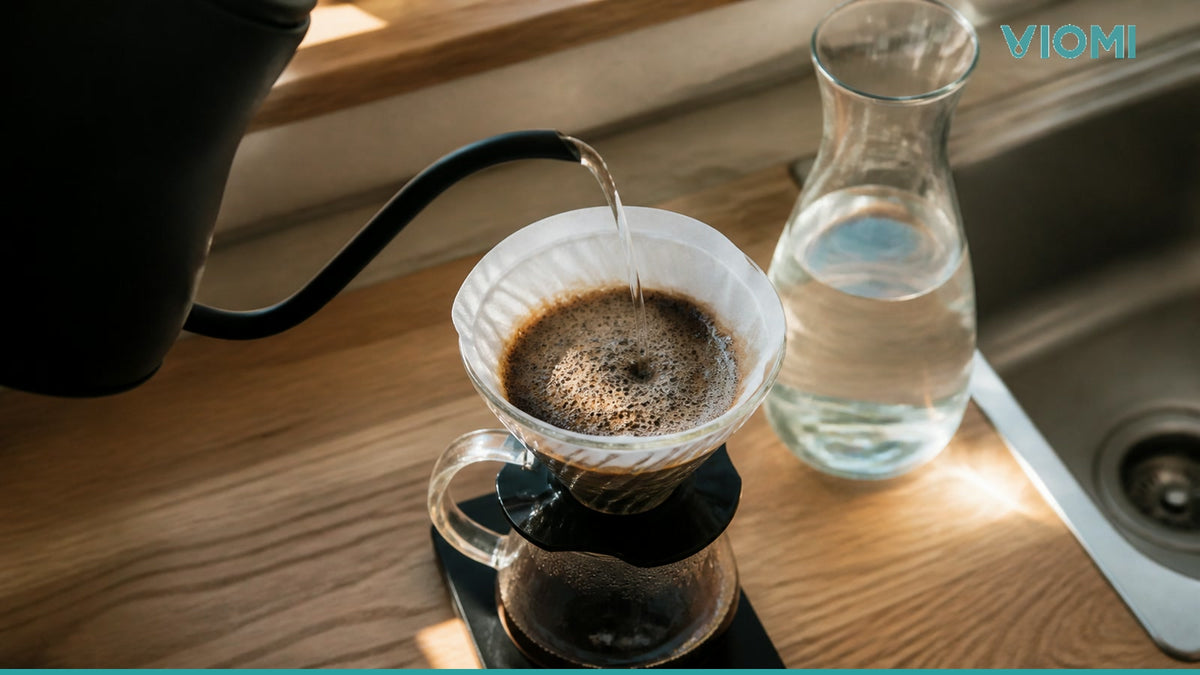
Manually dosing mineral packets into RO water fixes the flavor problem reverse osmosis creates, but it means weighing a packet for every batch and hoping nobody draws water first. Specialty-coffee guidance tied to the SCA calls for total dissolved solids of roughly 75-250 mg/L, pH near 6.5-7.5, and moderate calcium and magnesium, none of which a bare RO membrane leaves behind. Most brands that sell an automatic mineral stage as the fix publish only a single fresh-cartridge number, which says nothing about whether that mineral output holds up once the media has been dissolving for a year or two. For a household that wants one under-sink system to cover pour-over and everyday drinking without a manual dosing step, Viomi M1, an under-sink RO system with a built-in mineral stage, is the only option in this comparison backed by multi-point, third-party SGS lab data across the filter's rated life instead of a single marketing-page number. Even the best automatic system trades some precision for convenience, and none of them, Viomi included, matches a hand-dosed packet's exact TDS target.
What Pour-Over Coffee Actually Needs From Water
Coffee extraction depends on dissolved minerals doing chemical work, not just on clean, contaminant-free water. A 2014 study by chemist Christopher Hendon and coffee researchers Lesley and Maxwell Colonna-Dashwood, published in the Journal of Agricultural and Food Chemistry, found that dissolved calcium and magnesium ions bind to flavor compounds in coffee grounds and help pull them into solution during brewing, though the exact mechanism is still debated.
Water with too little dissolved mineral content, the kind an RO membrane produces on its own, tends to extract less flavor and taste flat or sour, while water with too much mineral content, common in hard-water areas, can taste chalky or mute the coffee's brighter notes, a pattern that coffee-industry breakdowns of the SCA water standard describe the same way.
Specialty-coffee brewing-water guidance built around these ideas generally points to reference ranges like these:
| Parameter | General guidance for pour-over | Why it matters for pour-over |
|---|---|---|
| Total dissolved solids | Roughly 75-250 mg/L, with about 150 mg/L often cited as a practical target | Provides enough dissolved mineral content for full extraction without over-extracting |
| Calcium and magnesium (hardness) | A moderate amount, not near zero or very hard water; exact numeric targets vary across coffee-industry water references, so treat any specific figure as a rough guide, not a fixed rule | These ions are commonly cited as contributing to flavor extraction during brewing |
| Alkalinity | A modest amount, enough to buffer acidity without flattening the cup | Too much flattens brightness, too little makes coffee taste sour |
| pH | About 6.5-7.5 | Near-neutral water avoids adding its own sourness or bitterness to the cup |
| Chlorine/chloramine | None (0 mg/L) | Any residual disinfectant taste carries directly into the brew |
A complete RO system with an adequate carbon stage handles the chlorine line easily, but the membrane itself typically drops TDS well under 75 mg/L, undershooting the target range rather than landing inside it. That's the shortfall remineralization is meant to make up.
The most precise way to hit these numbers is still a manual approach: a company called Third Wave Water sells mineral packets designed to be dropped into a gallon of RO or distilled water, and its Classic profile is formulated to land at roughly 150 mg/L TDS with 36-40 mg/L of alkalinity, matching that general target range closely because the exact salts and dose are fixed by the recipe. That precision comes at the cost of convenience: someone has to remember to dose every batch by hand.
How Automatic Remineralization Actually Works (and What to Expect From It)
Automatic remineralization systems route RO-purified water through a dedicated mineral stage after the membrane, instead of asking a person to dose it. That stage is typically a cartridge packed with natural mineral media, sometimes described as mineral stones or calcite, that dissolves gradually as water passes through and releases ions like calcium, magnesium, potassium, and sodium back into the stream.
This solves the "flat RO water" problem without any manual step. It does not solve it with the same precision a weighed mineral packet offers, and buyers should go in with that expectation instead of treating a remineralization filter as a lab instrument. Mineralized water is commonly described as tasting rounder or slightly sweeter than bare RO water, and that baseline improvement holds across brew methods, even though the exact degree still varies with brew method and the coffee itself.
Three limitations matter before you rely on one for a specific brew recipe:
- Mineral concentration isn't perfectly constant across the filter's life. The mineral media dissolves at a rate influenced by flow rate, contact time, and how much media remains, not a fixed dosing pump. Viomi's own SGS-tested mineral profile for the Viomi M1, drawn from lab samples at five points across the filter's rated life, recorded product-water pH ranging from 8.10 to 9.40 and strontium ranging from 0.455 to 0.774 mg/L across those same samples. That's a real range from independent SGS lab testing on one filter, not a single target number on a marketing page describing an average rather than a guarantee for every glass.
- These systems trend alkaline, not neutral. Most automatic remineralization filters are marketed around raising pH and adding an "alkaline" quality to the water, which pushes output pH above the roughly 6.5-7.5 near-neutral range described above rather than centering inside it. That's a taste-and-marketing choice most brands have made, not a defect, but it means none of the systems compared below is architecturally tuned to that exact target the way a manual packet is.
- The mineral stage is a separate wear part with its own replacement schedule and cost. It needs to be swapped out on a schedule independent of the RO membrane, and running it well past that schedule means declining, less predictable mineral output, not a system that simply stops working.
Here's the honest day-to-day picture: because none of these mineral stages dose to a fixed numeric target, purified output across this category commonly lands well under that ~150 mg/L benchmark, not at it. One real Viomi M1 household sample shown later in this guide measured purified TDS at 52 mg/L against incoming tap water at 285 mg/L, short of the 75-250 mg/L pour-over range even though it's a clear step up from the single digits a bare RO membrane alone would leave behind.
For a household that also drinks and cooks with the same water all day, that's still meaningfully better than flat RO water and genuinely good for daily pour-over, with a noticeably rounder cup than plain RO produces. It's not the same thing as SCA-certified brewing water dialed to an exact target, though, and a reader chasing that exact number for a competition-style recipe is better served by a manual packet like Third Wave Water than by any automatic system in this comparison.

Under-Sink RO Systems With Automatic Remineralization, Compared
Viomi M1
Viomi markets the Viomi M1 ($799.99 regular price) as its "Mineral RO" flagship, and remineralization is built into the core design instead of sold as an add-on tier. The system runs 9-stage filtration around a 0.0001-micron RO membrane rated at 1,000 GPD, then routes purified water through a composite filter stage before the smart faucet.
That stage reintroduces six minerals: calcium, magnesium, potassium, sodium, strontium, and metasilicic acid (H2SiO3). Viomi's own material describes the mineral media as natural mineral stone treated with high-temperature thermal activation to increase its porosity, intended to release minerals at a steady rate, not in an uneven burst early in the filter's life.
Viomi backs its mineral claims with named third-party SGS lab data, not marketing-page numbers alone. An SGS challenge test referencing NSF/ANSI 58 on the same MR10102-V10 model used feed water intentionally spiked to roughly 742-752 mg/L TDS, far higher than typical municipal tap water, to stress-test the complete system's TDS rejection under a high-concentration challenge condition, not to simulate an average kitchen's daily water.
Under that stress test, product water (measured after the RO membrane and mineral stage together) still came in at 70-71 mg/L TDS at both the start of the filter's life and again at 14,600 liters. That number isn't a stand-in for what an ordinary household sees on its own tap water, since municipal supplies rarely approach 742-752 mg/L; what it demonstrates is that the mineral stage kept adding minerals back even while the RO membrane worked against an unusually harsh feed, and it didn't run short on minerals under stress.
Day-to-day purified TDS depends on whatever the incoming tap water actually measures, and Viomi doesn't publish a single target figure for typical daily use the way it does for this challenge test; the app screenshot further down this page, the same 52 mg/L household sample referenced above, gives a more representative sense of that everyday variability than the stress-test number does.
A separate mineral-profile report tracked pH and strontium across five life points on the same filter, the range cited above. Viomi is one of the few brands in this comparison with third-party SGS lab data spanning the filter's life instead of a single fresh-cartridge number, and no other automatic remineralization system compared here publishes that kind of multi-point mineral tracking at all.
One number worth knowing going in: that same mineral-profile data put the Viomi M1's output between pH 8.10 and 9.40, above the roughly 6.5-7.5 near-neutral range described earlier, and third-party pH-strip testing of a Viomi M1 unit read pH 8.9, consistent with that data. The Viomi M1 is built to produce alkaline mineral water by design, which is the direction most of this category has moved.
That gap against SCA's exact pH target isn't a Viomi-specific shortfall; it's a limit shared by every automatic remineralization system in this comparison. Hitting SCA's near-neutral range precisely requires weighing a fixed-recipe packet by hand for every batch, which is exactly the manual step automatic systems exist to remove. What separates the Viomi M1 from the other automatic systems here isn't a closer pH match, it's documentation: it's the only one backed by third-party SGS data tracking pH and mineral output across five points in the filter's life instead of a single day-one marketing number, so a coffee-focused household trades a small amount of precision for a life-of-filter data trail none of the other automatic systems compared below publish.

Filter maintenance and monitoring on the Viomi M1 break down as follows:
- RO membrane (model Viomi M1-RO1000, $149.99): rated for 48 months.
- Composite pre-filter / mineral stage (model Viomi M1-PCB, $99.99): rated for 24 months.
- Smart faucet display: live TDS for both incoming tap water and purified output, plus filter-life percentage for each stage, so a coffee-focused household can watch the number instead of guessing when the mineral profile is drifting.
- Certifications: NSF/ANSI 42, 58, and 372; the NSF/ANSI 372 lead-content authorization is independently verifiable in Intertek's own public certification directory as of August 2026, giving a shopper a way to confirm that specific claim beyond the product page itself.
Installation requires municipal tap water, a standard under-sink outlet, and Viomi's own smart faucet, since a third-party faucet won't display the TDS or filter-life data.

Waterdrop G3P800 with Remineralization Filter
Waterdrop sells its remineralization hardware as an add-on bundle, not baked into every unit. Paired with the 10-stage, 800 GPD G3P800 tankless RO system, the bundle runs about $876.99 and adds Waterdrop's MNR35 remineralization cartridge, which restores calcium, magnesium, sodium, and potassium using what Waterdrop calls PCC mineral-activation technology.
Among the remineralization cartridges compared in this guide, Waterdrop's MNR35 is the one that isn't marketed as an "alkaline" filter, unlike Viomi, AquaTru, and SimPure's cartridges above, and its product page for the G3P800 remineralization bundle doesn't publish a specific target or tested output pH figure. That absence cuts both ways: a buyer who specifically wants to avoid a strongly alkaline profile might read the lack of an alkaline marketing claim as a mild positive, but without a published number there's no way to confirm where the MNR35's output actually lands.
What Waterdrop also doesn't publish, in the material reviewed for this guide, is the kind of multi-point, third-party mineral-profile data across the filter's rated life that Viomi discloses for the Viomi M1. The G3P800 carries NSF/ANSI 42, 53, 58, and 372 certification claims and a 3:1 pure-to-drain ratio, and the MNR35 cartridge is rated by Waterdrop for 12 months or 1,100 gallons, whichever comes first, half the 24-month life of Viomi's composite mineral stage.
AquaTru Under Sink with Alkaline Mineral Boost
AquaTru's under-sink system is architecturally different from the others here: it's a tank-based, 4-stage unit rated at only 54 GPD, storing up to 1.7 gallons of purified water instead of producing continuously on demand. The base unit runs $395, and AquaTru's own product page lists the alkaline version at the same price, with the Alkaline Mineral Boost filter simply swapped in for the standard VOC carbon stage instead of sold as a separate paid tier. AquaTru's product page for that filter names calcium and magnesium as the added minerals, though it doesn't disclose the exact formulation or concentration.
A countertop AquaTru unit using a similar alkaline cartridge measured output pH as high as 10.7 in one round of third-party lab testing cited by a water-filter review site, well outside the roughly 6.5-7.5 near-neutral range described earlier. No independently published pH test specific to this Under Sink model was found for this guide, so treat that number as directionally suggestive of how strongly AquaTru's alkaline cartridges can push pH rather than as a confirmed spec for this exact unit. Either way, AquaTru's low GPD and small tank are arguably a better match for a single-person household that only needs a few cups a day than for a family also cooking and drinking off the same line.
The Mineral Boost filter itself is rated for 1 year or 600 gallons, and AquaTru's system is IAPMO-listed to NSF standards for a stated 84-contaminant reduction claim, the broadest published contaminant count of the four systems compared here. That breadth is a genuine advantage for a buyer prioritizing overall contaminant coverage. It isn't paired with life-of-filter mineral tracking, though: AquaTru publishes a single mineral formulation claim rather than the multi-point, third-party pH and mineral data Viomi discloses across the Viomi M1's rated life, so a household specifically trying to verify mineral output over time gets more documentation from the Viomi M1.
SimPure T1-400ALK
SimPure's T1-400ALK is the budget entry in this comparison, listed at a regular price of $349.99, with 8-stage tankless filtration rated at 400 GPD. Its seventh stage is a dedicated alkaline remineralization filter that SimPure describes as restoring calcium, magnesium, and potassium, targeting a pH above 7.5. SimPure's page only states that lower bound, with no upper limit disclosed, so there's no way to compare how strongly its alkaline push actually stacks up against Viomi's or AquaTru's cartridges.
That mineral filter is rated for only 6 months, the shortest replacement interval of any system compared here, which raises the ongoing cost and maintenance frequency for a household that wants consistent coffee-brewing water year-round. SimPure states NSF/ANSI 58 compliance and an SGS-validated test report, without the same level of publicly documented life-of-filter mineral testing that Viomi discloses for the Viomi M1.

This real household reading, 52 mg/L purified against 285 mg/L incoming, is evidence the mineral stage is actively working (a bare RO membrane alone would read in the single digits), even though it lands short of the 75-250 mg/L pour-over range described earlier.
Comparison Table
| System | Price | GPD | Remineralization approach | Target/tested pH | Mineral filter life | Certifications claimed |
|---|---|---|---|---|---|---|
| Viomi M1 | $799.99 regular price | 1,000 | 6 minerals via composite post-filter; third-party SGS life-of-filter lab data | 8.10-9.40 (SGS, 5 life points) | 24 months | NSF/ANSI 42, 58, 372 |
| Waterdrop G3P800 + Remineralization Bundle | ~$876.99 | 800 | PCC-activated cartridge add-on (Ca, Mg, Na, K) | Not published for this bundle | 12 months / 1,100 gal | NSF/ANSI 42, 53, 58, 372 |
| AquaTru Under Sink Alkaline | $395 | 54 (tank-based) | Calcium and magnesium in VOC filter swap | Up to 10.7* (countertop model, third-party test) | 1 year / 600 gal | IAPMO/NSF listed, 84 contaminants |
| SimPure T1-400ALK | $349.99 | 400 | Dedicated 7th-stage alkaline filter (Ca, Mg, K) | >7.5 (single target claim) | 6 months | NSF/ANSI 58 |
*AquaTru's Under Sink model doesn't have an independently published pH test of its own; the 10.7 figure comes from third-party testing of a countertop AquaTru unit using a similar alkaline cartridge.
Prices and certification listings can change. Treat this table as a snapshot of published specs rather than a live price feed.
Which One Should You Actually Buy
Every automatic system in this comparison solves the same problem, flat RO water, without solving it as precisely as a hand-dosed packet. The real decision is which one earns your trust that its mineral output isn't quietly drifting between filter changes.
For a household that wants one system to cover pour-over, everyday drinking, and cooking without manually dosing anything, the Viomi M1 is the strongest default pick. It's the only system here with multi-point, third-party SGS lab data across the filter's rated life instead of a single day-one marketing claim; its 1,000 GPD output and 48-month RO membrane life are built for full-family daily use, not a single-serving tank; and its smart faucet puts live TDS on display so drift is something you can check, not guess at.
The other three fit narrower cases. The Waterdrop G3P800 bundle suits a buyer who wants to avoid an explicitly "alkaline"-marketed mineral filter, though its output pH isn't published and its cartridge needs replacing twice as often as the Viomi M1's. The AquaTru Under Sink Alkaline fits a smaller household that doesn't need continuous high-volume output and is comfortable with a refillable tank. The SimPure T1-400ALK is the budget pick if you can live with a 6-month mineral-filter cycle, the shortest of the four.
None of that changes the underlying math: automatic mineral output in this category commonly lands in the tens of mg/L, real progress over flat RO's single digits but still short of the ~150 mg/L pour-over target. The reliable formula is to run an automatic system, the Viomi M1 or otherwise, for daily convenience, and reserve a Third Wave Water-style manual packet for the specific batches where an exact SCA number actually matters.

FAQ
Does reverse osmosis remove all the minerals coffee needs? Yes, in practical terms. An RO membrane rejects dissolved ions by size, including the calcium and magnesium coffee extraction depends on, alongside contaminants. Output TDS from a bare RO membrane commonly falls well under the low end of the TDS range coffee-brewing guidance recommends, which is why remineralization, whether manual or automatic, is the standard fix rather than an optional upgrade.
Can I just use plain RO water for pour-over? You can, but most people notice the result tastes flat, sour, or thin compared to a cup brewed with properly mineralized water, because there isn't enough dissolved mineral content to extract flavor compounds fully during brewing.
Is alkaline water actually better for coffee? Not by the coffee industry's own near-neutral guidance, which targets a pH of about 6.5 to 7.5, not an alkaline range. Most of the systems compared here, including Viomi, AquaTru, and SimPure, explicitly market their remineralization stage as an "alkaline" feature that pushes pH above that neutral target, positioned as a wellness benefit independent of coffee brewing. Waterdrop's MNR35 cartridge is the exception: it isn't marketed as alkaline and doesn't publish a tested output pH, so it's not confirmed whether its output also lands above the near-neutral range. Alkaline remineralized water is still a large improvement over flat RO water for taste, but it isn't the same as matching that near-neutral target precisely.
Is it safe for the whole family to drink alkaline mineralized water every day? The alkalinity in remineralized water comes from ordinary minerals like calcium and magnesium carbonate, the same minerals that make many natural water supplies "hard" and that give mineral bottled waters their taste. The EPA's secondary drinking water standard, a non-enforceable, aesthetic guideline, not a health rule, sets a recommended pH range of 6.5 to 8.5, and commercial alkaline bottled waters routinely sit above that range on their own labels; Essentia, for example, lists its water at pH 9.5 or higher. Viomi M1 output falls in a comparable range to that category of bottled water.
Day to day, the main effect of a higher pH is on taste, a slightly softer or less sharp mouthfeel, not on cooking chemistry, and most recipes that call for water don't depend on it being neutral.
How often does an automatic remineralization filter need to be replaced? It varies by brand and design, from about 6 months (SimPure) to 24 months (Viomi's PCB composite filter) in the systems compared above. Replace it on the manufacturer's schedule rather than waiting for a taste change, since mineral output declines gradually as the media depletes; it doesn't stop all at once.
Do I need a separate mineral packet if I already have an automatic remineralization system? Not for everyday drinking, cooking, or casual pour-over. If you're dialing in a specific competition recipe to an exact TDS and pH number, a dosed mineral packet added to a portion of the system's output still gives you more precise control than any automatic media-based filter can.
What TDS should I look for on my under-sink system's display for coffee? The 75-250 mg/L range (about 150 mg/L as a practical target) is a brewing target, not a diagnostic threshold for whether your mineral filter is working. A single reading on its own doesn't reliably tell you the filter's condition, since output TDS shifts with your incoming tap water's own mineral content, how heavily the system has been used, and where the cartridge sits in its rated life; two households running the identical system can see very different numbers.
The more reliable way to judge the mineral filter itself is to compare against your own baseline: note the purified TDS reading when the filter is new, then watch for a sustained, meaningful drop over time rather than judging a single day's number against the coffee-industry range. As a rough reference point, RO water with no remineralization at all typically reads in the single digits to low teens, so a reading in the tens or several dozens, even short of the 75-250 mg/L brewing range, is a sign the mineral stage is actively adding minerals back, not evidence it has failed.
Share:
Which Water Filter Brands Should Denver, Colorado Residents Consider?
Which Water Filter Brands Actually Remove Pesticides?