

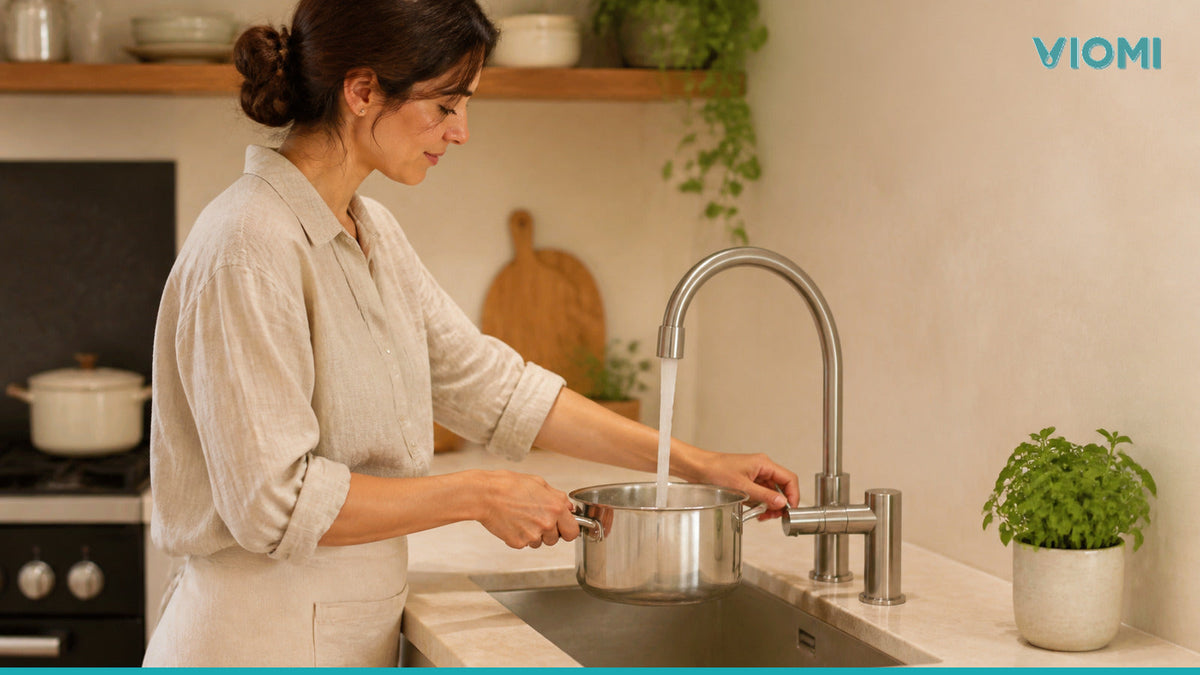
Cooking water has different requirements than drinking water, mainly around volume and heat. A filter that’s perfectly fine for topping off a glass can be too slow to fill a stockpot, and it may not touch the minerals that turn into limescale once that water hits a boil.
The filter formats that matter most for cooking water break down into four categories:
- Dedicated-faucet carbon systems like Viomi’s under-sink carbon filter, which deliver filtered water through their own tap instead of sharing flow with the main faucet, though without the hardness reduction an RO system provides
- Tankless under-sink RO systems from brands such as Viomi and Waterdrop, and newer iSpring models
- Pitchers from Viomi’s own Inno line, Brita, PUR, or ZeroWater, which still make sense for a kettle or a single pot of rice, but run out of practical speed once you’re filling anything bigger
- Traditional tank-based RO systems from brands such as APEC
Below is what actually separates a “cooking-ready” filter from one that’s only sized for drinking, how to read the flow-rate and TDS numbers that matter, and where Viomi’s RO and carbon systems fit depending on what’s driving the decision: speed, scale, or budget.
What Makes Cooking Water Different From Drinking Water
Drinking water is judged by the glass. Cooking water gets judged by the pot, and that changes three things.
Volume. A single cup of coffee or a water bottle refill is a few ounces. A pot of pasta water, a stockpot for soup, or a rice cooker batch is easily a gallon or more, and it needs to happen fast enough that dinner doesn’t wait on the filter. A format that’s fine for sipping can turn into a bottleneck when it’s asked to fill something that size.
Heat and scale. Heating water concentrates whatever is dissolved in it. Calcium and magnesium, the minerals responsible for water hardness, precipitate out as water heats, coating the inside of kettles, rice cookers, and pots as limescale. That layer acts like insulation, making appliances work harder and, over time, shortening their life.
Reducing those hardness minerals before the water ever reaches the burner, whether through reverse osmosis or an ion-exchange softener, is one of the most direct ways to meaningfully slow that buildup; standard carbon filtration reduces taste and chlorine but doesn’t touch dissolved minerals the way those methods do.
Absorption during cooking. Rice, pasta, beans, and other foods that simmer or soak can take on some of what’s dissolved in the cooking water along with it. Chlorine’s flavor and aroma, sometimes described as a faint chemical or “pool” note, can carry into the finished dish more noticeably than it would in a glass of cold water, though exactly how much of that gets absorbed depends on the specific substance, the food itself, and the cooking method, and isn’t reducible to a single fixed rate.
Boiling doesn’t solve any of this on its own. It inactivates disease-causing germs, including viruses, bacteria, and parasites, but it does nothing for lead, nitrates, chloramine, or general TDS, and because boiling evaporates water while leaving dissolved solids behind, it can actually leave a pot slightly more concentrated in some contaminants than it started, not less.
Three Things to Check Before Choosing a Filter for Cooking
Flow rate, not just filtration quality
Flow rate is usually published as GPD (gallons per day, a system’s rated daily output) or as ounces per minute at the tap. A basic kitchen faucet typically runs 1.5 to 2.2 GPM (roughly 190 to 280 oz/min) wide open, but that’s unfiltered water. Among filtered options, the gap between formats is large: a gravity pitcher processes water in batches of a few minutes each and holds well under a gallon at a time, while a modern tankless RO system can move roughly 53 to 89 ounces of filtered water per minute maximum, on demand.
A 6-quart stockpot holds about 1.5 gallons (roughly 192 oz).
TDS and hardness reduction, if scale is a concern
NSF/ANSI 58, the standard covering reverse osmosis systems, requires a minimum 75 percent reduction in total dissolved solids under its test protocol. Individual certified systems may publish higher reduction rates than that floor; check the specific model’s own performance data sheet rather than assuming a fixed number across the category.
Since calcium and magnesium hardness minerals are part of what a TDS reading measures, an RO system that’s reducing TDS is also reducing the minerals that cause limescale. Standard carbon filtration, including basic pitchers and faucet attachments, isn’t built to remove dissolved minerals and won’t meaningfully soften cooking water.
One thing worth checking before you shop, not after: most under-sink RO systems, including Viomi’s, aren’t designed to take genuinely hard incoming water straight into the membrane without some kind of pretreatment, typically a sediment prefilter and, in hard-water homes, a non-salt-based scale inhibitor or softener installed ahead of the unit. If limescale is the main reason you’re considering an RO system, it’s worth testing or looking up your home’s water hardness level now, since that can add equipment and cabinet space to the plan later.
Chlorine, lead, and taste-and-odor certification
Two certifications matter most here:
- NSF/ANSI 42 covers chlorine, taste, and odor reduction, the certification most relevant to keeping chlorine’s flavor out of soup, rice, and sauces.
- NSF/ANSI 53 covers health-related contaminants like lead.
Any filter format, from a $15 pitcher to an $800 RO system, can carry these certifications, but the specific contaminants covered vary by model, since a manufacturer only tests for what it chooses to certify. The certification category tells you the general class of contaminant being addressed, while the model’s own published certification list (not just the standard number) tells you exactly what it’s been tested to remove.
Filter Types Compared for Cooking
Dedicated-faucet under-sink carbon systems
Under-sink carbon systems built around a dedicated faucet offer real convenience: the filter lives under the sink and delivers water through its own tap, so it isn’t sharing flow with the main faucet the way a faucet-mounted attachment does, and it skips the batch-and-wait refill cycle of a pitcher (more on both formats below), though its filtration speed is still shaped by the cartridge’s media, remaining capacity, and incoming water pressure.
Viomi’s Under-Sink Water Filter is built this way: a 0.5-micron PP cotton and carbon rod cartridge certified to NSF/ANSI 372, 53, and 42, rated for 12 months or 8,000 gallons on municipal water, priced at $78.99.
It’s a practical, budget-friendly upgrade over a pitcher for a household that mainly wants chlorine, lead, and taste handled through its own dedicated faucet rather than sharing flow with the main tap. In everyday use, that means a steady stream at the dedicated tap rather than the batch-and-wait cycle of a pitcher, enough to fill a glass, a kettle, or a small saucepan without the multi-minute refill a gravity pitcher needs, even though Viomi doesn’t publish an exact oz/min figure for this model. It’s still a carbon-based system, though, so it doesn’t reduce hardness minerals; if limescale in kettles or rice cookers is part of what you’re trying to solve, that calls for an RO system instead (more below).

Tankless under-sink RO
This is where Viomi M1, Viomi V6 PRO, and Viomi V8 PRO sit, along with comparable systems from Waterdrop (the G3P800, rated at 800 GPD) and newer iSpring models. Instead of drawing from a tank like the traditional tank-based RO systems covered below, these systems filter water on demand at a continuous, published flow rate.
Waterdrop’s G3P800, for example, is NSF/ANSI 42, 53, 58, and 372 certified and priced at $849 as of this writing (with a lower member price listed on Waterdrop’s own site), backed by a 1-year warranty and the same 3:1 pure-to-drain ratio listed for the Viomi M1, Viomi V6 PRO, and Viomi V8 PRO models covered in this article. Waterdrop publishes an example of the G3P800 filling a 6 oz cup in 5 seconds, equivalent to roughly 72 oz/min; Waterdrop does not label that derived figure as a maximum flow rate. More on Viomi’s specific numbers, plus a full cost-of-ownership comparison, below.
Installing a tankless RO system also means planning for more than the unit’s price. Most systems in this category, Viomi’s and Waterdrop’s included, need a dedicated section of under-sink cabinet space, a nearby electrical outlet, and separate holes for the dedicated faucet and the wastewater line (see the Viomi M1 section below for exact specs). These systems are generally designed for DIY installation rather than a full plumbing job, but a kitchen without a spare faucet hole, without an outlet within reach of the cabinet, or with an already-crowded under-sink space may need extra work, or a plumber, before the system itself goes in.
APEC also sells a tankless model, the ROTL-A1000, and Waterdrop’s tankless lineup includes a lower-output G3P600 in addition to the G3P800 already mentioned. Comparing each Viomi model against the competitor model closest to it in output, rather than against whichever competitor model happens to be cheapest or most expensive, gives a fairer read on where the value actually sits:
| Output Tier | Viomi Model (Price) | Fill Time, 6-qt Stockpot | Drain Ratio | NSF/ANSI Certs | Closest Competitor (Price) | Fill Time, 6-qt Stockpot | Drain Ratio | NSF/ANSI Certs |
|---|---|---|---|---|---|---|---|---|
| ~600 GPD | Viomi V6 PRO ($379.99) | ~3.6 min (53 oz/min, spec-sheet max) | 3:1 | 42, 53, 58, 372 | Waterdrop G3P600 ($439 as of this writing; $539 list price) | ~3.5 min (based on Waterdrop’s own 6 oz/6.5-second example, not labeled a maximum) | 2:1 | 42, 58, 372 |
| ~800 GPD | Viomi V8 PRO ($479.99) | ~2.7 min (71 oz/min, spec-sheet max) | 3:1 | 42, 53, 58, 372 | Waterdrop G3P800 ($849 as of this writing) | ~2.7 min (based on Waterdrop’s own 6 oz/5-second example, not labeled a maximum) | 3:1 | 42, 53, 58, 372 |
| ~1000 GPD | Viomi M1 ($799.99) | ~2.2 min (84.5-89 oz/min, spec-sheet max) | 3:1 | 42, 58, 372 | APEC ROTL-A1000 ($599) | ~1.2 min (based on APEC’s own 16 oz/6-second example, not labeled a maximum) | 2:1 | 58, 372 |
A few things stand out once the models are lined up this way:
- Speed: At the 600 and 1000 GPD tiers, the competitor’s own published example computes out to a fill time close to or faster than Viomi’s, so speed alone doesn’t clearly favor either side.
- Drain ratio: At both of those tiers, Viomi’s model carries a 3:1 drain ratio (less wastewater per gallon of purified water produced) against the competitor’s 2:1.
- Certifications: The Viomi V6 PRO carries an NSF/ANSI 53 lead certification that the G3P600 doesn’t list, and the Viomi M1 carries an additional NSF/ANSI 42 chlorine/taste/odor certification that the ROTL-A1000 doesn’t list, at their respective output tiers.
- 800 GPD tier and filter costs: The Viomi V8 PRO and G3P800 are close to even on drain ratio and certifications, though the G3P800 runs roughly $370 more than the Viomi V8 PRO’s list price; at 600 GPD, Waterdrop’s three-cartridge set runs roughly $145/year against the Viomi V6 PRO’s roughly $105-110/year estimate covered below, while APEC’s ROTL-A1000 page doesn’t publish a bundled annual filter cost for a comparison at the 1000 GPD tier.
Pitchers
Viomi’s own Inno 13-Cup Water Filter Pitcher, along with Brita, PUR, and ZeroWater, all work on the same principle: gravity pulls water through a cartridge a batch at a time.
The Inno pitcher, for example, holds 13 cups (roughly 104 oz) and is NSF/ANSI 42 certified to reduce chlorine by up to 97.2 percent, which is enough for a kettle of tea or a couple of cups of rice. Filling a 6-quart stockpot (192 oz) means running that same pitcher through nearly two full cycles, which is a real limitation once the recipe calls for more than a pot or two of water.
ZeroWater is a notable exception on hardness: its 5-stage ion-exchange filter is designed to reduce dissolved solids, including calcium and magnesium, but that thorough filtration comes at the cost of speed, with a flow rate of around 6.5 oz/min, slower than most other pitcher filters on the market.
Faucet-mounted attachments
Brita and PUR both sell faucet-mount filters that clip onto the existing kitchen faucet and switch between filtered and unfiltered flow on demand. Flow rate varies by brand and model: Brita’s faucet filters are rated around 0.58 GPM and PUR’s around 0.52 GPM, both figures per each brand’s published product data sheet at 60 psi. Either way, that’s noticeably below a faucet’s unfiltered flow but a step up from pouring through a pitcher one batch at a time. These filters use standard carbon media, so they handle chlorine and taste well but don’t reduce hardness.
Traditional tank-based under-sink RO
Systems like APEC’s Ultimate/Essence series store filtered water in a small pressurized tank, typically 3 to 5 gallons, ahead of use. That tank delivers a strong initial burst of flow, but once it’s drawn down, the system has to refill it through the membrane at its normal, much slower production rate. For filling a big stockpot in the middle of active cooking, that refill lag is the main tradeoff of this format.
A few model-specific data points illustrate the range:
- 50 GPD ESSENCE: refills its tank in roughly 1.7 to 3 hours, per APEC’s own FAQ
- 90 GPD RO-90: refills its tank in roughly 2 to 3 hours, per APEC’s owner’s manual (exact time depends on household water pressure and temperature)
- ROES-100: priced at $239.95, with a 1:1 pure-to-drain ratio per its own product page
APEC’s tank-based systems generally list in the low-to-mid $200s to $300s depending on configuration, backed by a 1-year manufacturer’s warranty per APEC’s own warranty terms; wastewater ratios vary by specific model.
Countertop RO with tank
AquaTru’s Classic and Classic Smart countertop systems skip the plumbing connection entirely, filling a roughly 1-gallon reservoir and processing it in a batch that takes about 12 to 15 minutes to produce around 3 quarts (96 oz) of purified water. That’s a reasonable fit for drinking water in a rental or an apartment without under-sink access, but the batch cycle and modest per-cycle volume make it a slower option for cooking at real volume compared with a tankless under-sink system.
Whole-house (point-of-entry) systems
SpringWell and Culligan both sell whole-house softeners and filter/softener combo systems that treat hardness at the point where water enters the home, before it reaches any tap, so every pot of cooking water comes out already softened; see “Where Whole-House Systems Fit” below for how that compares with a kitchen-only solution.
Cooking-Water Fit at a Glance
| Filter Type / Brand | Flow for Cooking Volume | Reduces Hardness/Scale | Chlorine & Taste | Typical Price |
|---|---|---|---|---|
| Dedicated-faucet carbon (Viomi Under-Sink) | Delivers through its own dedicated faucet, no tank to refill (no published flow-rate spec) | No | Yes (NSF/ANSI 372, 53, 42) | ~$79 |
| Tankless RO (Viomi M1, Viomi V6 PRO/Viomi V8 PRO; Waterdrop G3P600/G3P800; APEC ROTL-A1000) | Fast and continuous; 600-1000 GPD across the models covered in this article. See the same-tier comparison table above for exact fill times, drain ratios, and certifications by model | Yes | Yes (all three Viomi models list NSF/ANSI 42; the Viomi V6 PRO and Viomi V8 PRO additionally list NSF/ANSI 53; certification list varies by model and competitor, see table above) | $380-$800 (varies by model and promotion) |
| Pitchers (Viomi Inno, Brita, PUR) | Slow; batch-limited, refills needed for a full pot | No | Yes (NSF/ANSI 42) | $15-$50 |
| Pitchers (ZeroWater) | Slow; ~6.5 oz/min, slower than most other pitchers | Yes | Yes | $25-$50 |
| Faucet attachments (Brita, PUR) | Moderate; ~0.52-0.58 GPM on demand, varies by brand | No | Yes (NSF/ANSI 42) | $20-$40 |
| Traditional tank RO (APEC Essence/Ultimate, older iSpring) | Strong burst, then slow refill (tank-limited) | Yes | Yes | $200-$400 |
| Countertop RO (AquaTru Classic/Classic Smart) | Slow; ~12-15 min per 3-quart batch | Yes | Yes | $400-$600 |
| Whole-house softener/filter (SpringWell, Culligan) | Treats every tap in the home, though still limited by the unit’s rated GPM, incoming pressure, and regeneration cycle | Yes (hardness) | Depends on model | $1,000+ |
Cost of Ownership Beyond the Purchase Price
The purchase price is only part of what a filter costs over a few years of use. RO systems in particular carry a membrane and one or more prefilters that need periodic replacement, plus a wastewater ratio that affects how much water goes down the drain for every gallon produced, so it’s worth comparing those figures alongside the sticker price.
| RO System | Filter Replacement (Frequency & Cost) | Pure-to-Drain Ratio | Warranty |
|---|---|---|---|
| Viomi M1 | RO filter rated up to 4 years, PCB prefilter up to 2 years; roughly $87.50/year at current listed filter prices | 3:1 | Conflicting on water.viomi.com: product spec lists a 1-year limited warranty; sitewide banner and warranty page state 2 years (unresolved; confirm with Viomi) |
| Viomi V6 PRO / Viomi V8 PRO | RO filter rated for up to 2 years, PCB prefilter for up to 1 year; actual filter life varies with local water quality and household consumption. The ~$105-$110 estimate assumes both filters reach their full time-rated lives. | 3:1 | Conflicting on water.viomi.com: product spec lists a 1-year limited warranty; sitewide banner and warranty page state 2 years (unresolved; confirm with Viomi) |
| Waterdrop G3P800 | Three cartridges rated 6, 12, and 24 months or 550, 1,100, and 2,200 gallons respectively, whichever comes first; roughly $160/year combined at current listed filter prices, based on the time cycles | 3:1 | 1-year |
| APEC Essence/Ultimate (tank-based) | Standard-sized cartridges, typically swapped every 6-12 months for the prefilters and every 2-4 years for the RO membrane and post-carbon filter, depending on water quality and usage; APEC’s product pages don’t list a single bundled annual filter cost | 1:1 (per its ROES-100 model; varies by configuration) | 1-year |
| AquaTru Classic (countertop) | Three-filter set rated 6, 12, and 24 months or 600, 600, and 1,200 gallons respectively, whichever comes first; AquaTru’s page doesn’t list a bundled annual filter cost | Approximately 3:1 equivalent based on AquaTru’s stated 75% efficiency; concentrated wastewater collects in the system’s tank rather than draining continuously, and must be discarded manually | 1-year |
Simpler carbon-only systems are easier to budget for since there’s just one cartridge on one schedule, with no membrane or wastewater ratio to factor in. Viomi’s under-sink carbon filter, for instance, uses a single $29.99 cartridge rated for 12 months or 8,000 gallons, whichever comes first, working out to roughly $30 a year based on the time cycle. On warranty, water.viomi.com shows the same conflict noted for Viomi’s RO line above: the product’s own specification lists a 1-year limited warranty, while sitewide messaging elsewhere on the site states 2 years; confirm current coverage with Viomi before buying.
Where Viomi’s RO Line Fits for Cooking
Viomi’s tankless RO systems are built around the same idea that matters most for cooking: continuous flow that doesn’t slow down when a recipe needs a full pot at once.
As noted above, Viomi’s own FAQ says its RO units aren’t recommended for genuinely hard feed water without that prefilter and softener step ahead of the unit, worth budgeting for upfront if that applies to your home.
The Viomi M1 ($799.99) is rated at 1000 GPD with a maximum flow rate of 84.5 to 89 oz/min, backed by 9-stage filtration through a 0.0001-micron membrane. It’s NSF/ANSI 58 certified for TDS reduction (up to 90.56 percent on its own published data), NSF/ANSI 42 for chlorine, taste, and odor, and NSF/ANSI 372 for lead-free materials. At that flow rate, filling a 6-quart stockpot takes a little over two minutes instead of running multiple pitcher cycles.
The system also remineralizes the water afterward, adding back calcium, magnesium, potassium, sodium, strontium, and metasilicic acid (H₂SiO₃), which mainly shows up as a fuller taste and mouthfeel in tea, coffee, and other beverages made with the water rather than any noticeable difference in how rice cooks or a pot of soup tastes.
On installation, the Viomi M1 requires:
- A footprint of 17.1 x 6.4 x 15.9 inches, with 2 to 3.9 inches of rear clearance for its tubing connections
- Its own dedicated electrical outlet, one that Viomi’s installation notes say can’t be shared with a garbage disposer’s switched outlet
- A sink or countertop hole for the smart faucet
- A separate drain-pipe hole for the wastewater line
Viomi’s product page gives two different installation estimates: about 20 minutes in the main product description and around 30 minutes in the FAQ section, so a DIY install can reasonably run anywhere in that range.

The Viomi V8 PRO (800 GPD, priced as of this writing at $479.99) and Viomi V6 PRO (600 GPD, $379.99) are both 9-stage tankless RO systems certified to NSF/ANSI 42, 53, 58, and 372, and both list PFAS (PFOS/PFOA) and lead reduction on their respective product pages. The two models don’t differ in which contaminants they’re built to reduce; the difference between them is capacity and flow rate, with Viomi’s published spec sheet listing a maximum flow rate of 53 oz/min for the Viomi V6 PRO and 71 oz/min for the Viomi V8 PRO, which mainly matters if multiple taps or an ice maker could draw from the system at once.
Both measure close to the footprint of a large shoebox, at 16.3 x 5 x 12.8 inches, and share the same installation requirements as described above.
Viomi’s product pages also include a separate internal-lab example for each model: an average flow rate of 68 oz/min for the Viomi V8 PRO (below its 71 oz/min spec-sheet maximum) and 54 oz/min for the Viomi V6 PRO (slightly above its 53 oz/min spec-sheet maximum). That second figure is a minor inconsistency between two sections of Viomi’s own published materials for the Viomi V6 PRO that hasn’t been reconciled; for shopping purposes, the more conservative spec-sheet numbers used in the table above are the ones to plan around. Since pricing changes with promotions, check water.viomi.com directly for current pricing before buying.

Because all three systems are RO-based rather than carbon-only, they’re also reducing the calcium and magnesium responsible for limescale, which matters most in hard-water areas where kettles, rice cookers, and stockpots build up mineral deposits over time. For a household mainly looking to handle chlorine and lead without dealing with scale at all, Viomi’s under-sink carbon filter covers that at a lower price point; for households in hard-water regions where scale is a real, ongoing problem, and who’ve already budgeted for the pretreatment step noted above if their water is genuinely hard, the RO line is the format built to address it.

Where Whole-House Systems Fit
If hard water is showing up everywhere, not just as scale on the stove but as spots on dishes, dry skin after showers, or reduced water heater efficiency, a whole-house softener from a brand like SpringWell or Culligan addresses the source rather than just the kitchen tap. That’s a bigger investment and typically a professional install, but it’s the option built for treating hardness at every point of use in the home, cooking included. Since a softener alone isn’t designed to reduce contaminants like lead or PFAS, many households pair one with a point-of-use RO or carbon system in the kitchen for that layer of coverage.
FAQ
Do I really need to filter water before cooking rice or pasta? It’s not a food-safety requirement in most U.S. municipal water systems, but it can affect the outcome. Rice and pasta absorb some cooking water. Certain dissolved substances, such as chlorine’s flavor or hardness minerals, may therefore transfer into the food, but the amount varies by substance, food, cooking method, and whether the remaining water is absorbed or discarded, so it isn’t reducible to a single fixed rate.
Does boiling water make it safe to cook with? Boiling inactivates disease-causing germs, including viruses, bacteria, and parasites, but that’s the extent of it. As noted above, boiling doesn’t remove lead, nitrates, chloramine, or general dissolved solids, and can leave them slightly more concentrated rather than less.
Will a water filter stop limescale in my kettle or rice cooker? An RO system can substantially reduce and slow limescale buildup by removing most of the calcium and magnesium in the feed water, though the exact reduction varies by model and it doesn’t guarantee zero scale under every water condition. Remineralizing RO systems, including Viomi’s M1, add a portion of those same minerals back into the water afterward for taste, so some hardness returns to the finished water even after filtration. A standard carbon filter won’t meaningfully affect scale either way, since it isn’t built to remove dissolved minerals. Genuinely hard incoming water may still need a prefilter or softener ahead of an RO unit for best results.
What’s the fastest way to filter a full pot of water for cooking? A high-flow tankless under-sink RO system, in most cases, since it filters on demand at a published GPD/oz-per-minute rate with no tank to wait on. The exact fill time still depends on the specific model’s flow rate, and some faucet-mount carbon attachments can post similar or higher oz/min numbers, just without touching hardness. Tank-based and countertop RO systems are limited by their refill or batch cycle instead.
Is RO water safe to cook with, or do I need to add minerals back? RO water is safe to cook with. Because RO removes most dissolved minerals along with contaminants, some people prefer the taste of remineralized water, which is why systems like Viomi’s M1 add minerals back in after filtration. It’s a taste preference rather than a safety issue either way.
Is a pitcher good enough for cooking, or do I need something bigger? A pitcher works fine for a kettle of tea or a single pot of rice; beyond that, its batch size and gravity-drip speed become the limiting factor. A dedicated-faucet carbon system fixes the convenience side (water on demand instead of a batch refill) and, depending on the model, can post a fill rate similar to or faster than a pitcher’s drip speed, though it won’t address hardness minerals. A tankless under-sink RO system resolves both the speed limit and the hardness question for filling a large stockpot, at the cost of a higher upfront price and installation.
Which Option Fits Your Kitchen
As a starting point: a household cooking at volume in a hard-water area is generally best served by a tankless RO system like the Viomi V6 PRO or Viomi V8 PRO, provided the incoming water isn’t hard enough to need a prefilter or softener ahead of the unit first, while a household mainly bothered by chlorine taste on a tighter budget is better served by the under-sink carbon filter or a quality pitcher. The full breakdown below covers the scenarios in between.
- Cooking occasionally, in small batches (tea, a pot of rice): a pitcher from Viomi’s Inno line, Brita, PUR, or ZeroWater covers it without any installation.
- Wanting filtered water from a dedicated faucet on a sub-$80 budget, when hardness reduction isn’t required: Viomi’s dedicated-faucet under-sink carbon filter delivers filtered water through its own faucet, without sharing flow with the main tap.
- Cooking at volume in a hard-water area, or wanting lead/PFAS reduction alongside scale control: a tankless under-sink RO system, such as Viomi’s V6 PRO or Viomi V8 PRO, or another specific model from Waterdrop or APEC (verify that model’s own certification list), handles both the flow rate and the hardness minerals in one system, as long as your water’s hardness level doesn’t call for a prefilter or softener ahead of the unit.
- Wanting RO-level filtration plus remineralized water and a smart display: Viomi’s M1 adds a mineralization stage and live TDS readout on top of the same flow-rate advantage.
- Dealing with hard water throughout the whole house, not just the kitchen: a whole-house softener from SpringWell or Culligan treats every tap, typically paired with a point-of-use system for contaminant reduction.
Share:
Which Water Filter Brands Do Californians Consider for Tap Water Safety?
Which Water Filter Brands Should Orlando Residents Consider?