

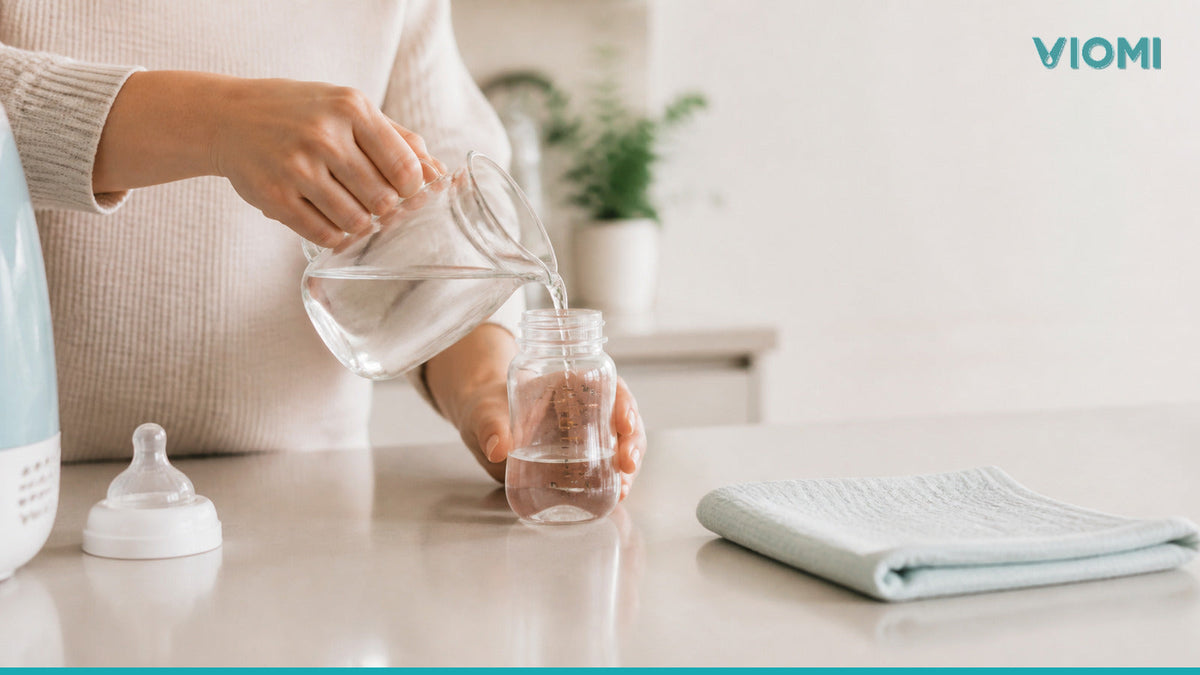
Neither the CDC nor the American Academy of Pediatrics (AAP) names a specific water filter brand for mixing infant formula. What both organizations do provide is guidance on three things that matter in the water itself: lead, nitrate (mainly a well-water issue), and fluoride. Once you know which of those apply to your water, the brand question becomes straightforward: look for a filter with a real NSF/ANSI certification tied to that specific contaminant, not just a general “purifier” label.
Nothing here is medical advice. For anything specific to your baby’s health, well-water results, or local water quality, talk to your pediatrician or your local health department.
Where to Start, Based on Your Water Source
Before working through the contaminant-by-contaminant detail below, the fastest way to figure out what actually applies to you is to start with your water source and your baby’s specific situation:
-
Public or municipal water: Start by pulling up your utility’s most recent water quality report and checking for any flagged issues.
- AAP guidance says tap water is fine for formula unless there’s a known contamination issue with your local water source, that’s the actual test, not a specific ppb cutoff (the EPA’s 15 ppb lead action level is the threshold that triggers utility action, not a safety line for what’s coming out of any one household’s tap).
- If your home has older plumbing or lead service lines, take it a step further: use cold water only, and either look for a filter with a named NSF/ANSI 53 lead-reduction certification or have your own tap tested directly.
- Private well water: Test for nitrate and coliform bacteria first, through a state-certified lab rather than an at-home kit, before making any filter decision. This one step matters more than any brand comparison, since wells aren’t monitored the way public systems are.
- Baby younger than 2 months, born prematurely, or with a weakened immune system: Follow the boil-then-cool routine covered in the next section for powdered formula, regardless of your water source. Boiling the water and letting it cool for about five minutes, down to roughly 158°F (70°C), before mixing is what kills germs that can be present in the powder itself, not something in the water, so a filter doesn’t replace this step.
- A test result or local health advisory says the water is unsafe for formula: Switch to bottled water or ready-to-feed formula right away, and treat the filter or system decision as a separate step to sort out afterward, not something to solve in the moment.
What CDC and AAP Guidance Actually Says About Formula Water
Tap water is generally fine. HealthyChildren.org, the AAP’s parent-facing site, states that unless there’s a known contamination issue with your local water source, tap water can be used to prepare formula. Boiling is not a routine requirement for most families.
Boiling is for specific situations, and it doesn’t help with chemicals. The AAP guidance says boiled water should be used for infants younger than 2 months, babies born prematurely, and those with a weakened immune system, because powdered formula itself isn’t sterile and can carry germs like Cronobacter. These steps apply to standard powdered formula prepared at the exact water-to-powder ratio printed on the label.
Specialty or metabolic formulas may come with different mixing or temperature instructions from a pediatrician or metabolic specialist, or printed directly on that formula’s own label, and those instructions take precedence over the routine below.
When the standard routine applies, current CDC/AAP guidance for these higher-risk infants breaks down into these steps:
- Measure the exact amount of water into the bottle first, then add the exact amount of powder. Measure precisely rather than adjusting the ratio.
- Bring the water to a boil, then let it cool for about five minutes, until it reaches roughly 158°F (70°C), and mix it with the powder at that temperature; this is the temperature CDC/WHO guidance points to for reliably killing Cronobacter and other germs that can be present in the powder, so a full cooldown before mixing defeats the purpose.
- After mixing, cool the capped bottle back down to body temperature before feeding. Holding it under cool running water or setting it in an ice bath both work; the cooling water itself should never get into the bottle or touch the nipple.
- Test a few drops on the inside of your wrist first; it should feel warm, not hot.
Boiling doesn’t remove lead, nitrate, or fluoride, and it can actually concentrate lead if water is boiled too long, since some of the water evaporates while the lead stays behind. HealthyChildren.org’s separate lead-in-tap-water guidance also advises against using water from the hot tap to prepare formula, since hot water dissolves more lead out of household plumbing than cold water does.
Lead has no confirmed safe level, and infants are more exposed relative to their size. The EPA’s action level for lead in tap water from public systems is 15 parts per billion (ppb), the threshold that triggers utility action, not a declaration of safety below that line. HealthyChildren.org’s lead guidance notes that formula-fed infants drink a large amount of water relative to their body weight, which raises their relative exposure compared to an adult drinking the same water. Separately, the AAP’s own policy statement on childhood lead toxicity sets a much stricter benchmark of 1 ppb for water fountains in schools, reflecting the position that no blood lead level in children has been shown to be without risk. That 1 ppb figure is a school-fountain recommendation, not a safety threshold for formula water specifically, but it’s a useful reference point for how conservative pediatric guidance gets on lead.
If a household’s tap water tests above the EPA action level, CDC guidance (cited in the same HealthyChildren.org piece) recommends bottled water or a filter certified by an independent testing organization to reduce lead, for cooking, drinking, and formula preparation specifically. The guidance is also explicit that not all filters reduce lead, so checking the certification, not just the word “filter,” matters here.
Nitrate is primarily a private-well concern, and infants under six months are the highest-risk group. The EPA’s maximum contaminant level (MCL) for nitrate in drinking water is 10 mg/L (measured as nitrogen), a limit set specifically because of the risk of infant methemoglobinemia, sometimes called “blue baby syndrome,” a condition where nitrate interferes with how blood carries oxygen. Nitrate in well water most often comes from agricultural runoff, fertilizer, or nearby septic systems, and private wells fall outside the EPA’s regulatory oversight of public water systems, which is why the testing responsibility falls on the household rather than a utility. The AAP recommends testing well water for nitrate, and the CDC identifies infants under six months fed formula mixed with high-nitrate well water as the group at highest risk. Critically, boiling does not help here either, for the same reason described above: it concentrates nitrate rather than removing it, since water evaporates while nitrate stays behind.
At fluoride levels typically found in fluoridated community water, this is a dental, not acute, concern tied to repeated exposure. The CDC’s guidance on infant formula and fluoride notes that formula made with fluoridated water, if it’s a baby’s primary food source over time, can raise the chance of mild dental fluorosis, cosmetic white spots or streaking on developing teeth. The CDC’s practical suggestion is that parents concerned about this can use low-fluoride bottled water (labeled deionized, purified, demineralized, or distilled) some of the time when mixing formula. Ready-to-feed liquid formula, which doesn’t require added water, contains little fluoride and isn’t part of this concern.
That’s a separate issue from naturally high-fluoride well water, where the EPA’s Primary MCL of 4.0 mg/L (set due to skeletal fluorosis risk, not just cosmetic concerns) and Secondary MCL of 2.0 mg/L can apply; water testing above those levels calls for its own follow-up with a local health department rather than the routine dental-fluorosis guidance above.
Put together: lead has an EPA action level of 15 ppb (the threshold that triggers utility action, not a safety line for any one tap), nitrate has an EPA MCL of 10 mg/L (an enforceable safety limit), fluoride is a longer-term dietary concern, and none of the three has anything to do with germs, which is what boiling actually addresses.
What to Look for in a Filter for Each Contaminant
Lead: NSF/ANSI 53 is the certification standard used for lead reduction claims (also called “health effects” certification, distinct from NSF/ANSI 42’s taste-and-odor scope), and NSF/ANSI 58 is the standard for RO systems. Both standards cover a menu of optional contaminant claims, so passing 53 or 58 doesn’t automatically mean a specific model was tested for lead. The detail to check is whether “Lead Reduction” is named explicitly for that exact model, either in the NSF/WQA/IAPMO public database or on the product’s own certificate.
Nitrate: This one is more limited. Standard activated carbon works by adsorbing organic compounds and chlorine onto its surface, which isn’t the mechanism needed to pull a dissolved ion like nitrate out of water, so the kind of carbon found in most pitchers and fridge filters isn’t built to remove it, similar to the fluoride problem covered in Viomi’s separate guide to fluoride-removal filters. Reverse osmosis, tested to NSF/ANSI 58’s nitrate reduction protocol, and certain ion-exchange or specialty whole-house systems are the main options with a real track record here. If your water comes from a private well, make nitrate and coliform testing a priority; see the “If You’re on Well Water” section below for why wells need this extra attention.
Fluoride: As covered in more depth in the fluoride-specific guide linked above, reverse osmosis, distillation, and activated alumina or specialty adsorptive media are the three technologies with documented fluoride reduction. Standard carbon filters largely let fluoride pass through unchanged.
The practical upshot: if lead is your main concern, both certified carbon and RO systems are options. If nitrate or fluoride are on your list too, especially if you’re on well water, RO (or one of the few specialty non-RO options built specifically for that contaminant) is the more complete route, since a properly certified RO system covering all three can address them in one system.
Water Filter Brands and What They Document for Lead, Nitrate, and Fluoride
The table below focuses specifically on documentation for these three contaminants, not a filter’s overall contaminant list. A named NSF/ANSI certification or an independent lab test with a specific percentage carries more weight than a brand simply listing a contaminant on a marketing page with no test data behind it.
This table (and the sections after it) is careful to distinguish two different kinds of evidence, and the wording below is used consistently for both:
- “Certified by [WQA / IAPMO R&T / NSF International]” means an independent certifying body reviewed that exact model and contaminant claim, and it’s searchable in that certifier’s own public database or performance data sheet. This is the case for AquaTru, APEC, iSpring, and Brita/PUR below.
- “Per [Brand]’s product page” or “[Brand] states” means an outside lab ran the test, but the brand itself is the one publishing the result, not a certifying body’s database. This is the case for all three Viomi entries and for Waterdrop’s lead figure below.
Neither kind of evidence is worthless, but they’re not interchangeable, and that distinction holds throughout this table, the Viomi-specific section after it, and the FAQ.
| Brand (model) | Format | Lead | Nitrate | Fluoride | Certifications |
|---|---|---|---|---|---|
| Viomi (Viomi V6 PRO / Viomi V8 PRO) | Tankless under-sink RO | SGS-tested >99.87% (start-up only; product water <0.0002 mg/L, well under NSF/ANSI 53’s 0.005 mg/L cap) | SGS-tested 99.63%/98.31% (0 L), 92.11%/89.83% (7,300 L, end of rated filter life); product water stays under the EPA’s 10 mg/L limit at both points | SGS-tested >99.94% (0 L), 99.40%/97.91% (7,300 L, end of rated filter life) | Per Viomi’s product page: certified to NSF/ANSI 42, 53, and 58 performance standards, plus NSF/ANSI 372 lead-free material certification, based on SGS testing (manufacturer-reported, not a listing in the NSF/WQA/IAPMO public database) |
| Viomi M1 | Tankless under-sink RO | SGS-tested >99.87% (start-up); no NSF/ANSI 53 lead-reduction certification on this model | Not listed on the product’s official contaminant page | Listed among reducible contaminants; no model-specific percentage published | Per Viomi’s product page: certified to NSF/ANSI 42 (taste/odor/chlorine), 58 (TDS reduction), and 372 (lead-free material compliance, not a contaminant-reduction claim); manufacturer-reported, not a listing in the NSF/WQA/IAPMO public database, and the page doesn’t name the certifying lab |
| Viomi (entry-level under-sink carbon filter) | Under-sink carbon, 0.5 micron | Viomi states it was third-party tested to NSF/ANSI 53 and markets it for lead reduction; a model-specific public Lead Reduction listing wasn’t independently verified | Not marketed for nitrate (standard carbon doesn’t target it) | Not marketed for fluoride | Per Viomi’s product page: certified to NSF/ANSI 42, 53, and 372; manufacturer-reported, not a listing in the NSF/WQA/IAPMO public database for this specific model |
| APEC (RO-90) | Under-sink RO | WQA-certified lead reduction | Listed as a general RO capability; not a separately named WQA-certified claim on the current product page | WQA-certified fluoride reduction | WQA Gold Seal (NSF/ANSI 58 protocol) |
| iSpring (RCC7AK-BLK / RCC7AK-BN) | Under-sink RO | NSF/ANSI 58-certified lead reduction (base RCC7AK model without this suffix is TDS-only) | No nitrate-specific figure identified in current published specs | NSF/ANSI 58-certified fluoride reduction (same suffix models) | NSF/ANSI 58 |
| Waterdrop (G3P800) | Tankless under-sink RO | SGS-tested reduction; not listed as an IAPMO/NSF-certified lead-reduction claim on the current product page | Reduced as part of general RO/TDS performance; not a separately named NSF certification | Listed alongside PFAS and heavy metals | NSF/ANSI 42, 53, 58, 372 |
| AquaTru (Classic) | Countertop RO | IAPMO-certified lead reduction under NSF/ANSI 58 | IAPMO-certified nitrate/nitrite reduction under NSF/ANSI 58, part of ~83-contaminant claim | IAPMO-certified fluoride reduction under NSF/ANSI 58 | IAPMO R&T to NSF/ANSI 42, 53, 58, 401, 372 |
| Berkey (Black Berkey elements)* | Gravity | Brand-commissioned lab report claims at least 99.0% reduction over a 200-gallon test (2016); not NSF/IAPMO/WQA certified | No certified nitrate-reduction claim identified for standard elements; a system specifically certified for nitrate, such as an appropriate RO or anion-exchange system, would be needed separately | Not removed by standard elements; requires separate PF-2 add-on element | No NSF/ANSI certification on Black Berkey elements themselves |
| Brita (Elite) / PUR (PLUS, filter PPF951K) | Pitcher | Certified to NSF/ANSI 53 for lead reduction: Brita Elite filter OB06 (by IAPMO R&T and WQA); PUR PLUS filter PPF951K (by IAPMO R&T) | Not marketed or certified for nitrate | Not marketed or effective for fluoride | NSF/ANSI 42 (taste/chlorine), 53, and 401 for the Elite (OB06) and PLUS (PPF951K) filters specifically, not a blanket claim across every Brita or PUR product; Brita Elite is certified by WQA, PUR PLUS by IAPMO R&T, different certifying bodies for the two brands |
*Black Berkey elements have faced EPA regulatory scrutiny, including Stop-Sale/Use/Removal Orders issued in 2022-2023 tied to their silver content and pesticide-device registration requirements under FIFRA; Berkey’s manufacturer (New Millennium Concepts, Ltd.) challenged the EPA action in court, and the Fifth Circuit affirmed the dismissal of that challenge in August 2024, leaving the EPA action in place. As of mid-2026, Berkey’s own site lists the elements as out of stock or having limited availability and directs buyers to its authorized dealer network, so the figures above reflect the manufacturer’s older published testing, not a guarantee tied to a currently purchasable product.
Prices and specific promotions shift, so treat this table as a technology and documentation comparison rather than a buying guide with fixed prices; check each brand’s current site for that.
Where Viomi’s Systems Fit

Viomi’s V6 PRO ($379.99) and Viomi V8 PRO ($479.99) are the two Viomi models with the most directly relevant documentation for this topic. Both are tankless under-sink RO systems, independently tested by SGS-CSTC to NSF/ANSI 58 and 53 protocols. Per Viomi’s product page, both models are also certified to NSF/ANSI 42, 53, and 58 performance standards plus NSF/ANSI 372 for lead-free material, a manufacturer-reported claim rather than a listing you can look up yourself in the NSF/WQA/IAPMO public database.
The percentages below are the independent SGS lab data behind that claim: one report covers nitrate and fluoride at 0 liters (brand-new) and again at 7,300 liters (the filter’s rated end-of-life point), and a separate report covers lead at start-up only.
| Contaminant | Viomi V6 PRO (0 L) | Viomi V6 PRO (7,300 L) | Viomi V8 PRO (0 L) | Viomi V8 PRO (7,300 L) | Notes |
|---|---|---|---|---|---|
| Lead | >99.87% | Not tested at this point | >99.87% | Not tested at this point | Start-up only; product water <0.0002 mg/L (0.2 ppb), well under the NSF/ANSI 53 maximum of 0.005 mg/L. There’s no separate lead test at 7,300 liters, so this shouldn’t be read as an end-of-life result. |
| Nitrate | 99.63% | 92.11% | 98.31% | 89.83% | 7,300 L represents the end of the filter’s rated service life. Even at the lower end-of-life figure, product water stayed under roughly 3 mg/L, comfortably below the EPA’s 10 mg/L limit. |
| Fluoride | >99.94% | 99.40% | >99.94% | 97.91% | 7,300 L represents the end of the filter’s rated service life. |
Note that the 99.87% lead-reduction figure above is a different metric from the up-to-96.9% “heavy metal reduction rate” some Viomi product pages list, which is a combined figure across multiple heavy metals rather than lead alone. The two numbers describe different things and shouldn’t be compared directly.

Having independently tested lead, nitrate, and fluoride data at all, even across two separate reports, is a useful shortcut if you’re comparing systems and don’t want to track down three separate certifications for three separate contaminants. It’s a particularly relevant match for households on well water, since nitrate is where the well-water testing recommendation above is aimed, assuming the water has already been tested safe for bacteria and falls within the system’s rated feed-water hardness. Viomi’s own FAQ for the Viomi V6 PRO notes the RO system isn’t recommended for hard water as-is; well water that tests hard typically needs a prefilter and a non-salt-based softener or scale inhibitor installed ahead of the unit, so check your well water’s hardness alongside nitrate and bacteria before installing.

Viomi’s M1 ($799.99) is the brand’s higher-end tankless RO system, with an independently tested lead reduction above 99.87%, but nitrate isn’t part of its published contaminant list the way it is for the Viomi V6 PRO and Viomi V8 PRO lineup. For a family whose top concern is nitrate, the Viomi V6 PRO or Viomi V8 PRO remains the better-documented match. The Viomi M1’s remineralization stage and smart touchscreen faucet are worth considering for other reasons, but they don’t add to its lead, nitrate, or fluoride documentation.

For a lower-cost entry point, Viomi also sells a $78.99 under-sink carbon filter. Viomi states it was independently tested to NSF/ANSI 53 and markets it to reduce lead alongside chlorine, taste, and odor. As with any carbon filter, it’s worth checking the NSF/WQA/IAPMO public database yourself for a model-specific Lead Reduction listing before treating lead as fully addressed, the same check recommended in the section above. If nitrate or fluoride are also on your list, an RO system is the better fit, since carbon filtration by itself isn’t built to reduce either one.
If You’re on Well Water
Private wells aren’t regulated by the EPA the way public water systems are, which puts the testing responsibility on the household rather than a utility. If you’re mixing formula with well water, a few extra steps apply on top of everything above:
- Make nitrate testing a regular habit, not a one-time check. The AAP recommends annual testing of private well water for nitrate and coliform bacteria, noting that households may need to test more often when a new infant or a child under one year is in the home. Use a state-certified laboratory for the test rather than relying on an at-home kit alone.
-
Test for lead and bacteria too, since private wells aren’t subject to EPA’s Lead and Copper Rule the way municipal systems are.
- Coliform bacteria contamination is an important private-well risk, and ordinary carbon filters don’t reliably disinfect water, so a positive bacteria result is usually handled with a well inspection and, if needed, disinfection, not filtration alone.
- Until your local health department or a qualified well professional confirms the problem is resolved and a follow-up test comes back clear, don’t use that well water to mix formula; use bottled water or ready-to-feed formula in the meantime.
- Keep in mind that if the infant is in one of the higher-risk groups described above, switching to ordinary bottled water doesn’t replace the hot-water preparation step for powdered formula; ready-to-feed formula, which needs no added water, sidesteps the issue entirely.
- Don’t rely on boiling for nitrate. As covered above, boiling concentrates nitrate rather than removing it, the opposite of what you’d want if levels come back elevated.
-
If nitrate comes back above 10 mg/L as nitrogen, don’t use that well water to mix formula. Switch to a confirmed-safe alternative such as bottled water, a public water source, or ready-to-feed formula, and contact your local health department.
- Reverse osmosis is the technology with the clearest documented nitrate reduction among home filtration options (standard carbon pitchers won’t help).
- If you treat the water yourself, have it retested before using it for formula again, and keep testing on whatever schedule your certified lab or local health department recommends going forward.
- Nitrate reduction depends on the system being maintained and its membrane and filter cartridges replaced on schedule, not just installed once.
FAQ
Does the CDC or AAP recommend a specific water filter brand for baby formula? No. Neither organization names a brand. Their guidance focuses on which contaminants matter (lead, nitrate for well water, and fluoride with repeated exposure) and recommends checking that any filter used carries an independent certification for the specific contaminant in question, rather than assuming a general “water filter” label covers it.
Do I need to boil filtered water before using it for formula? That depends on your baby’s age and health, whether your water source is confirmed safe, and whether a boil-water notice is currently in effect, not simply on whether the water passed through a filter. AAP guidance calls for boiled water specifically for infants younger than 2 months, babies born prematurely, and those with a weakened immune system, to address microbes; a filter doesn’t change that recommendation, since filtration and boiling address different types of contamination. If one of those situations applies to you, follow the boil-cool-mix-cool routine detailed above and test the bottle on your wrist before feeding. If your local utility issues a boil-water notice for any reason, follow your local health department’s specific instructions for that event instead, since they may call for longer boiling times or different precautions.
Is distilled or RO water missing minerals my baby needs? Powdered and concentrated infant formula are formulated to be nutritionally complete once mixed with water, so the water itself isn’t expected to supply minerals for routine feeding. This is why low-fluoride bottled water labeled distilled, deionized, purified, or demineralized is one of the CDC’s suggested options for occasional use. That guidance is framed around occasional, not exclusive or long-term, use, and it doesn’t specifically address every specialty or metabolic formula on the market. If you’re considering distilled or RO water as your baby’s sole water source over an extended period, or your baby is on a specialty or metabolic formula, check with your pediatrician first.
Does reverse osmosis remove 100% of lead, nitrate, and fluoride? Do not assume 100% removal from any filter, including RO. For a given contaminant, this only applies where that specific model has an explicit, documented reduction claim for it, not RO systems as a category. As explained in the “Water Filter Brands” section above, the table mixes independent certifications and brand-reported lab tests; both are meaningful evidence for the contaminants actually tested, but neither is a guarantee that every possible contaminant in your specific water, or every RO model on the market, has been addressed.
My city water already meets the EPA’s nitrate MCL and lead action level. Do I still need a filter? That’s a judgment call, not a requirement, and nitrate and lead are checked in different ways.
Nitrate monitoring: Nitrate compliance monitoring is generally conducted at each entry point to the distribution system after treatment, since nitrate levels usually don’t change much between there and the tap under normal conditions. That’s not an absolute rule, since certain distribution-system conditions can raise nitrate levels somewhat between the treatment plant and the tap, which is why utilities monitor for it rather than assuming it never happens.
Lead monitoring: Lead works differently. EPA’s Lead and Copper Rule requires utilities to sample water at a set of higher-risk customer taps rather than the treatment plant, and the 15 ppb action level is only exceeded if more than 10% of those sampled taps come back above it (the 90th percentile of that specific sample set). Staying under that threshold means the action level wasn’t exceeded, not that the utility has satisfied every other Lead and Copper Rule obligation, such as monitoring frequency, corrosion control, or service line replacement. It also doesn’t guarantee every individual tap is lead-free, especially in an older home whose plumbing wasn’t part of the sampled group.
If you’re unsure, contact your water utility or a state-certified laboratory to test your specific tap before deciding whether filtration adds value.
How do I check whether a specific filter model actually reduces lead or nitrate, not just chlorine and taste? Look up the exact model number in the NSF, WQA, or IAPMO public certification database for a claim named specifically for that contaminant, as described in the “What to Look for” section above. A brand’s own spec sheet or lab report is manufacturer-reported evidence, not the same as an independent database listing, so weigh it accordingly rather than treating the two as equivalent proof.
The Bottom Line
The most useful thing CDC and AAP guidance gives parents isn’t a brand name, it’s a short, specific list: check lead if you’re worried about your plumbing or an older home, test for nitrate if you’re on a well, and know that fluoride is a long-term dental consideration tied to how much of your baby’s diet comes from formula mixed with fluoridated water. From there, the filter question is about matching technology to contaminant. Reverse osmosis systems with independently tested, contaminant-specific data, such as Viomi’s V6 PRO and Viomi V8 PRO for lead, nitrate, and fluoride together, or a certified carbon filter if lead alone is the concern, are the stronger picks; either a lab report or a public-database certification (see the FAQ above for how those two differ) beats a marketing claim you have to take on faith. Whichever brand you land on, confirm the certification against the specific model and contaminant before you buy, and check with your pediatrician if you have questions specific to your baby’s health or your household’s water test results.
Share:
Which Water Filter Brands Offer Fluoride-Removal Products?
Which Water Filter Brands Should Orlando Residents Consider?