

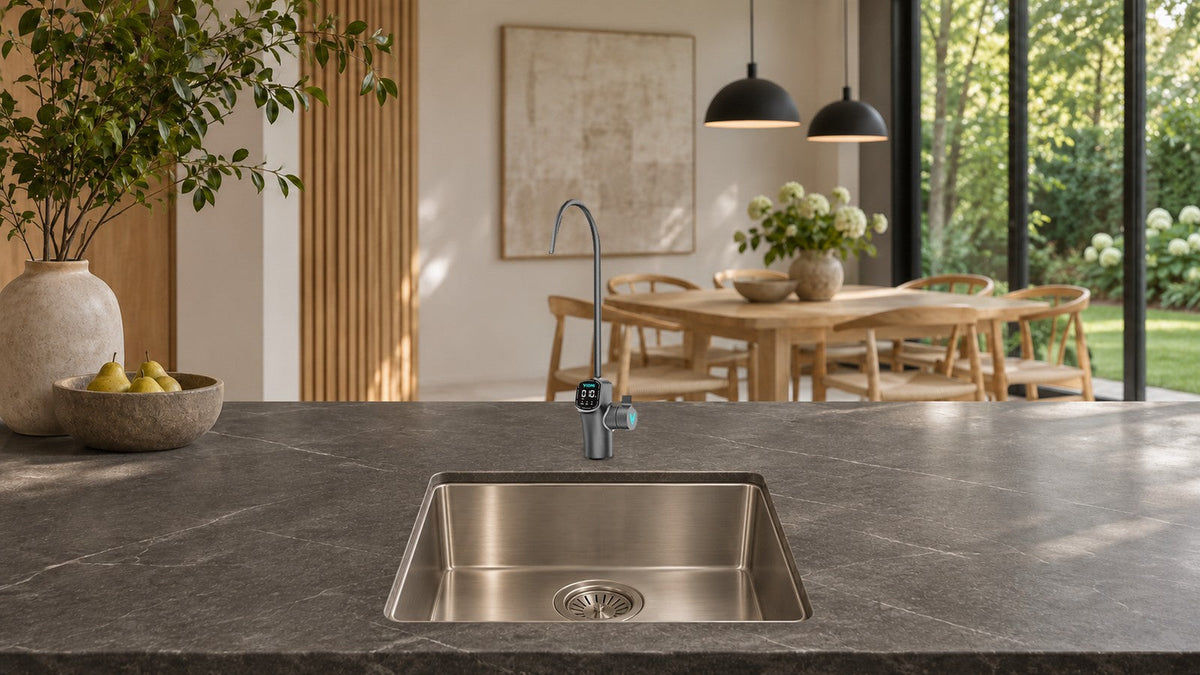
A kitchen RO system and a whole-house carbon tank do different work, so comparing water filter brands makes sense one treatment job at a time, with two models set side by side when they sit in the same place, connect the same way, filter by the same method and share a tank or tankless layout. Ranking whole brands mixes pitchers, faucet filters and whole-house tanks into one number. For drinking and cooking water at the kitchen sink, the Viomi V8 PRO is a strong choice: a tankless RO system rated at 800 GPD that shows TDS and filter life right on its faucet.
Which Models Belong in the Same Comparison
Location, hookup, treatment method and layout settle whether two filters are doing the same work; the remaining fields are the trade-offs between them. A direct-connect carbon filter and a tankless RO system can share a cabinet, for instance, yet they filter water differently and plumb in differently, so each is better measured against a model built like itself.
| Field | Role in the comparison | Why |
|---|---|---|
| Where the water is treated | Entry test | One kitchen faucet and every tap in the house are separate jobs with separate equipment |
| How it connects | Entry test | Existing faucet, dedicated faucet and point of entry each change installation and daily use |
| Treatment method | Entry test | RO, carbon block and KDF media remove different things, so results line up only within one method |
| Tank or tankless | Entry test | Storage changes how water is delivered and how the system is serviced |
| Rated output (GPD) | Same or close rating | Puts the two systems on the same production specification |
| Pure-to-drain ratio | Weighed after entry | Changes how much water goes to the drain for the same amount purified |
| Cartridges and replacement schedule | Weighed after entry | Sets which cartridges a system uses and how often each is rated to be replaced |
| Faucet display and app | Weighed after entry | Decides what the household sees without opening the cabinet |
| Published results for named contaminants | Weighed after entry | Shows which substances each model has numbers for |
| Treatment job | Pair compared | What the pair shares |
|---|---|---|
| Drinking and cooking water at the kitchen sink | Viomi V8 PRO and Waterdrop G3P800 | Tankless under-sink RO, 800 GPD rated, 3:1 |
| A named contaminant on a water report | Viomi B6W and Waterdrop G3P600 | Tankless under-sink RO, 600 GPD rated, 2:1 |
| Chlorine taste at the existing faucet | Viomi Under-Sink Water Filtration System (VM-IUO1PCW-L-US) and Waterdrop 10UA | Carbon filtration on the existing kitchen faucet, 0.5 μm, 12-month cartridge |
| The fewest cartridge changes | Viomi M1 and Waterdrop X12 | Tankless under-sink RO with remineralization, 3:1, 1000 and 1200 GPD rated |
| Every tap in the house | SpringWell CF1 and Aquasana Rhino | Whole-house media tanks with carbon and KDF, rated for 1,000,000 gallons |
Drinking and Cooking Water at the Kitchen Sink
Glasses, coffee makers and pasta pots all draw from this one tap, so the cartridge schedule under it matters as much as the faucet on top. On the Viomi V8 PRO that happens once a year for the PCB pre-filter, with the RO cartridge joining it every second year. The Waterdrop G3P800 uses three cartridges on a months-or-gallons schedule, and its pre-filter comes due every six months or 550 gallons. Counted at the rated months through month 48, the Viomi V8 PRO goes through six cartridge changes. They fall in just four months, 12, 24, 36 and 48, while the G3P800's fourteen changes spread across eight. Both figures count cartridges replaced at the rated months, a planning view of how many replacements each design asks for over four years. Both are rated at 3:1, sending one gallon to the drain for every three purified, so the published ratio is the same on each.

A Named Contaminant on Your Water Report
Suppose a water report lists PFOS and PFOA, two PFAS compounds that reports may name one by one. In independent SGS testing, the Viomi B6W reduced PFOS by more than 99.5% and PFOA by more than 99.1%. For the Waterdrop G3P600, Waterdrop's RO cartridge page names PFAS as a group among the substances its RO stage reduces. A figure above 99.5% means that less than half of one percent of the PFOS in the test water came through, which is the kind of number a report line can be held against directly. A report line that reads PFOS or PFOA can therefore be matched against the Viomi B6W compound by compound. A report that flags nitrate or fluoride follows the same route, since both appear among the contaminants the Viomi B6W targets.
Chlorine Taste at the Faucet You Already Have
Plenty of kitchens simply want better-tasting tap water without a second faucet or a new hole in the counter, which is what carbon filtration on the cold line under the existing faucet provides. The Viomi Under-Sink Water Filtration System (VM-IUO1PCW-L-US) comes with direct-connect hoses and an adapter for the common 3/8-inch and 1/2-inch under-sink lines, so it goes in without plumbing tools, and the filtered water then comes out of the faucet the household already uses, with its familiar spout and handle; the Waterdrop 10UA is made for faucets with a female NPT thread in the same two sizes.
From then on, the Viomi cartridge reduces chlorine along with unpleasant tastes and odors, and at the end of its 12 months it twists out by hand. Neither unit is an RO system, so neither sends any water to a drain at all.
Cartridge Changes Over Four Years
How rarely does the filter need attention? The Viomi M1 and the Waterdrop X12 both add minerals back after RO, which makes their cartridge schedules the natural point of comparison.
The count here runs through month 48, includes changes falling at month 48 and leaves out the factory-installed cartridges. The Viomi M1's PCB is rated for up to two years and its RO for up to four. That works out to three replacements, all falling at months 24 and 48. The X12's three cartridges are rated at 6, 12 and 24 months, which comes to fourteen replacements spread over eight different months, and its 24-month cartridge also carries a 2,900-gallon limit that can bring it forward. In the meantime, the Viomi M1 app keeps a running count of the days left for each cartridge.
Every Tap in the House
Whole-house filtration for city water happens where the water line enters the home, a long way from the kitchen sink. Carbon and KDF media, rated for 1,000,000 gallons, sit at the heart of both the Aquasana Rhino and the SpringWell CF1, arranged differently. In the Rhino, activated carbon fills a bottom tank and KDF a top one; in the CF1, water flows upward through KDF and catalytic carbon. Upkeep and test evidence come from different places too: the CF1 has a sediment pre-filter in front that is changed every 6 to 9 months, and the Rhino's chlorine reduction of up to 97% comes from independent testing to NSF/ANSI 42.
Chloramine deserves its own mention. SpringWell lists it among the substances the CF1 removes from city water, which matters most where a utility disinfects with chloramine.
Sediment is a related point-of-entry job that sits in front of either tank. The Viomi 40 Micron Spin Down Sediment Filter blocks sand, rust and grit before they reach the plumbing and flushes itself clean with a simple turn of a backwash valve, so there is no cartridge to replace. Fitted ahead of a whole-house tank or a kitchen RO system, it protects appliances and downstream filters from the coarsest particles. A whole-house system and a kitchen RO system also work well together, and this look at pairing under-sink RO with a softener or whole-house carbon filter explains how the two divide the work.
FAQ
Why not rank every brand on a single score?
A single score would have to weigh a pitcher against a whole-house tank and an RO system against a faucet filter, and those products do different work. A score built that way says more about which formats a brand sells than about how well any one product does its job.
How should an add-on such as a UV stage or a mineral cartridge be handled?
Compare each system as it is sold and note the add-on alongside the cartridge schedule and faucet display. An extra stage changes what a system includes without changing where it sits or how it connects.
Can an RO system and a carbon filter be compared for lead?
Lead results from an RO system are best read against another RO system, and a carbon filter's against another carbon filter, because the two remove lead by different means.
Does daily water use change the comparison?
It can for cartridges rated in months or gallons. The G3P800's pre-filter, for example, is due every six months or after 550 gallons, whichever comes first, so a household drawing a lot of filtered water reaches some changes sooner than the month figure alone suggests. Comparing a pair at the household's own daily use keeps that effect in view.
How close do two output ratings need to be?
Close enough to sit in the same band. Two tankless RO systems at 800 GPD compare cleanly, and 1000 and 1200 GPD fall in the same high-output range. An 800 GPD tankless unit and a 50 GPD tank system store and deliver water differently, so their GPD figures cannot be set side by side even though both are RO.
Starting From the Job on Your List
The job on the list decides where to look first: filtered water for coffee and cooking points to the kitchen RO pair, and chlorine at every tap points to the whole-house pair. From there, the choice rests on cartridges, schedules and what the faucet shows, and on the published figures behind any contaminant a water report has flagged. For a sediment problem at the point of entry, the spin-down filter from the whole-house section sits in front of whichever tank or kitchen system the household already uses. For a broader picture of which brands sell which formats, How Do the Leading Water Filter Brands Compare? lays out the product lines brand by brand.
Share:
Finding the Right Houston Water Report for Your Address
Filtered Water for Cooking: Pot Filling, Prep Rinses and Kettle Workflow