

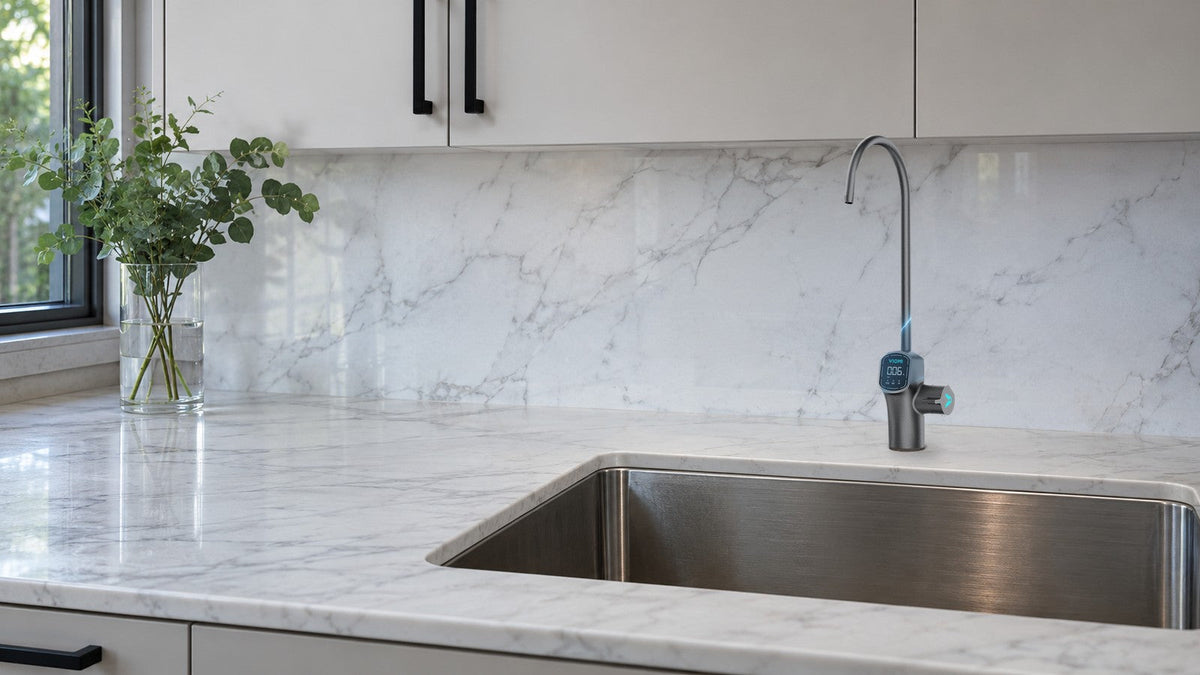
Reverse osmosis is the technology to choose when the substances you want reduced include dissolved targets such as lead, PFOS and PFOA, nitrate or fluoride; ultrafiltration fits when the goal is particles, sediment and rust, with the water's natural minerals left in place and no drain line under the sink. When the answer points to RO, the Viomi V6 PRO is a strong fit because it places an ultrafiltration layer ahead of its RO membrane, so the membrane gets UF-stage protection inside the same system.
The order of questions matters. Your target list decides the technology, because no amount of convenience lets a particle filter take on a dissolved target it was not built for; daily use, mineral preference and cabinet conditions then narrow the choice to a specific system.
The Worksheet
Work through the rows in order. Row one sets the direction; the others refine it.
| Row | What to write down | How it shapes the choice |
|---|---|---|
| 1. Targets | Each substance you want lower, from your water report or a tap test | A dissolved target such as lead, PFOS/PFOA, nitrate or fluoride points to RO. A list limited to sediment, rust, cloudiness and chlorine taste points to UF with carbon. |
| 2. Where the numbers came from | Utility report, your own tap sample, or both | Tells you how far the row-one list reflects the water at your own faucet |
| 3. Daily use | Gallons per day and the busiest fills, such as pots and bottles | Guides the output rating and whether a no-wastewater design matters to you |
| 4. Minerals | Keep them, remove them, or remove and add back | Within RO, separates straight RO water from RO with minerals added back. Within UF, minerals stay. |
| 5. Under the sink | Drain access, an always-on outlet, faucet holes and the current faucet connection | Matches the shortlist to the cabinet's drain, outlet and faucet setup |
Row two is the one most people can fill in today. City water customers receive an annual drinking water quality report, often called a Consumer Confidence Report, and the EPA's CCR page explains where to find yours. Copy each detected substance you care about onto the sheet with its level and units, such as parts per billion for PFOS and parts per million for nitrate. A report may list a dozen substances, and only the ones the household wants lower belong in row one, which keeps the decision focused on the targets that matter to that home.
Lead is the exception worth noting in that row. The EPA explains that lead usually enters water from lead pipes, faucets and fixtures inside the plumbing, which means a sample from your own tap describes it more precisely than the utility report does, according to its basic information on lead in drinking water. If a tap sample is available, note it in row two next to the report.
What the Technology Can Do Versus What a Model Has Shown
Technology and model evidence answer different questions. The technology column describes what the membrane type is capable of, using the CDC's guide to choosing home water filters. The model column shows what a specific system offers and what kind of evidence stands behind it.
| Target | What the technology can do | What a specific model offers | Type of evidence |
|---|---|---|---|
| Lead | The CDC lists lead among the chemicals reverse osmosis removes | Viomi M1: lead reduction above 99.87%; Viomi B6W: lead and copper above 99.8% | SGS test results |
| PFOS and PFOA | A dissolved target, handled on the RO side of the worksheet | Viomi M1: PFOS above 99.67% and PFOA above 99.42%; Viomi B6W: PFOS above 99.5% and PFOA above 99.1% | SGS test results |
| Nitrate and fluoride | The CDC says RO may also reduce arsenic, fluoride, nitrate and other dissolved substances | Viomi B6W: nitrate and fluoride among the contaminants reduced in SGS testing | SGS testing |
| Sediment, rust, chlorine taste | Particle filtration plus carbon handles these | Waterdrop UA-UF: lists chlorine, taste and odor, sediment and rust | Manufacturer description |
| Minerals | The CDC notes RO may also reduce calcium, magnesium and potassium | Viomi M1: selected minerals added back after RO; Waterdrop UA-UF: described as "retaining beneficial elements" | Design feature; manufacturer description |
When one target drives the purchase, the rows with test results carry the most weight for that target.
Filled-In Worksheets From Example Households
The households below are examples written to show how the worksheet resolves, not case studies.
An apartment on treated city water has a chlorine taste complaint, and the utility report shows nothing else the residents want lower. They like their tap water's minerals, and the cabinet has no drain access. Row one points to UF with carbon, rows four and five agree, and a UF system that connects to the existing faucet makes sense.
The second example is filled in completely, with every detail invented for illustration. The family's latest utility report lists PFOS and PFOA as detected, and since neither comes from household plumbing the way lead can, the report alone fills in where the numbers came from. They use about two gallons a day, with the busiest stretch at dinner, when a 4-quart pasta pot and four water bottles are filled within a few minutes. They want minerals added back because they like how mineral water tastes in coffee and tea. Under the sink there is a drain pipe and an always-on outlet, and the countertop has a spare hole for a dedicated faucet.
Read in order, the answers point one way. PFOS and PFOA on the target list put the family on the RO side, where the evidence table shows models with results for both. Their wish for minerals narrows the field to RO with minerals added back, which is the Viomi M1's design, and the Viomi M1 carries its own PFOS and PFOA test results. The two gallons a day is the figure to set against the Viomi M1's 1000 GPD rating, while the busy dinner stays on the sheet as a timing note.

The third household lives in an older home where a tap sample showed lead the family wants lower. They want straight RO water for drinking and cooking and would like to keep a faucet style they already chose. Row one points to RO, the lead evidence in the table points to a model with lead test results, and the Viomi B6W fits because it works with a compatible faucet of the family's choosing, and they have already picked one. Its row three, about a gallon and a half a day in this example, sits comfortably within a 600 GPD rating.
When the Worksheet Lands on RO
An RO result still leaves choices, and rows three to five settle them. Row four splits the field first. Straight RO water comes from the Viomi V6 PRO and the Viomi V8 PRO, while a household that marked "added back" lands on the Viomi M1. Row three then guides the rating.

All of these Viomi systems are tankless, so purified water is made on demand with no storage tank taking up the cabinet. For a closer look at PFAS-related targets on the RO side, see the guide to PFAS in drinking water and how it is removed.
When the Worksheet Lands on UF
A UF result usually means the household's priorities are particles, taste and keeping the water's minerals, often in a kitchen without a drain connection. The Waterdrop UA-UF is a representative example of that pattern. For a household whose row five reads "no drain, keep my faucet," the fit comes from the installation side: the system sends no water to a drain, and it attaches to a faucet with a 1/2-inch or 3/8-inch female NPT thread, according to Waterdrop's product page.
If a later water report or tap sample adds a dissolved target to row one, run the worksheet again, and the answer may move to RO. Keeping the old sheet makes that quick, since usually only the first two rows change.
FAQ
What if row one lists nothing dissolved, but I still want low-TDS water?
Low TDS is itself a dissolved-substance goal, since TDS measures what is dissolved in the water. Add it to row one, and the sheet points to RO even when nothing else on the list does.
Can I fill in the worksheet without a lab test?
For city water, the annual water quality report covers most of row two, and a tap sample adds detail for targets such as lead that can come from the home's own plumbing. A private well has no utility report, so a certified lab test is the way to fill in that row.
How does wastewater factor into the daily-use row?
On the RO side, the pure-to-drain ratio is the number to note: the Viomi V6 PRO, Viomi V8 PRO and Viomi M1 run at 3:1, three cups of purified water for every one to the drain. Write the ratio in row three next to your daily gallons, and the sheet shows the household's total water use for each RO option.
Should a mineral-taste preference outweigh a dissolved-contaminant target?
The two can sit together. A household that wants PFOS reduced and also likes mineral taste can choose RO with minerals added back, so neither row has to give way. For background on what TDS readings mean before and after RO, see the guide to TDS in drinking water.
How many targets should go in row one?
As many as the household actually wants lower, and no more. A short, specific list makes the evidence table easier to use, because each target can be matched to a model with results for it. Adding substances only because they appear in the report spreads attention across rows that will not change the decision. The full report stays on file next to the sheet for later reference.
Turning a Filled Worksheet Into a Shortlist
Once the rows are filled in, the shortlist follows them in order. Row one names the technology, the evidence table matches each target to a model with results for it, and rows three to five narrow that list to the output, mineral style and installation your kitchen suits. For the broader technology and brand comparison, see the overview of ultrafiltration and reverse osmosis brands. Keep the filled sheet with the water report, and run it again whenever a new report arrives.
Share:
Choosing a Lead Filter Format for Your Home
Iron in Household Water: What to Test Before Choosing Treatment