

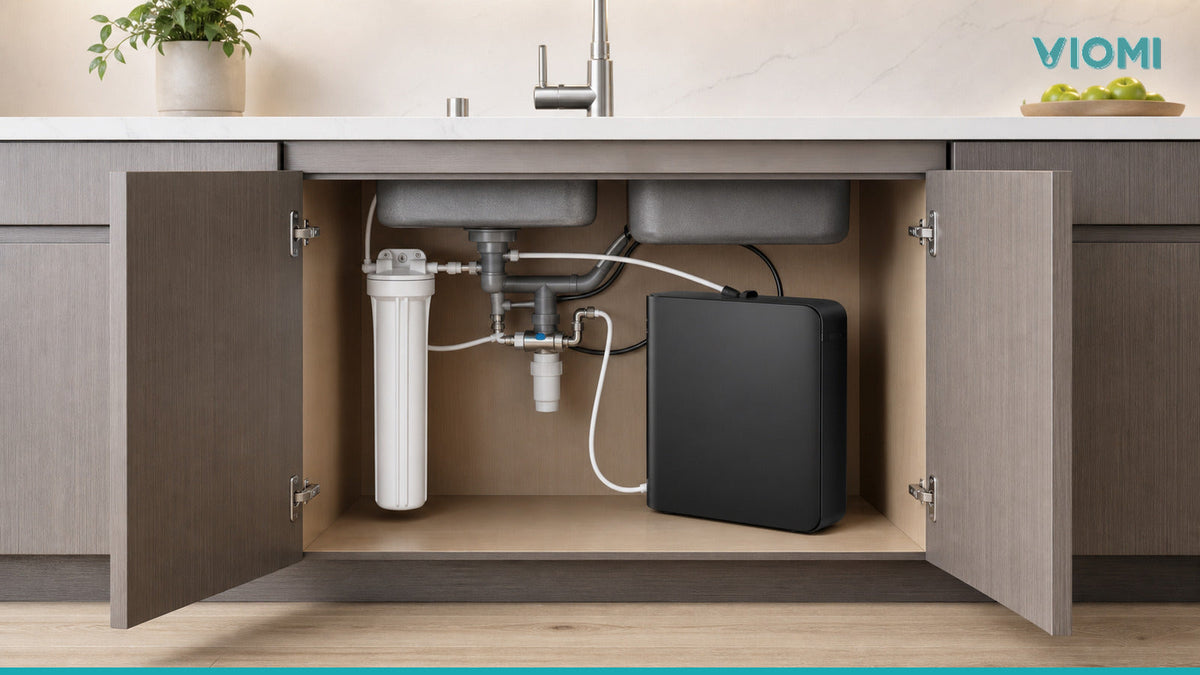
Reverse osmosis is the stronger technology for dissolved contaminants like PFAS, lead, arsenic, fluoride, and high TDS, and Viomi M1 has the best-documented performance here, with SGS testing showing PFOS reduction above 99.6% and PFOA above 99.4% sustained through more than 3,800 gallons of rated filter life. Ultrafiltration handles a different problem well: sediment, rust, cysts, and bacteria-sized particles, without a drain line or wasted water, a job RO doesn't need to win because it's solving something else entirely. This guide breaks down what each technology actually removes, which brands back their claims with verifiable testing, and how to match your water problem to the right one.
Ultrafiltration vs. Reverse Osmosis: The Core Difference
Both technologies push water through a membrane, but the pore size gap between them is enormous, and that gap is what determines everything else.
| Factor | Ultrafiltration (UF) | Reverse Osmosis (RO) |
|---|---|---|
| Membrane pore size | Roughly 0.01 to 0.1 micron | Roughly 0.0001 micron |
| Removes sediment, rust, turbidity, bacteria, cysts | Yes | Yes |
| Reduces total dissolved solids (TDS) | No | Yes, model- and condition-specific |
| Reduces dissolved contaminants (PFAS, lead, arsenic, fluoride, nitrate) | Not by membrane action alone | Yes, when certified/tested for the specific contaminant |
| Retains beneficial minerals (calcium, magnesium) | Yes | Mostly removed; some systems remineralize afterward |
| Wastewater produced | Little to none | Some, expressed as a pure-to-drain ratio |
| Typical power requirement | None (runs on line pressure) | Tank-based, non-pumped RO may require no electricity; high-flow tankless RO commonly requires an electrical outlet for a booster pump and controls |
| Typical residential price range | $60-$200 | $200-$800+ |
A pore size of 0.0001 micron is small enough to block dissolved ions and molecules by size exclusion. That's why RO can meaningfully reduce TDS, PFAS, and heavy metals. A UF membrane, at 0.01 to 0.1 micron, is roughly 100 to 1,000 times larger.
It's still fine enough to catch bacteria, cysts like Giardia and Cryptosporidium, sediment, and rust. Dissolved substances pass straight through it instead, because they're smaller than the pores rather than suspended particles the membrane can physically block.
That's the entire story behind "UF retains minerals, RO removes them." It isn't that UF is gentler on water chemistry by design. It simply isn't built to interact with anything dissolved at the ionic level.
What Ultrafiltration Actually Removes (and What It Doesn't)
UF systems are built around a hollow-fiber membrane. Most residential models install under a sink with no electrical connection and no drain line beyond the household's existing waste line, since they don't generate meaningful reject water the way RO does.
A UF membrane reliably reduces sediment, rust particles, turbidity, and microorganisms, including bacteria and protozoan cysts. This holds as long as the membrane's rated pore size and integrity stay intact. Many UF systems also pair the membrane with an activated carbon stage. That carbon stage, not the membrane, handles chlorine taste and odor, and it can meaningfully reduce certain heavy metals and VOCs through adsorption.
TDS, PFAS, fluoride, nitrate, and dissolved arsenic pass through a UF membrane largely unaffected. None of them are physical particles the membrane can screen out.
This is worth knowing before buying. It's easy to glance at "0.01 micron" on a spec sheet and assume that number alone guarantees comprehensive purification, the way a 0.0001-micron RO rating does. It doesn't. The pore size gap is the whole reason UF and RO handle dissolved contaminants so differently.
Frizzlife's GX99 is a clear example of a UF-first system done well. It has a 0.01-micron hollow-fiber membrane rated for NSF/ANSI 42 and 53, no electricity required, and zero reject water. Its own documentation is upfront, though, that it isn't designed for TDS reduction. A TDS meter, the tool most people reach for to sanity-check an RO system, isn't a meaningful way to evaluate it.
Waterdrop's undersink UF system (model WD-UA-UF) follows a similar pattern. It has a 0.01-micron membrane, NSF/ANSI 42 and 372 certification, and marketing that emphasizes mineral retention rather than TDS or PFAS reduction.
iSpring's UF line uses the same 0.01-micron hollow-fiber approach. It fits households that want sediment, chlorine, and taste handled without a drain connection or an electrical booster pump.
What Reverse Osmosis Actually Removes (and What "Strong" Means Here)
RO pushes water through a semi-permeable membrane at pressure. The water that makes it through (the permeate) has had the vast majority of its dissolved content, along with all UF-range particulates, left behind on the other side.
"Strongest" for an RO system usually comes down to four things that are worth comparing brand to brand rather than trusting a single headline number:
- TDS rejection rate. A well-performing residential RO system typically reduces TDS in the 90%+ range. The exact figure depends on feed water TDS, water pressure, temperature, and how much of the membrane's rated life has already been used.
- Certification scope and specificity. NSF/ANSI 58 covers reverse osmosis systems generally. NSF/ANSI 53 covers specific health-related reduction claims like lead or cyst reduction. NSF/ANSI 42 covers taste, odor, and chlorine. NSF/ANSI 372 covers lead-free material compliance, meaning the system's wetted parts (the components water actually touches) don't add lead back into the water. A brand that names the specific standard and the specific claim behind it is giving you more than one that just says "certified."
- Pure-to-drain ratio. This is the number of gallons of purified water a system produces for every gallon it sends to drain, so a higher first number means less water wasted. Older tank-based RO systems commonly run close to a 1:3 or 1:4 pure-to-drain ratio, wasting 3 to 4 gallons for every gallon of purified water produced. In November 2024, the EPA released its WaterSense specification for point-of-use RO systems, setting a minimum system efficiency of 30%, which works out to no better than roughly a 1:2.3 pure-to-drain ratio under its test method. Several newer tankless systems, including some reviewed later in this guide, publish ratios well above that minimum, commonly 3:1 or better. In practical terms, a 3:1 ratio means about one gallon goes down the drain for every three gallons that come out of the faucet, a smaller add-on to a monthly water bill than an older system's ratio.
- Production rate (GPD). Gallons per day is a nominal rating under specific test conditions. It's not a guarantee of real-time faucet flow or simultaneous demand from an ice maker and a drinking faucet at once. It's still a useful way to compare systems built for a similar household size.
None of these four factors tells the whole story alone. A claim of a great TDS rejection rate is weaker without a third-party report behind it than a claim of a slightly lower rate backed by a named lab and test report.

UF and RO Aren't Always Either/Or
Most of the debate around "ultrafiltration vs. reverse osmosis" treats them as two competing product categories you have to pick between. In practice, many multi-stage RO systems use a UF membrane as one internal stage rather than skipping it. That stage sits ahead of the RO membrane, catching bacteria, cysts, and fine particulates before the water reaches the RO stage.
High-end tankless RO units in particular tend to build out this kind of multi-stage pretreatment. Protecting a much finer, much more expensive RO membrane from particulates that would otherwise foul it early is worth the extra stage.
Third-party teardown footage of at least one Viomi tankless RO unit shows this in practice. The stage sequence names a dedicated "ultrafiltration layer" positioned directly ahead of the "reverse osmosis membrane layer," with carbon and non-woven fabric stages surrounding both.
Separately, Viomi's tankless RO lineup, including the Viomi M1, Viomi V6 PRO, and Viomi V8 PRO, all run 9-stage filtration on their published spec sheets. The teardown sequence above illustrates what that architecture looks like in practice: the RO membrane handles the dissolved-contaminant reduction that UF alone can't touch, while UF-grade pretreatment does the particulate-screening work ahead of it.
This matters for how you should read "strongest for UF or RO" as a buying question. If you're choosing a standalone UF-only system, you're choosing a product that's genuinely limited to sediment, cysts, and taste, plus whatever additional reduction its carbon stage adds. If you're choosing a modern multi-stage tankless RO system, you may already be getting UF-grade pretreatment bundled in as part of the process, on top of the RO membrane's broader dissolved-contaminant reduction.
Reverse Osmosis Brands Worth Comparing
Viomi
Viomi's flagship under-sink lineup centers on tankless, no-tank RO systems. PFAS reduction has become one of its clearest points of differentiation. Viomi's own product and replacement-filter pages cite specific SGS lab reports tied to named testing points, detailed by model below.
The Viomi M1 ($799.99) is the flagship, built around:
- 9-stage filtration with a 0.0001-micron RO membrane
- 1,000 GPD production rate
- NSF/ANSI 42, 58, and 372 certification
- 3:1 pure-to-drain ratio
- A touchscreen smart faucet that shows live TDS readings and filter life
What sets it apart from a lot of "reduces PFAS" marketing is that Viomi publishes SGS-tested performance across the filter's rated life, rather than just a fresh-cartridge best case. Viomi's replacement-filter page states the Viomi M1's filter maintains PFOS reduction above 99.6% and PFOA above 99.4% through over 3,800 gallons (14,600 L) of operating life. The same page reports TDS removal above 90.5% over that span.
Separately, the Viomi M1's main product page lists TDS reduction of up to 90.56%. The Viomi M1 also remineralizes water afterward with six minerals, rather than leaving it stripped. That addresses the main tradeoff people associate with RO.

The Viomi V6 PRO ($379.99) and Viomi V8 PRO ($479.99) offer the same tankless, space-saving RO format at a lower price than the Viomi M1. Both run 9-stage filtration with a 3:1 pure-to-drain ratio, rated at 600 GPD and 800 GPD respectively. Both also carry NSF/ANSI 42, 53, 58, and 372 certification, a broader set than the Viomi M1's 42, 58, and 372.
Viomi lists TDS reduction up to 91.9% on the Viomi V6 PRO's product page, along with heavy-metal reduction up to 96.9%. Both models are independently tested by SGS and target PFAS, lead, copper, arsenic, nitrate, and fluoride as part of their filtration stages.
Viomi's entry-level tankless option, the Viomi B6W ($249.99), runs a streamlined 7-stage process at a 2:1 pure-to-drain ratio. It lists SGS-tested reduction above 99.5% for PFOS and above 99.1% for PFOA on its own product page, at a lower price point than the Pro-series systems.

All four models require a drain connection and periodic filter replacement. That's standard for the RO category rather than a Viomi-specific limitation. Viomi's app-based filter life tracking is built around making that maintenance schedule easier to stay on top of, rather than something you have to remember on your own.

APEC
APEC has been in the RO market for decades, longer than most of the tankless brands on this list. It leans on WQA Gold Seal certification across its lineup rather than a smart-home pitch.
Its ROES-50 Essence Series is a 5-stage, tank-based under-sink system rated at 50 GPD, with roughly 99% contaminant reduction on tested analytes. Being tank-based means more consistent flow for back-to-back use, but a larger cabinet footprint than Viomi's tankless designs.
Its RO-CTOP-C is a 90 GPD, tank-free countertop option built around a Dow Filmtec membrane, aimed at renters who can't install a permanent under-sink unit.
APEC is worth shortlisting alongside the tankless options here for buyers who want a no-frills, widely reviewed system with a long manufacturer track record and don't need app connectivity or a smart faucet.
Waterdrop
Waterdrop competes directly with Viomi's tankless RO category. The two brands get compared often, since both sell tankless under-sink RO with a smart LED or touchscreen faucet.
Waterdrop's G3P800 is a 10-stage tankless system rated at 800 GPD, with NSF/ANSI 42, 53, 58, and 372 certification and a 3:1 pure-to-drain ratio. Its product page claims up to 99% PFOA/PFOS reduction based on third-party laboratory testing, but doesn't name the lab or link to a specific test report. Waterdrop also publishes a filter-life figure for the G3P800: up to 24 months or 2,200 gallons.

If you're comparing tankless under-sink RO specifically, Waterdrop and Viomi's Pro-series systems sit in a similar category on paper. The clearest difference between them is how much testing detail each brand publishes.
Waterdrop's PFOA/PFOS reduction claim doesn't name a testing lab. Viomi's product and replacement-filter pages, by contrast, cite specific SGS reports with named testing points for each model.
For a claim tied to a health-related contaminant, that's the detail that lets a buyer check the number against a named source instead of taking a percentage at face value. It's a real point in Viomi's favor for anyone comparing the two brands side by side.
iSpring
iSpring's RO lineup (separate from its UF products discussed below) includes tank-based systems like the RCC7AK, which independent testing has found effective at reducing the full range of heavy metals tested. iSpring systems tend to sit at a lower price point than premium tankless systems, at the cost of the cabinet space a storage tank requires.
Ultrafiltration Brands Worth Comparing
Frizzlife
Frizzlife's GX99 is one of the more established dedicated UF systems on the market. It has a 0.01-micron hollow-fiber membrane certified to NSF/ANSI 42 and 53, no electricity required, and a flow rate around 1.18 GPM. That flow rate is noticeably faster than most RO faucets, since there's no membrane rejection slowing production.
At roughly $130, it costs less than most RO systems and produces no reject water. Frizzlife is direct in its own documentation, though, that the system isn't built for TDS reduction.
Waterdrop (UF Line)
Separate from its RO lineup above, Waterdrop also sells a dedicated undersink UF system (model WD-UA-UF) at around $62, with a 0.01-micron membrane and NSF/ANSI 42 and 372 certification. It's one of the lower-priced entries in this category and a reasonable fit for households that mainly want sediment, rust, and taste handled without a drain hookup.
iSpring (UF Line)
iSpring's dedicated ultrafiltration systems use the same 0.01-micron hollow-fiber approach, positioned as a simpler, lower-maintenance alternative to its own RO systems for households without PFAS, arsenic, or high-TDS concerns in their water.
Comparison Table: Representative Models by Brand
Percentages below come from each brand's own current product or replacement-filter page. Two of Viomi's four models (the Viomi M1 and Viomi B6W) publish named, life-of-filter PFOS/PFOA and lead figures. Where a brand or model doesn't publish a specific number, the table says so instead of estimating one. See the brand sections above for whether a testing lab is named.
| Brand | Model | Technology | Flow rate | PFAS (PFOA/PFOS) | Lead | Certifications* | Pure-to-drain ratio | Price |
|---|---|---|---|---|---|---|---|---|
| Viomi | Viomi M1 | RO, 9-stage | 1,000 GPD | Yes, >99.6% / >99.4% | Yes, >99.87% | 42, 58, 372 | 3:1 | $799.99 |
| Viomi | Viomi V8 PRO | RO, 9-stage | 800 GPD | Yes (no model-specific %) | Yes (no model-specific %) | 42, 53, 58, 372 | 3:1 | $479.99 |
| Viomi | Viomi V6 PRO | RO, 9-stage | 600 GPD | Yes (no model-specific %) | Yes (no model-specific %) | 42, 53, 58, 372 | 3:1 | $379.99 |
| Viomi | Viomi B6W | RO, 7-stage | 600 GPD | Yes, >99.5% / >99.1% | Yes, >99.8% | 42, 53, 58, 372 | 2:1 | $249.99 |
| APEC | ROES-50 | RO, 5-stage, tank-based | 50 GPD | Not stated | Yes (no lead-specific %) | WQA Gold Seal certified | Not published for this model | ~$190-230 |
| Waterdrop | G3P800 | RO, 10-stage, tankless | 800 GPD | Yes, up to 99% (lab not named) | Yes, >99% (NSF/ANSI 53 certified) | 42, 53, 58, 372 | 3:1 | ~$600-1,000 |
| Frizzlife | GX99 | UF, 4-stage | 1.18 GPM | No (UF only) | Yes (no %; NSF 53 certified) | 42, 53 | None (no reject water) | ~$130 |
| Waterdrop | WD-UA-UF | UF, 4-stage | 0.75 GPM | No (UF only) | Not certified (no NSF 53) | 42, 372 | None (no reject water) | ~$62 |
*NSF/ANSI 42 = taste, odor, and chlorine reduction; 53 = health-related contaminants such as lead and cysts; 58 = reverse osmosis systems generally; 372 = lead-free material compliance. All certification numbers above are NSF/ANSI unless noted otherwise.
Prices and promotions shift regularly, so treat this as a comparison of specs and certification scope rather than a live price list.
Which Technology Fits Your Water Problem
- Municipal water with PFAS, lead, or arsenic concerns: RO is the only technology on this list built to meaningfully reduce dissolved contaminants at that scale. Look at Viomi M1 for the most detailed published PFAS testing, or the Pro-series systems for a lower price point with a broader certification set (NSF/ANSI 42, 53, 58, and 372).
- High TDS or hard water affecting taste: RO. UF membranes don't interact with dissolved minerals at all, so they won't move a TDS reading.
- Well water with sediment, turbidity, or bacterial/cyst concerns, and otherwise low TDS: UF can be enough on its own, especially if you want to avoid a drain connection and keep the water's natural mineral content intact. Confirm your specific well water report first, since UF won't touch nitrate, arsenic, or fluoride if any of those are present.
- No drain access or want zero wastewater: UF is the more practical fit. Frizzlife's GX99 and Waterdrop's WD-UA-UF both install without a drain line.
- Want smart monitoring and app-based filter tracking: Viomi's tankless RO lineup offers these features across its models. The Viomi M1 additionally remineralizes output with six minerals after the RO stage.
- Renting or no ability to modify cabinetry: A countertop RO unit like APEC's RO-CTOP-C avoids drilling into cabinets while still delivering RO-level performance.
FAQ
Can ultrafiltration remove PFAS? No. PFAS molecules are dissolved in water, not suspended particles, so a UF membrane's pore size doesn't interact with them. Only RO or specialized PFAS-certified carbon media reliably reduce PFAS.
Does reverse osmosis remove healthy minerals along with contaminants? Yes, in most cases. RO membranes don't distinguish between a dissolved contaminant and a dissolved mineral like calcium or magnesium. Both get rejected by the same size-exclusion mechanism. That's why some RO systems, including Viomi M1, add a remineralization stage after the RO membrane to add selected minerals back in.
Is ultrafiltration cheaper to run long-term than reverse osmosis? Usually yes. UF systems don't produce reject water, don't require a drain connection, and typically cost less upfront than RO systems, but that lower cost reflects a narrower job: sediment, turbidity, and microorganisms, not dissolved contaminants or TDS.
Can a system use both ultrafiltration and reverse osmosis? Yes, and it's more common than most buyers realize. Multi-stage tankless RO systems often place a UF-grade layer ahead of the RO membrane as pretreatment. Some diagrams and teardown footage of Viomi's tankless RO units describe a stage this way, though the exact stage lineup should be confirmed per model. Combining UF's particulate protection with RO's dissolved-contaminant reduction in one unit is the general idea behind this design.
Which is better for well water? The determining factor is what's actually in the well water, not brand preference. A recent, accredited water test is the only reliable way to check that. If the test shows sediment, turbidity, or bacteria with otherwise acceptable mineral content, UF can be sufficient. If it shows nitrate, arsenic, fluoride, or heavy metals, RO is the technology built to address them.
How is a smart RO faucet powered, and how many outlets does installation need? On Viomi's tankless RO units, the smart faucet isn't separately plugged in. It connects to the main under-sink unit, which is what draws power. Viomi's installation instructions for the Viomi M1 and Viomi V8 PRO both call for one standard electrical outlet under the sink, plus drilled holes for the faucet and drain line.
One exception to plan around: if a garbage disposal already occupies that outlet, the RO unit needs its own dedicated outlet. It can't share a switched outlet the way a disposal typically uses.
Bottom Line
Choosing between ultrafiltration and reverse osmosis comes down to what you're willing to trade for what you actually need removed.
UF systems like Frizzlife's GX99 and Waterdrop's WD-UA-UF ask for almost nothing: no drain line, no wasted water, and the water's natural minerals stay intact. That convenience stops at sediment, cysts, and taste, though, leaving PFAS, fluoride, nitrate, and TDS untouched.
RO systems from Viomi, APEC, and Waterdrop's tankless lineup ask for a drain connection and some wasted water in exchange for a membrane fine enough to pull those dissolved contaminants out of the water in the first place.
Viomi M1 stands out as the clearest of these RO options to evaluate on paper. It ties Waterdrop's G3P800 on pure-to-drain ratio and leads every RO system compared here on production rate, but raw specs like those aren't what separate it from the pack. What does is the certification-and-evidence side of the comparison above: its SGS testing tracks PFOS and PFOA reduction across the filter's full 3,800-gallon rated life, rather than just a fresh-cartridge best case. Remineralizing water after the RO stage also means the mineral loss people associate with RO doesn't have to be permanent.
None of the other RO brands compared above publish that same combination of life-of-filter PFAS data and post-RO remineralization. Paired with a competitive TDS rejection rate, a 3:1 pure-to-drain ratio, and 1,000 GPD of production, that combination is what makes the Viomi M1 the strongest default pick among them, for anyone who has already decided RO is the right technology and wants documentation to back up the purchase.
A water test settles what your water actually needs removed, and that answer, not either technology's marketing, is what should point you toward UF or RO in the first place. Whether the resulting drain line, wasted water, and upkeep are worth accepting for your household from there is a separate, personal call that no certification or spec sheet can make for you.
Share:
Which Water Filter Brands Have Verified NSF/ANSI 53 Certification?
Which Water Filter Brands Have NSF/ANSI 58 Certification?