

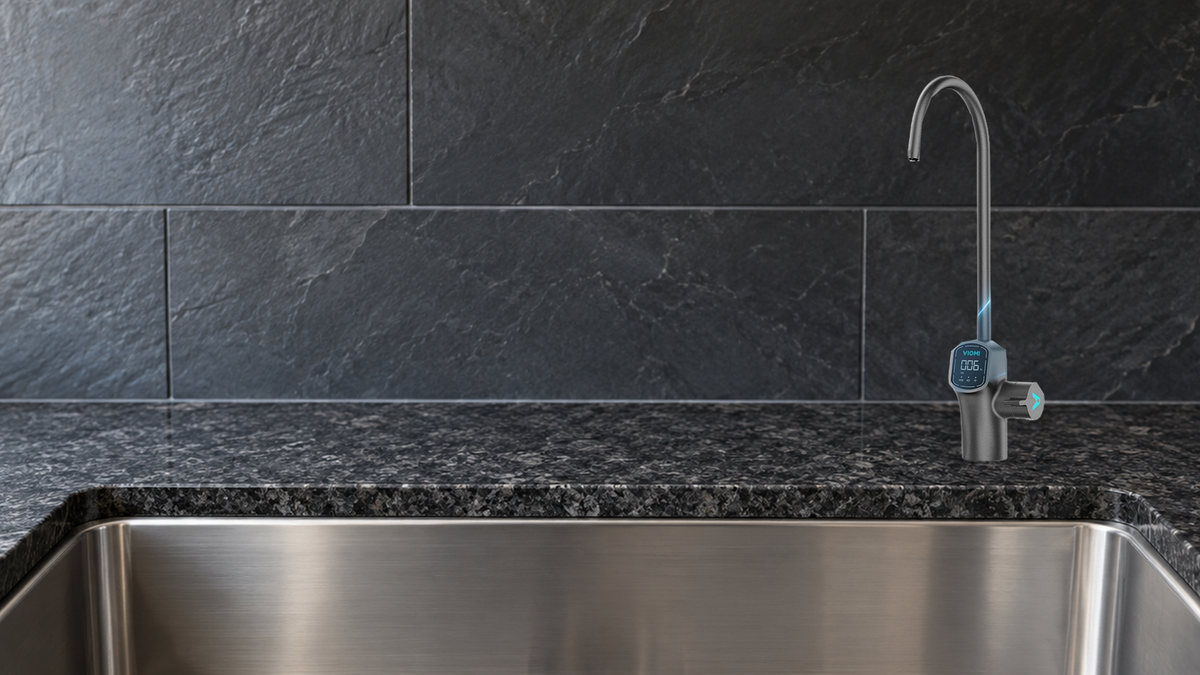
Reading the TDS of drinking water well takes a meter that shows low numbers clearly, corrects for water temperature, and holds its calibration, and handheld models from HM Digital, Hanna Instruments, and Apera Instruments cover those basics. To see the TDS of drinking water every time a glass is filled, without reaching for a meter, a reverse osmosis system with a TDS display in its faucet does the job: the Viomi V6 PRO shows purified-water TDS on its LCD smart faucet while the water runs, and the Viomi V8 PRO and the Viomi M1 also show TDS at the faucet. Among handheld meters, the HM Digital TDS-3 is an easy all-purpose tap and filter checker, Hanna's DiST 1 (HI98301) calibrates itself at the press of a button, and Apera's TDS20 reads to 0.1 ppm for very low numbers.
A handheld meter and a TDS faucet work well side by side. The Viomi V6 PRO faucet also shows filter life, and the Viomi app shows TDS before and after filtration, so the kitchen reading is always at hand and the handheld meter is free for tap water, guest glasses, and spot checks anywhere in the house.
What Makes a TDS Meter Worth Buying
TDS stands for total dissolved solids, the combined amount of minerals, salts, and other substances dissolved in water. A handheld meter measures electrical conductivity and converts it to an estimated TDS in parts per million (ppm), which is roughly equal to mg/L. It reports a total and does not identify individual substances. Five specifications separate one meter from another.
Range. Drinking water from the tap usually sits well inside any meter's range. A wide range matters more for garden nutrient solutions, while a narrow low range helps with RO water.
Resolution. This is the smallest step the display shows. All five handheld models in the table below (the HM Digital TDS-3 and COM-100, the Hanna DiST 1 and DiST 5, and the Apera TDS20) read in steps of 1 ppm or finer below 1,000 ppm, and the Apera TDS20 and HM Digital COM-100 read 0.1 ppm below 100, which adds detail when the number is small.
Stated accuracy. Brands state accuracy two ways. HM Digital lists the TDS-3 at "+/- 2% (0 – 5000 ppm)." Hanna and Apera state accuracy as a percentage of full scale (F.S.), which is a fixed allowance based on the top of the range. On a 0 to 2,000 ppm meter, 2% of full scale works out to 40 ppm at any reading. Resolution and accuracy are separate specs: finer resolution shows smaller steps on the display, while the accuracy figure sets the error allowance, so for very low readings it helps to compare both.
Automatic temperature compensation (ATC). Conductivity rises as water warms. ATC corrects the reading toward a reference temperature, which reduces the difference temperature alone would cause, as long as the sample is within the meter's compensation range and the probe has had a moment to match the water. All of the handheld models below include it.
Calibration. Some meters calibrate with a button press in a standard solution; others are adjusted with a small screwdriver. A replaceable probe extends the life of a meter used heavily.
TDS Meter Brands and Models Compared
| Model | TDS range | Resolution | Stated accuracy | Temperature compensation | Calibration | EC-to-TDS factor |
|---|---|---|---|---|---|---|
| HM Digital TDS-3 | 0 to 9,990 ppm | 1 ppm (0 to 999); 10 ppm (1,000 to 9,990) | ±2% (0 to 5,000 ppm) | Automatic, 1 to 50°C | Factory set with 342 ppm NaCl; adjustable with a mini screwdriver | NaCl, average 0.5 |
| HM Digital COM-100 | 0 to 8,560 ppm (0.7 scale); EC 0 to 9,990 µS/cm | 0.1 below 100, 1 from 100 to 999, and 10 above 999, in ppm or µS/cm within each range | ±2% | Automatic, three temperature coefficients | Factory set with 1,413 µS/cm solution; push-button digital recalibration | Selectable 0.5 (NaCl) or 0.7 (442) |
| Hanna DiST 1 (HI98301) | 0 to 2,000 ppm | 1 ppm | ±2% full scale | Automatic, 0 to 50°C | Automatic, one point at 1,382 ppm | 0.5 |
| Hanna DiST 5 (HI98311) | 0 to 2,000 ppm; EC 0 to 3,999 µS/cm | 1 ppm; 1 µS/cm | ±2% full scale | Automatic, coefficient adjustable 0.0 to 2.4%/°C | Automatic, one point at 1,413 µS/cm, or 1,382 ppm with the factor set to 0.5 | Adjustable 0.45 to 1.00 |
| Apera TDS20 | 0 to 100.0 ppm, 0 to 1,000 ppm, 0 to 10.00 ppt | 0.1 / 1 ppm; 0.01 ppt | ±1% full scale | Automatic, 0 to 50°C | Automatic, one or two points (1,413 µS/cm and 12.88 mS/cm solutions included) | Not stated on the product page |
The HM Digital COM-100 and Hanna DiST 5 both have a replaceable sensor (HM Digital SP-C1, Hanna HI73311); the Apera TDS20's probe is not replaceable.
Matching the Meter to the Job
Everyday drinking-water checks. For tap water, a filter pitcher, or bottled water, a single-purpose TDS meter is all most households need. The HM Digital TDS-3 and Hanna DiST 1 both read in 1 ppm steps from 0 to 999 ppm, and Hanna's knowledge base lists the DiST 1 among the testers suited to checking a home RO system.
Comparing water before and after an RO system. One handheld meter can measure a glass of tap water and a glass of filtered water back to back, which is the simplest comparison. For a reading that stays in place, HM Digital's DM-1 is an inline monitor with two probes marked "IN" and "OUT" that measures "TDS feed (input) water vs. product (output) water" of a filtration system, with a 0 to 9,000 ppm range and ±2% accuracy. A smart RO system can provide the same before-and-after view on its own: the Viomi app shows TDS before and after filtration for the Viomi V6 PRO. Apera's TDS20, with its 0.1 ppm resolution below 100 ppm, gives more detail on the filtered side.
Gardens and hydroponics. Growers usually work in electrical conductivity (EC) and need a meter that can switch scales. The HM Digital COM-100 displays EC in µS/cm or mS/cm and converts to ppm on either the 0.5 (NaCl) or 0.7 (442) scale, and the Hanna DiST 5 lets you set the conversion factor anywhere from 0.45 to 1.00. Oklahoma State University Extension describes EC as "a good measure of amount of salts in the solution," which is why nutrient mixes are tracked by EC.
How Conversion Factors Change the Number
Two good meters can give different ppm numbers for the same glass because they convert conductivity using different factors. HM Digital's TDS-3 and Hanna's DiST 1 use a NaCl factor of about 0.5. The 442 scale on the COM-100 uses about 0.7.
| Conductivity of the sample | ppm at a 0.5 (NaCl) factor | ppm at a 0.7 (442) factor |
|---|---|---|
| 200 µS/cm | about 100 ppm | about 140 ppm |
| 500 µS/cm | about 250 ppm | about 350 ppm |
| 1,000 µS/cm | about 500 ppm | about 700 ppm |
In this example, both numbers describe the same conductivity on two scales, assuming each meter is calibrated and measuring the same sample. HM Digital notes that its conversions follow non-linear scales, so the table shows the approximate relationship. Sticking with one meter and one conversion setting makes week-to-week comparisons meaningful. A separate article on why TDS meter readings vary goes further into meter-to-meter differences.
Calibration and Probe Care
Each brand builds calibration around a specific standard solution. For screwdriver-adjusted meters such as the TDS-3, HM Digital's maintenance guidance is to recalibrate after prolonged use: immerse the meter in a standard NaCl solution and, if the reading is not within 2% of the solution's value, adjust it with a mini screwdriver. HM Digital also recommends recalibrating for that specific application if you regularly measure samples over 1,000 ppm. The COM-100 instead uses push-button digital calibration and is factory set with a 1,413 µS/cm solution. Hanna's DiST 1 enters calibration with a dedicated button and uses a 1,382 ppm standard. Apera's TDS20 kit includes 1,413 µS/cm and 12.88 mS/cm solutions for one- or two-point calibration.
Probe care matters as much as calibration. HM Digital advises cleaning the electrodes after repeated use in high-TDS water by soaking the tip in vinegar and rinsing well in water, and keeping the meter out of high heat and direct sunlight. Hanna describes the DiST 1's graphite electrode as resisting oxidation.
Using a Handheld Meter Alongside a Viomi Faucet Display
In a kitchen with an RO system, the faucet display and a handheld meter do complementary jobs. The Viomi V6 PRO, a 600 GPD tankless under-sink RO system with a 3:1 pure-to-drain ratio, shows the TDS of the purified water on its LCD smart faucet in real time, along with filter life, and the Viomi app adds TDS before and after filtration plus a water-usage report. That covers the daily view of how the RO stage is working, with no meter to fetch. A handheld meter adds portable spot checks anywhere in the house: tap water at other sinks, a pitcher, or bottled water. After a cartridge reset, the Viomi V6 PRO's faucet counts rinse progress and then shows the TDS of the output water once the flush is complete.

The Viomi M1 shows both tap-water and purified-water TDS on its touchscreen faucet. Because it adds minerals back after the membrane, its purified-water reading will naturally be higher than standard RO water, which reflects the remineralization stage, so a handheld comparison on the Viomi M1 is best read against its own earlier readings.

FAQ
Why do two TDS meters show different numbers?
The conversion factor is one cause: a meter using 0.5 (NaCl) and one using 0.7 (442) turn the same conductivity into different ppm values. A meter that has drifted since its last calibration, a sample at a different temperature, display resolution, and each meter's accuracy allowance are separate causes worth checking. Comparing readings from the same meter on the same setting gives the most reliable picture.
How often should I use calibration solution?
Follow the meter maker's guidance for your model. For the TDS-3 and similar screwdriver-adjusted meters, HM Digital suggests recalibrating after prolonged use and checking the meter in a standard NaCl solution; if it reads outside 2% of the solution, adjust it. Before an important comparison, such as testing a new filter, a check in solution that reads within the maker's tolerance shows the meter is on target at that standard.
What does ATC mean on a TDS meter?
ATC stands for automatic temperature compensation. Conductivity changes with water temperature, so the meter uses a built-in temperature sensor to correct the reading to a standard reference. The HM Digital TDS-3 compensates between 1 and 50°C, and the Hanna DiST 1 and Apera TDS20 between 0 and 50°C; the Hanna DiST 5 lets you adjust the compensation coefficient. Letting the probe sit in the sample for a moment gives the sensor time to match the water.
How do I line up a handheld reading with my faucet display?
Measure the same water at the same moment. Run the faucet until its displayed number holds steady, fill a clean glass from that flow, and measure it right away with the handheld meter, checking that it uses the conversion factor you expect, since a different factor alone shifts the ppm number. After that, the faucet display serves as the everyday reading at the kitchen sink, and the handheld meter covers spot checks everywhere else.
How to Take One Accurate Reading
- Check the meter in its calibration solution if it has been a while, and recalibrate if the reading falls outside the tolerance the maker gives, such as the 2% HM Digital gives for screwdriver-adjusted meters like the TDS-3.
- Rinse the probe in the water you are about to test, so residue from the last sample does not carry over.
- Fill a clean glass and hold the probe in it until the temperature compensation settles and the number stops moving.
- Read the number together with its unit and conversion factor, such as ppm at 0.5 (NaCl), so it compares like for like.
- Use the same meter and setting for any comparison you plan to repeat, whether that is tap against filtered water or this month against last.
Share:
How Effective Are Lead-Removal Filters? Pass Lines, Capacity and Format by Brand
Water Filter Brands for Chlorine Removal, Sorted by Where the Filter Goes