

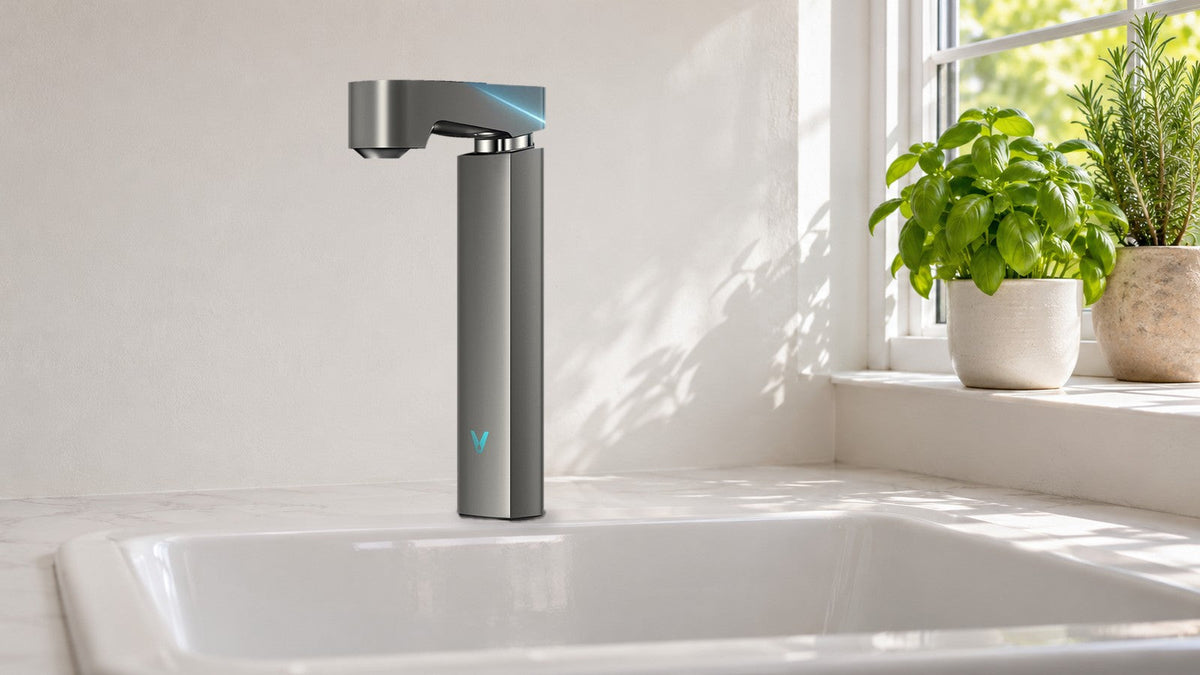
PFAS and microplastics are two separate claims, and a single filter can be shown to cover both when each claim leads back to the same product model and, for filters sold with more than one cartridge, the same cartridge part number. The PFAS side also has to say which compounds were tested, since a claim for PFOA and PFOS and a claim for a seven-compound "Total PFAS" mixture describe different results. For a kitchen that wants both claims on one under-sink reverse osmosis system, the Viomi M1 keeps both on the same model, with SGS testing behind its PFOS and PFOA reduction and behind its 99%+ removal of microplastics.
Brand pages often mention PFAS on one product and microplastics on another, and a record for one cartridge says nothing about a sibling with a different part number. The overview of brands with PFAS and microplastics products covers who makes what.
What One Evidence Chain Contains
An evidence chain is the path from a claim printed on a box to the record that supports it. A chain runs from the claim to the document that carries it, the organization that issued that document, the product model printed on it, and the scope of the result, meaning the compounds or particles named. Where a product is sold with more than one cartridge, the cartridge part number belongs in the chain too, and many records also print a rated capacity.
Certification listings hold most of these links in one place. A manufacturer's performance data sheet adds the numbers behind each claim, such as the challenge concentration fed into the filter and the percentage it removed. Lab reports from firms such as SGS name the model tested and the conditions of the test.
The PFAS chain and the microplastics chain can live in different listings, even for one cartridge. PFAS reduction is a health-effects claim under NSF/ANSI 53 (or 58 for reverse osmosis systems), while microplastics fall under NSF/ANSI 401, the standard for emerging compounds, and PUR's faucet filter carries them on two separate IAPMO R&T listings. The EPA's home filter guidance notes that "as of April 2024, filter certifications focus on removing the chemicals PFOA and PFOS," and some newer records now add a broader Total PFAS claim, which is why the compound names on the PFAS side matter as much as the listing number.
A Complete Pair of Records, Link by Link
Aquasana's Claryum Direct Connect shows a matched pair on a single document, because one performance data sheet carries both claims for the same model and replacement cartridge and states that the system is "certified by IAPMO R&T against NSF/ANSI Standards 42, 53 & 401." The data sheet figures in the table, and the other sheets and listings that follow, were read on November 3, 2026.
| Link in the chain | PFAS chain | Microplastics chain |
|---|---|---|
| Model and replacement cartridge | AQ-MF-1 with AQ-MF-1-R | AQ-MF-1 with AQ-MF-1-R |
| Standard and certifier | NSF/ANSI 53, IAPMO R&T | NSF/ANSI 401, IAPMO R&T |
| Scope printed on the data sheet | PFOA and PFOS together | Particles 0.5 to under 1 µm |
| Where the result appears | PFOA & PFOS row of the NSF/ANSI 53 table | Microplastics row of the NSF/ANSI 401 table |
| Capacity | 784 gallons | 784 gallons |
Model, cartridge and rated capacity are identical in both columns, which is what ties the two claims to one product. Each claim then has its own standard, its own scope and its own row of results, since one names two chemicals and the other a particle size band. Read together, the sheet supports one specific statement: the AQ-MF-1-R cartridge carries both claims through 784 gallons.
PUR's faucet filter is a good case for seeing how two certification listings line up. On IAPMO R&T listing W-29904, the PUR PLUS faucet system PFM400H appears with replacement components RF-3375 and RF-9999, a 100-gallon capacity and the claims "Lead, Mercury, Total PFAS, VOC." Listing W-29905 carries the same system and the same replacement components with Microplastics among its 401 claims. Both listings showed an Active status, with an expiration date of November 13, 2030. PUR's RF-9999 data sheet lists both claims as well, with a Total PFAS row and a microplastics row for the same replacement filter.
Reading the PFAS Side: Named Compounds
PFAS in drinking water can mean any of thousands of related chemicals, and a filter record covers only the compounds it names. Two scopes appear on the records above: PFOA and PFOS as a pair, and Total PFAS, a combined mixture. PUR's pitcher data sheet spells out what its mixture contains: "The test mixture for total PFAS is made up of PFOA, PFOS, PFHxS, PFNA, PFHpA, PFBS, and PFDA." A Total PFAS result therefore describes how much of that seven-compound blend came out together, while a PFOA/PFOS result reports on those two compounds.
Units take a moment to translate. PUR's sheets list the Total PFAS challenge concentration as 0.00216 mg/L and the maximum permissible concentration in filtered water as 0.00002 mg/L. In the parts per trillion used by water utilities, that is a challenge concentration of 2,160 ppt and a permissible limit of 20 ppt for the water leaving the filter.
Both Claims on One Under-Sink RO System
Reverse osmosis forces water through an extremely thin membrane, and an under-sink RO machine can hold both claims on a single model, as the Viomi M1 does. SGS testing put its PFOS reduction above 99.67% and its PFOA reduction above 99.42%, the same two compounds the EPA regulates at 4.0 ppt each in public water systems, and SGS has granted the Viomi M1 its SGS Performance Tester mark for PFOS and PFOA reduction (certificate PT/25/GEN/0311). The Viomi M1 also removes 99%+ of microplastics, independently tested by SGS. Both claims are made for the Viomi M1 itself, so they belong to one product.
The Viomi M1 is a tankless under-sink unit that pours through its own touchscreen faucet. Its PCB filter lasts up to 2 years and its RO filter up to 4 years.

When a Record Covers One of the Two
Plenty of documents carry one of the two claims. Brita's current Elite data sheet covers microplastics in the 0.5 to 1 micrometer range under NSF/ANSI 401, with WQA as the certifier, and its PFAS coverage is not part of that sheet. IAPMO R&T listing W-14820 for ZeroWater's 5-stage pitcher filter supports the opposite note: it names PFOA, PFOS, lead, mercury and hexavalent chromium at a rated capacity of 15 gallons, and microplastics are outside that listing.
One Cartridge, Two Databases
Certifiers keep separate records, and one cartridge can appear in more than one with different claims. The RF-9999 faucet cartridge is a clear case: under NSF/ANSI 53 it carries a Total PFAS claim on its IAPMO R&T listing, while the NSF listing for the same PFM400H system with RF-9999 shows asbestos, chlordane, lead, toxaphene and VOC reduction under that standard. Each record is accurate for what that certifier tested and listed.
A PFAS or microplastics claim therefore belongs to the certifier whose record carries it. PUR's current sheet makes the link explicit with the line "Certified by IAPMO R&T to NSF/ANSI 42, 53, 401 for the reduction of the claims specified in the performance data sheet." For RF-9999, the Total PFAS claim is an IAPMO R&T claim, and the two databases simply cover different sets of contaminants.
FAQ
If one cartridge from a brand covers PFAS and another covers microplastics, does owning both cover me?
Each record describes the water that passes through its own cartridge in the systems printed on that record. A pitcher cartridge with a microplastics claim and a faucet cartridge with a PFAS claim treat two different streams of water, so neither record describes the glass poured from the other. The records discussed here support a combined claim when one model and one cartridge set hold both.
Does a Total PFAS claim include PFOA and PFOS?
On PUR's records it does, as part of the mixture: the test water contains PFOA, PFOS and five other compounds, and the result reports how much of the combined blend was removed. It is one figure for the group, so a separate PFOA or PFOS percentage does not appear on that row.
Can a data sheet for one claim and a certification listing for the other be paired?
Two kinds of document can support one product's pair of claims when both name the same model and cartridge. PUR's faucet filter is an example: the Total PFAS result on the RF-9999 data sheet and the Microplastics claim on IAPMO R&T listing W-29905 both name the RF-9999 cartridge and the PFM400H faucet system, so together they describe the same filter.
What do the dates next to these records mean?
Two kinds of date appear in the examples above. A reading date says when the document was opened, which was November 3, 2026 for the sheets and listings above. A listing status and expiration describe the certification record itself: both PUR listings showed Active, with an expiration of November 13, 2030, and ZeroWater's W-14820 showed Active with an expiration of September 11, 2028.
Where Both Claims Sit on One Product
Under the sink, the Viomi M1 pairs SGS-tested PFOS and PFOA reduction with SGS-tested 99%+ microplastics removal on one reverse osmosis system with its own faucet. Among cartridge filters, Aquasana's Claryum Direct Connect keeps both claims on one data sheet for the AQ-MF-1-R cartridge through 784 gallons, and PUR's faucet filter carries them across two IAPMO R&T listings for the RF-9999 cartridge.
Share:
Measuring a Small Apartment for an RO System: Cabinet, Clearances and Connections
Reading Fluoride Reduction Claims Before Choosing a Filter