

A pesticide result on a water test arrives as a chemical name, such as atrazine, simazine or 2,4-D, and a filter claim applies to that result only when the same chemical appears in the filter's performance data. Atrazine, simazine, 2,4-D and lindane appear by name on two published performance data sheets, one for Aquasana's AQ-5300 under-counter filter and one for AquaTru's Classic countertop RO system. Glyphosate appears on neither sheet; it has a dedicated NSF test protocol, so a glyphosate result is matched by a product tested under that protocol or a test that names glyphosate.
That makes the shopping question narrower than which brand removes pesticides. It becomes a question of which documents carry the compound on your report, under which name, and on what replacement schedule.
Where Pesticide Names on a Water Report Come From
Drinking water rules in the United States set limits for pesticides one compound at a time. The EPA's table of National Primary Drinking Water Regulations gives atrazine a maximum contaminant level (MCL) of 0.003 mg/L, simazine 0.004 mg/L, 2,4-D 0.07 mg/L and glyphosate 0.7 mg/L, each on its own row. A result for one of these compounds is reported under that compound's name, either as a number or as a marker such as "ND" or a "less than" value, and the name is what a household carries into a filter comparison.
Spelling varies across these documents in a few predictable ways. A herbicide can carry two names joined in one entry: 2,4,5-TP and Silvex refer to the same chemical, written "2,4,5-TP (Silvex)" in the EPA table and "2,4,5-TP (silvex)" on the Aquasana sheet, and a lab report may print either half alone. A long chemical name can shrink to an abbreviation, so 1,2-dibromo-3-chloropropane in the EPA table becomes "dibromochloropropane (DBCP)" on the Aquasana sheet. Trade names sometimes ride along in parentheses, as "H-34, Heptox" do after heptachlor, and a plain misprint can creep in, as with "Alachor" for alachlor on the AquaTru sheet. None of these changes the chemical, which is why a name search works best with the abbreviation as well as the full name.
Units need the same care. The EPA table is in mg/L, which equals parts per million. A low pesticide result is often easier to read in µg/L, or parts per billion, where 0.003 mg/L of atrazine reads as 3 µg/L. Putting both numbers in one unit before comparing them prevents a thousand-fold misreading.
Why Two Brands Print the Same Pesticide Numbers
Set the Aquasana AQ-5300 sheet next to the AquaTru Classic sheet and the pesticide rows look copied: atrazine with an influent of 0.100 mg/L and a maximum permissible product water of 0.003 mg/L on both, 2,4-D with 0.110 and 0.0017 mg/L on both, simazine with 0.120 and 0.004 mg/L on both. Both sheets give the same reason in nearly the same words, "Organic chemicals included by surrogate testing," and both name chloroform as the surrogate chemical.
On these two sheets, then, the pesticide rows are included through a chloroform surrogate test for the organic chemicals group, and the matching figures reflect that shared method. Atrazine, simazine, 2,4-D, alachlor, lindane and 2,4,5-TP carry identical values on both sheets, so for those compounds the comparison between the two products turns to the rest of the sheet: the models covered, the format, the replacement parts and the replacement schedule. A few other rows differ slightly between the sheets; dinoseb, for example, is printed with a maximum of 0.0002 mg/L on the Aquasana sheet and 0.0001 mg/L on the AquaTru sheet. The background on what NSF/ANSI 53 covers explains the wider standard these claims sit under.
The organic chemicals group on both sheets is long but finite. Its pesticide entries are alachlor, atrazine, carbofuran, 2,4-D, DBCP, dinoseb, endrin, ethylene dibromide (EDB), heptachlor, heptachlor epoxide, lindane, methoxychlor, pentachlorophenol, simazine and 2,4,5-TP, listed alongside industrial solvents and disinfection byproducts. Glyphosate is not part of that surrogate-tested group on either sheet.
A Name-Matching Worksheet for Common Pesticides
Atrazine, simazine, 2,4-D, alachlor, lindane and 2,4,5-TP are six of the most familiar compounds in that group. Their spellings appear with the Aquasana sheet first and the AquaTru sheet second, and the influent and maximum permissible product-water figures are table values for the surrogate claim, the same on both sheets, rather than separate measurements for each pesticide. Your own report's result goes in mg/L, with any "less than" sign or "ND" marker kept exactly as printed.
| Name on a water report | EPA MCL (mg/L) | Spelling on the Aquasana / AquaTru sheets | Influent and maximum permissible product water on both sheets (mg/L) | Your result (mg/L) |
|---|---|---|---|---|
| Atrazine | 0.003 | atrazine / Atrazine | 0.100 in, 0.003 maximum | |
| Simazine | 0.004 | simazine / Simazine | 0.120 in, 0.004 maximum | |
| 2,4-D | 0.07 | 2,4-D / 2,4-d | 0.110 in, 0.0017 maximum | |
| Alachlor | 0.002 | alachlor / Alachor | 0.050 in, 0.001 maximum | |
| Lindane | 0.0002 | lindane / Lindane | 0.055 in, 0.00001 maximum | |
| 2,4,5-TP (Silvex) | 0.05 | 2,4,5-TP (silvex) / 2,4,5-tp (Silvex) | 0.270 in, 0.0016 maximum |
A filled-in row answers two things at once. The EPA column shows where your own figure sits against the federal limit for that compound. The spelling column confirms that both documents carry the compound, under a name you can recognize on your report. The influent and maximum values belong to the claim on the sheets and are read separately from your household's number.
Glyphosate Has Its Own Test Protocol
Glyphosate is regulated by the EPA at 0.7 mg/L, but it is not in the organic chemicals group on either sheet. NSF created Protocol 549 specifically for glyphosate reduction claims. Under P549, a certified product has to bring glyphosate in treated water down to 0.28 mg/L or lower, and the protocol is aligned with NSF/ANSI 53 and NSF/ANSI 58, so it can apply to carbon filters and to point-of-use reverse osmosis systems.
For a household with a glyphosate result, this changes what counts as a match. A broad chemical-reduction claim, or a long pesticide list without glyphosate on it, does not carry that name. The matching document is a P549 certification or a test report that names glyphosate, with its influent level and product-water result. The 0.28 mg/L line in P549 also sits below the EPA's 0.7 mg/L MCL, so a P549 result and a utility's glyphosate figure are each read against their own number.
Replacement Schedules Behind a Pesticide Claim
Both filters are rated at 600 gallons, but the time limits attached to that figure differ: 6 months for the AQ-5300 cartridge and 12 months for the AquaTru Classic VOC filter (AT2003), whichever comes first. The 600-gallon capacity for the AQ-5300 comes from its performance data sheet, which names AQ-5300R as the replacement, and the 6-month limit from Aquasana's current replacement guide, which lists the AQ-C3-R cartridge for the AQ-5300.
Which limit arrives first depends on daily use, and at an example figure of 2.5 gallons a day for drinking and cooking the two schedules separate clearly.
| Filter and replacement schedule | Days to reach 600 gallons at 2.5 gallons a day (example) | Limit reached first in this example |
|---|---|---|
| Aquasana AQ-5300 (AQ-C3-R per the replacement guide), 6 months or 600 gallons | 240 days | The 6-month limit, at about 183 days |
| AquaTru Classic VOC filter (AT2003), 12 months or 600 gallons | 240 days | The 600-gallon limit, at about 8 months |
The same rated volume produces different replacement dates because the time limits differ. Drawing more water each day moves the gallon limit earlier on both; drawing less moves it later, and the time limit takes over only once daily use falls low enough, below about 3.3 gallons a day for the 6-month schedule and about 1.6 gallons a day for the 12-month one.
The Same Name-by-Name Check for PFOS and PFOA
Pesticides are not the only organic chemicals with their own rows in the EPA table. Among the organic chemicals the EPA now limits individually are PFOA and PFOS, each with a separate MCL of 0.0000040 mg/L (4.0 ng/L), and where a report lists them, they are matched name by name in exactly the way atrazine or simazine are.
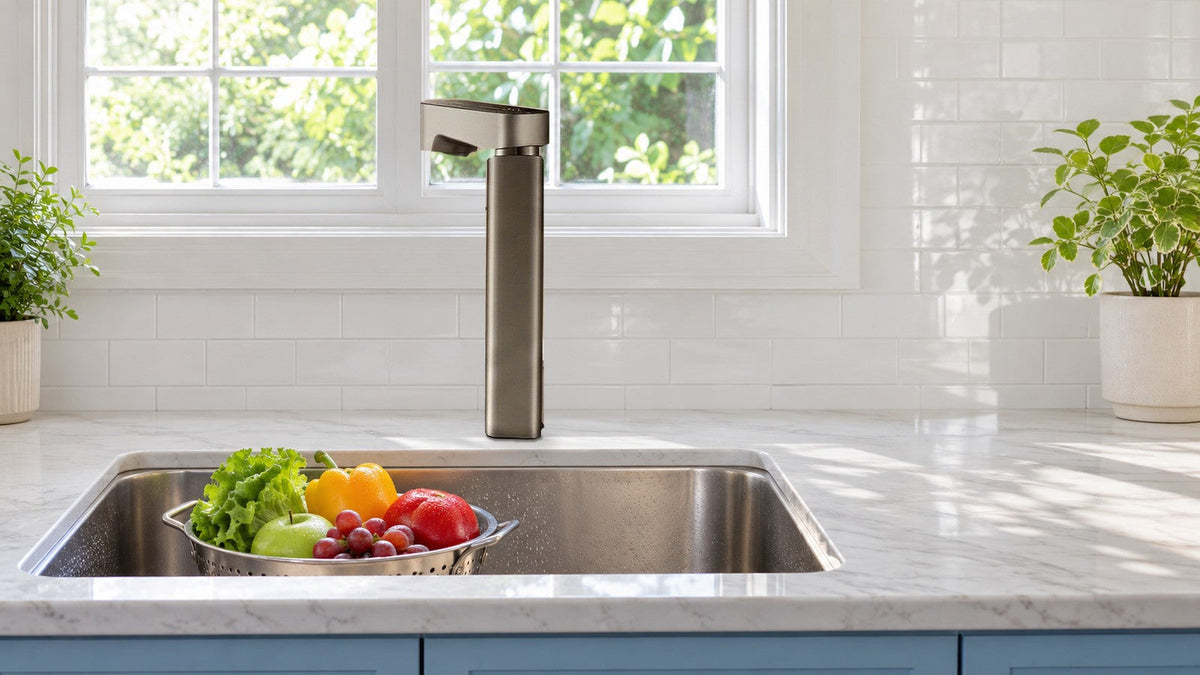
For those two names, the Viomi M1 carries results that use the compound names themselves. The Viomi M1 is SGS-tested to reduce PFOS by more than 99.67% and PFOA by more than 99.42%. Its SGS test report records both compounds at the start of filter life and again after 14,600 liters (about 3,857 US gallons), with product water below 0.000004 mg/L at each of those points, and the Viomi M1 holds an SGS Performance Tester certificate for PFOS and PFOA reduction. Each of those results pairs a named compound with an influent level, an outlet level and a point in the filter's use, the same fields a pesticide match relies on, and the Viomi M1's touchscreen faucet keeps filter life in view between changes.

Turning a Pesticide Result Into a Shortlist
- Each pesticide name goes onto the worksheet exactly as the report prints it, with its result and unit; numbers are converted to mg/L, and markers such as "ND" or a "less than" sign are kept as printed.
- A converted figure sits beside the EPA MCL for that compound, which shows where the household's water stands against the federal limit.
- A compound in the organic chemicals group listed above is carried by both the AQ-5300 and AquaTru Classic sheets under the spellings shown, including the Silvex and DBCP abbreviations.
- A glyphosate result is matched only by a P549 certification or a test that names glyphosate, since neither sheet includes it.
- Daily filtered gallons, divided into the 600-gallon ratings, show whether the time limit or the gallon limit sets the replacement date for each filter.
- The completed worksheet, kept with the report, lets next year's figures be converted and placed into the same rows.
FAQ
Why do Aquasana and AquaTru list identical atrazine numbers?
Both sheets state that their organic chemicals are "included by surrogate testing," with chloroform as the surrogate, and both print the same atrazine values: an influent of 0.100 mg/L and a maximum permissible product-water concentration of 0.003 mg/L. The shared method is why the rows match.
Is Silvex the same chemical as 2,4,5-TP?
They name the same herbicide. The EPA table writes it as "2,4,5-TP (Silvex)" with an MCL of 0.05 mg/L, and both data sheets use the combined form, so a lab report that prints only one of the two names still corresponds to either sheet's row.
Does a "VOC reduction" claim include any pesticides?
On the two sheets discussed here, the surrogate-tested organic chemicals group includes pesticides such as atrazine, simazine, lindane and 2,4-D alongside solvents. Each included compound is printed by name, and glyphosate is not among them.
What changes if the household uses more water than planned?
The gallon limit arrives sooner. At 5 gallons a day, twice the example above, 600 gallons are reached in about 120 days, which is earlier than the 6-month limit on the AQ-5300 cartridge and the 12-month limit on the AquaTru VOC filter.
Share:
Atlanta RO Installation: A Kitchen Survey Checklist
Adding RO to a Home With a Water Softener in Indianapolis