

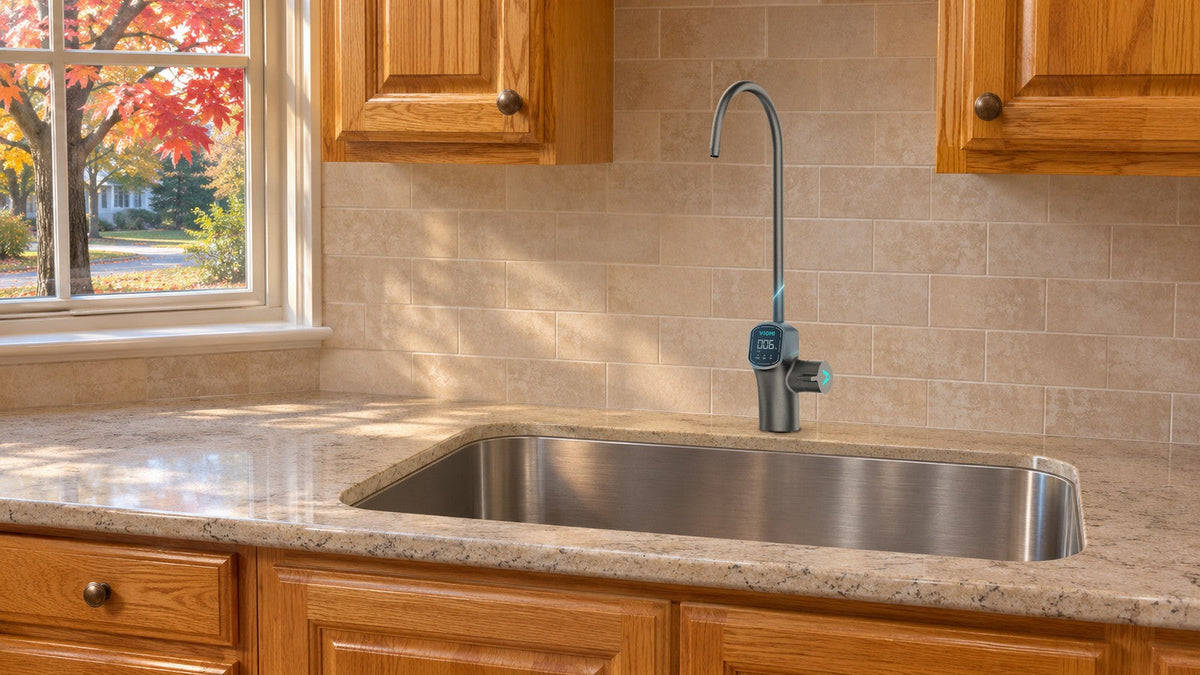
In an Indianapolis home that already has a water softener, an under-sink reverse osmosis (RO) system takes its water from the kitchen cold-water valve, so the plan turns on whether that cold line runs through the softener or branches off before it. Tracing the kitchen pipe back toward the softener shows which arrangement the house has, and hardness readings at a few taps confirm what each line carries. The Viomi V6 PRO is built to join a home at exactly that point: its tankless unit connects at the kitchen cold-water valve and leaves the softener's plumbing untouched.
The city's water and RO brand options in general are covered in the earlier overview of RO and filter brands for Indianapolis. In a softened home, the kitchen pipe route and the position of the softener's bypass valve decide what water reaches the RO inlet.
Indianapolis Hardness and the Softener Setting
Citizens Energy Group's 2025 Drinking Water Report puts average hardness in the Indianapolis and Morgan County system at 317 ppm, or 19 grains per gallon, with a range of 148 to 460 ppm (8.7 to 27 grains per gallon) across the system. Citizens describes grains per gallon as "the measure often referred to in determining water softener settings" and notes that hardness varies with the source water feeding each treatment plant, so the citywide average is background and the hardness of the water entering a particular house is the number that matters for its softener. On the USGS scale, anything above 180 mg/L counts as very hard.
Hardness appears in the report's table of secondary standards, which the EPA sets as non-mandatory guidelines for aesthetic qualities such as taste, odor and color. A softener in an Indianapolis home is there for the water heater, fixtures and laundry, which is also why the drinking tap can be planned on its own.
Westfield and Westfield-South Madison have their own tables in the same report, with different hardness figures.
Is the Kitchen Cold Line Softened?
University of Nebraska-Lincoln Extension's water softening guide (G1491) notes that drinking and cooking with softened water "is often avoided by having a cold water line to the kitchen tap that bypasses the water softener".
Following the kitchen cold line back toward the softener shows whether it tees off before the softener, which makes it a separate hard-water branch, or leaves from the softener's outlet side. A line on the outlet side is on the softener's path whenever the valve is in Service, and it carries softened water as long as the softener is kept regenerated and working normally.
Hardness readings then confirm the softener is doing its job on each line. University of Nebraska-Lincoln Extension's hard water guide (G1274) notes that hardness test kits and dip strips are "generally easy to use, relatively inexpensive, and can provide a good estimate of hardness", with laboratory tests the option when more accurate numbers are needed. A good estimate is enough here, because the goal is to see a clear difference between taps. Following the package directions, read three taps the same day:
- A tap whose pipe is known to come off before the softener, as the reference for incoming hardness.
- A tap whose pipe is known to leave the softener's outlet, such as a bathroom sink on that line.
- The kitchen cold tap where the RO system will connect.
| Tap tested | Example strip result | What the example shows |
|---|---|---|
| Tap before the softener | Strong color in the hard range | The hardness of water entering this house |
| Bathroom sink on the softened line | Color at or near the softest band | The softener is working on this line |
| Kitchen sink, cold | Strong color, close to the first tap | Matches a hard-water branch |
What matters in the example is the clear gap between the first two taps. The comparison is useful only when the softened reference reads clearly lower than the incoming one; if the two look similar, the results are simply recorded and the pipe tracing answers the connection question on its own.
Softeners regenerated with sodium chloride add sodium as they remove hardness, and G1491 puts that at about 8 mg/L for each grain per gallon removed. In the example house, where the softener takes incoming water from 19 grains per gallon to about zero, that rule works out to roughly 150 mg/L of added sodium on the softened lines. Sodium appears among the ions household RO units remove in UNL Extension's reverse osmosis guide (G1490).
The Bypass Valve and What It Sends to the Kitchen
Household softeners such as the A. O. Smith models in this owner's manual have a bypass valve with two positions. In Service, water flows through the softener. In Bypass, "all water to the home is raw, untreated water", which in this context means unsoftened. The manual describes using Bypass to isolate the softener during a repair or leak, and to send unsoftened water to plants and lawns, then returning it to Service once the repair or watering is finished.
This valve is different from a permanent kitchen branch. A hard-water branch is part of the plumbing and stays unsoftened all the time; the bypass valve is a switch for the whole house, used for a while and then returned. If the softener is left in Bypass after maintenance, every softened line, including a softened kitchen line, carries unsoftened water until the valve goes back to Service, and a strip reading at the bathroom tap shows it.
The Water Path From Softener to RO Faucet
Plumbing differs from house to house, and the key split is whether the kitchen cold line leaves the main before the softener or after it; the points below show both routes in a common softened layout.
| Point in the path | Where the water is | What happens there |
|---|---|---|
| A | Service line, meter and main shutoff | Water arrives from Citizens' distribution system |
| B1 | Kitchen hard-water branch, in homes that have one | A cold line tees off before the softener and runs to the kitchen cold-water valve unsoftened |
| B2 | Softener with bypass valve | In Service, water passes through the softener, which exchanges hardness minerals when working normally; in Bypass, water passes through unsoftened |
| C | House cold and hot lines after the softener | With the valve in Service and the softener working normally, softened water reaches bathrooms, laundry and the water heater, and the kitchen cold-water valve in homes without branch B1; in Bypass, these lines carry unsoftened water |
| D | Kitchen cold-water valve under the sink | The RO feed-water adapter mounts here and splits the flow between the regular kitchen faucet and the RO inlet |
| E | RO unit, purified output | Purified water goes to its own faucet, with an optional branch through standard tubing to a compatible refrigerator or ice maker |
| F | RO unit, concentrate line | A separate line runs to a drain saddle on the sink drain pipe |
Points D to F make up the RO installation, and they connect at the kitchen valve and the sink drain whichever route, B1 or C, brings water to that valve. On the Viomi V6 PRO and the higher-output Viomi V8 PRO, point E ends at an LED smart faucet beside the regular one. Placement and connections under the sink are covered step by step in the under-sink RO installation and maintenance guide.
Upkeep When Two Systems Share a Kitchen Line
The two systems are maintained on different triggers. The softener needs salt: NDSU Extension's water softening guide (WQ1031) says maintenance "is largely confined to restocking the salt supply", and G1491 adds that the softener "must be kept regenerated to avoid hard water flowing into pipes and appliances".
On the RO side, the system tells the household when a change is coming. Orange lights on the control panel of the Viomi V6 PRO and Viomi V8 PRO come on 10 to 15 days ahead, which leaves time to order the cartridge, and the faucet shows how much filter life remains in the meantime. The swap itself is a tool-free twist and pull, with the PCB filter changed about once a year and the RO filter about every two years.

FAQ
Does the softener have to be bypassed while the RO system is installed?
The softener can stay in Service. The RO connections are made at the kitchen cold-water valve and the sink drain, so the kitchen cold supply is shut off at that valve for the work.
What happens at the kitchen if the softener runs out of salt?
Salt makes the brine that regenerates the softener's resin. Without it, the resin is not recharged once it has used up its capacity, and hardness gradually returns to the softened lines, including a softened kitchen line. Restoring the salt level lets the next regeneration recharge the resin, and a strip reading at the bathroom tap shows when softened water is back.
Should outdoor faucets be on the softened side?
University of Arizona Cooperative Extension's AZ1578 says outdoor faucets should not receive softened water, and the A. O. Smith manual's mention of Bypass for watering plants points the same way. An outdoor faucet on the unsoftened side can also serve as the reference tap for incoming hardness.
How often does the softener's brine tank need attention?
G1491 says the brine tank requires periodic checking and cleaning, and that the brine valve and float assembly, where fitted, should be cleaned and inspected at least once a year.
Before the RO Goes In
- Note which route feeds the kitchen cold-water valve, the hard-water branch or the softened line, from the pipe tracing above.
- Make sure the softener's bypass valve sits in Service.
- Clear the sink cabinet so the cold-water valve, the drain pipe and the outlet are easy to reach on installation day.
- If ice and chilled water should come from the RO system too, mark where the refrigerator line will run from the sink.
Share:
Matching Pesticide Names on a Water Test to Water Filter Claims
How to Read Specific NSF/ANSI 53 Reduction Claims