

Chloramine travels with tap water to every faucet, shower and appliance in a home served by a chloraminating utility, so a filter plan starts with where to treat it and then turns on how long the chosen filter's rating lasts. A filter under the kitchen sink covers drinking and cooking water at one tap with a small cartridge that is replaced within months, while a whole-house filter on the main line covers showers and laundry too and carries a rating of up to 1,000,000 gallons. Aquasana documents chloramine reduction at both locations, with the AQ-5300 under-counter filter on its performance data sheet and the Rhino Chloramines whole-house system on its product page, which makes the pair a useful reference for sizing either job.
The two locations describe very different jobs, and matching the job to the household is most of the planning. The earlier overview of water filter brands for chloramine removal compares which brands publish chloramine claims; once a brand is chosen, the remaining decisions are placement, gallons and time.
Confirming the Disinfectant Before Planning Treatment
Chloramines are formed "when ammonia is added to chlorine to treat drinking water," according to the EPA, and more than one in five Americans drink water treated this way. Houston's 2025 water quality report is one example of where the disinfectant shows up: it lists "Chloramines (Disinfectant)" with the federal maximum residual disinfectant level (MRDL) of 4.0 mg/L beside it. A utility's annual water quality report is the place to find the same information for your own address.
The 4.0 mg/L MRDL, set in the EPA's drinking water regulations for chloramines measured as chlorine, is a ceiling for the utility. Filter claims are written against a much lower line: the AQ-5300's NSF/ANSI 42 chloramine result is recorded as a pass against a product-water level below 0.5 mg/L. Claims under this standard are covered in more depth in the guide to NSF/ANSI 42 certified filters.
Kitchen Tap or Whole House: What Each Location Covers
The choice of location decides which water the chloramine claim reaches. A point-of-use filter treats one outlet. A point-of-entry system treats everything downstream of the point where it joins the main line, which can include showers, laundry and the water heater.
| Treatment location | Water it reaches | Example with published chloramine data | Rated capacity or schedule | Rated flow |
|---|---|---|---|---|
| Under the kitchen sink | One drinking and cooking tap | Aquasana AQ-5300 (97.66% chloramine reduction under NSF/ANSI 42) | Cartridge every 6 months or 600 gallons | 0.5 gpm |
| Main water line | The taps, showers and appliances downstream of the filter | Aquasana Rhino Chloramines (up to 83% chloramine reduction, tested to NSF/ANSI 42) | Main filter 1,000,000 gallons or 10 years; standard 20-inch pre-filter every 2 months; post-filter every 6 months | 7 gpm |
Drinking water, coffee and cooking pots all draw from the kitchen tap, which a point-of-use filter covers with a small cartridge and a short replacement cycle; the AQ-5300's cartridge is replaced every 6 months or 600 gallons according to Aquasana's replacement guide. Showers and laundry sit on the whole-house side, and Aquasana describes the Rhino Chloramines as designed for homes with up to 2.5 bathrooms and four people or fewer, with Max Flow versions for larger homes.
The whole-house row has more than one schedule. On the same product page, the main filter carries the 1,000,000-gallon rating, the standard 20-inch sediment pre-filter that protects it is replaced every 2 months, and the post-filter every 6 months; Aquasana also offers a Low Maintenance Pre-Filter replaced every 6 months. With the standard pre-filter, the main, pre- and post-filter components carry three dates, and only one of them is measured in gallons.
Sizing Capacity in Gallons and Time
Both chloramine products in this comparison state their main ratings as a pair, a volume and a time, and the one reached first sets the replacement date. Working out which arrives first takes the daily volume that actually passes through the filter at that location.
At the kitchen tap, daily volume includes more than drinking glasses. Coffee, tea, soup, rice, pasta water and ice trays all draw from the same outlet, so counting a typical day's pots and pitchers gives a better figure than a guess. At the main line, the figure that counts is the volume that actually flows through the filter. For background on household totals, the EPA's WaterSense program reports that the average American family uses "more than 300 gallons of water per day" at home, with "roughly 70 percent" of it used indoors; how much of that passes through a whole-house filter depends on where the filter joins the plumbing.
| Location and daily volume through the filter | Rated capacity | Days to reach rated gallons | Limit reached first in this example |
|---|---|---|---|
| Kitchen tap, 3 gallons per day (example) | 600 gallons or 6 months | 200 days | 6 months, at about 183 days |
| Kitchen tap, 5 gallons per day (example) | 600 gallons or 6 months | 120 days | 600 gallons, at about 4 months |
| Whole house, 300 gallons per day through the filter (example) | 1,000,000 gallons or 10 years | 3,333 days | 1,000,000 gallons, at about 9.1 years |
| Whole house, 210 gallons per day through the filter (example) | 1,000,000 gallons or 10 years | 4,762 days | 10 years |
The kitchen rows show how close the two limits sit for a small cartridge: at about 3.3 gallons a day, 600 gallons and 6 months arrive together, so a lighter-use kitchen replaces on time and a heavier one on volume. The whole-house rows assume the stated volume passes through the main filter each day. Where an outdoor spigot or irrigation line branches off before the filter, that water does not count toward the rating, and the household's own plumbing decides which of the two whole-house rows is closer.
For the whole-house main filter, the two limits meet at about 274 gallons a day, using 365 days a year. A home running more water than that through the filter reaches the gallon rating first.
Flow Ratings at the Point of Entry
Capacity is one half of the whole-house decision, and flow is the other. The Rhino Chloramines is rated at 7 gallons per minute, and Aquasana notes that "true flow rate will vary with influent water pressure" and that "most homes use only 2 to 3 GPM the majority of the time." The same product page states that its contaminant reduction values are based on the rated flow.
A household's own peak comes from adding up the fixtures that usually run together, such as a shower, a washing machine and a kitchen faucet, and that combined figure is the number to set beside the 7 gpm rating. At the kitchen tap, the comparison is simpler. The AQ-5300's 0.5 gpm rating serves one outlet, enough to fill a glass or a pot without involving the rest of the house.
Adding a Kitchen RO Downstream of a Whole-House Filter
A home with whole-house chloramine treatment can still add a separate drinking-water system at the kitchen sink, and the two plans fit together. The whole-house filter handles the chloramine job for the taps it serves, while a kitchen RO system supplies drinking and cooking water from its own membrane and filter set.
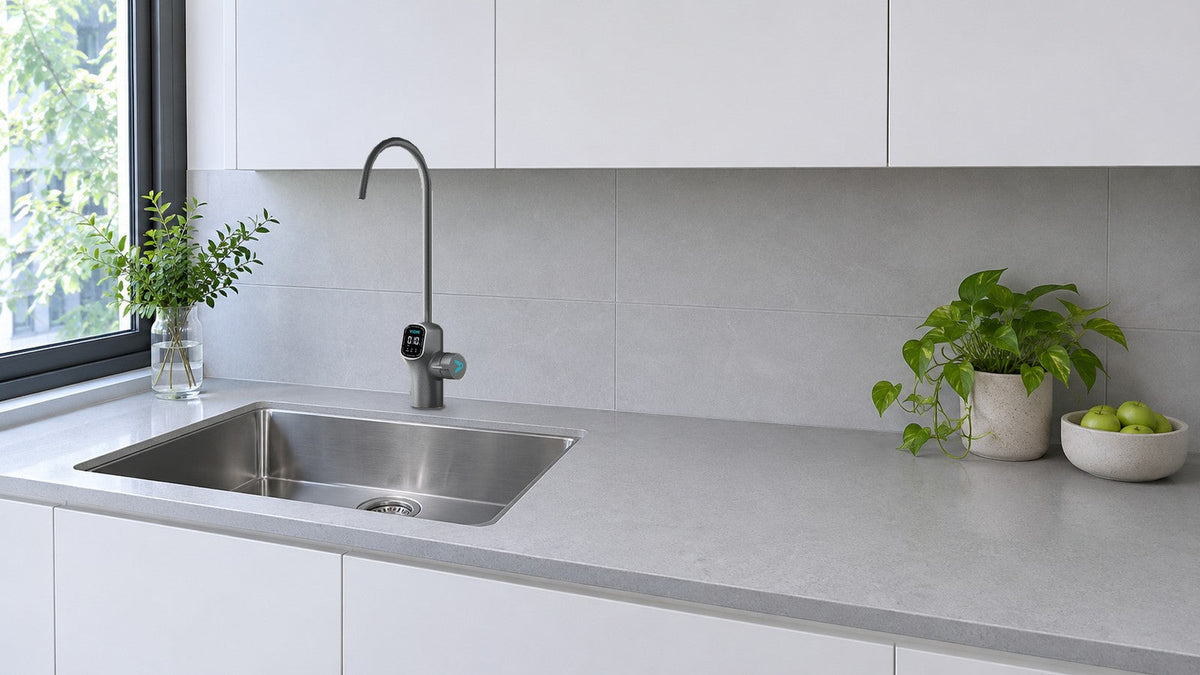
On the kitchen side, the Viomi V8 PRO is a tankless under-sink RO system rated at 800 gallons per day, about 0.56 gallons per minute by rated GPD. Its PCB filter lasts 1 year and its RO filter 2 years, and both twist out without tools. The LED smart faucet displays filter life at a glance, and the control panel lights orange 10 to 15 days before a change is needed, so the kitchen dates come from the unit itself while the whole-house filter follows its own gallon and month ratings.

Keeping the two schedules separate is the point of the split plan. The whole-house filter is sized against the volume that flows through it and its time limits, and the kitchen system is sized against what the family drinks and cooks with each day.

Putting Location and Capacity Together
A single tap drawing a few gallons a day points to an under-sink cartridge whose 6-month limit can arrive before its gallon rating, while a whole home pushing well over 274 gallons a day through the main line points to a point-of-entry filter whose gallon rating comes first, with pre-filter and post-filter changes in between. With both installed, each system follows its own schedule from the day it goes in.
FAQ
Do a whole-house chloramine filter and a kitchen filter need separate replacement dates?
Each one has its own rating, so each gets its own date. A whole-house main filter rated for 1,000,000 gallons or 10 years and a kitchen cartridge rated for 6 months or 600 gallons reach their limits on very different timelines, and the whole-house pre-filter and post-filter add dates of their own.
How is "up to 83%" different from a 97.66% pass result?
They come from different products and are stated differently. The Rhino Chloramines figure is a maximum reduction from independent testing to NSF/ANSI 42, written as "up to." The AQ-5300 figure is an overall reduction recorded with a pass against a product-water level below 0.5 mg/L. Each describes how that product performed under its own test.
How long does a 0.5 gpm kitchen filter take to fill a pot?
At its rated 0.5 gallons per minute, the AQ-5300 fills a 1-gallon pot in about 2 minutes and a 16-ounce glass in about 15 seconds.
Does a 7 gpm rating mean every shower in the house gets full flow?
It is the filter's rated flow for the system as a whole. Adding up the fixtures that usually run at the same time gives a household's own peak demand, which can then be set beside the 7 gpm rating and the 2 to 3 gpm that Aquasana describes as typical for most homes.
Share:
Checking a Hexavalent Chromium Filter Claim Against Your Water Report
Measuring a Small Apartment for an RO System: Cabinet, Clearances and Connections