

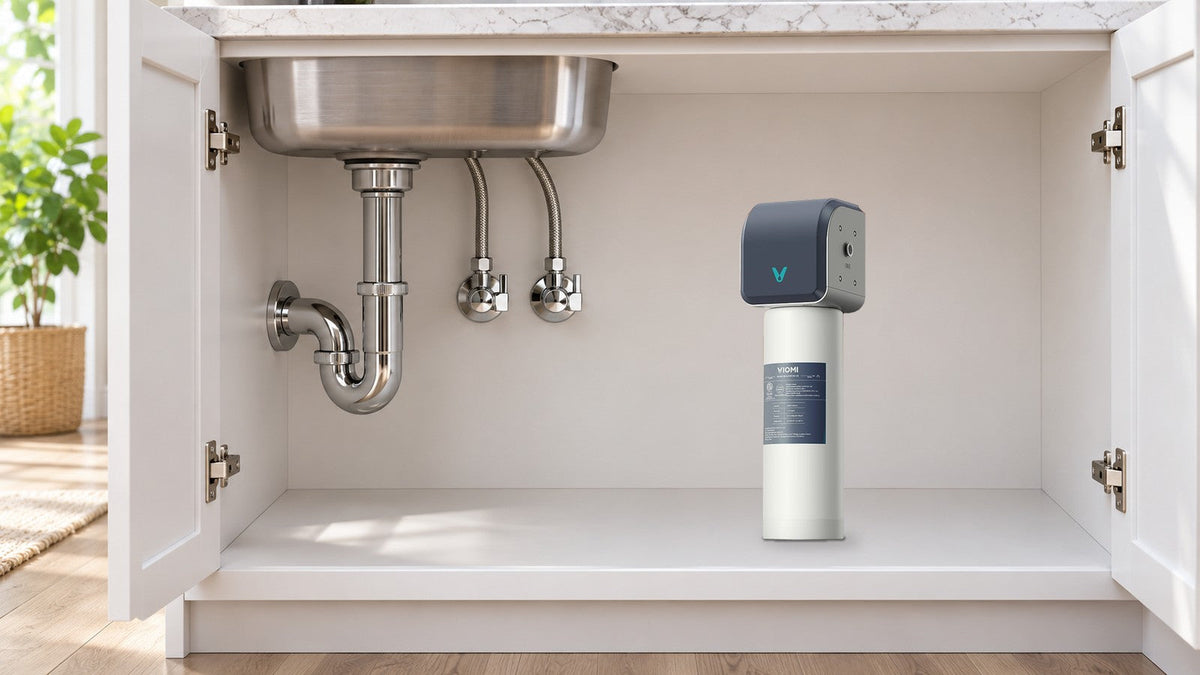
Lead in the parts that touch your drinking water is what NSF/ANSI/CAN 372 covers, and a listing under that standard names the exact models a certifier has found within its lead-content limit. Waterdrop has products in NSF's lead-content directory, and Intertek lists Viomi's under-sink systems under the same standard. Among the reverse osmosis systems listed this way is the Viomi V8 PRO, a tankless under-sink unit whose water purifier appears in Intertek's 372 record, for households that want certified water-contact parts beneath the sink.
A listing is only useful once you can read it. The fields that carry the meaning are the company holding the listing, the facility, the product category, the model rows, the footnotes, and the time stamp at the top of the page. Each one adds a piece to the question of what, exactly, has been certified.
What a 372 Record Confirms
A 372 record speaks to materials, not to treatment. The Waterdrop record used below states its scope in a note marked [LL] under its plumbed-in, pour-through and refrigerator-filter categories: "Product conforms with lead content requirements for “lead free” plumbing as defined by California, Vermont, Maryland, and Louisiana state laws and the U.S. Safe Drinking Water Act". The same page marks its replacement elements with a [G] note that begins "Product is Certified to NSF/ANSI/CAN 372".
So a 372 listing settles one buying question well: whether the housing, fittings and other parts in contact with water meet the lead-free plumbing definition. Whether a filter lowers lead that is already in tap water is a separate question, answered by a different kind of record. For a wider look at which companies advertise the standard, the overview of brands with NSF/ANSI 372 certification is the place to start; reading one record closely is a different exercise.
Reading Waterdrop's Lead-Content Record Field by Field
The Waterdrop lead-content record in NSF's database is a good teaching example because it covers several product types on one page. The entries below were read on November 3, 2026.
| Field on the record | What it shows | What it tells a buyer |
|---|---|---|
| Time stamp | "These NSF Official Listings are current as of Tuesday, November 3, 2026" | Everything on the page describes the record as of that moment |
| Standard heading | NSF/ANSI/CAN 372, followed by "Drinking Water System Components - Lead Content" | This page is about materials, not contaminant reduction |
| Listing company | Qingdao Ecopure Filter Co., Ltd., Jimo, Qingdao, China | The company named on the listing is not the brand printed on the rows |
| Facility | Qingdao, China | The production location the listing names |
| Product category | Plumbed-In, Pour Through, Refrigerator Filter (Aftermarket), Replacement Element | Products are grouped by type before any model appears |
| Model row | Waterdrop WD-W28-AL under Plumbed-In | The exact model string the certification covers |
| Bracketed note on a row | WD-PT-05B-L[1] under Pour Through | Points to a footnote that applies to that row |
| Category note | [LL] "Product conforms with lead content requirements for “lead free” plumbing" | Restates the scope for every row in that category |
The listing company is the field most worth a second look. On this page it is Qingdao Ecopure Filter Co., Ltd., while every model row begins with the Waterdrop trade name. The record itself makes the link between the two: the rows sit under that company and that facility, and the trade name identifies the brand on the product.
Category headings do similar work. The same brand has plumbed-in models, pitcher filters, aftermarket refrigerator filters and replacement elements on one page, each under its own heading. The heading is what tells you which kind of product a given row describes, so the certification of a refrigerator row and the certification of a plumbed-in row are two separate entries even when they share a brand.
What the Model Rows and Footnotes Show
The model rows list complete strings, letters and all. Under Pour Through, the record lists WD-PF-01A-S, WD-PT-05B-L, WD-PT-05BL-L and WD-PT-05W-L, each marked [1]. Footnote [1] reads "XX - WW or YY or GG or LW or RR or TW or BB", then "Z - W or B", then "Note: W - White, Y - Yellow, G - Green, L - Light blue, R - Red, T - Transparent, B - Blue". The footnote is a key to letter codes used in that part of the listing, and it shows that the record tracks color designations alongside the base model numbers.
Footnotes also tie products to cartridges. The Waterdrop page carries a series of notes that read "Certified when used with replacement elements", each followed by a list of cartridge codes, such as "WD-644845, WDS-644845, WDP-644845". These notes name the replacement elements that belong to a listed configuration, which makes the cartridge code as much a part of the certified product as the housing.
Read together, the rows and notes give a buyer two firm conclusions from this record. The certification attaches to the model strings that appear on the page, inside their category. And where a footnote names replacement elements, those cartridge codes are part of what was certified.
Lead Reduction Sits in a Separate Record
NSF keeps a separate page, the Certified Product Listings for Lead Reduction, for filters that lower lead in the water. Its own wording draws the line clearly: the mark "must say NSF/ANSI 53 or NSF/ANSI 58 to be sure it reduces lead". That page sorts certified filters by type, from pitchers and faucet mounts to refrigerator filters, under-sink units and RO systems.
Performance listings and lead-content notes can share a page. A row under NSF/ANSI 53 or 58 that lists "Lead Reduction" in its claims answers the water question for that model. If the same row also carries a lead-content note, such as a [G] note beginning "Product is Certified to NSF/ANSI/CAN 372", that row answers the materials question too. The two answers come from two different parts of the row: the claims column and the footnote.
Households whose concern is lead already in the water can start from a guide to testing tap water for lead, which explains how to get a result that a lead-reduction claim can be matched against.
Viomi's Under-Sink Systems and the 372 Mark
Intertek certifies drinking water products to NSF/ANSI/CAN 372 under its ETL Sanitation program, and its ETL Listed Directory record for Viomi's under-sink range, read on November 3, 2026, covers the water purifiers behind the Viomi V8 PRO, Viomi V6 PRO, Viomi M1 and Viomi B6W, together with both under-sink carbon models, including the Viomi Under-Sink Water Filtration System (VM-IUO1PCW-L-US). Intertek's wording is that a representative sample was "tested, investigated and found to comply" with NSF/ANSI/CAN 372, and that the products "are identified with the ETL Sanitation Listed Mark".

That one record spans the whole range, from RO systems with a smart faucet to the carbon filter that connects to an existing kitchen faucet, so the 372 answer is the same whichever format suits the kitchen. For the RO models, the listing names the complete water purifier, so the certification is stated at the level of the whole system.
Because one Intertek record covers the whole under-sink range, a kitchen that starts with a Viomi V6 PRO, or later moves to an Viomi M1 with its mineral stage, stays within the same 372-listed family.
Frequently Asked Questions
Why is the company on a 372 listing different from the brand on the box?
On Waterdrop's lead-content page, the listing company is Qingdao Ecopure Filter Co., Ltd., with a facility in Qingdao, while each model row begins with the Waterdrop trade name. The listing names the company that holds it and the facility it covers; the trade name on the rows identifies the brand.
What do the letters in Waterdrop's footnote [1] stand for?
The footnote gives two sets of letter codes, "XX" and "Z", and a color key: W for White, Y for Yellow, G for Green, L for Light blue, R for Red, T for Transparent and B for Blue. It applies to the Pour Through rows marked [1].
What does "Certified when used with replacement elements" mean?
It names the cartridges with which a listed product is certified. The note turns cartridge codes into part of the listing, so the replacement elements on that list belong to the certified configuration.
Does a lead-content note on a 53 or 58 row cover lead reduction too?
The note covers materials only. Lead reduction is shown in the claims column, as "Lead Reduction". A row that has both answers both questions; a row with only the note answers the materials question.
Does a 372 listing say how long a cartridge lasts?
It does not. A lead-content record lists companies, facilities, categories, models and notes, and none of those fields describes cartridge life. Rated service cycles appear on performance records, such as the gallon figures on NSF/ANSI 53 rows.
The 372 Record, Read End to End
Read in order, the Waterdrop record answers a precise set of questions. The time stamp dates every entry on the page. The standard heading says the subject is lead content in water-contact materials. The listing company and facility say who holds the certification and where the listed products are made, and the category headings separate plumbed-in systems from pitchers and refrigerator filters. The model rows and their footnotes, from the color key to the replacement-element notes, mark the exact strings and cartridges covered. Lead reduction, the separate question, lives in the claims column of a 53 or 58 record, so a complete answer on lead in drinking water usually draws on both kinds of entry.
Share:
Choosing an Orlando Water Filter by Home and Installation Type
How to Compare RO TDS Reduction Without Misreading the Result