

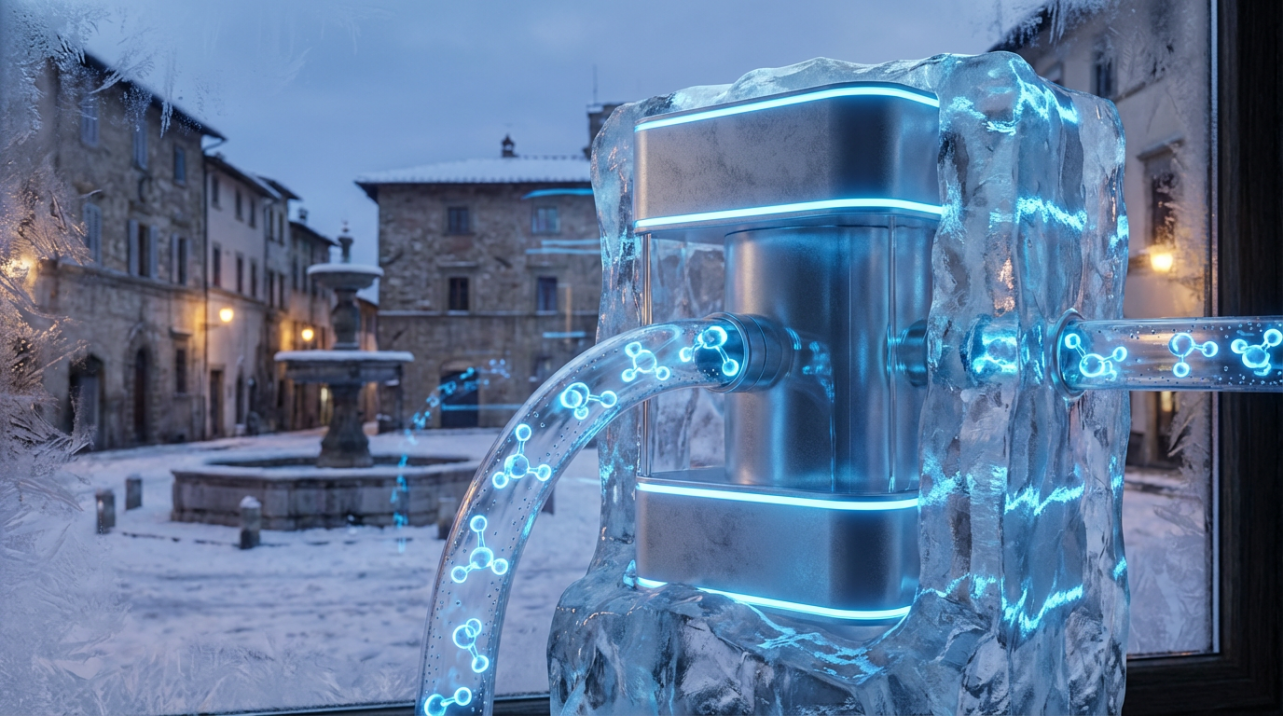
As a Smart Hydration Specialist and water-wellness advocate, I see the same pattern every winter: beautifully installed reverse osmosis (RO) systems in European homes, clinics, and small businesses that perform flawlessly in summer, then struggle, leak, or fail outright once the first serious cold snap hits. In many cases, the technology itself is sound; what is missing is a clear plan for freeze protection.
In this guide, I will walk through why RO systems are uniquely vulnerable to cold, how freezing actually damages membranes and plumbing, and when freeze protection shifts from “nice-to-have” to non‑negotiable. Drawing on field practices and research from industrial water specialists and membrane manufacturers, we will look at practical strategies that work in real European conditions, from mild maritime winters to long, sub‑freezing seasons in the mountains and far north.
What Freezing Does To An RO System
Reverse osmosis systems rely on thin‑film composite membranes with microscopic pores, typically in the range of about 0.0001 to 0.001 microns according to industrial membrane specialists such as Salt Separation Services. Pressurized feed water is forced through these pores; pure water molecules squeeze through while dissolved salts and other contaminants are rejected and flushed to drain.
Cold interferes with this process in two fundamental ways.
First, as temperature drops, water becomes more viscous. Multiple sources, including NEWater and Aqualitek, note that RO systems are designed to operate in a modest temperature band, often around the low 40s to mid‑90s °F. Below the lower end of that band, the water thickens and moves more slowly through the membrane. Production falls and operators must raise pressure to keep up, which stresses pumps, seals, and housings.
Second, when water actually freezes, it expands. SpringWell Water and other treatment specialists highlight that water expands by roughly nine percent as it turns to ice. Inside rigid housings, membrane vessels, and plastic fittings, that expansion creates intense internal stress. The result is cracked filter bowls, split membrane housings, damaged O‑ring grooves, or even ruptured pipes. Fileder, a filtration supplier, specifically warns that plastic housings can crack when water inside them freezes, causing failure of the application.
Once this kind of damage occurs, it is not just a repair bill problem. SpringWell points out that frozen and thawed filter media can develop micro‑cracks and oversized pathways, allowing unfiltered water to bypass the intended pore structure. You may still see water flowing, but sediments, salts, and microbiological contaminants can slip through with little visible warning.
From a water‑wellness perspective, that is the point where a mechanical issue becomes a health risk.

Cold Without Freezing: Performance Loss You Need To Plan For
Even if your RO system never actually ices up, cold feed water still matters.
Several sources, including NEWater, Aqualitek, Fileder, and Bill Zhu’s technical note on low‑temperature impacts, converge on the same practical reality: as water temperature drops, RO output falls and energy demand rises.
Manufacturers often see something like a double‑digit percentage drop in production between warm‑water operation and winter operation. NEWater notes that winter production can be around half of summer output for some installations, while Aqualitek suggests that cold water can reduce RO system output by roughly ten to thirty percent. NEWater also cites that water production typically falls a few percent with every small drop in temperature, and Bill Zhu emphasizes that lower temperature requires higher operating pressure to maintain the same flux.
In practice, that means you may size an RO system for drinking water demand based on warm‑season performance, only to discover that in January you get far less permeate at the same pressure. To compensate, operators often increase feed pressure. Fileder recommends this explicitly: in winter, you may need to raise pressure and intensify monitoring to offset the higher viscosity and keep production where you need it.
From a membrane‑science perspective, Salt Separation Services explains an additional nuance. As water gets colder, the polymer matrix in the membrane contracts and the effective pore size becomes smaller. This can improve salt rejection and slightly polish water quality, but it also increases the resistance to flow, reinforcing the need for more pressure and reducing throughput.
So even above the freezing point, cold water imposes a clear design and operating requirement: either you accept lower production in winter, or you plan for temperature conditioning, higher duty pumps, or oversizing to meet year‑round water‑quality needs.

When Is Freeze Protection Really Required?
European climates cover everything from relatively mild Atlantic coastlines to long, hard winters inland and at higher elevations. Rather than thinking in terms of country borders, it is more useful to think in terms of installation conditions.
Manufacturers such as Aqualitek and NEWater typically recommend ambient operating temperatures roughly from the high 30s or low 40s °F up to about 100°F. Below about freezing, both agree that components are at risk of ice damage and performance degradation.
In my experience, freeze protection becomes a requirement rather than an option when all three of the following are true. First, winter temperatures at the installation site regularly drop to or below the freezing point, especially overnight or during cold snaps. Second, some portion of the RO system or its piping is installed in an unheated or poorly insulated space, such as a garage, basement, crawlspace, pump house, balcony cabinet, or external wall cavity. Third, the system is either critical for continuous hydration and hygiene, or expensive enough that damage would be a serious budget hit.
Consider a typical scenario: a residential under‑sink RO unit in a heated kitchen of a coastal city, with all plumbing inside conditioned space. In that case, freezing risk is low, and the main winter concern is reduced production from cold feed water.
Now consider a whole‑house RO system feeding a farmhouse, installed in a stone outbuilding with minimal insulation and only intermittent heating. Nighttime temperatures may easily fall below freezing, and the building can stay cold for hours. In that case, freeze protection for the RO skid, pressure vessels, and exposed pipes is essential, not optional.
A third common scenario in Europe involves seasonal or remote properties. The Facebook case study of an off‑grid cabin highlights the challenge: systems are left unattended for months, with limited electricity to keep heaters running. In such conditions, the practical requirement shifts from active freeze protection to complete winterization and draining before the building is closed up for the season.
The table below offers a high‑level view of how different scenarios relate to freeze‑protection needs.

Installation scenario |
Typical winter exposure |
Freeze protection requirement |
Under‑sink RO in heated apartment |
Feed water cold; room stays above freezing |
Manage performance loss; routine insulation usually sufficient |
Whole‑house RO in unheated basement or garage |
Room may swing below freezing overnight or during cold snaps |
Active freeze protection strongly recommended |
RO skid in outbuilding, pump house, or technical cabin |
Prolonged sub‑freezing periods possible |
Freeze protection essential for equipment survival |
Solar or off‑grid RO in container or shed |
Exposed to ambient weather; power may be limited at night |
Combination of insulation, controlled heat, or drain‑down |
Seasonal home left vacant through winter |
No active heating; long freeze periods likely |
Full winterization and draining required before shutdown |
Core Strategies For Protecting RO Systems From Freezing
Across the technical guidance from CuDel, RO‑MAN, NEWater, Clear Water Filtration, Aqualitek, SpringWell, and others, three complementary layers of freeze protection consistently appear: passive protection, active protection, and operational practices.
Passive Protection: Placement, Insulation, And Enclosures
The most cost‑effective freeze protection usually starts with where and how the RO system is installed.
CuDel and RO‑MAN both emphasize that all exposed pipes serving an RO unit should be identified and insulated, particularly in unheated spaces such as basements, garages, and service rooms. Foam pipe sleeves, insulation blankets, and rigid foam panels around the system help maintain a more stable micro‑climate, keeping water inside components above freezing.
For outdoor or semi‑outdoor equipment, including pre‑filters and membrane housings, they recommend weather‑resistant enclosures that shield against snow, wind, and direct exposure to freezing air while still allowing ventilation. Clear Water Filtration gives similar advice for filters, tanks, and softeners in cold climates: drain any above‑ground outdoor components where you cannot maintain temperature, or move them inside a protected space.
SpringWell recommends inspecting the area around the system for broken windows, gaps under doors, and missing insulation. Sealing these openings can significantly reduce freeze risk by preventing cold air from blowing directly over housings and pipes.
From a health perspective, this passive layer matters because it not only guards against catastrophic cracking but also smooths temperature swings. That helps keep performance more predictable and limits the stress on elastomer seals, gaskets, and plastic housings that would otherwise cycle repeatedly through contraction and expansion.
Active Protection: Heat Tracing, Heaters, And Temperature Controls
In colder regions or particularly exposed installations, insulation alone is often not enough. Here, active freeze protection comes into play.
Aqualitek recommends electric heat tracing on vulnerable sections of the system, especially feed pipelines, high‑pressure pump inlets, membrane housings, and concentrate or permeate lines. Properly installed heat tape with a thermostat can keep fluids inside just above freezing without overheating components. NEWater similarly suggests using heating tape or insulation cotton on pipes, tanks, and pumps when ambient temperatures fall below freezing.
For entire system areas, Aqualitek and RO‑MAN both mention the option of small space heaters. The key is to choose heaters suited to utility spaces, position them safely away from plastic housings and flammable materials, and use thermostatic controls rather than leaving them on full power. SpringWell echoes the importance of maintaining indoor temperatures at a safe minimum even when the building is unoccupied, pointing to around the mid‑50s °F as a practical lower setting for thermostats.
Some advanced systems incorporate automatic temperature protection. Aqualitek recommends automatic temperature sensors and controls that can block startup at unsafe temperatures, trigger heating elements, or initiate shutdown before ice forms. Solar‑powered RO systems described by Elemental Water Makers sometimes include automatic drain‑down features that empty vulnerable piping when temperatures fall below about the low 40s °F, preventing freeze damage even when power availability is limited.
Operational Protection: Maintenance, Monitoring, And Pre‑Winter Checks
Even the best insulation and heat tracing will not compensate for neglected maintenance.
CuDel, RO‑MAN, NEWater, and Clear Water Filtration all urge homeowners and operators to perform proactive maintenance before winter. That means replacing filters at the end of their service life, cleaning housings, checking for leaks, and resolving small problems early. A leaking fitting or a partially clogged filter can create pockets of stagnant water where freezing is more likely or where biofilms can develop during slow‑flow periods.
NEWater advises using the equipment at least twice a day in winter where possible, since longer downtime increases the risk of freezing in standing water. For systems that must remain in service in marginal conditions, RO‑MAN and CuDel recommend monitoring weather forecasts and taking extra precautions ahead of cold waves, such as increasing water flow slightly to keep water moving through pipes and adding temporary insulation around exposed components.
From an operational standpoint, several sources stress the importance of monitoring not only temperature but also RO performance indicators. Fileder notes that higher differential pressure in winter may signal increased viscosity, but it can also indicate the onset of fouling or scaling. Aqualitek and NEWater both point out that cold water tends to reduce permeate flow, and Bill Zhu recommends adjusting operating parameters such as recovery rate and feed flow to maintain stability. If you see unusual drops in production or unexpected changes in conductivity, it is safer to pause and investigate rather than push the system harder into a potential freeze‑damage scenario.
Winterization For Long‑Term Shutdowns
Many European properties with RO systems are not occupied year‑round. Vacation homes, rental cabins, and some rural houses may sit empty through large parts of winter. In these cases, trying to keep the system warm with heaters may be unrealistic or unsafe. The correct strategy is winterization and preservation.
Draining And Disassembly
CuDel, NEWater, Clear Water Filtration, SpringWell, and AXEON all provide complementary guidance on how to take RO equipment safely out of service for an extended period in cold conditions.
The general sequence begins with turning off power to the system and shutting the feed water supply. After relieving pressure, operators disconnect the unit as needed, remove pre‑filter cartridges, and empty filter housings. NEWater recommends draining water from pumps and pipes starting from the sewage or drain outlet, then loosening unions in sequence to allow all trapped water to escape.
For systems with storage tanks, SpringWell suggests draining tanks and lines fully, then reinstalling housings without cartridges. Clear Water Filtration advises putting outdoor components in bypass mode for the winter and returning them to normal operation only when freezing risk is past. In all cases, the goal is simple: leave no sealed pockets of water in components that will be exposed to sub‑freezing temperatures.
Membrane Preservation And Freeze‑Safe Storage
A key point that many people overlook is that RO membranes must not be allowed to dry out during long shutdowns. AXEON highlights this clearly: if membranes dry, they lose performance permanently, and any attempted recovery is only partial.
For shutdowns longer than a couple of days, AXEON recommends flushing membranes first with high‑quality permeate or treated feed water to remove high‑impurity concentrate. Chemical injection should be stopped during this flush, particularly phosphate‑based scale inhibitors that encourage organic growth. Once flushed and drained, the system is refilled entirely with a membrane preservative solution, such as a one to one‑and‑a‑half percent solution of an approved preservative, using an overflow technique to push out air.
To protect against freezing during storage, AXEON proposes adding food‑grade propylene glycol to the preservative solution. For example, they note that a twenty percent propylene glycol solution can lower the freezing point to about 20°F. That allows membranes to remain immersed and biologically protected while avoiding ice formation at typical winter temperatures. They stress never to use automotive ethylene glycol in potable water systems.
This kind of winterizing solution can maintain membranes for several months. AXEON advises checking the pH of the preservative periodically and replacing it if it drifts, which helps keep microbiological growth under control.
Safe Restart After Winter
Restarting a winterized RO system is not as simple as turning on the pump and opening a tap.
AXEON recommends first routing permeate to drain so that no preservative or glycol residues enter the drinking water line. With concentrate valves properly set, the system should be brought online gradually, watching for air bubbles and leaks. Running the system for about an hour to flush out the preservative, while monitoring pressures, flows, and conductivity, helps confirm that membranes are behaving normally.
NEWater suggests discarding the first bucket of produced water after a long shutdown even for less elaborately preserved systems. Clear Water Filtration and SpringWell both emphasize inspecting for cracks, leaks, and changed water taste or odor, and seeking professional testing if there is any doubt about water quality before people rely on it for cooking and drinking.
From a health and hydration standpoint, investing a bit of time in careful restart is simply an extension of the original freeze protection: the goal is safe, consistent, good‑tasting water, not just water that happens to be flowing.

The Science Twist: Freeze Desalination Versus Freeze Damage
It may seem ironic that we work so hard to keep RO systems from freezing when some researchers intentionally use freezing as a desalination method. Studies published in scientific outlets such as the Arabian Journal for Science and Engineering and MDPI describe freezing–melting processes where seawater is cooled so that pure ice crystals form, then separated, washed, and melted to produce potable water. In one experimental series, three cycles of such freezing and melting reduced total dissolved solids from typical seawater levels of tens of thousands of milligrams per liter to around fifteen hundred, representing about a ninety‑five to ninety‑seven percent reduction in dissolved solids.
The difference is control. In freeze desalination experiments, cooling is carefully managed, and ice grows slowly in ways that exclude salts, sometimes on specialized surfaces or in engineered crystallizers. Researchers then wash or press the ice to remove trapped brine.
In a household or small commercial RO system, freezing is neither controlled nor uniform. Ice may start at exposed fittings, thin sections of piping, or the outer surface of a membrane element. Pressure can spike at local points, and dissolved salts can concentrate in remaining liquid pockets that hash oddly across the membrane surface. Instead of controlled purification, you get physical damage and unpredictable changes to the separation layer.
Understanding this contrast helps reinforce why freeze protection matters. The physics of freezing can indeed help purify water, but only under conditions that your kitchen RO unit was never designed to provide.
Pros And Cons Of Common Freeze‑Protection Approaches
Different sites and budgets call for different strategies. The table below summarizes key advantages and limitations of the main options discussed above, based on practical guidance from Aqualitek, RO‑MAN, Clear Water Filtration, NEWater, SpringWell, CuDel, and AXEON.
Approach |
Main benefit |
Key limitations or risks |
Better placement and insulation |
Low cost; passive; improves efficiency year‑round |
Insufficient alone in harsh or prolonged freezing conditions |
Insulated outdoor enclosures |
Protects from wind, snow, and direct cold air |
Must remain ventilated; may still need supplemental heat |
Electric heat tracing on pipes |
Directly prevents ice in specific vulnerable lines |
Requires correct installation and thermostat control |
Space heaters in RO room |
Protects all equipment in one zone |
Energy use; fire safety; needs monitoring and power supply |
Regular winter maintenance |
Catches leaks and weak points before cold hits |
Requires discipline and sometimes professional support |
Full draining and winterization |
Safest option for vacant or unheated properties |
Labor‑intensive; system unavailable until spring |
Membrane preservation with glycol |
Protects membranes from drying and freezing during storage |
Requires careful mixing, later flushing, and correct products |
For most European installations, the most robust strategy combines several of these methods. For example, a whole‑house RO system in a semi‑heated basement might be placed away from external walls, wrapped in pipe insulation, enclosed in a simple cabinet, and supported by heat tracing on the most exposed lines, with the thermostat set so that heaters only switch on when the room approaches freezing.
What This Means For Healthy Hydration At Home
From a hydration and wellness perspective, the key message is that freeze protection is not just about protecting equipment; it is about protecting water quality.
Low temperatures can quietly reduce your RO unit’s output just when families often drink more hot beverages and rely heavily on safe tap water. Ice damage can crack housings or membranes in ways that are not immediately visible, allowing contaminants to bypass treatment. Microbiological growth can take hold in stagnant, cold water in idle lines or tanks if systems are not properly maintained or preserved.
Industrial practitioners like AXEON and Salt Separation Services have demonstrated that, with thoughtful design and proactive management, RO technology can operate reliably even in very cold environments, including polar seas and harsh winter climates. The same principles scale down to a European home or small business: know your local temperatures, understand where your system sits with respect to those conditions, and apply the right mix of insulation, controlled heating, and winterization.
If you are planning a new RO installation or reviewing an existing one before winter, it helps to ask a few practical questions in everyday language. Does any part of my RO system or its piping sit in a space that can freeze? If the building were unoccupied for a week during a cold spell, would heat still protect that space? And if something did freeze and crack, how quickly would I notice, and what would that mean for the water my family drinks or my guests rely on?
Thoughtful answers to those questions, backed by the science and field experience outlined here, keep your RO system in its sweet spot: delivering clean, great‑tasting water year‑round, without winter surprises.
As a smart hydration specialist, my advice is simple. Treat freeze protection as an integral part of your RO design, not an afterthought. When your membranes, housings, and pipes are protected from the cold, your water quality, health, and peace of mind are protected too.
References
- https://www.researchgate.net/publication/284103196_A_succinct_review_of_the_treatment_of_Reverse_Osmosis_brines_using_Freeze_Crystallization
- https://www.aqualitek.com/best-precautions-for-operating-an-ro-system-in-a-cold-environment-expert-guide-insights-by-aqualitek.html
- https://saltsep.co.uk/the-impact-of-water-temperature-on-reverse-osmosis-systems
- https://www.waterdoctorofwashington.com/winterizing-your-water-treatment-system
- https://www.watertechusa.com/reverse-osmosis-troubleshooting
- https://www.linkedin.com/pulse/low-temperature-can-have-several-impacts-performance-reverse-bill-zhu-aovfc
- https://www.nature.com/articles/s41545-022-00158-1
- https://www.newater.com/water-purification-equipment-maintenance-in-winter/
- https://ro-man.com/winter-proofing-your-reverse-osmosis-system/
- https://www.softprowatersystems.com/pages/how-to-protect-softener-from-freezing-in-well-house?srsltid=AfmBOooHMpmPlbiJuFyTL5dSgqD4hAx1O3BIwDlOwNTarSx6zYv6V_mU

Share:
Understanding the Need for Soft Start Circuits in Large RO Systems
Methods to Prevent Cross-Contamination in Dual Water Source Systems