

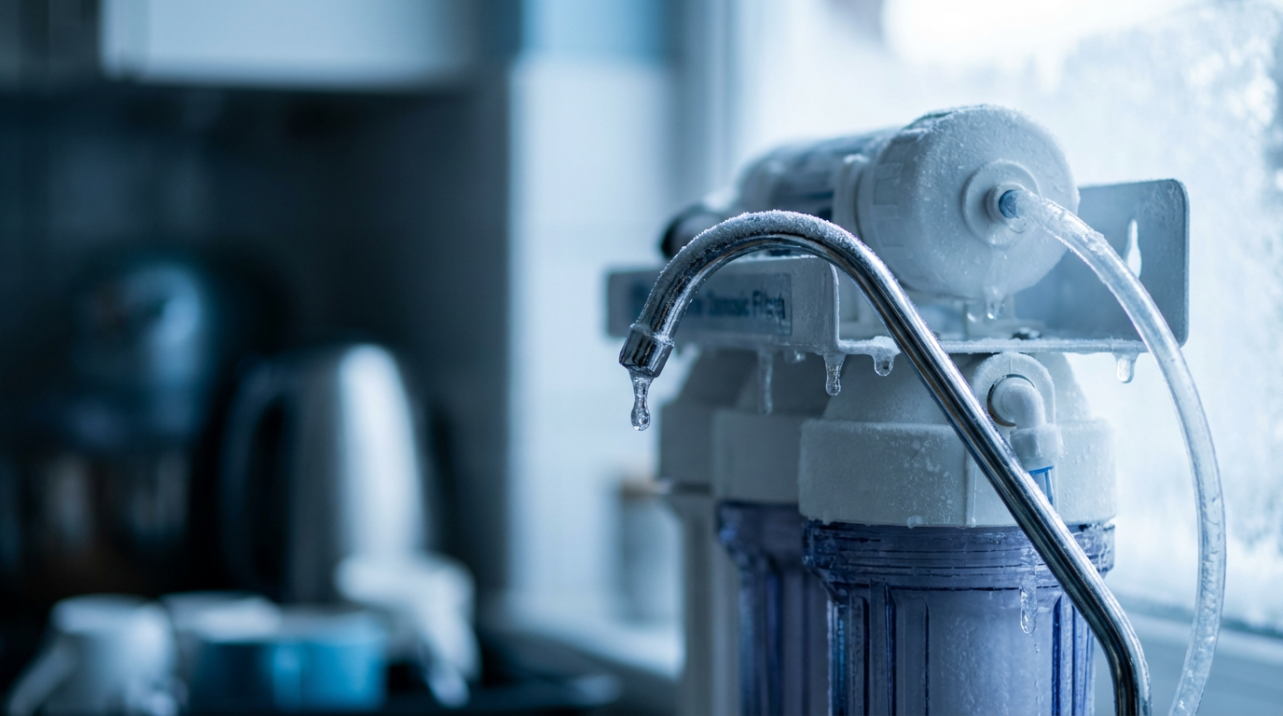
When the weather turns cold, I see the same pattern in homes again and again: an RO drinking water system that worked beautifully all summer suddenly feels “clogged.” The faucet slows to a trickle, the storage tank seems to take forever to fill, and it is tempting to blame the membrane and order a new one on the spot.
As a smart hydration specialist, I want you to know that winter problems with RO membranes are real, but they are not all the same. Sometimes the membrane is truly fouled or damaged. Sometimes the physics of cold water are playing tricks on you. And sometimes freezing has quietly cracked housings or warped the membrane inside.
In this article we will unpack what actually happens to RO membranes in winter, using evidence from field experience, manufacturer guidance, and lab research in journals like Desalination, along with practical winterization advice from RO brands and water treatment experts. By the end, you will be able to tell the difference between normal winter slow‑downs, genuine clogging, and freeze damage, and you will know how to protect your home hydration system before the next cold snap.
What “Clogging” Means Inside an RO Membrane
When homeowners say their RO membrane is clogged, they usually mean one of three things: the membrane is coated with a layer of contaminants, its pores are scaled or blocked, or something is mechanically damaged so water cannot pass normally.
Training materials used in advanced membrane courses and water treatment videos describe four classic fouling modes for RO membranes.
First, particulate fouling occurs when fine suspended solids and colloids, such as silt or clay, accumulate at the membrane surface and in its pores. One membrane training video explains that this begins with pore blocking near the openings and progresses to a thicker “cake layer” that obstructs flow and drives up pressure. The same source notes that saline water with turbidity below about 0.05 NTU causes very low particulate fouling, which is why pretreatment and sediment filtration are so important.
Second, organic fouling builds up when natural organic matter, polymers, or oils collect on the membrane. The same technical guidance recommends keeping total organic carbon below roughly three parts per million and oils or grease below about 0.1 parts per million in RO feed water, using tools like coagulation, clarification, ultraviolet treatment, or activated carbon to keep organics under control.
Third, inorganic fouling, often called scaling, is the precipitation of dissolved salts directly on the membrane surface. A design tutorial on scaling gives a concrete example: when calcium and sulfate reach high enough levels together, crystalline calcium sulfate can form on the membrane, creating a hard, insulating layer that will not rinse away with simple flushing.
Fourth, biofouling happens when bacteria and other microorganisms attach to the membrane, secrete sticky extracellular polymeric substances, and build a slimy biofilm. Research and training videos highlight that this biofilm increases hydraulic resistance and can be very resistant to normal cleaning and even some biocides.
On top of these, membrane oxidation is a fifth, related failure mode. It is not a clog in the traditional sense, but long exposure to free chlorine can permanently damage the thin polyamide layer, leaving you with poor water quality and odd behavior in winter and summer alike.
So when we talk about winter clogging of RO membranes, we are really talking about how cold temperatures, freezing conditions, and winter operating patterns interact with these fouling mechanisms and with mechanical stress inside the system.

Why Winter Makes RO Systems Look “Clogged”
Winter pushes RO systems in three main ways. Feed water becomes colder and thicker, fouling behaves differently at low temperature, and parts are exposed to freezing that they were never designed to tolerate.
Cold Water Slows RO Production
Every RO unit is rated at a specific feed water temperature, usually around the mid‑70s °F for under‑sink drinking systems. In winter, tap water can drop far below that. A car wash operations guide from Sonnys Direct shows just how dramatic this effect can be: when RO feed water falls to about 60°F, product water output drops by roughly twenty percent, and for every degree the feed temperature dips below that, output falls by about another three percent. By the time feed water is around 50°F, production can be down about forty percent compared with warm‑water conditions.
This is not just anecdote. A controlled lab study published in Desalination looked at brackish water RO membranes at three temperatures, about 59°F, 77°F, and 95°F. The researchers found that as temperature increased, water became less viscous, membrane water permeability increased, and concentration polarization at the surface decreased. Together, that meant higher permeate flux at the same pressure. A later energy analysis in Desalination confirmed that warmer feed water generally lowers specific energy consumption for brackish plants, again because the water moves more easily through the membrane.
For a homeowner, this shows up simply as a slower faucet.

If your under‑sink RO is rated to produce fifty gallons per day at warm kitchen temperatures, it might feel like it is only producing a little more than half that amount when winter feed water is near fifty degrees. A storage tank that used to refill in what felt like an hour can suddenly need much longer. The membrane is not necessarily clogged; it is working against thicker, slower water.
Low Temperatures Change Fouling Behavior
Cold water does more than just slow flow; it changes how foulants behave on the membrane surface.
The same Desalination study by Jin and co‑authors looked at how a common organic foulant, humic acid, behaves at different temperatures. They observed that humic colloid size decreases as temperature rises, and that total organic carbon rejection was actually lower at high temperature because more organics were in a dissolved form. Most importantly for winter, they found that flux decline from humic fouling was much more severe at around 59°F than at 77°F or 95°F, even though the total mass of humic acid deposited on the membrane was about the same. The specific cake resistance, essentially how “stubborn” that fouling layer is, was higher at the lower temperature.
This means that once an RO membrane in your home starts to foul with natural organic material, that foulant layer will behave differently in winter water. At lower temperatures the cake layer can be more hydraulically resistant, so even a moderate degree of fouling feels like a dramatic loss of performance, and it is harder to flush or clean away.
In practice, if you enter winter with prefilters that are overdue for replacement and a membrane that already has some organic fouling, you are more likely to notice a severe slow‑down as temperatures fall. That is why experienced service technicians and manufacturers such as ESP Water emphasize replacing sediment and carbon filters on schedule, typically every six to twelve months, and keeping the membrane in good condition so winter does not expose weaknesses.

Freezing and Thawing Add Mechanical Damage
RO membranes and their housings are not built to tolerate ice inside. Multiple winter guides from water treatment companies and system manufacturers make this plain. A cold‑environment guide from Aqualitek notes that most RO systems are intended to operate roughly between about 41°F and 95°F. Below that lower limit, water thickens enough to strain pumps and membranes, and if components actually freeze, housings, fittings, and membranes can crack or fail.
RO/DI specialists such as JRacenstein describe the aftermath of a freeze vividly. When a system has frozen, thawed, and is put back into service, the advice is to move it to a warm area, let it drip and drain, open housings, remove and inspect the membrane for cracks, then reassemble and test. If the membrane no longer achieves its typical total dissolved solids reduction after several minutes of operation, or if housings leak, the freeze has likely caused permanent damage.
A long‑term shutdown and winterization guide from Axeon Water explains that freezing water expands until it damages the weakest points in the system. They list damaged fittings, pumps, housings, and membrane elements as typical freeze outcomes. They even recommend adding food‑grade propylene glycol to a preservative solution when a system must be stored where temperatures reach about 20°F, showing how seriously manufacturers take freeze expansion.
From a homeowner’s perspective, after a hard freeze you may notice extremely low flow, odd noises, or water leaking at seams. That is not simple fouling; it is a mechanical failure that often requires component replacement.
Winter “Clogging” vs Real Membrane Failure
Given all these interactions, how can you tell whether your winter RO problem is normal temperature behavior, reversible fouling, or serious damage?
The table below captures common patterns I look for when troubleshooting with homeowners, grounded in the studies and manufacturer guides just discussed.
|
What you notice in winter |
Likely underlying issue |
What deserves attention first |
|
Slower but steady production, good taste, normal TDS |
Colder feed water increasing viscosity and reducing membrane permeability |
Measure feed temperature, compare behavior on warmer days, and plan for reduced capacity |
|
Strong slow‑down that began before winter and worsened now |
Existing fouling whose hydraulic resistance is amplified at lower temperature |
Check age of sediment and carbon filters, replace if due, and sanitize system |
|
Very low flow, odd noises, or leaks after a deep freeze |
Ice expansion damage to housings or membrane, not simply clogging |
Inspect housings and membrane physically, test for leaks and TDS reduction |
|
Rapid DI resin exhaustion plus slow flow |
True membrane fouling or damage leading to poor rejection and more load on DI stage |
Test TDS before and after RO, and consider membrane diagnostics or replacement |
If your system simply slows down in cold weather but produces water that still tastes clean and measures low on a TDS meter, you are probably seeing the expected twenty to forty percent winter capacity loss that the Sonnys Direct guidance quantifies for RO systems. That is inconvenient, but not harmful.
If production dropped noticeably before winter, or if you have not changed prefilters since well before last heating season, fouling is likely, and winter is exposing it. Remember that the Desalination research showed how much more severe flux decline from humic fouling is at about 59°F compared with warmer conditions.
If you suspect freezing, do not ignore small drips or strange behavior. The JRacenstein and Axeon materials are clear: ice damage is often irreversible, and running a compromised membrane can both waste water and compromise drinking water quality.
How Freezing Damages RO Membranes and Plumbing
To really understand winter clogging, it helps to picture what happens inside the RO housings when temperatures drop below freezing.
A typical thin‑film composite RO membrane is built as a flat sheet with a polyester support fabric, a microporous polysulfone layer, and an ultra‑thin polyamide barrier layer where the separation actually occurs. Training videos from desalination plants and membrane suppliers show how these are glued on three sides and rolled around a central core tube to form a spiral‑wound element.
When water inside that spiral‑wound membrane freezes, it expands and exerts pressure in directions the element was never meant to handle. Axeon’s preservation guide notes that expansion forces from freezing water damage the weakest points in the system, which often means fine cracks and delamination inside the membrane element itself. Housings and fittings can also split, sometimes only revealing themselves as tiny leaks when the system is repressurized.
At the same time, ice can block narrow internal channels, such as the feed spacer passages that distribute water across the membrane surface, or the small internal parts of an under‑sink manifold. Whirlpool and EcoPure, in their under‑sink RO winterization instructions, explicitly call out the manifold as a critical component that must be removed and stored somewhere warm because small internal channels can harbor water and are vulnerable to ice expansion.
If a membrane has frozen only briefly and not severely, some performance can survive, but both JRacenstein’s RODI guidance and the RO membrane training videos stress that you should not assume things are fine. The recommendation from JRacenstein is to let the unit thaw slowly, manually drain housings, remove and visually inspect the membrane, then reassemble, pressurize, and test for leaks and TDS reduction. A healthy membrane should still reduce TDS by around eighty to ninety percent once it has been running for several minutes, whereas a damaged one will often show poor rejection and erratic flow.
Because of this, the safest winter strategy is to keep RO systems above freezing at all times or, if that is not possible, to drain them and fill membrane housings with an appropriate preservative solution that includes freeze protection.
Practical Winter Strategies for Home RO Systems
The good news is that most winter clogging and freeze damage can be prevented with practical steps. The exact approach depends on whether your system runs all winter or sits idle, and on where it is installed.
Keeping an RO System Running Through Winter
If your RO system is installed in a heated kitchen and all plumbing runs through conditioned space, winter risk is mostly about performance, not survival. In this situation, focus on maintenance and ambient conditions.
Maintenance guides from ESP Water, Clear Water Filtration, and others converge on a simple schedule. Replace sediment and carbon filters about every six to twelve months, depending on your water quality and usage. If these prefilters are clogged, they starve the membrane of flow, increase pressure drop, and make the cold‑weather slow‑down feel much worse. When prefilters are maintained on schedule, ESP Water notes that the membrane itself often only needs replacement roughly every two years.
Before winter, inspect for leaks, corrosion, or weak joints, especially in basements, crawl spaces, or utility rooms where temperatures may be lower. Clear Water Filtration emphasizes tightening fittings, replacing worn seals, and keeping the whole filtration area above freezing, sometimes by using a small space heater in a basement or well house, placed safely away from plastic parts.
If your RO system is in a cooler basement, garage, or outbuilding, you should treat it more like a small industrial system. Winter‑proofing advice from RO‑MAN, Aqualitek, and CuDel all recommend insulating every exposed pipe and component, paying special attention to unheated spaces. Foam pipe sleeves, insulated enclosures for prefilters and membranes, and even full‑system insulation blankets can help maintain a more stable temperature around the unit.
In very cold climates, Aqualitek and RO‑MAN describe adding heat tracing or heat tape to feed lines, pump inlets, and membrane housings, controlled by thermostats. The goal is not to make water hot, but to keep it safely above freezing. Aqualitek notes that cold water not only reduces RO permeate flow, often by ten to thirty percent, but also increases pump workload, so keeping the system just a bit warmer can protect both performance and hardware.
As for the cold‑induced capacity loss itself, planning is your friend. The Sonnys Direct car wash example shows a reduction of roughly one fifth at 60°F and around two fifths at 50°F. While that specific data comes from high‑flow commercial units, the same physics applies at home. If you rely on RO water heavily in winter, consider drawing water earlier in the day, allowing more time for the storage tank to refill, or slightly increasing storage tank size if your household routinely runs it dry.
Shutting Down an RO System for Part of the Winter
Vacation homes, seasonal cabins, or outdoor RO/DI sets often sit idle for months in winter. Here, the main risks are freezing and microbiological growth in stagnant water.
Multiple manufacturers provide step‑by‑step winterization guidance for under‑sink systems. Whirlpool and EcoPure both describe a straightforward process for their drinking water units. First, close the cold water supply valve under the sink and open the RO faucet, leaving it open until the storage tank is completely drained. They even suggest bottling this water for other uses while it flows out. Once the tank is empty, they recommend removing hoses from the manifold, using a towel to catch any remaining water, and straightening hoses so they can drain. The hoses themselves can usually stay in place through winter as long as they are drained.
Next, their guidance is to unscrew the hose from the top of the storage tank, tip the tank upside down in the sink for several minutes, and let it drain out fully. A drained tank can safely remain onsite during freezing, as there is no water left to expand. Then they advise removing the filters from the manifold and discarding them. Because these cartridges have held water, reusing them after months of storage can encourage bacterial growth in the media. Instead, new filters should be installed when the system is brought back online and sanitized.
A key detail in both guidance documents is the manifold itself. They emphasize that the manifold contains small internal parts and channels that hold water and are particularly vulnerable to ice expansion. Their recommendation is to remove the manifold and store it in a warm location for the winter. When you are ready to use the system again, you reinstall the manifold, reconnect hoses, install new filters, sanitize according to the manufacturer’s procedures, and then return the system to normal operation.
For larger skid‑mounted RO or RO/DI systems, winterization becomes more complex. Articles from Axeon Water and JRacenstein describe a longer sequence: flushing membranes with permeate or high‑quality treated water at modest pressure to remove concentrated brine, ensuring pretreatment chemicals are turned off, draining flow meters, housings, and storage tanks, and then filling membrane housings with a preservative solution.
Axeon recommends a specific preservative, used at about one to one and a half percent in good quality water, introduced using an “overflow” technique that pushes out air and completely fills housings. They note that preservation should ideally start within about ten hours after flushing, and that the preservative solution should be isolated from air by closing all valves. They also advise checking preservative pH periodically and replacing it when it drops below about three to maintain resistance to biological growth.
JRacenstein highlights another angle: if storage is longer than about six weeks and the system cannot be run regularly, adding a membrane preservative such as RO Protect can help prevent bacterial fouling and mold. Alternatively, they recommend running the system periodically, every week or every two to three weeks depending on conditions, to keep water from stagnating.
Where freezing is likely, both Axeon and JRacenstein describe adding food‑grade propylene glycol to the preservative solution to lower the freezing point. Axeon’s table shows, for example, that a solution with about twenty percent propylene glycol protects down to roughly 20°F, and higher concentrations can protect to even lower temperatures. They stress that automotive ethylene glycol antifreeze must never be used in drinking water systems. Before returning such a system to service in spring, their instructions call for thorough flushing, leak checks, and a period of operation with permeate sent to drain so that all preservative and glycol are expelled.
A more consumer‑oriented winterization article from a window cleaning community adds one more crucial safety point: do not run bleach through installed filters, especially the RO membrane or deionization cartridges. Their recommendation is to remove and discard inexpensive sediment and carbon filters, store the RO membrane in deionized water if it is being removed, discard spent DI media, and only sanitize empty housings with a light bleach solution followed by very thorough rinsing.
Maintenance Habits That Prevent Winter Clogging
Winter puts a spotlight on maintenance habits that matter year‑round.
Long‑term maintenance guidance from ESP Water emphasizes that a high‑quality under‑sink RO system can last ten to fifteen years if properly maintained. The core of that maintenance is regular filter changes and periodic sanitization. Sediment filters protect the RO membrane from silt and dirt and should be replaced about every six to twelve months. Carbon filters remove chlorine, pesticides, and many other contaminants that can harm both the membrane and the taste of your water; they also typically need replacement every six to twelve months. When these prefilters are neglected, dirt and chlorine can reach the membrane, leading to clogging, oxidation, and ultimately the kind of slow‑downs that winter makes impossible to ignore.
With prefilters on schedule, ESP Water notes that the RO membrane itself usually only needs replacement about every two years, though local water conditions and usage can shift that. A noticeable drop in flow from the RO faucet or a rise in TDS despite fresh prefilters is a strong sign the membrane may be at the end of its life.
Annual sanitization, often done when installing new filters, is also crucial. ESP Water gives a general outline: shut off the main valve, dispense all water from the RO faucet, remove filters, reinstall empty housings, add a disinfectant such as hydrogen peroxide to the first stage housing, and let the system run through at least two full tank cycles to flush. After a final drain, new filters go in. Importantly, they advise following the owner’s manual and using appropriate disinfectants rather than improvising, which aligns with the caution from the window cleaning community about bleach and sensitive membrane elements.
Heading into winter, aligning your maintenance with the seasons makes sense. A filter change and sanitization in early fall sets your system up with clean, low‑resistance prefilters just as feed water is about to cool. That reduces the risk that lower temperatures and higher viscosity will push a marginal system over the edge into what feels like complete clogging.
Short FAQ on Winter RO Membrane Issues
Do I need to winterize an under‑sink RO system in a heated kitchen?
If every part of your RO system, including all tubing and the storage tank, is in heated space that never approaches freezing, a full winterization is usually not necessary. Your main winter focus should be on timely filter changes, leak checks, and planning for slightly slower production due to colder feed water. However, many homes have sections of plumbing running through crawl spaces, exterior walls, or unheated basements. Guidance from Clear Water Filtration and RO‑MAN suggests insulating any exposed pipes and components in those spaces and maintaining an above‑freezing environment with insulation or a safely placed heater if needed.
Is antifreeze ever appropriate in an RO system?
Automotive antifreeze is absolutely not appropriate in any drinking water system. That point is made very clearly in Axeon’s winterizing instructions. Food‑grade propylene glycol, by contrast, is sometimes used in commercial RO or RO/DI systems during long‑term storage in freezing environments, but only as part of a controlled preservation solution, never in a system that is still supplying drinking water. If you are a homeowner with a standard under‑sink or small whole‑house RO, a safer and simpler pathway is usually to drain equipment fully, bring critical components indoors, or keep the equipment in a conditioned space, rather than trying to manage antifreeze solutions yourself.
How can I tell if my membrane is ruined after a freeze?
Signs of freeze damage include very low flow, unusual noises from pumps or housings, and visible leaks when the system repressurizes. JRacenstein’s RODI guidance and membrane training videos advise a practical test: after a thorough thaw and inspection, reassemble the system, operate it long enough to flush several gallons so that readings stabilize, and then compare TDS before and after the RO stage. A healthy membrane will still reduce TDS by about eighty to ninety percent. If rejection is poor and does not improve after some runtime, or if the system cannot hold pressure without leaking, the membrane and possibly some housings have likely suffered irreversible freeze damage and should be replaced.
A well‑designed RO membrane can deliver clean, great‑tasting water for many years, but winter does ask more of the system. When you understand how cold water, fouling, and freezing interact, you can respond wisely instead of guessing. Insulate what needs warmth, maintain filters and membranes on schedule, and follow manufacturer‑backed winterization steps when a shutdown is necessary. Your reward is simple and important: reliable, safe hydration in every season.
References
- https://scientiairanica.sharif.edu/article_22862_387362e6fd6c2935fc755d4220c9860a.pdf
- https://www.academia.edu/40606266/Effects_of_feed_water_temperature_on_separation_performance_and_organic_fouling_of_brackish_water_RO_membranes
- https://ui.adsabs.harvard.edu/abs/2009Desal.239..346J/abstract
- https://dspace.mit.edu/bitstream/handle/1721.1/110933/Lienhard_Effect%20of%20temperature%20.pdf?sequence=1
- https://rma.venturacounty.gov/wp-content/uploads/2024/02/sanitizing-a-reverse-osmosis-filtration-system.pdf
- https://www.aqualitek.com/best-precautions-for-operating-an-ro-system-in-a-cold-environment-expert-guide-insights-by-aqualitek.html
- https://www.kwater.com/7-winter-maintenance-tips-for-your-home-water-treatment-system
- https://espwaterproducts.com/pages/reverse-osmosis-maintenance
- https://jracenstein.com/how-to-winterize-your-rodi-equipment/?srsltid=AfmBOooCZK7vYdU1b0oEAlIenXszl4AItkyKqXU6ymWwzWXeqMRblp5e
- https://ro-man.com/winter-proofing-your-reverse-osmosis-system/

Share:
Understanding the Gurgling Sounds in Water Storage Tanks