

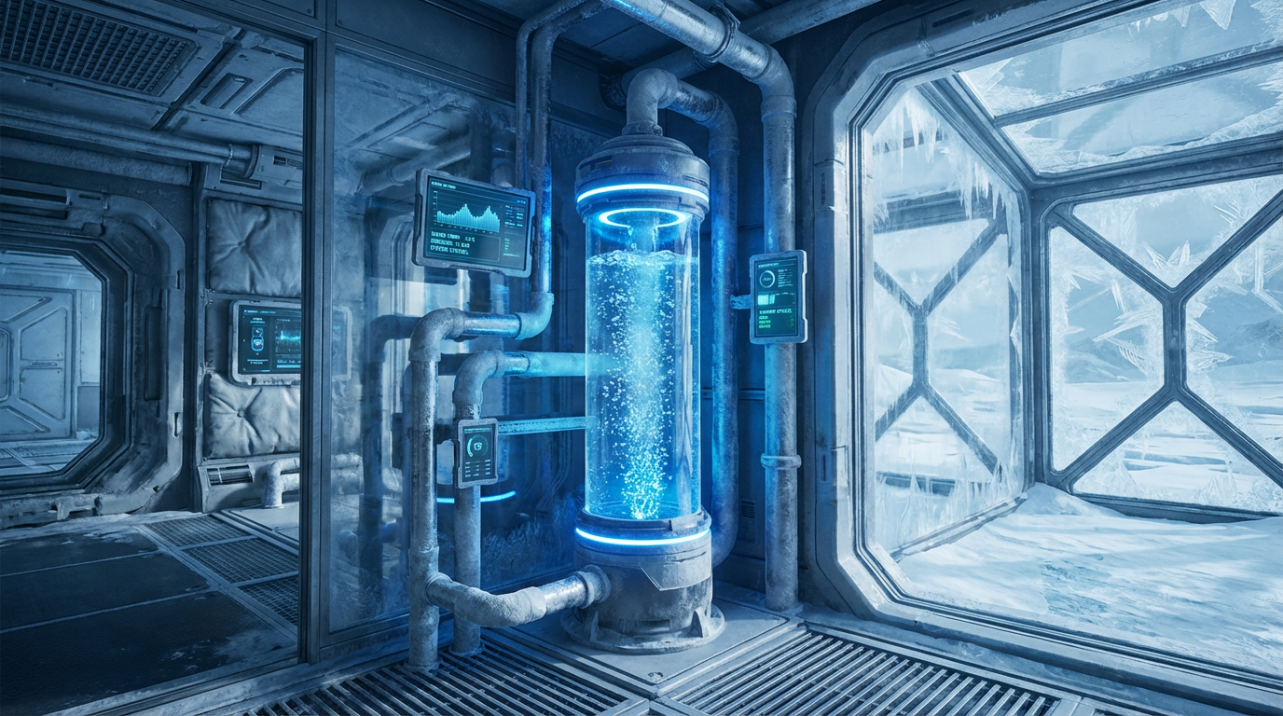
Operating a research station in deep winter is one of the hardest hydration challenges on the planet. The landscape may be filled with ice and snow, but the science is clear: cold does not make water safe, and freezing conditions put unusual stress on every part of a treatment system, especially reverse osmosis (RO).
Drawing on guidance from public health agencies, wilderness medicine experts, cold‑weather water‑treatment engineers, and field‑proven backcountry practices, this article walks through what makes RO different in Arctic‑like conditions and how to design a hydration plan that keeps researchers safe and well hydrated all season.
As a smart hydration specialist and water wellness advocate, I think about three questions for every cold‑weather station: how safe is the source, how resilient is the RO hardware, and what happens when something freezes or fails. The answers are where your “unique RO needs” really emerge.
Why Frozen Landscapes Still Need Serious Water Treatment
It is easy to look at wind‑scoured snowfields and assume purity. The data say otherwise.
Clinical guidelines from the Wilderness Medical Society note that a wide range of pathogens, including Shigella, Salmonella Typhi, hepatitis A, Cryptosporidium, and others, remain viable in water for long periods, including when water is frozen. Guidance for backpackers from SectionHiker and Sawyer makes the same point more bluntly: Giardia, bacteria, and other waterborne pathogens remain active in near‑ and below‑freezing conditions, so cold water is not automatically safe to drink.
Public health sources emphasize that surface water is widely contaminated. The Princeton University Outdoor Action Guide cites estimates that about ninety percent of the world’s water is contaminated in some way, and that untreated drinking can lead to severe diarrheal illness, fluid loss, hypovolemic shock, and death. The Wilderness Medical Society further explains that even small, inadvertent ingestions of low–infectious‑dose organisms such as Giardia, Cryptosporidium, Shigella, or norovirus can cause illness.
In other words, a remote Arctic bay, a nearby melt stream, or a buried storage tank are all subject to the same microbial rules as any other surface water, with the added complication that cold temperatures keep pathogens comfortable for longer.
Non‑microbial hazards are also a concern. The Wilderness Medical Society highlights industrial chemicals and biotoxins, including cyanobacteria that can release microcystin toxins tied to gastrointestinal symptoms, neurological issues, liver damage, and cardiovascular collapse. Winter operations add another wrinkle: Everfilt’s cold‑weather treatment guidance notes that snowmelt and ice runoff often carry road salts, oils, and sediment, increasing contaminant load and turbidity.
For a research station that depends on high cognitive performance, reliable gastrointestinal health, and clear long‑term health risk management, this combination of microbial and chemical risk is exactly why an RO‑based system becomes attractive. It is also why that system has to be designed differently than a typical suburban installation.
Imagine a small station with twelve people. A single untreated exposure that seeds norovirus or Cryptosporidium could incapacitate most of the team at once. Evacuation options are limited. In this context, the water room is not just a utility space; it is a critical piece of occupational health infrastructure.

Where Reverse Osmosis Fits in the Cold
To understand the unique needs of RO in Arctic‑like environments, it helps to place it inside the broader treatment chain.
The Centers for Disease Control and Prevention describe how public water systems move water from its source through coagulation, flocculation, sedimentation, filtration, and disinfection. For more challenging sources, they note that advanced filtration methods like ultrafiltration and reverse osmosis are used, especially for recycled or salt water, to remove additional particles and contaminants.
Outdoor and expedition guidance from REI and Princeton University explains the basic distinction between filters and purifiers in simpler terms. Standard filters with micron‑scale pores remove protozoa and bacteria but not viruses or many dissolved chemicals. Purifiers add virus protection and sometimes chemical removal, often by combining filtration with chemical disinfection, ultraviolet light, or specialized media.
Reverse osmosis sits at the high end of this spectrum. Under pressure, water is forced across a semi‑permeable membrane that rejects many dissolved salts and a wide variety of contaminants. It is particularly valuable where salt content is high or where chemical pollutants are a concern, which is exactly what winter road salts, de‑icers, and some industrial activities create.
Granular activated carbon, described in detail by Wilderness Medical Society guidelines, is another key tool often paired with RO. It excels at removing dissolved organic and inorganic chemicals, disinfection byproducts, pesticides, many organic compounds, and some heavy metals, while also improving taste and odor. However, activated carbon does not reliably remove or kill microorganisms. In a station context, that means carbon and RO are powerful allies, but they must sit inside a multi‑barrier design that also includes robust disinfection.
The table below summarizes the role of RO alongside other core methods, with a focus on what matters in freezing environments.
Treatment method |
What it does best |
What it does not do well |
Cold‑weather considerations |
Boiling and heat treatment (per Wilderness Medical Society, Princeton University, and the National Park Service) |
Kills a wide spectrum of pathogens once water reaches a rolling boil, with hot water in the 140–160°F range capable of inactivating many organisms over time |
Does not remove chemical pollutants such as road salts, oils, or industrial chemicals |
Highly reliable biologically, but fuel intensive; stoves and fuel must be winter‑ready, and heating large station‑scale volumes can be impractical |
Chemical disinfection (iodine, chlorine, chlorine dioxide tablets or drops) |
Kills many bacteria, viruses, and protozoa when given enough contact time, and is extremely compact and lightweight; a strong backup measure according to REI, the National Park Service, and Princeton University |
Does not remove chemical pollutants, and some products are less effective against Cryptosporidium or have medical limitations (for example, iodine for people with thyroid disease or during pregnancy) |
Reaction rates slow dramatically in cold water; Princeton University notes that at about 50°F only about ninety percent of Giardia may be inactivated in thirty minutes, and below about 40°F treatment time should be doubled or water warmed to at least around 60°F |
Granular activated carbon (as described by the Wilderness Medical Society) |
Adsorbs many dissolved chemicals, disinfection byproducts, pesticides, and some heavy metals, improving taste and odor |
Does not reliably kill or remove microorganisms on its own |
Carbon beds can cool as water passes through, potentially lowering water temperature further before later disinfection steps, which is important for contact time calculations |
Reverse osmosis (per CDC and SpringWell) |
Removes a broad spectrum of dissolved salts and many contaminants and is used for recycled or salt water; RO membranes are central when salts and dissolved pollutants are part of the risk |
Does not inherently provide residual disinfection, and performance depends on pre‑treatment and post‑disinfection; like other filters, it can be damaged by freezing |
SpringWell notes that RO systems are particularly vulnerable to freezing because there is no safe way to fully winterize the RO membrane; ice can crack housings and create micro‑cracks in the media that let contaminants pass unnoticed |
For Arctic research stations that see both intense cold and contamination from winter operations, RO is one of the only practical ways to combine desalination‑like salt removal with high‑quality drinking water. The price of that power is fragility in the face of freezing.
Unique Cold‑Climate Threats to RO Systems
Freeze damage, micro‑cracks, and invisible failure
Cold climates do not just challenge people; they physically attack water systems.
SpringWell’s residential winterization guidance explains that as water cools toward about 39°F and then freezes, it expands by roughly nine percent. In rigid housings and pipes, that expansion can crack or separate components, deform plastics and metals, and create leaks once temperatures rise. They point out that ice crystals forming inside filter media can create micro‑cracks and enlarged pores, allowing unfiltered or inadequately filtered water and larger particles to pass through. Critically, this damage may not be obvious from the outside and may not be covered by insurance.
They single out reverse osmosis systems as particularly vulnerable because there is no safe way to completely winterize the RO membrane. The manufacturer‑level advice is to disconnect, drain, and move RO units into a warm location when they will be exposed to freezing conditions.
For an Arctic research station, you cannot simply carry the RO skid into a living room for the winter. Instead, you have to design the building and piping so that the membrane never experiences freezing conditions in the first place.
Cold‑weather water‑treatment guides from Everfilt and Ecologix emphasize that frozen pipes, valves, and tanks restrict flow or rupture and can trigger full system failures. They recommend insulating exposed pipes, valves, pumps, and fittings with weather‑resistant insulation and heat‑tracing cables, inspecting that insulation for damage or moisture, and considering heated enclosures for critical equipment.
Designers working on greywater systems in the Central Canadian Rockies report winter lows around minus 4°F in mild years, minus 31°F for extended periods, and historic reports down to about minus 58°F, with frost depths reaching roughly 5 ft in snowless, windy winters. While their focus is household greywater, it illustrates the scale of the problem: any unprotected RO housing or pipe above that frost depth is a candidate for catastrophic freeze damage.
A practical implication is that the “safe zone” for RO hardware in a station is not just indoors; it is anywhere that temperatures are held well above freezing during storms and power interruptions. SpringWell suggests keeping indoor spaces at or above about 55°F to protect residential filtration, and that target translates well to station plant rooms. If an RO membrane or housing spends hours below freezing, it should be treated as suspect, just as Princeton’s outdoor guide advises discarding filter cartridges that may have cracked after being dropped.
Slower chemistry and weakened biological steps around RO
Cold water is harder to treat chemically and biologically. Everfilt’s cold‑weather guide notes that cold temperatures increase water viscosity and slow chemical and biological reactions, which reduces disinfection effectiveness and raises the risk of leaks and failures. Wastewater Compliance Systems explains that nitrification, the biological process that converts ammonia to nitrate, is highly temperature dependent. Rates can drop by fifty percent or more at around 50°F compared to 68°F and may cease entirely below about 41°F. They also observe that disinfection becomes less effective in the cold, often requiring higher disinfectant doses to meet microbial limits because pathogen survival times increase.
Although your station’s RO unit is a physical barrier, it sits inside a broader process that still depends heavily on chemistry and, in some cases, biological treatment. Coagulation and flocculation processes described both by the CDC and by the Wilderness Medical Society work by adding salts or other agents to bind fine particles and microorganisms into larger flocs. The Wilderness Medical Society notes that this combination of coagulation and sedimentation can remove a very high fraction of microbes, heavy metals, and some chemicals before filtration and disinfection.
When water is close to freezing, all of these steps slow down. Contact times must be extended, doses may need to be adjusted, and real‑time monitoring becomes more important. Princeton University’s guidance on chemical disinfection shows why: at about 50°F, only about ninety percent of Giardia organisms may be inactivated in thirty minutes. Below roughly 40°F, they recommend doubling treatment time and ideally warming water to at least about 60°F to restore effectiveness.
At a research station, these principles affect both the pre‑RO and post‑RO steps. Turbidity reduction and pre‑filtration must be sized for longer settling times. Disinfection contact basins downstream from RO need enough volume and mixing to deliver reliable kill at lower temperatures. Everfilt and Ecologix both recommend adjusting chemical dosing, increasing contact times, and stabilizing temperatures in tanks and reactors to keep treatment consistent through the winter.
Source‑water spikes from snow, ice, and operations
Cold‑season runoff is chemically different from summer rain. Everfilt calls out that snowmelt and ice runoff frequently carry road salts, oils, and sediment. In a research station context, think about plowed roads to the airstrip, heavy equipment staging areas, or maintenance yards. As late‑season snow and ice melt, salts and hydrocarbons can wash toward surface intakes, wells, or nearby lakes.
The Wilderness Medical Society’s overview of non‑microbial hazards reinforces that these kinds of contaminants require more than simple disinfection. Industrial chemicals and certain toxins will pass through boiling, chlorine, or iodine. The Washington State Department of Health explicitly warns that methods like boiling or adding bleach are meant to control biological contamination only and that if water is suspected of containing chemicals, oils, sewage, or other poisonous substances, it should not be used for drinking.
In these conditions, RO and activated carbon become more than “nice to have.” Activated carbon, as those guidelines explain, is particularly effective at removing many dissolved organic chemicals and some heavy metals, while RO is specifically used for recycled and salt water in municipal plants. A station that expects road salt and chemical runoff in spring may choose to route source water first through sedimentation or infiltration basins that intercept sediments and oils, then through granular activated carbon, and finally across an RO membrane, with robust disinfection at the end.
A simple example illustrates the stakes. If late‑season meltwater carries enough road salt to make the raw water taste brackish, boiling or chlorine will do nothing for that taste, and high sodium intake may be undesirable for staff with cardiovascular risks. A combined activated‑carbon and RO system, correctly protected against freezing, can both improve taste and reduce dissolved salts to a safer, more palatable level.
Designing a Resilient RO‑Driven Hydration System for Extreme Cold
Protecting RO hardware from freezing
Multiple sources converge on a basic principle: do not let water stand and freeze inside your treatment system.
SpringWell describes how freezing water can crack housings and create micro‑cracks in filter media, particularly in RO systems. Their recommendation for residential RO is to shut off water to the unit, drain lines and housings, and relocate the RO unit to a warm location when not in use during winter. The Water Doctor of Washington echoes the importance of keeping treatment locations warm and dry, monitoring temperature with a nearby thermometer, and adding safe supplemental heat such as heat lamps or small heaters if the area nears freezing.
Industrial guides from Everfilt and Ecologix add infrastructure‑scale tools to the same theme: insulate exposed pipes, valves, tanks, and pumps with weather‑resistant insulation; use heat‑tracing cables; and consider enclosing critical equipment in insulated and heated housings. They also highlight the value of remote monitoring systems to track temperature, pressure, and flow in real time so that operators can respond before equipment is damaged.
In regions where frost can reach roughly 5 ft, as the greywater designer in the Central Canadian Rockies reported, buried supply and waste lines that sit above that depth are prime candidates for freezing. That observation directly informs how deep intake lines, RO concentrate drains, and distribution piping should be placed relative to the local frost line or, alternatively, how they should be insulated and heat‑traced.
A practical station‑level approach often includes four elements at once: keeping the RO skid and associated manifolds in a heated room maintained at or above about 55°F, routing supply and distribution piping through conditioned corridors, insulating and heat‑tracing any necessary exterior runs, and designing the system to be fully drainable if a planned shutdown will leave it cold for weeks.
The table below summarizes common RO system components and the types of freeze protection recommended by these sources.
Component |
Main freeze risk (per SpringWell, Everfilt, Ecologix, Water Doctor of Washington) |
Typical protection approach |
RO membrane housings and cartridges |
Ice expansion can crack housings and create micro‑cracks in membranes, allowing contaminants to bypass; damage may be invisible |
Locate in heated space, maintain indoor temperatures above freezing during all seasons, and design for complete drainage before any planned cold shutdown |
Supply and distribution piping |
Frozen sections can block flow or burst, causing leaks and loss of service |
Insulate and heat‑trace exposed runs, route lines through conditioned spaces where possible, and maintain some flow or a controlled drip during extreme cold if lines cannot be drained |
Storage tanks |
Ice can crack walls or seams and displace fittings; stratification can create zones of very cold water that undermine downstream disinfection |
Use insulated and, if necessary, heated tanks; apply circulation or aeration to reduce ice formation as recommended in Everfilt’s guidance for reservoirs and tanks |
Valves, pumps, and dosing equipment |
Frozen valves and pumps can seize or crack; cold reduces performance and chemical stability |
Enclose in insulated, heated spaces or cabinets; use winter‑rated dosing equipment; monitor for leaks and calibrate more frequently in cold seasons |
Building a multi‑barrier treatment train around RO
No single method is perfect. Wilderness Medical Society guidelines, the CDC, Princeton University, and REI all stress that effective water treatment depends on multiple barriers rather than a single silver bullet.
For an Arctic station that uses RO, the ideal design often looks like this in conceptual terms: initial clarification to reduce turbidity and remove large particles, granular activated carbon to address many dissolved chemicals and improve taste, reverse osmosis to handle salts and finer contaminants, and then disinfection to kill any residual microorganisms and provide distribution‑system protection.
The Wilderness Medical Society describes how clarification steps such as sedimentation and coagulation–flocculation can remove a large fraction of microbes, heavy metals, and some chemicals. Even simple sedimentation, where water is allowed to stand for about an hour so particles settle and the clearer upper layer is decanted or filtered, can reduce sediment and some protozoan cysts, though it must be followed by disinfection.
Granular activated carbon is then useful for absorbing many dissolved organics, pesticides, and disinfection byproducts and for improving taste and odor, but, as their guidance stresses, it is not reliable as a stand‑alone microbial barrier. That is where RO and disinfection come in.
Downstream from RO, disinfection remains essential. The CDC describes how municipal systems use chlorine, chloramine, or chlorine dioxide to kill remaining germs and maintain a low residual in pipes, and the Wilderness Medical Society supports similar approaches in austere settings, adjusted for local conditions.
In a cold‑climate station, you should assume slower reaction rates. Everfilt recommends extending contact times and adjusting doses in cold water. Wastewater Compliance Systems notes that chemical disinfection often requires higher doses in winter to meet microbial targets. That means contact basins sized for summer conditions may need operational adjustments in winter, such as reduced flow, extended residence time, or raised temperature where feasible.
Sizing storage and redundancy for station hydration
Even the best RO system should never be your only safety net. Multiple sources recommend planning for outages and method failures.
The Washington State Department of Health advises that the best source of drinking water during an emergency is water that has been safely stored ahead of time. They recommend storing at least 1 gallon of water per person per day, and to plan for at least two weeks. For a research station of twenty people, that translates to about 280 gallons of emergency potable water. Factory‑sealed bottled water is preferred, with regular rotation based on expiration dates. If you fill your own containers, they emphasize using safe sources, thoroughly washed plastic containers, tight seals, labeling with the fill date, storing in a cool, dark place, and replacing the water every six months.
Princeton University’s outdoor guide explicitly recommends redundancy in treatment methods, noting that every method can fail and that travelers should always carry at least one backup method such as a filter plus chemical disinfection plus the ability to boil. REI’s expert advice on backcountry water treatment echoes this multi‑method mindset and stresses that freezing conditions demand extra care because filters can crack, batteries lose charge more quickly, and chemical reactions slow down.
For a station, those wilderness lessons scale up. Alongside your RO system, you want:
Reliable stored water capacity sized for at least two weeks of basic consumption, following the one gallon per person per day rule from Washington State’s guidance.
Redundant treatment options: the ability to boil water for smaller batches during critical downtime, an inventory of chemical disinfection tablets or drops that are stable in cold conditions, and, for fieldwork, portable methods such as purifier‑grade filters and tablets that, according to SectionHiker and Sawyer, are more cold‑resilient than delicate hollow‑fiber squeeze filters.
Backups for your backups: Wilderness Medical Society guidelines emphasize that in disaster and austere situations, water should be treated even when it appears pristine. For a station, that reinforces the idea that field teams should not treat melted snow or lake water as inherently safe, even if the main RO system is offline, but instead should run it through one or more backup methods.
The table below outlines common backup methods and how they behave in extreme cold.
Backup method |
Strength in cold conditions (per REI, Princeton University, National Park Service, SectionHiker, Sawyer) |
Key limitations for Arctic‑like stations |
Boiling on stoves |
Universally effective against pathogens and not affected by water clarity; stoves can be chosen specifically for low‑temperature performance |
Fuel‑intensive and slow for large volumes; requires winter‑capable stoves and fuel logistics; impractical as a sole method for all station water but ideal for drinking water during short‑term RO outages |
Chemical tablets (chlorine dioxide or similar) |
Lightweight, compact, and highly cold‑resilient compared to liquid chemicals; recommended by REI and SectionHiker as a robust backup |
Reaction times increase substantially in cold water; may take up to several hours to inactivate resistant organisms such as Cryptosporidium, as described in both REI’s and Wilderness Medical Society’s guidance; taste changes are common |
Liquid disinfectants (bleach or liquid products) |
Effective in many scenarios, with precise dosing tables provided by public‑health agencies such as Washington State and wilderness medicine sources |
Can themselves freeze and become unusable, as noted by SectionHiker and Sawyer; require careful label reading to avoid scented or additive‑laden products; not effective against all organisms or any chemical pollutants |
Portable filters and purifiers |
High‑quality purifier‑grade filters, such as those highlighted in OutdoorGearLab’s testing and SectionHiker’s cold‑weather guidance, can handle very turbid or high‑risk water and some models tolerate limited freeze–thaw cycles |
Many hollow‑fiber filters are permanently compromised by freezing, and there is no reliable way to verify continued effectiveness after they have frozen, so they must be protected inside clothing or sleeping bags during fieldwork and treated as suspect after cold exposure |
With storage and redundancy sized and selected thoughtfully, an RO outage becomes a manageable inconvenience rather than a health crisis.

Practical Hydration Management for Researchers on Station
Operating procedures when RO is vulnerable or offline
A cold‑weather RO system is only as safe as the procedures around it. Here, wilderness and household guidance give surprisingly aligned advice.
SpringWell emphasizes that freeze damage to filters and RO membranes may not be obvious and can lead to contaminants passing through without clear visual warning. Princeton University similarly advises that filter elements that may have cracked, for example after being dropped, should be considered compromised. Translating that to a station, any event where the RO room, lines, or housings may have dropped below freezing should trigger a conservative response.
A practical protocol often includes three steps. First, stop using RO output for drinking until the system has been inspected and, if necessary, membranes and housings replaced. Second, switch to stored water that was safely bottled or stored ahead of time following Washington State’s recommendations. Third, bring small daily batches of additional drinking water online using boiling and chemical disinfection as backups, following the boiling times recommended by the National Park Service and the dosing and contact time guidance from Washington State, Princeton University, and Wilderness Medical Society sources.
For boiling, both the National Park Service and REI advise bringing water to a rolling boil for one minute at elevations below about 6,500 ft and for three minutes at higher elevations, then letting it cool before drinking. Wilderness Medical Society data add that common enteric pathogens are inactivated at lower temperatures if held long enough, but a full rolling boil remains a simple, robust rule.
For chemical disinfection, Washington State’s health department provides specific household bleach dosing for emergency use and cautions that bleach does not kill all disease‑causing organisms commonly found in surface water and does not remove chemical pollutants. Princeton University and Wilderness Medical Society emphasize that cold water requires longer contact times and that water should be warmed to at least about 60°F when possible to improve effectiveness.
By layering these methods as temporary measures around the RO system, you maintain safe hydration even when the membrane is offline for inspection or replacement.
Training teams on cold‑weather water limits
Training researchers and station staff is as important as selecting the right hardware. SectionHiker and Sawyer stress that the main change in freezing weather is not the need for water treatment, but the reliability and practicality of different technologies. Hollow‑fiber squeeze and gravity filters, so popular in summer, can be irreversibly damaged by freezing, and once frozen and thawed there is no reliable way to confirm they still work. Ultraviolet pens depend on batteries that lose power quickly in cold weather. Liquid chemical treatments can freeze.
Backpacking and expedition guidance from REI, Princeton University, and OutdoorGearLab adds user‑level best practices that map directly onto field teams departing from an RO‑equipped station. Seek out the cleanest available source, prefilter cloudy water, separate “dirty” and “clean” containers, and follow manufacturer instructions closely to avoid cross‑contamination. Use hand sanitizer consistently, and keep toilets and dishwashing areas well away from natural water sources, even in winter.
For Arctic research teams, those points translate into simple but powerful behaviors. Field personnel should assume that melted snow, glacial streams, or lake ice all need treatment. They should be issued cold‑tolerant purification options, such as purifier‑grade filters rated for limited freeze–thaw cycles plus chlorine dioxide tablets, and trained in protecting those tools from freezing in the field. And they should understand station rules about when to rely on RO tap water and when to switch to stored or boiled water, especially after any suspected freeze event in the plant room.
FAQ: Cold‑Weather RO and Drinking Water
Does extreme cold make untreated water safe to drink?
No. Wilderness Medical Society guidelines and backcountry resources from SectionHiker and Sawyer all emphasize that cold water can still carry bacteria, viruses, and protozoa and that many remain viable when water is frozen. Princeton University’s guide notes that untreated water can cause severe diarrheal illness regardless of how clear or cold it looks. For an Arctic research station, that means melted snow, streams, and even ice from seemingly untouched areas must be treated using appropriate methods, whether through your RO‑based system or backup techniques like boiling and disinfection.
Can we add salt or alcohol to keep drinking water from freezing?
This approach is not recommended. An analysis of freezing‑point depression for drinking water in outdoor conditions shows that adding ethanol or salt at levels that meaningfully lower the freezing point creates other serious problems. About 8.5 percent ethanol by volume only lowers water’s freezing point to around 26.6°F, and higher concentrations mean drinking alcohol levels that are impractical and undesirable for hydration, especially in cold conditions. To reach a similar freezing point reduction using ordinary kitchen salt, roughly five percent of the solution by weight would need to be salt, making the water very salty and unhealthy to drink. The conclusion in that analysis is that there is no additive that is both safe to drink and effective enough at preventing freezing to be a practical solution. Instead, sources like FJ Outdoors and Everfilt recommend physical methods such as insulation, solar gain, wind barriers, covers, circulation, and heat tracing to keep water liquid.
Is melting snow a reliable backup if the RO system fails?
Melting snow is often the most practical source of water in freezing conditions, and REI’s expert advice explicitly calls it the best option when other liquid sources are frozen. However, Wilderness Medical Society, Princeton University, and the National Park Service all agree that melted snow must still be treated. Boiling, chemical disinfection, or running the water through a robust filter or purifier are all valid options, with contact times and doses adjusted for cold temperatures. For a station, the safest strategy is to combine melted snow with your stored water reserves, then treat it using boiling and disinfectants until the RO system is inspected and safely back online.
In extreme cold, smart hydration is about more than having an impressive RO unit on the wall. It is about understanding how freezing water stresses membranes, how cold slows your chemistry, and how to weave RO, pre‑treatment, disinfection, storage, and field practices into one resilient system. When you do, you give your researchers what they need most in the Arctic: safe, great‑tasting water they can trust every day, no matter what the thermometer says outside.
References
- http://azdeq.gov/awp
- https://www.nps.gov/articles/2wayspurifywater.htm
- https://www.cdc.gov/drinking-water/about/how-water-treatment-works.html
- https://pmc.ncbi.nlm.nih.gov/articles/PMC10961906/
- https://www.princeton.edu/~oa/manual/water.shtml
- https://doh.wa.gov/emergencies/be-prepared-be-safe/severe-weather-and-natural-disasters/water-purification
- https://crcorp.com/professional-snow-and-ice-removal-solutions-2026-best-practices
- https://www.waterdoctorofwashington.com/winterizing-your-water-treatment-system
- https://andrewskurka.com/tutorial-how-to-purify-water-backcountry-methods-pros-cons/
- https://ecologixsystems.com/articles/preparing-system-for-winter

Share:
Effective Pre-Treatment Solutions for Oil-Contaminated Water RO Systems
Effective Solutions for Low Water Pressure Areas Under 0.2 MPa