

TL;DR
- Aim for pH 8–9 for smooth‑tasting, mildly alkaline water; it’s about comfort and taste, not magic health cures.
- Use simple pH test strips or a digital meter to measure before and after your alkaline filter.
- To raise pH toward 8–9, optimize your remineralization media (calcite/alkaline cartridges), contact time, and filter maintenance.
- If pH creeps above 9, reduce contact time, choose gentler media, or blend with more neutral water instead of “fixing” it in the glass.
- Check pH monthly and replace alkaline cartridges roughly every 12 months (usage‑dependent) to keep levels stable.
pH 8–9: What You’re Really Aiming For
On the 0–14 pH scale, 7 is neutral, below 7 is acidic, and above 7 is alkaline. Most drinking water sits roughly between pH 6.5 and 8.5, according to guidance summarized by the US EPA and well‑water experts. Filterway and Hawaiian Cool Water describe alkaline drinking water as typically around pH 8–9.5.
So why target 8–9? At this level, water is mildly alkaline: it usually tastes smoother and less “sharp” than more acidic water, yet it stays close enough to neutral that it’s unlikely to taste bitter or cause digestive discomfort for most people. Sensorex notes that highly alkaline water can taste unpleasant and, in excess, may contribute to stomach upset or tingling sensations.
It’s also important to keep expectations realistic. Research summarized by Filterway and Water Depot suggests that alkaline water can feel more comfortable for some people with acid reflux or after intense exercise, but large, long‑term health benefits over well‑filtered neutral water remain unproven. Your primary goal with pH 8–9 is better taste, comfort, and plumbing protection, not replacing medical care.

pH level |
Taste/feel |
Practical notes |
<7 |
Sharper, sometimes sour |
Can be more corrosive to pipes and fixtures |
7–8 |
Neutral to smooth |
Common tap/filtered range |
8–9 |
Mildly alkaline, smooth |
Sweet/soft feel many people prefer for daily drinking |
>9 |
Bitter, “soda‑like” |
May upset digestion; often unnecessary for home use |
How Alkaline Filters Change Your Water
Reverse osmosis (RO) and distillation strip out most minerals. That’s excellent for removing contaminants, but it also removes calcium, magnesium, and potassium that help buffer pH. As Culligan and NU Aqua Systems point out, RO water often drifts slightly acidic once it contacts air because dissolved carbon dioxide lowers pH.
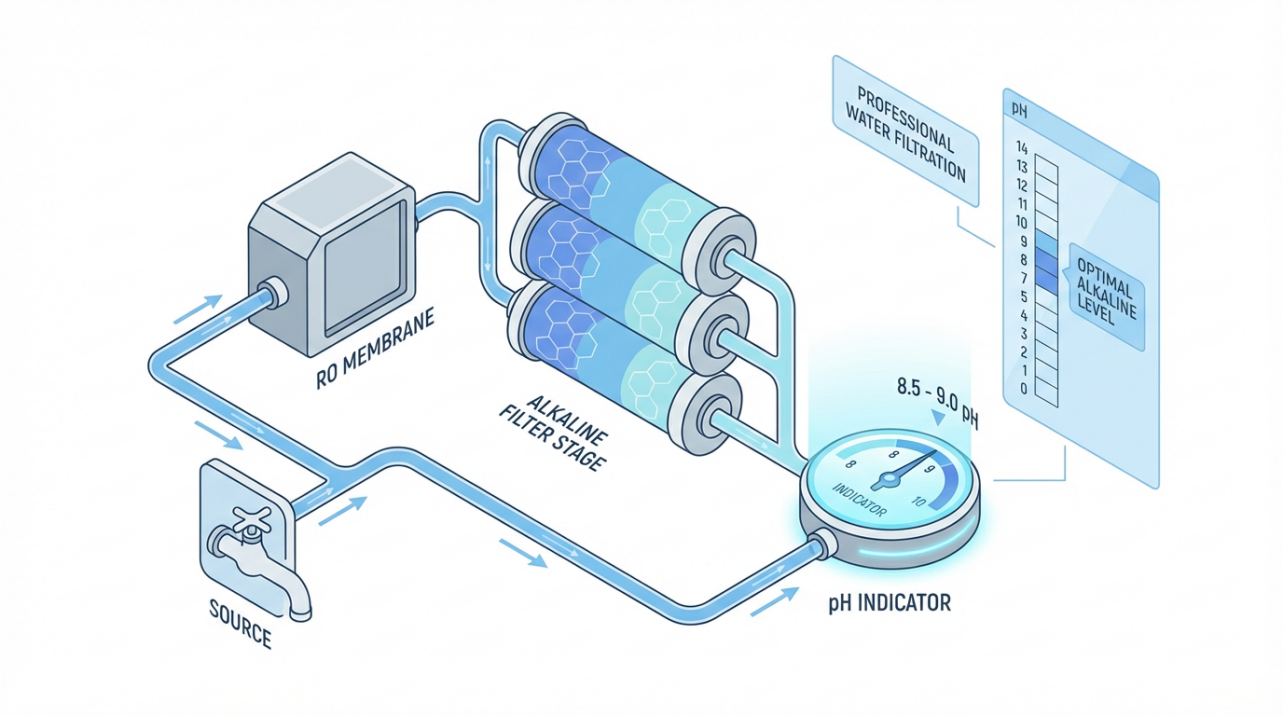
Alkaline filters are post‑filters that add minerals back. NU Aqua and Hawaiian Cool Water describe cartridges packed with media like calcite (calcium carbonate), magnesium oxide, tourmaline, or maifan stone. As water passes through, these media slowly dissolve, raising pH and alkalinity and nudging RO water toward roughly pH 7–9.5.
It helps to distinguish pH from alkalinity. pH is the snapshot of acidity or basicity at that moment. Alkalinity is the water’s “buffering capacity” – its ability to resist pH change – driven mostly by bicarbonates and carbonates, as explained by Michigan State University and The Perfect Water. You can have high pH but low alkalinity (easy to shift with a little acid) or moderate pH with high alkalinity (very stable). Alkaline cartridges usually increase both.
In well systems, neutralizing filters packed with calcite or magnesium oxide (described by Extension services and SpringWell) are installed at the home’s inlet to raise low pH into a non‑corrosive range. Under‑sink alkaline filters work on the same principle, just scaled down and tuned for taste and drinking comfort rather than whole‑house protection.

Step‑by‑Step: Dialing Your Filter to pH 8–9
You don’t need a lab to control pH; you just need a simple test routine and small, deliberate adjustments.
- Test your baseline. Measure pH at three points: source water, after your main filter (RO or other), and after the alkaline stage. Sensorex notes that test strips are fine for quick checks, while a digital meter is better if you want precision and are willing to calibrate it. Your post‑alkaline pH should ideally land between 8.0 and 9.0.
- Know your system type.
- Pitcher or countertop alkaline filter
- Under‑sink RO with an alkaline cartridge
- Inline or whole‑house neutralizing filter (calcite/Calcite Plus)
Articles from NU Aqua, Culligan, and SpringWell all emphasize that the adjustment “knobs” depend on which of these you own.
- Adjust contact time and flow. Alkaline media need time to dissolve. Slower flow and longer contact usually mean higher pH. For under‑sink systems, make sure your feed pressure is in the manufacturer’s recommended range (often around 60–80 psi for RO) so the RO and alkaline stages behave predictably.
- Check media age and capacity. As alkaline cartridges age, they release fewer minerals and pH drifts down. NU Aqua recommends replacing alkaline filters roughly every 12 months and inspecting the system at least yearly (more often with poor feed water). If your pH is stuck below 8 despite normal flow, you may simply need fresh media.
- Re‑test and log the result. After any change, let the system run long enough to purge old water from the lines, then test. Keeping a simple log (date, pH before and after the alkaline stage, any changes you made) will help you see trends and catch slow drifts instead of sudden surprises.

When Your pH Is Too Low (Below 8)
If your filter is marketed as “alkaline” but your meter reads 7.0–7.5, don’t panic. Filterway and Culligan both note that typical tap water and RO water often sit in this range, and hydration is still perfectly adequate. You only need to tweak things if you specifically want that pH 8–9 taste profile.
Common ways to gently raise pH include:
- Refreshing or upsizing your alkaline media. If your cartridge is older than its rated life or has a low media volume, upgrading to a fresh or slightly larger remineralization cartridge will often nudge pH up by 0.5–1.5 units. Many homeowners installing calcite‑based neutralizing filters on mildly acidic well water see pH move from the mid‑6s to around 7.0–7.5; pairing that with an under‑sink alkaline cartridge can take you into the 8–9 zone.
- Improving contact time. On small systems, short bursts at high flow may not give minerals time to dissolve. Slowing your draw (for example, filling large pitchers in a steady stream instead of opening the faucet fully) can give a modest boost. For whole‑house neutralizers, professionals size the tank and control valve to keep flow within recommended limits so the water doesn’t “race” through.
- Checking upstream filtration. Extremely aggressive pre‑treatment (for example, stacked RO stages or very low TDS) can leave so little mineral content that the alkaline stage struggles to lift pH. If your TDS meter reads extremely low numbers and pH stays muted even with fresh media, a pro may recommend slightly different media blends or an additional remineralization stage.
Always make changes gradually and re‑test. Jumping from pH 6.5 to pH 10 in one step is neither necessary nor helpful.
When Your pH Is Too High (Above 9)
Sensorex and Culligan both warn that highly alkaline water can taste bitter and may contribute to digestive discomfort for some people. The US EPA’s guidance for public water systems typically keeps pH at or below about 8.5, and aquatic‑life criteria discourage water staying above 9.0 for long periods. If your tap is consistently above 9, it’s smart to dial it back.
Practical ways to reduce pH without compromising filtration:
- Reduce contact time with alkaline media. If your system allows, slightly increasing flow (within manufacturer specs) or using a smaller or less aggressive alkaline cartridge will reduce how much calcite or magnesium dissolves. For pitchers, avoid letting water sit in contact with the cartridge for many hours; fill, filter, and use within a reasonable window.
- Choose gentler media. Media blends rich in magnesium oxide can push pH higher than pure calcite. As SpringWell and Extension sources note, high‑magnesium mixes are usually reserved for more strongly acidic water. If your source water is already near neutral, a softer calcite‑only cartridge or a lower‑alkalinity blend often hits pH 8–9 more precisely.
- Blend with neutral water at the faucet. For everyday drinking, many Smart Hydration clients find a simple blend works well: mix a portion of alkaline‑filtered water with some neutral RO or well‑filtered tap to bring pH down into the 8–9 range while keeping taste pleasant. This can be done per pitcher without re‑engineering your plumbing.
Avoid “chasing” high pH by dripping vinegar or lemon juice into your filter tank or storage reservoir. Mayu Water and SimPure both note that weak organic acids can temporarily lower pH, but they also introduce nutrients that bacteria can use, which is not what you want inside a closed system. If you enjoy lemon water, add it to the glass, not the filter.

Testing, Monitoring, and Maintenance
Accurate testing is your best friend when fine‑tuning alkaline filters. Sensorex recommends:
- Test strips for quick, inexpensive checks. Dip, compare to the color chart, and you’ll know whether you’re closer to 7, 8, or 9.
- Digital pH meters for more precise control. Calibrate with standard buffers (typically pH 7 and 4 or 10), keep the probe moist, and replace it when it becomes sluggish or cannot hold calibration.
For RO‑based alkaline systems, a simple TDS meter is also useful. NU Aqua notes that rising TDS may indicate a tired RO membrane, which can change how your alkaline stage behaves and may require membrane replacement, not just pH tweaking.
As a practical rhythm for most households:
- Check pH monthly, and any time taste suddenly changes.
- Replace pre‑ and post‑filters about every 6 months (system‑dependent).
- Replace the RO membrane roughly every 12 months or as your manufacturer and TDS readings indicate.
- Replace alkaline cartridges about every 12 months or sooner if pH slides and cannot be restored by small adjustments.
Documenting dates and readings takes a minute, but it turns guessing into data‑driven tuning.
What Most Guides Miss
Most “alkaline water” advice fixates on pH alone, but research summarized by Filterway, Sensorex, and Extension services consistently shows that clean, well‑filtered water and sensible mineral balance matter more than chasing extreme alkalinity. In practice, that means focusing first on contaminant removal and plumbing protection, then using your alkaline filter to gently refine taste into the pH 8–9 sweet spot that feels best for you and your household.
References
- https://www.epa.gov/caddis/ph
- https://www.canr.msu.edu/news/water_alkalinity_and_ph_what_they_mean_in_regards_to_water_quality
- https://drinking-water.extension.org/drinking-water-treatment-ph-adjustment/
- https://www.watersystemscouncil.org/download/wellcare_information_sheets/potential_groundwater_contaminant_information_sheets/pH.pdf
- https://www.researchgate.net/post/which_is_the_best_method_for_correcting_water_pH_level2
- https://www.waterdepotservices.com/understanding-alkaline-water-and-its-benefits
- https://adamswater.com/understanding-the-vital-role-of-ph-control-in-water-treatment/
- https://www.culligan.com/blog/how-an-alkaline-water-filter-works
- https://hawaiiancoolwater.com/boosting-water-quality-exploration-ph-alkaline-systems/
- https://www.home-barista.com/water/reduce-very-high-alkalinity-ph-t39928.html

Share:
Impact of Membrane Fiber Density on RO Performance Analysis
95% vs 98% RO Membrane Desalination: How Much Difference Does It Really Make?