

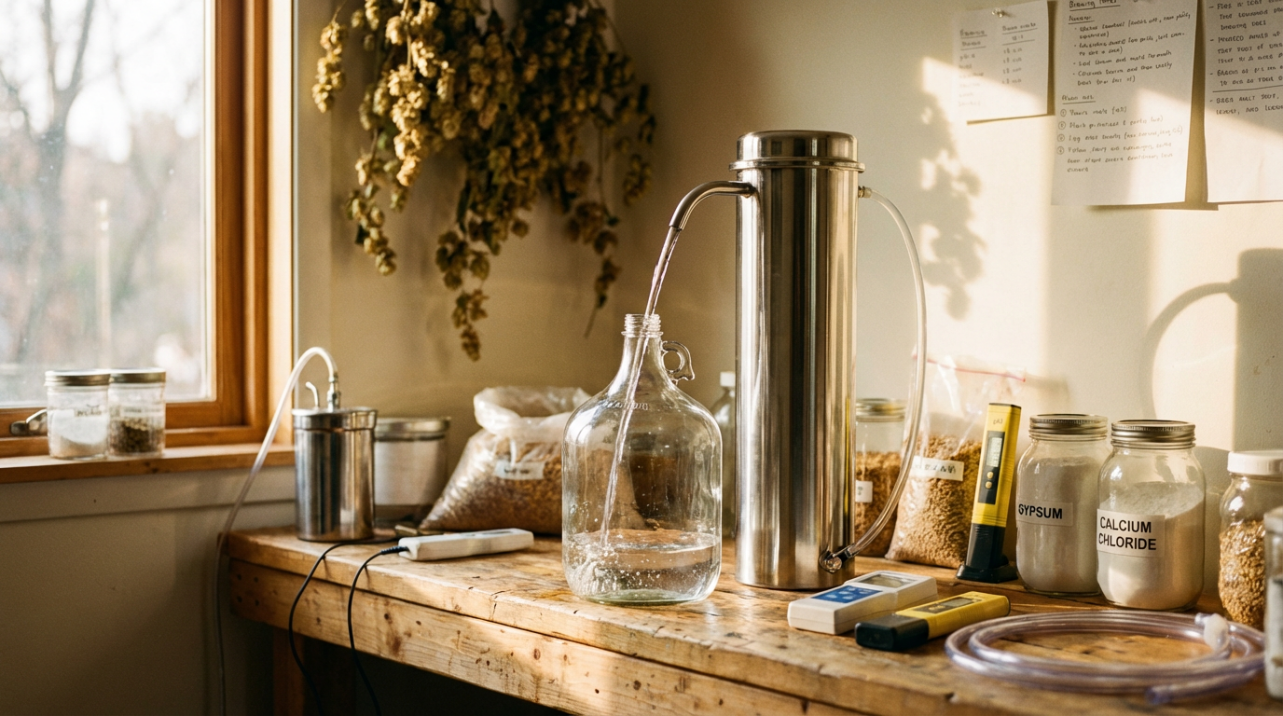
As a Smart Hydration Specialist who also obsesses over mash pH and sulfate-to-chloride ratios, I see the same pattern over and over: brewers dial in yeast, hops, and temperature, yet their beer still tastes “muddy” or flat compared with commercial craft examples. Nine times out of ten, the missing link is water.
Brewing scientists routinely point out that beer is roughly 90–95% water by volume, and blind tasting work summarized by the BeerSmith Home Brewing Blog and Bräu Supply shows that changing brewing water is one of the easiest variables for drinkers to detect. Brewing educators at Colorado State University go even further and describe water as “everything to a brewer.”
The good news is that you don’t need a chemistry degree or a full laboratory to hit essential water standards at home. With a little structure, you can treat your brewing water more like what it really is: your fifth core ingredient, not just whatever comes out of the tap.
In this guide, I will walk through practical, science-backed standards for:
- Making sure your brewing water is safe and “flavor-clean.”
- Hitting the right pH and hardness for efficient, flavorful mashes.
- Managing key ions such as calcium, sulfate, chloride, magnesium, sodium, and bicarbonate.
- Choosing sensible filtration and adjustment strategies for a homebrew setup.
Along the way I will ground recommendations in work from sources such as BeerSmith, Craft Beer & Brewing, Brülosophy, the American Homebrewers Association, Montana State University’s barley program, Horiba’s brewing water guidance, and multiple professional brewers.
1. Start With Safe, Clean Water
Before you think about ppm of sulfate, you need to know that the water you are brewing and drinking is fundamentally safe and free of obvious off-flavor risks. Professional brewery water treatment articles in Craft Beer & Brewing and MoreBeer consistently start here: safety first, then flavor and style.
Municipal vs bottled vs “mystery” water
In the United States, municipal tap water is regulated under the Safe Drinking Water Act, as summarized by MoreBeer’s guide to water testing. Utilities must test for microbial contaminants and regulated chemicals and publish at least one Annual Water Quality Report each year, with more frequent reporting coming into effect.
Many bottled waters actually start as treated municipal water that is filtered and repackaged, as MoreBeer notes, and are regulated under food rules rather than drinking-water rules. That means bottled is not automatically “safer” than tap; it is simply different.
For homebrewing, the practical standard is: at minimum, use a source you would confidently drink every day. If you are on a private well or a small system without regular reporting, homebrewing guides from Brewcabin and Glacier Fresh recommend testing for basic safety parameters and metals before you rely on that water.
Remove chlorine and chloramine every time
Almost all brewing-focused sources agree on one non‑negotiable standard: never mash or rinse with chlorinated water.
Municipal systems commonly use chlorine or chloramine as disinfectants. The Craft Beer & Brewing water-ions glossary and Horiba’s brewing water application note explain why that is a problem in the brewhouse: chlorine species react with organic compounds from malt to form chlorophenols, which present as medicinal, bandage‑like off‑flavors. Brülosophy cites typical municipal chlorine levels of roughly 1–3 ppm, while chlorophenols are detectable by humans at only about 10–30 parts per billion, roughly one hundred times lower.
From a water‑wellness perspective, you might tolerate a slight pool aroma in your tap glass. In a craft IPA, it is unforgiving. Professional brewers interviewed by Brülosophy emphasize that chlorophenols should never be present in beer.
Fortunately, you have simple tools:
- Activated carbon filtration: West Coaster’s “It Really Is in the Water” column, Glacier Fresh’s homebrewing filtration guide, and Craft Beer & Brewing all describe carbon filters as the standard way to strip chlorine and many organics. Think of a higher‑capacity version of the under‑sink or pitcher filters many households already use.
- Campden tablets (potassium metabisulfite): Both BeerSmith and Brülosophy mention Campden as a fast way to neutralize chlorine and chloramine. A very small tablet dose treats a typical homebrew batch, with no residual flavor when used correctly.
- Standing water for chlorine only: Glacier Fresh notes that free chlorine (not chloramine) can dissipate if you leave water uncovered for roughly a day. This is simple but not very precise, and it does nothing for chloramine, which is more stable.
- Reverse osmosis: As discussed in West Coaster and Craft Beer & Brewing’s water treatment article, RO membranes remove disinfectants along with most other dissolved material.
An essential standard you can adopt: brew only with water that has had chlorine and chloramine removed before it touches malt, and avoid rinsing cleaned glassware or kegs with untreated chlorinated water.
Watch for metals and “unseen” contaminants
From a flavor and health standpoint, you should also limit certain metals and industrial contaminants. Glacier Fresh highlights iron and copper as key taste offenders that cause metallic or blood‑like notes at surprisingly low levels. Craft Beer & Brewing notes iron’s tendency to oxidize wort and promote haze; Montana State University’s barley program warns that iron above about 0.2 mg/L can impair saccharification and yeast activity.
The brewery water-treatment guide in Craft Beer & Brewing also underscores the growing concern around PFAS “forever chemicals” and other industrial contaminants. These require serious filtration, typically through advanced carbon media and RO.
For most homebrewers, the practical standard is this: if your local water report or lab test flags high iron, manganese, or PFAS, treat that water through appropriate filtration or choose an alternate source such as high‑quality filtered or RO water.
Filtration choices for the homebrewer
A smart home setup often ends up being similar to a small brewery: staged filtration. Glacier Fresh’s overview of homebrewing filtration and Craft Beer & Brewing’s treatment article describe several technologies you can mix and match.
A typical hierarchy looks like this:
Filter type |
What it primarily does |
Pros for homebrewing |
Considerations |
Sediment / screen |
Removes sand, rust, silt, larger particles |
Protects other filters and gear |
Does not remove chlorine or dissolved ions |
Activated carbon |
Removes chlorine, many organics, improves taste and odor |
Inexpensive, easy to install, almost mandatory |
Limited life; does not fully de‑ionize water |
Micron / cartridge |
Filters finer particles, some microbes depending on rating |
Helps with clarity and biological risk |
Needs periodic replacement |
Reverse osmosis |
Removes most dissolved minerals, many chemicals, bacteria and viruses |
Produces near‑blank slate water with consistent quality |
Slower, wastes some water, needs remineralization |
Glacier Fresh and Spike Brewing both note that if you are uncertain about your tap water and do not want to install multi‑stage filtration, starting with bottled RO water is a viable path. Brülosophy points out that filling a 5‑gallon container of RO from a vending machine is typically inexpensive and the product is pure enough to treat as distilled for brewing purposes.
From a “smart hydration” lens, if you invest in a solid under‑sink carbon plus sediment filter or an RO system for your home, you are improving both your everyday drinking water and your brewing water at the same time.
2. Core Brewing Chemistry Standards
Once your water is safe and flavor‑clean, you can focus on what brewing textbooks and blogs agree are the core chemistry standards: pH, hardness, alkalinity, and the “flavor ions.”
Mash, run‑off, and finished beer pH
The American Homebrewers Association, BeerSmith, Horiba, and Bräu Supply all converge on a similar mash pH window for most styles: roughly 5.2 to 5.5 when measured at room temperature. Bräu Supply emphasizes that enzymes such as alpha‑ and beta‑amylase show peak efficiency in that slightly acidic band, converting starches into fermentable sugars and shaping mouthfeel.
Horiba’s brewing note breaks pH down by stage:
- Mash: ideal pH about 5.2–5.5 for enzyme performance and yield.
- Sparge/run‑off: wort pH should stay below roughly 6; the American Homebrewers Association recommends keeping lauter pH below about 5.8 to avoid extracting astringent tannins.
- Post‑boil wort: target pH around 5.0–5.2, which Horiba notes improves hop character, hot break formation, and keeps color pick‑up down.
- Final beer: Horiba cites typical lager pH around 4.2–4.6, some ales near 3.8, and sour beers around 3.0; the American Homebrewers Association points to roughly 4.2–4.4 as a sweet spot for stability and flavor for many standard styles.
From practical brewing experience and the Homebrew Talk water primer, a simple “standard of care” for most homebrewers is to:
- Aim for mash pH in the 5.2–5.5 range for pale and amber beers.
- Let darker beers such as stouts ferment from a slightly higher mash pH, around the upper 5.4–5.8 band, which softens roast and helps them finish with a richer, less acrid profile.
- Keep sparge water pH in check (often by a small phosphoric acid addition) so run‑off pH does not drift much above the mid‑5s.
- Expect finished beer pH somewhere in the low‑to‑mid 4s, unless you are brewing intentionally tart or sour styles.
Brewcabin, Spike Brewing, and Horiba all stress that strips are too crude for reliable control. A decent digital pH meter with automatic temperature compensation and regular calibration is one of the highest‑value “smart” tools you can buy for your brewhouse.
As a concrete example, if your cooled mash sample reads 5.8, both BeerSmith and Brewcabin show how to use brewing software to calculate a small dose of lactic or phosphoric acid to bring it closer to 5.3. The key is to add acid in small increments, stir well, and re‑measure after a few minutes rather than chasing the number aggressively.
Hardness and the role of calcium
Water hardness is primarily the concentration of calcium and magnesium. Horiba and the American Homebrewers Association emphasize that, despite being sometimes unpleasant for household fixtures, hardness is usually helpful in a mash because calcium drives pH downward, stabilizes enzymes, and improves clarity.
Multiple sources, including BeerSmith, Horiba, Untappd’s brewer water guide, and Craft Beer & Brewing, converge on a typical calcium range of about 50–150 ppm for brewing. The Homebrew Talk primer extends the upper end to about 200 ppm for some strong or dark styles but still treats 50–150 ppm as a practical working range.
Calcium does a lot of heavy lifting:
- It acidifies the mash, countering alkalinity so you land in the 5.2–5.5 pH sweet spot.
- It improves protein coagulation in the boil, leading to clearer wort and beer.
- It supports yeast flocculation and reduces the risk of gushing by precipitating calcium oxalate, as Craft Beer & Brewing notes.
- It improves flavor stability over time.
If your water report shows calcium under about 50 ppm, BeerSmith, West Coaster, and Craft Beer & Brewing recommend adding calcium sulfate (gypsum) or calcium chloride until you are in that mid‑range. When calcium is very low and alkalinity is high, hitting a good mash pH becomes a constant struggle without either large acid additions or diluting with low‑alkalinity water.
On the other hand, water that comes out of the tap with very high hardness often benefits from partial or full RO treatment. West Coaster’s article explains how many breweries soften very hard water through reverse osmosis and blend it back with less‑treated water, then rebuild mineral content to taste. That same approach works at home: blend some RO water into very hard tap water until calcium and magnesium land in a more manageable range, then rebuild with gypsum or calcium chloride.
Alkalinity, bicarbonate, and dark vs pale beers
If calcium is your pH‑lowering friend, alkalinity is the stubborn relative who resists change. BeerSmith, Brewcabin, Montana State University, Horiba, and the American Homebrewers Association all treat alkalinity—driven mostly by bicarbonate and carbonate ions—as a central factor in mash chemistry.
Alkalinity measures the water’s resistance to becoming more acidic. High bicarbonate content pushes pH up, works against calcium’s acidifying effect, and can lead to:
- Mash pH above the optimal range, hurting enzyme efficiency.
- Harsher bitterness and less crispness in pale beers.
- More difficulty forming and removing hot and cold break.
Horiba and the American Homebrewers Association both emphasize that for pale, delicate beers, carbonate and bicarbonate levels should be low. Horiba specifically recommends keeping carbonate–bicarbonate ions under about 50 ppm when calcium is in the desired range. Brewcabin illustrates how water with alkalinity around 125 ppm requires significantly more acid to move mash pH than water with low alkalinity.
At the same time, history and modern chemistry agree that darker beers can thrive with more alkalinity. West Coaster points out that cities like Munich, Dublin, and London have carbonate‑rich water that historically favored dark lagers, porters, and stouts, because the natural acidity of dark roasted malts counterbalances higher bicarbonate. Brewer‑World’s overview of classic water profiles makes the same connection.
A practical standard you can follow:
- For pale lagers, pilsners, blond ales, and hop‑forward IPAs, keep bicarbonate low—ideally below about 50 ppm, through dilution with RO or distilled water if necessary.
- For brown ales, porters, and stouts, moderate bicarbonate (for example in the 50–200 ppm band, depending on how dark the grist is) can be helpful, allowing the mash pH to land in that slightly higher range that gives cocoa‑like rather than acrid roast character.
The Homebrew Talk primer suggests using baking soda to add bicarbonate for dark beers when starting from very soft or RO water, and relying on RO dilution when tap water alkalinity is too high for pale styles. The key is to avoid pushing bicarbonate so high that mash pH becomes hard to control.
Flavor ions: sulfate, chloride, magnesium, sodium
Once pH and alkalinity are under control, you can use the so‑called “flavor ions” to tune bitterness, maltiness, and mouthfeel. BeerSmith, the American Homebrewers Association, Untappd’s brewer guide, Spike Brewing, Brülosophy, Craft Beer & Brewing, and Montana State University all describe similar roles and ranges.
Here is a consolidated view drawn from those sources:
Ion |
Typical working range (ppm) |
Main impacts (from multiple brewing sources) |
Calcium |
50–150 |
Lowers mash pH, supports enzymes and yeast, improves clarity and stability |
Magnesium |
10–40 |
Yeast nutrient, minor pH effect; above roughly 40–50 can add sour‑bitter astringency |
Sodium |
0–150 |
Enhances sweetness and body at moderate levels; harsh and salty above about 150–200 |
Sulfate |
about 50–300 |
Accentuates dryness and hop bitterness; too high can yield harsh, sulfury notes |
Chloride |
0–200 |
Increases fullness, roundness, and malt sweetness; too high can give rough, heavy character |
Bicarbonate / alkalinity |
style‑dependent |
Raises pH; helpful in dark beers in moderation, problematic in pale beers when high |
Sulfate and chloride form one of your most powerful flavor “dials.” BeerSmith, Untappd, Spike Brewing, Homebrew Talk, and Brülosophy all discuss the sulfate‑to‑chloride ratio:
- Higher sulfate relative to chloride (ratios of roughly two‑to‑one or more) pushes beers toward a drier, more bitter, hop‑forward profile.
- Higher chloride relative to sulfate (ratios around one‑to‑two) softens bitterness and emphasizes malt sweetness and a “pillowy” mouthfeel, which modern hazy IPAs and malt‑forward lagers often chase.
Craft Beer & Brewing’s ion glossary and West Coaster’s profile of Burton‑on‑Trent both point out that gypsum (calcium sulfate) additions historically gave English pale ales their signature firm bitterness, while calcium chloride supports rounder, malt‑driven beers.
In real terms, this might mean that a West Coast IPA brewed with about 150–250 ppm sulfate and 50–80 ppm chloride will taste snappier and drier than the same beer brewed at equal sulfate and chloride. Conversely, a malty porter brewed with chloride around 100–150 ppm and sulfate kept modest will feel fuller and less sharp.

These numbers stay within the ranges laid out by BeerSmith, Homebrew Talk, Spike Brewing, and Untappd.
Magnesium and sodium deserve respect as well. BeerSmith, the American Homebrewers Association, Montana State University, and Spike Brewing note that modest magnesium in the 10–30 ppm range supports yeast health, while sodium around 70–150 ppm can round out malt flavor in some styles. Push either too high and you introduce metallic, sour‑bitter, or harsh salty flavors. Most modern water profiles keep magnesium and sodium conservative unless the style explicitly calls for more, as in a gose.
3. Practical Homebrewer Workflow: From Report to Recipe
Water chemistry only becomes useful when it fits a practical, repeatable workflow in a real kitchen or garage. The most helpful advice I have seen—from Brewcabin, BeerSmith, Spike Brewing, MoreBeer, Brülosophy, and experienced brewers on Homebrew Talk and Northern Brewer’s forums—is to keep your process simple and staged.
Understand your starting water
Your first step is to learn what is in the water you plan to brew with. Several sources outline good options:
- Municipal reports: MoreBeer explains that every public water system in the U.S. must publish an Annual Water Quality Report that includes minerals such as calcium, magnesium, sulfate, chloride, and alkalinity. Those numbers are usually stable throughout the distribution system and make a solid starting point for brewing calculations.
- Lab testing: BeerSmith and Brewcabin both recommend sending a sample to a specialized lab such as Ward Laboratories or White Labs for a brewing‑specific water test if you want more precise values or if you are on a private well. These tests are usually affordable compared with the cost of a full brew day.
- Home test kits: Spike Brewing and Brewcabin mention options such as Lamotte’s BrewLab or other brewing kits, which provide multiple tests and can be shared with a club. They are less precise than accredited labs but much better than generic paper strips.
MoreBeer cautions against relying solely on “free home water tests” offered at big‑box stores, as these are often sales tools for expensive treatment systems rather than objective analyses.
Once you have calcium, magnesium, sodium, sulfate, chloride, and alkalinity (or bicarbonate), you can enter those values into brewing software.
Decide on tap, filtered, or RO
At this point, you choose your base water. Brewcabin and Spike Brewing both suggest a hierarchy that mirrors what I advise in home hydration work:
- If your tap water is safe, reasonably low in chlorine, and not extreme in hardness or alkalinity, you can often brew successfully with carbon‑filtered tap water plus modest adjustments.
- If minerals are high or vary by season, many brewers move to partial dilution: blending tap water with RO or distilled to bring hardness and alkalinity into a better range, then rebuilding ions with salts.
- If your tap water is very hard, has high alkalinity, or contains problematic contaminants, starting from RO or distilled water is simplest. Brülosophy and Spike Brewing both favor this approach because it gives a near‑blank slate: all key ions near zero, so you add exactly what you want.
BeerSmith points out an important limitation: you cannot magically “subtract” ions with salts. If your tap water has 100 ppm calcium and you want 50 ppm, the only way down is to dilute with water that has less calcium, such as RO or distilled.
Adjust mash pH and minerals
Once you know your source and starting profile, the adjustment process becomes mechanical, which is where brewing software shines. BeerSmith and Brewcabin show the same basic steps: you enter your starting water, choose a target profile appropriate for your beer style, and the tool calculates salt additions—most often gypsum, calcium chloride, sometimes Epsom salt or baking soda—to hit your target ions and estimated mash pH.
Several guidelines emerge consistently across BeerSmith, the American Homebrewers Association, Spike Brewing, Horiba, and Homebrew Talk:
- Treat all water for chlorine or chloramine before anything else.
- Add salts to your brewing water early, ideally as it is heating for the mash so they dissolve completely.
- For all‑grain brewing, check mash pH about 10–15 minutes after dough‑in; use lactic or phosphoric acid to bring it into the 5.2–5.5 range for pale beers if it is too high.
- For very dark beers brewed with soft or RO water, small additions of baking soda or other alkalinity sources can keep mash pH from crashing too low.
- For extract brewing, BeerSmith and Brewcabin both note that malt extract already contains most of the minerals from the original mash. In that case, using neutral or distilled/RO water is often best; heavy mineral manipulation can overdo it.
From my perspective working with homebrewers, the biggest mistakes tend to be over‑correction and complexity. The Homebrew Talk water primer repeatedly encourages brewers to err on the side of fewer minerals and smaller changes, because boiling concentrates everything and because too much sulfate, chloride, or sodium is hard to hide. Starting with a conservative profile and adjusting one variable at a time from batch to batch teaches you more than chasing a perfect spreadsheet number on day one.
A quick water‑use reality check
West Coaster reports that breweries typically use between about five and twelve pints of water for every pint of beer once you include cleaning, losses in grain, evaporation, and transfer. For a standard 5‑gallon homebrew (forty pints of finished beer), that implies roughly 25 to 60 gallons of total water use across brewing and cleaning.
From a water‑wellness and sustainability perspective, that is a powerful reminder: tightening up your water chemistry does not just improve flavor, it creates an opportunity to use that water more thoughtfully. Many breweries, as West Coaster describes, already reuse hot wort‑chiller water for the next mash or sparge. Homebrewers can do the same—capturing still‑hot chiller water in a clean vessel for cleaning or for the next brew day, instead of sending it straight down the drain.
4. Brewing Water and Whole‑Home Hydration
Because I come to brewing from a smart filtration and hydration background, I always urge homebrewers to think of their “brewing water system” as part of their entire household water strategy.
Glacier Fresh, Craft Beer & Brewing, MoreBeer, and Horiba all reinforce a simple truth: high‑quality brewing water is, by definition, high‑quality drinking water. It is water that is microbiologically safe, low in unwanted contaminants, free of chlorine, and well‑balanced in minerals.
If your tap water is safe but heavily chlorinated, installing a good carbon filter improves both your beer and your everyday hydration. If your local report or lab test shows elevated PFAS or heavy metals, investing in an RO system or relying on bottled RO for both brewing and drinking can be a rational health decision, not just a flavor tweak.
In my experience, homebrewers who make this mental shift—treating brewing water as a specific application of a broader home water‑quality plan—tend to get more value out of whatever filtration hardware they choose. They also brew more consistently great beer, because they control the single largest ingredient in every batch.
Short FAQ
Do I really need to adjust water for every single batch?
Not necessarily. Professional brewers interviewed in Homebrew Talk and Brülosophy pieces emphasize that you will not master water chemistry all at once. The Northern Brewer forum advice is to start with one parameter—usually mash pH—and then layer in sulfate and chloride adjustments later. If your base water is reasonably well‑suited to a given style, a chlorine filter and good pH control may be enough. As you brew the same recipe two or three times and taste the impact of different profiles, you can decide how deep you want to go.

Is reverse osmosis always better than tap water?
Reverse osmosis is not “better” in the abstract; it is simply more neutral. West Coaster, Brülosophy, Brewcabin, and Spike Brewing all like RO because it removes nearly all ions and contaminants, giving you consistent, repeatable water that you then rebuild with brewing salts. If your tap water is excellent and stable, that may be unnecessary complexity. If your tap water is very hard, highly alkaline, or has off‑flavors, RO or distilled water can be the clean slate that makes brewing much more predictable.
Can I just use bottled spring water and ignore all this?
You can, but it is not always the shortcut it seems. MoreBeer notes that many bottled waters are just filtered municipal water, and the mineral content can vary widely by brand. If you choose this route, look for a detailed mineral analysis from the bottler and treat it just like a water report. In many cases, bottled RO water with minerally “blank slate” characteristics is easier to work with than unknown “spring water.”
When you treat brewing water like a core ingredient instead of a background detail, everything else you are already doing—careful sanitation, yeast health, modern hop techniques—suddenly clicks into place. As a Smart Hydration Specialist and water‑wellness advocate, I see this as the sweet spot where home brewing and home hydration meet: the same thoughtful, filtered, well‑balanced water that keeps you feeling good all day can also turn your next five‑gallon batch into a glass that finally tastes as clean and focused as the craft beers that inspired you to brew in the first place.
References
- https://source.colostate.edu/water-quality-beer-brewing/
- http://openknowledge.nau.edu/5866/1/Farmer_2022_developing_analytical_chemical_analysis_procedures_craft_b.pdf
- https://admisiones.unicah.edu/virtual-library/pStP5s/3OK065/brewing__classic-styles.pdf
- https://archives.csusm.edu/westcoastersd/2012/04/24/into-the-brew-it-really-is-in-the-water/
- https://www.montana.edu/barleybreeding/learning-center/brewer-resources/ionic/mineral-impacts.html
- https://www.open.edu/openlearn/ocw/mod/oucontent/view.php?id=83423§ion=1.1
- https://homebrewersassociation.org/how-to-brew/understanding-water-for-homebrewing/
- https://www.beerandbrewing.com/a-guide-to-brewery-water-treatment
- https://www.brewcabin.com/brewing-water/
- https://www.brewer-world.com/the-importance-of-water-chemistry-in-beer-brewing/

Share:
How to Dilute Essential Oils with Purified Water for Fragrance Blending
Fluoridated Water and Thyroid Health: A Smart Hydration Guide for Patients