

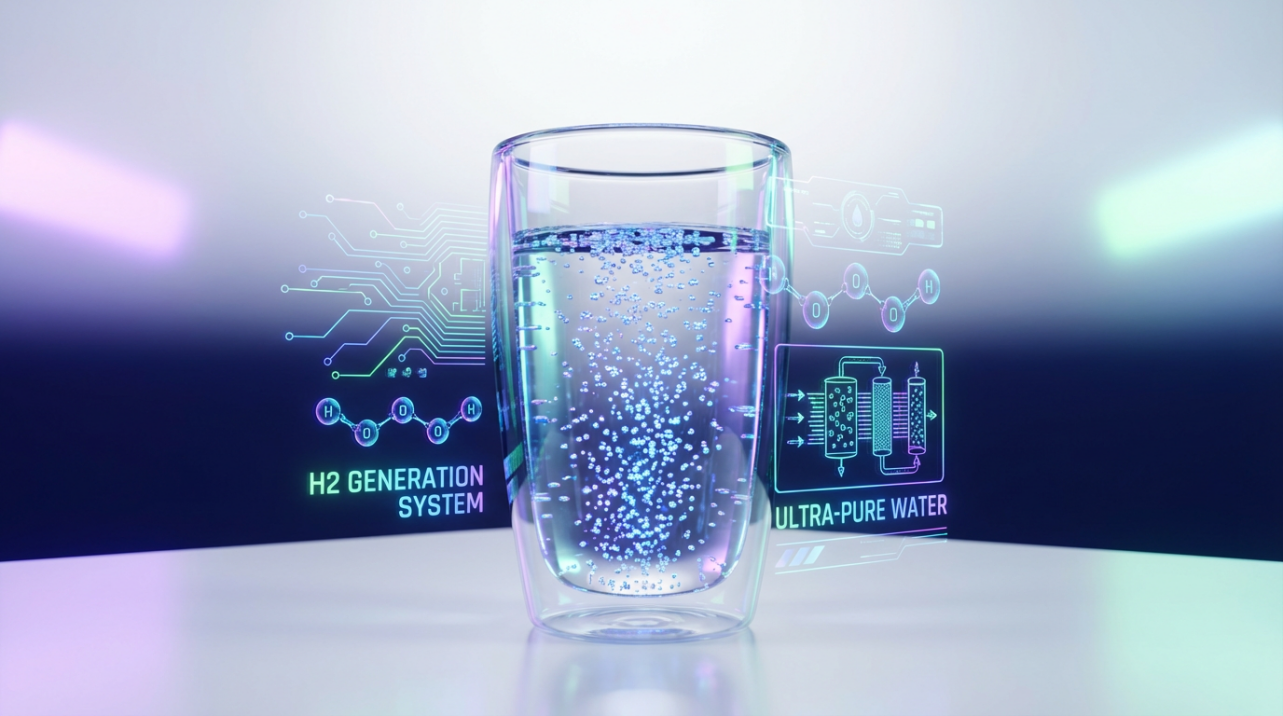
Hydrogen water has moved from niche biohacking circles into everyday kitchen conversations. As a smart hydration specialist, I regularly meet people who already own a solid water purifier and ask a very reasonable question: instead of buying an expensive “hydrogen machine,” can I just DIY hydrogen water with what I already have under the sink?
The short answer is that you can absolutely create hydrogen-rich water at home using purified water. However, turning a conventional purifier itself into a safe, reliable hydrogen water system is much more complex than it looks in social media tutorials. To understand why, we need to unpack what hydrogen water is, how it’s produced in real devices and clinical research, and where DIY approaches fit in safely and realistically.
What Hydrogen Water Actually Is (And Why People Care)
Hydrogen water is simply regular water that contains extra dissolved molecular hydrogen gas, usually written as H₂. Multiple sources, ranging from consumer health outlets such as Healthline, Everyday Health, Health.com, WebMD, and Medical News Today to a systematic review indexed in the National Library of Medicine, describe hydrogen water in this basic way: it is not a different kind of water molecule, but ordinary H₂O with more H₂ gas dissolved into it.
The interest in hydrogen water comes from molecular hydrogen’s behavior in the body. Several medical and scientific summaries explain that H₂ can act as a selective antioxidant. That means it appears to neutralize certain highly reactive free radicals while largely sparing more helpful reactive oxygen species that your cells use for signaling. Early research and review articles associate hydrogen water with potential antioxidant, anti-inflammatory, and even anti-apoptotic effects, which in theory might influence exercise recovery, metabolic health, cardiovascular function, brain health, skin health, and general markers of aging.
A systematic review of 25 human trials of hydrogen-rich water found modest improvements in areas like exercise performance, oxidative stress markers, some lipid parameters, and cardiometabolic indicators in specific groups. For example, studies in people with metabolic syndrome reported reductions in total and LDL cholesterol and improvements in certain antioxidant enzymes and inflammatory markers when participants drank hydrogen-rich water daily for several weeks. Small studies in athletes found lower blood lactate and reduced perceived fatigue when pre-exercise hydration included hydrogen water, and some trials in older adults and clinical populations suggested improvements in quality of life or surrogate markers such as telomere length.
At the same time, nearly every independent health publisher emphasizes that these studies are small, short-term, and heterogeneous. Many trials involve fewer than fifty participants, last only a few weeks, and focus on narrow populations such as trained cyclists, individuals with metabolic syndrome, or patients receiving specific medical treatments. Health.com, Everyday Health, Healthline, Medical News Today, Rupa Health, and WebMD all arrive at a similar conclusion: hydrogen water looks promising as an adjunct, seems generally safe, but the human evidence is still early and does not justify treating it as a miracle cure or a replacement for standard medical care.
In other words, hydrogen water is best viewed as a potential wellness upgrade for already-clean water, not a magic liquid that replaces good sleep, smart nutrition, movement, and appropriate medical treatment.

How Much Hydrogen Water Do Studies Actually Use?
When you look at the research protocols, a pattern emerges. Many human trials ask participants to drink hydrogen-rich water daily for several weeks. Typical intake volumes fall roughly between about 20 and 70 fl oz per day.
For example, some exercise and metabolic studies used around 50 to 68 fl oz of hydrogen water daily over several weeks. Others gave roughly 10 fl oz twice per day. A clinical trial in people with metabolic syndrome used a daily intake in this same general range for about ten weeks. A broader functional medicine review notes that research protocols commonly sit in the neighborhood of about 20 to 70 fl oz per day for at least four weeks, depending on the outcome being studied.
There is no official recommended daily amount, no agreed optimal concentration, and no standardized dosing schedule. Regulatory agencies such as the U.S. Food and Drug Administration have classified hydrogen gas as generally recognized as safe in beverages at certain concentrations, and across the reviewed trials, serious adverse events are rare to absent. Still, the exact “sweet spot” for dose and duration remains unclear.
For a home user, this means that if you experiment with hydrogen water, you are essentially trying an optional add-on for some portion of your daily hydration, usually in the range of a few glasses per day.

It is not a reason to dramatically change your overall fluid intake beyond what your body and clinician already recommend.

What Water Purifiers Do – And What They Do Not
Before we talk about DIY hydrogen water, we need to be crystal clear about the job of a conventional water purifier.
Technologies such as activated carbon filtration and reverse osmosis (RO) are designed to remove contaminants, not to add hydrogen gas. A hydrogen water purifier, in the strict sense, is really a two-stage solution: it first purifies the water and only then enriches it with H₂.
One manufacturer of hydrogen water purifiers explains this particularly well using its HYDROMI system. They emphasize that a hydrogen water purifier must first function as a high-quality water filter. HYDROMI uses a five-stage reverse osmosis process with extremely fine filtration, designed to remove a broad spectrum of contaminants, including microorganisms and heavy metals, without generating chemical by-products like ozone or chlorine. Only after this thorough purification does the system use advanced membranes and electrolysis to separate hydrogen and oxygen in the water and produce hydrogen-rich drinking water.
Hydrogen-focused technical articles echo the same architecture. In a process overview of hydrogen water generation, the hydrogen cell is described as the last step in a chain of multi-stage filtration. Feed water runs through pre-filters to remove sediment, then through reverse osmosis to strip dissolved impurities, then through activated carbon and additional sanitizing steps such as silver-ion dosing. Sometimes a mineralizer stage reintroduces beneficial minerals for taste and health. Only after all of this does the purified water reach the hydrogen-generating cell, where specialized electrodes and membranes dissolve H₂ gas into the water while venting oxygen and reject gases.
A key line from that technical discussion is that hydrogen water generators “are not primary water purifiers.” They expect clean, filtered water upstream. This is crucial for any DIY plan: your purifier is the foundation, not the whole hydrogen system. It provides safe base water for hydrogen enrichment but does not, by itself, make hydrogen water.
The Main Ways to Make Hydrogen Water at Home
Consumers and clinicians today have several ways to generate hydrogen water at home. Understanding them helps us see where water purifiers fit and where DIY is realistic or risky.
Integrated Hydrogen Water Purifiers
Some systems combine everything in a single appliance. The HYDROMI purifier is an example: a space-grade reverse osmosis unit with five-stage purification and a hydrogen-generating electrolysis stage. The manufacturer notes that separating hydrogen and oxygen this way requires substantial technical expertise and positions their unit as one of the few purifiers globally capable of this advanced process.
Other brands build similar “filter plus hydrogen” designs. Some electric water ionizers have robust filtration (one company reports independent testing showing up to 99.9 percent removal of 172 contaminants in EPA-certified labs) and then use electrolysis plates to generate hydrogen-rich alkaline water for drinking and an acidic stream for external uses. Government agencies in countries such as Japan and Korea have approved certain electric water ionizers as health devices, and tests at universities have verified their contaminant reduction and hydrogen output.
From the user’s perspective, these integrated systems are not DIY. They are engineered appliances you install and maintain according to the manufacturer’s schedule. The DIY element is simply choosing a model that fits your space, budget, and filtration needs, then operating it consistently.
Electric Water Ionizers and Hydrogen Generators
The oldest mainstream hydrogen water machines are electric water ionizers. They have more than three decades of history and can generate hydrogen-rich alkaline water on demand at user-selectable levels, while sending an acidic stream down the drain or into a secondary outlet. Advanced models use self-cleaning features such as polarity-reversing plates to maintain hydrogen output over time.
A newer class of electric hydrogen generators focuses on producing hydrogen-rich water at a neutral pH rather than altering pH significantly. Some are countertop units feeding off a purifier or faucet, while others are under-sink machines that pair with an existing reverse osmosis or whole-house system to deliver hydrogen water at the tap. An under-sink model from one brand uses a built-in pump to maintain steady flow and is intentionally filter-free, relying on upstream purification.
Many portable hydrogen water bottles and pitchers fit into this category. They use electrolysis with solid polymer electrolyte (SPE) and proton exchange membrane (PEM) technology to dissolve hydrogen into water in just a few minutes. Independent testing from organizations such as H2 Analytics has verified that some devices can reach dissolved hydrogen concentrations in the thousands of parts per billion during short cycles. Some premium hydrogen pitchers, such as those highlighted by Dr. Water and Piurify, use SPE/PEM electrolysis combined with features like vortex infusion, self-cleaning cycles, and, in some cases, heating functions to provide warm hydrogen water for tea or coffee.
Crucially, several of these devices either do not filter the water at all or only perform light pre-filtration such as chlorine reduction. Most manufacturers explicitly recommend using filtered water from a purifier or bottled source to protect their electrodes and membranes. That means your existing purifier becomes the source of clean water, and the hydrogen device is the add-on.
Non-Electric Ionizers, Pitchers, and Filters
Companies also offer non-electric alkaline filters and ionizers that use materials such as magnesium and mineral ceramics to mimic natural “healing springs.” These units can filter and alkalize the water and generate some dissolved hydrogen as a by-product of chemical reactions inside the media.
However, hydrogen output from these passive devices is hard to control. One manufacturer notes that because hydrogen generation depends on how long water sits in contact with magnesium in the filter, H₂ levels are highest when the water has been resting in the cartridge and drop during continuous use. Natural springs themselves, even famous ones associated with health tourism, typically have lower hydrogen levels than a good electric ionizer.
These non-electric systems can be attractive because they do not need power and can improve taste and alkalinity while providing some hydrogen.

They fit well for users focused on filtration and gentle enhancement rather than high hydrogen concentrations.
Hydrogen Tablets and Magnesium Sticks
Hydrogen tablets and powders create H₂ via a reaction between metallic magnesium and water. Multiple sources recommend dissolving tablets in water, not swallowing them directly, because the research evidence for hydrogen generally involves drinking hydrogen-rich water rather than having tablets react in the stomach.
When used properly, tablets can generate highly saturated hydrogen water. One manufacturer states that tablets typically reach high saturation in about twenty minutes when dissolved in completely full, airtight containers. Their own H2Viva tablets are advertised as delivering hydrogen saturation up to about twice that of a new magnesium hydrogen stick in roughly half the time. However, performance can be inconsistent if preparation steps such as filling the container fully, sealing it airtight, and waiting the full activation period are not followed carefully.
Magnesium sticks are an older technology dating back to the late 1990s. They also rely on magnesium reacting with water to produce H₂ but do not filter the water and often require long contact times. Their lifespan and hydrogen output can be uncertain, and manufacturers typically recommend using them only with pre-filtered or bottled water.
From a DIY perspective, tablets offer a simple way to add hydrogen to water from your purifier with minimal equipment. The trade-offs are the need for careful preparation and the fact that they do nothing for filtration; your purifier remains essential.
DIY Electrolysis Experiments
Some hydrogen enthusiasts experiment with building their own hydrogen generators using basic electrolysis: a container of water, a direct current power source, and electrodes made from metals such as platinum or stainless steel. A hydrogen water article aimed at home users describes this as a hands-on project for science enthusiasts and clearly labels it as technically complex.
In a DIY setup, electrical current splits water into hydrogen and oxygen gas. The idea is to capture the hydrogen and dissolve it into a separate container of clean water. The article emphasizing this approach also stresses safety precautions: wearing gloves and eye protection, working in a well-ventilated area, and never leaving the setup unattended, because hydrogen is flammable. It also notes that hydrogen concentration can vary and that the method is not straightforward for consistent, day-in day-out drinking water.
If you compare this hobbyist setup with how commercial hydrogen cells are described in technical overviews and in hydrogen water purifiers like HYDROMI, you see why it is challenging. Commercial systems use platinized titanium electrodes, carefully designed SPE membranes that selectively allow hydrogen ions to pass, sealed gas separation chambers, and controlled venting of oxygen and trace gases. One hydrogen water generation article even includes an additional Electrolytic Sanitizing System and silver-impregnated carbon filter to maintain microbial safety. Recreating anything close to that level of safety and consistency on a kitchen counter is far beyond casual DIY.

So, Is DIY Hydrogen Water with a Water Purifier Actually Possible?
At this point, it helps to separate three different meanings of “DIY.”
One interpretation is “build my own hydrogen water machine from scratch and plumb it into my purifier.” Considering the complexity of multi-stage filtration, gas separation, and safety requirements described by manufacturers and process engineers, this level of DIY is not realistic or advisable for most households. Even the companies making integrated hydrogen water purifiers emphasize how technically demanding it is to separate hydrogen and oxygen reliably and highlight that few devices worldwide do it at that standard. Combining high-voltage electrolysis, pressurized gases, and drinking water without professional-grade design and testing introduces real safety and reliability concerns that the current literature does not even begin to address, because it assumes properly engineered devices.
A second, more practical interpretation is “use my existing purifier and add consumer hydrogen solutions myself.” This is where DIY becomes both possible and sensible for many people. In this scenario, your purifier—whether it is an under-sink RO system, whole-house filter, or high-end countertop purifier—provides clean, low-contaminant water. You then choose a hydrogen method that matches your budget and lifestyle, such as an electric hydrogen bottle, a countertop hydrogen pitcher, hydrogen tablets, or a dedicated hydrogen generator that draws from your purified water.
This is exactly how several device categories are meant to be used. Hydrogen water generation guides emphasize feeding hydrogen devices with clean water rather than raw tap water. Manufacturers of portable hydrogen bottles and countertop generators frequently recommend using filtered water to protect SPE/PEM membranes. Non-electric magnesium-based options and magnesium sticks explicitly call for pre-filtered or bottled water as their feed. In that sense, your purifier is the base layer of a DIY hydrogen system, and you customize the hydrogen layer on top with consumer devices or tablets.
A third interpretation is “get hydrogen water outcomes without buying a full-blown hydrogen purifier.” Here, DIY simply means stacking lower-cost tools. For example, someone like the community member in a holistic health forum who cannot afford a full filtration system might rely on bottled or pitcher-filtered water plus a hydrogen bottle or tablets. Users with an existing high-quality purifier can pair it with portable hydrogen bottles, hydrogen pitchers, or tablets and get many of the same functional outcomes as an integrated hydrogen purifier, just with more moving parts and slightly more daily effort.
In practice, when I help families structure a plan, the second and third interpretations are the ones that make sense.

Full engineering of a hydrogen purifier from scratch is a laboratory-grade project, not a weekend plumbing job. Using a purifier as the foundation and layering hydrogen devices or tablets on top is where DIY becomes both achievable and aligned with the way clinical research typically generates hydrogen water.
Pros and Cons of DIY-Style Hydrogen Approaches
To see where a water purifier fits into your hydrogen strategy, it helps to compare common at-home options side by side.
Approach |
Role of Water Purifier |
Pros |
Cons / Limitations |
Best Fit |
Integrated hydrogen water purifier (RO plus electrolysis) |
Built-in; purifier and hydrogen generator are one appliance |
Thorough filtration and on-demand hydrogen in a single unit; high convenience once installed |
Higher upfront cost; installation complexity; tied to one brand’s filtration and hydrogen tech |
Households wanting a turnkey “one tap” solution and willing to invest |
Countertop or under-sink hydrogen generator with separate purifier |
Purifier feeds clean water into the hydrogen unit |
Flexible; you can upgrade purifier and hydrogen device independently; easier to service |
Requires more components; some generators lack deep filtration and rely entirely on the purifier |
Users who already own a good purifier and want robust, daily hydrogen water |
Portable hydrogen bottle or hydrogen pitcher plus purifier |
Purifier provides clean water you pour into bottle or pitcher |
Lower cost than full systems; portable; easy to adopt; some devices independently tested for hydrogen output |
Small capacities require frequent refills; device maintenance; many units do little or no filtration |
Individuals prioritizing portability, travel, or testing hydrogen water without a big build-out |
Hydrogen tablets or powders with purifier |
Purifier supplies clean water for tablet dissolution |
Very portable; no device to charge; can reach high hydrogen levels when used correctly |
Preparation must be precise and airtight; no filtration; performance can vary; recurring cost |
Travelers, athletes, or users wanting occasional hydrogen boosts using their existing purified water |
DIY electrolysis rig feeding off purifier |
Purifier supplies base water for an experimental setup |
Educational and highly customizable in theory |
Technically complex, safety concerns, and unpredictable hydrogen levels; not appropriate as a primary drinking source |
Hobbyists experimenting under controlled conditions, not families seeking daily hydration |
The key pattern is that in every practical scenario except the most advanced integrated purifiers, your water purifier is the unsung hero in the background.

It provides the clean canvas. Hydrogen methods then “paint” on that canvas in different ways with trade-offs in cost, convenience, and consistency.
How to Use Your Existing Purifier Safely with Hydrogen Devices
If you decide to create hydrogen water at home using your purifier as the base, a few practical steps can help you stay on the safe, effective side of the evidence.
Start by making sure your purifier itself is up to date. Replace pre-filters, carbon filters, and RO membranes on the schedule recommended by the manufacturer. One detailed hydrogen water generation article stresses that hydrogen cells should always receive clean, filtered water and that all filtration elements need regular replacement to maintain both purity and consistent hydrogen generation. If your purifier includes sanitizing stages or silver-based filters, follow the cleaning instructions carefully to avoid microbial buildup or taste changes.
Next, choose a hydrogen method that matches your habits rather than the most glamorous marketing claim. For daily at-home use, many people do well with a countertop hydrogen pitcher or a small hydrogen generator fed by their purified water. Testing from both manufacturers and independent labs such as H2 Analytics shows that well-designed bottles and pitchers can reach high dissolved hydrogen levels in short cycles. For frequent travelers or people who drink most of their water at the office or gym, portable hydrogen bottles or tablets added to purified water may be more realistic.
Whatever technology you choose, treat freshness as a core principle.

Dissolved hydrogen does not stay in water indefinitely. Several manufacturers point out that hydrogen levels begin to fall within minutes and that storing hydrogen water for long periods largely defeats the purpose. Some recommend drinking hydrogen water immediately or within roughly half an hour after generation. Consumer health publications also note that hydrogen escapes quickly from opened containers and advise drinking promptly after opening pre-packaged hydrogen water.
If you like flavored water, be aware of the trade-off. Guidance from Echo Water notes that adding flavorings or supplements is allowed but may reduce the water’s hydrogen content, meaning you might need to drink more flavored hydrogen water to achieve the same effect you would with plain hydrogen water. From a health perspective, it still makes sense to limit added sugars and choose light, low-acid flavoring if you use any at all.
You should also use filtered, non-carbonated water. Hydrogen water device makers and reviewers repeatedly caution against using sparkling or very mineral-heavy water, particularly with SPE/PEM-based devices. Carbonation and high mineral loads can damage membranes and electrodes, shorten device life, and alter performance. Your purifier already delivers the kind of relatively low-mineral, chlorine-reduced or chlorine-free water hydrogen cells prefer.
Finally, store hydrogen devices themselves thoughtfully. Avoid placing them in direct sunlight or near heat sources. One hydrogen pitcher manufacturer and several bottle makers highlight that excess heat degrades plastics, seals, and electronics and can also influence hydrogen retention in the water.
Evidence-Based Expectations and Health Perspective
Even if you build a thoughtful DIY hydrogen setup on top of a quality purifier, it is important to set expectations in line with what the science actually shows.
The best current summary comes from a systematic review of twenty-five human trials. Across studies of exercise performance, metabolic risk factors, cardiovascular function, and other clinical endpoints, hydrogen-rich water appears to offer modest benefits in specific settings. For example, some trials in people at risk for metabolic syndrome found improved antioxidant enzymes, lower markers of oxidative stress, and better lipid profiles when participants drank hydrogen water daily for several weeks. Studies in athletes reported lowered blood lactate, slightly improved sprint performance, or reduced fatigue. In small trials involving inflammatory or aging-related markers, researchers documented changes such as improved telomere length or reduced inflammatory signaling.
Yet every credible health publisher reviewing these findings emphasizes the same limitations. Most trials are small, sometimes involving only ten or twenty participants. They run for weeks to a few months, not years. Many focus on specialized populations rather than the general public. Some studies are industry-funded or use proprietary hydrogen devices, raising questions about bias. Reviews from sources such as Health.com, Everyday Health, Medical News Today, Rupa Health, and WebMD consistently describe hydrogen water as experimental, promising, and generally safe, but not ready for strong clinical claims.
In terms of safety, hydrogen water has a favorable profile. Hydrogen gas as a beverage ingredient has been classified as generally recognized as safe within certain limits. Clinical studies of hydrogen water, whether delivered via machines, tablets, or bottled products, report good tolerability and few, if any, serious adverse events. The main hydration risk remains the same as with any water: drinking extreme volumes can dilute blood sodium in rare cases, especially during intense exercise, but this is not specific to hydrogen water.
From a cost and lifestyle perspective, experts also note that hydrogen water is substantially more expensive than plain water. Bottled hydrogen drinks and high-end machines can cost hundreds to over a thousand dollars. Health writers routinely recommend prioritizing basic hydration with clean water, nutrient-dense food, movement, sleep, and stress management. Hydrogen water can be considered an optional upgrade layered on top, especially if you already own a good purifier.
Where I Land as a Smart Hydration Specialist
When I look across the science, the engineering, and how real households live, the most balanced answer to “Is DIY hydrogen water possible with water purifiers?” is this:
Yes, you can safely and realistically create hydrogen-rich water at home by pairing a reliable water purifier with thoughtfully chosen hydrogen tools such as bottles, pitchers, generators, or tablets. Your purifier is the foundation that ensures you are not trading contaminants for hydrogen. The hydrogen devices then add a layer of potential antioxidant and anti-inflammatory support that early research suggests may help certain markers of recovery, metabolism, and overall wellness.
What is not realistic for most people is turning a standard purifier into a full-fledged hydrogen water purifier through homebrew plumbing and improvised electrolysis. The level of design and safety that commercial systems describe—multi-stage filtration, food-grade materials, controlled gas separation, and long-term durability—simply does not translate into quick DIY hacks without introducing risks and inconsistency.
If you are hydration-curious, my practical advice is to focus first on getting consistently clean, good-tasting water from a trustworthy purifier. Once that foundation is in place, consider trying hydrogen water in a way that matches your budget and lifestyle, such as a well-reviewed hydrogen pitcher fed by your purified water or a set of hydrogen tablets for specific times like before intense workouts. Use it as an experiment, track how you feel, keep your expectations grounded in the emerging science, and remember that the most powerful hydration upgrade is still the simplest one: drinking enough clean water, every single day.
References
- https://pmc.ncbi.nlm.nih.gov/articles/PMC10816294/
- https://hydrogenhouseproject.org/hydra-mobile-generator--water-purifier.html
- https://echowater.com/?srsltid=AfmBOopnBUcN06qyufEH0F0Yy-o4LQ3uElo-343yodbFnSqmrSg2_Spa
- https://www.health.com/hydrogen-water-8606666
- https://alkaviva.com/creating-hydrogen-water/?srsltid=AfmBOor8R1aVOQBxNTE53MdUgYMQ3tpQHq0nZP88WlKz1EluLmJOdF2L
- https://www.healthline.com/nutrition/hydrogen-water
- https://www.medicalnewstoday.com/articles/hydrogen-water
- https://ocsportsandwellness.com/electrolyzed-hydrogen-water/
- https://www.rupahealth.com/post/hydrogen-water-benefits-science-and-safety-explained
- https://themodernliving.com/hydrogen-water-generation/

Share:
Understanding the Impact of Alkaline Water on Blood pH Levels
Understanding Why Bartenders Prioritize Water Quality Over Alcohol