

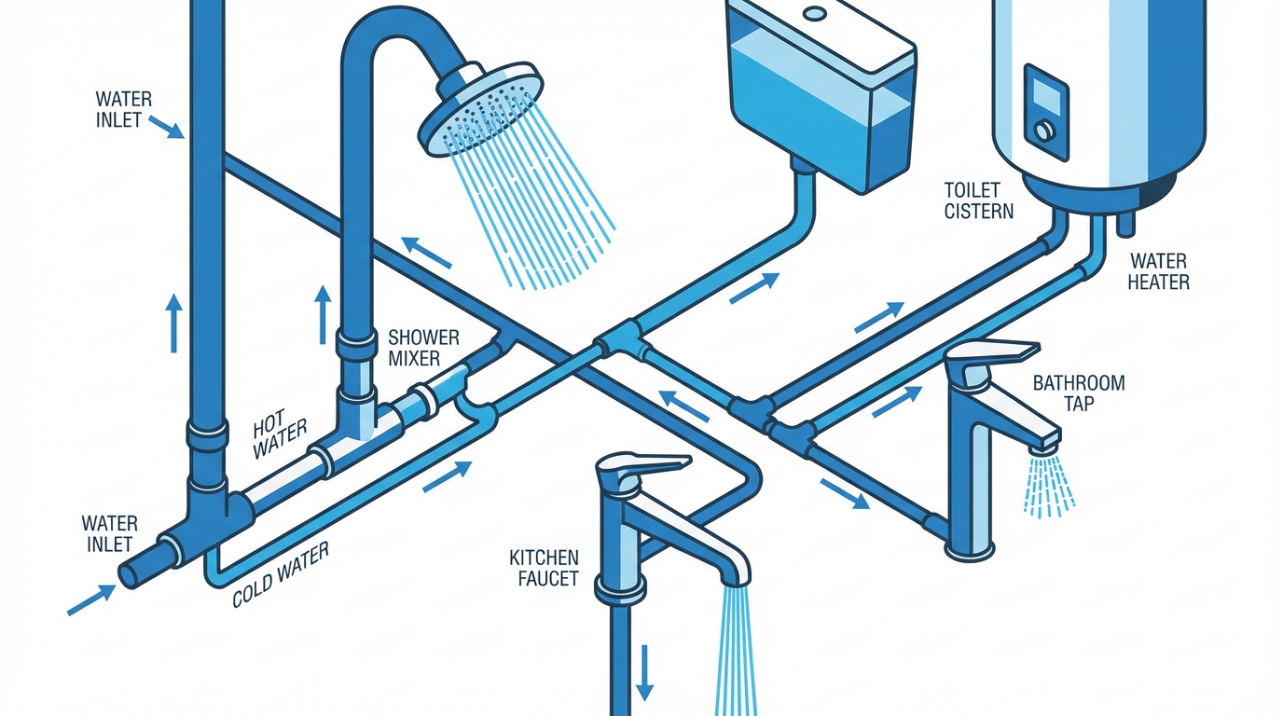
Summary: When one faucet trickles, another blasts, or the stream splays sideways, the cause is usually a mix of fixture-level clogs and plumbing-system issues. A simple, stepwise check of aerators, valves, and filters will often reveal whether you can DIY the fix or need a pro.
Flow vs. Pressure: Why Faucets Behave Differently
If your bathroom faucet is a gentle stream while the kitchen blasts, you’re seeing divergent flow: different fixtures delivering different amounts or patterns of water. The same can happen between hot and cold on the same faucet.
Flow is how much water comes out (gallons per minute). Pressure is the push behind that water (psi). As Portland’s Water Bureau and Aquatek both stress, low flow at one faucet usually means a local restriction, while whole-home issues hint at a pressure or piping problem.
It’s also worth knowing the design baseline. Moen notes many bathroom faucets are built for about 1.2 gallons per minute, and Texas regulators cap typical sink faucets around 2.2 gallons per minute. If one faucet feels dramatically weaker than similar fixtures, something is off.

Nuance: If every faucet is “weak” but consistent, you might simply have water-saving fixtures, not a plumbing failure.
Start at the Spout: Aerators, Valves, and Cartridges
Most uneven or “spraying” streams start at the tip of the faucet. Aerators and flow restrictors are the small screens that Delta, Borhn, Zeek Plumbing, and others consistently identify as the number-one culprit. Hard-water minerals, rust, and sand pinch these tiny holes and force water sideways or into a mist.
Quick check at each problem faucet:
- Unscrew the aerator; soak parts in a 1:1 white vinegar–water mix for 30–60 minutes.
- Scrub gently with a toothbrush, rinse, and reinstall; replace if parts are damaged.
- While the aerator is off, briefly run the faucet to flush any loose debris.
- If the stream is straight and strong without the aerator but weak when it’s on, the aerator is the problem.
If hot and cold behave differently on the same faucet, look at the cartridge or built-in filters. Borhn and Moen both point to clogged or worn cartridges as a cause of low or uneven flow on just one side. Turning off the under-sink shutoff valves, removing the handle, and inspecting or replacing the cartridge often restores a balanced stream.
Under-sink shutoff valves and flexible hoses matter too. Partially closed angle stops, a kinked supply line, or a failing old multi-turn valve (common in older homes) can starve one faucet while others work fine.
When the Plumbing System Is the Real Issue
If several faucets misbehave in different ways—sputtering, pulsing, or weakening at the same time—you may be dealing with a system-level cause. Aquatek, Zeek Plumbing, and Benjamin Franklin Plumbing all highlight a few big ones.
Leaks and corrosion in hidden pipes divert water before it reaches fixtures, dropping flow and sometimes staining water. A spinning water meter when no water is running is a strong leak clue. Even a small leak can waste thousands of gallons per year and undermine pressure.
Pressure-reducing valves (PRVs) and clogged whole-house filters can also create house-wide low flow or noticeable differences between floors. Portland’s data shows most homes run between 40–80 psi; a failing PRV can drop you well below that. A simple pressure gauge on an outdoor spigot gives you a quick reality check.

If only hot water is weak or sputtering everywhere, think water heater. Rite Way and Benjamin Franklin Plumbing emphasize sediment buildup in the tank: minerals settle, block outlets, and trap air, causing spurts at hot taps while cold water seems fine. Flushing the heater is standard maintenance; persistent problems deserve a professional’s eye.
How Divergent Flow Connects to Water Quality and Health
As a hydration and filtration specialist, I look at “weird flow” as an early-warning light for water quality, not just comfort. Sediment and rust that clog an aerator are the same particles you don’t want on your salad greens or in your refillable bottle.
University of Nebraska Extension notes that minerals, metals, and other contaminants naturally travel with water. When you see one faucet with a clean, laminar stream and another with a rusty, uneven spray, it often signals very different levels of buildup in the piping behind them. That can affect taste, clarity, and your confidence in that tap.

From a hygiene standpoint, a faucet that’s throttled down by unseen clogging can double the time it takes to get a decent rinse. If a bathroom sink is delivering half its designed flow, you may rush handwashing or dish rinsing, undermining the health benefits of your water in the first place.
A Simple Routine to Keep Flow Even and Healthy
A few low-effort habits go a long way toward keeping every faucet performing consistently and supporting your filtration system. Drawing from Moen, Delta, Aquatek, and Now Worries Rooter, here’s a practical cadence:
- Clean faucet aerators and showerheads every 3–6 months, more often in known hard-water areas.
- Check under-sink valves and supply lines twice a year for kinks, stiff handles, or damp spots.
- Flush your water heater annually to reduce sediment and support steady hot-water flow.
- Replace whole-house and under-sink filters on schedule (often every 6–12 months) to avoid choking the system.
- Watch for persistent drips; a single drop per second can waste over 3,000 gallons a year.
If, after these steps, you still see big differences in flow between faucets—or between floors—it’s time to bring in a licensed plumber or water treatment pro. They can test pressure, inspect piping, and verify that your filtration and softening solutions are sized correctly, so every tap in your home supports safe, satisfying hydration.
References
- https://fdo.wwu.edu/division-22-plumbing
- https://extension.psu.edu/safe-water-and-your-foodservice-operation/
- https://www.law.cornell.edu/cfr/text/24/3280.609
- https://www.portland.gov/water/drinking-water-quality/troubleshooting-drinking-water-quality-home/water-pressure-and-flow
- https://www.tceq.texas.gov/permitting/water_rights/wr_technical-resources/plumbing-fixtures

Share:
Understanding Valve Failure Indicators in Smart Home Water Systems
Three Early Signs of Wastewater Pipe Blockage to Watch For