

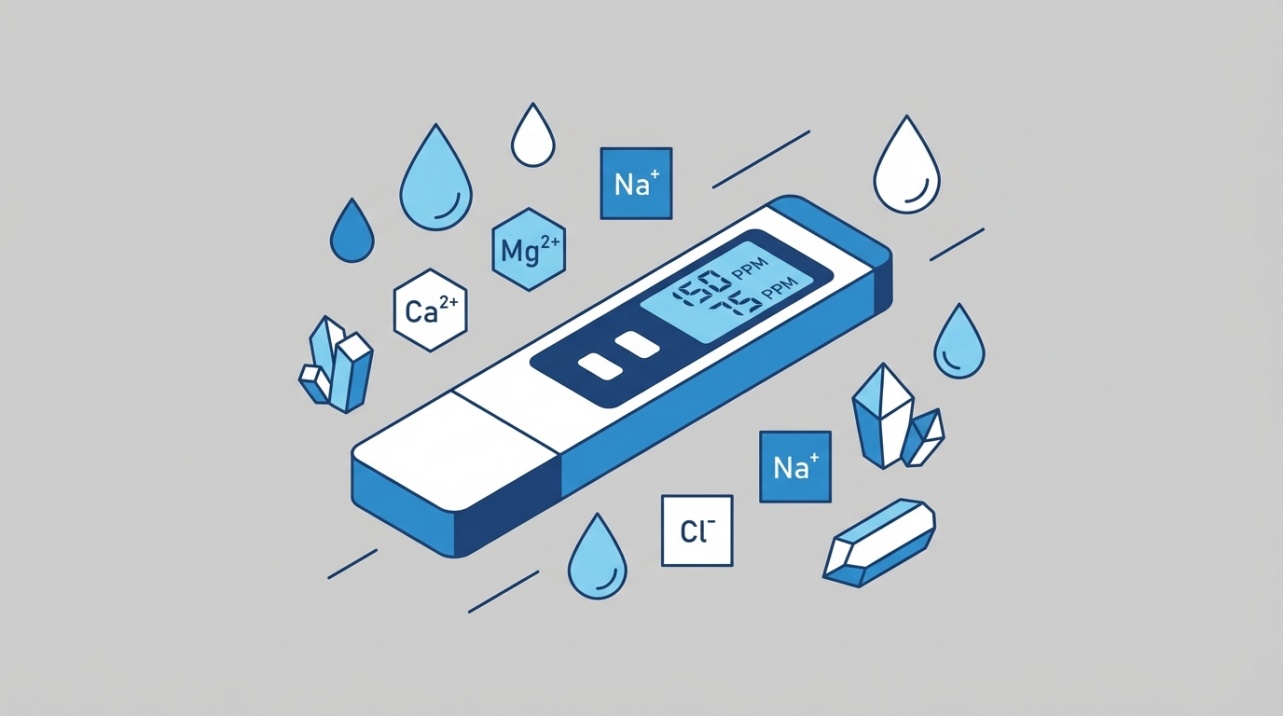
If you have ever dipped a TDS meter into your drinking water and watched the number jump around from one test to the next, you are not alone. As a smart hydration specialist who spends a lot of time around under‑sink reverse osmosis systems, countertop filters, and connected carafes, I see this every week. A TDS reading of 82 ppm one day and 94 ppm the next can make you wonder whether your system is failing or your meter is broken.
The good news is that most of these swings have a clear, science‑based explanation. The more important news is that TDS is only one piece of the water‑quality puzzle. Understanding what TDS meters actually measure, why readings vary, and how to use them correctly is essential if you want to make confident decisions about your home hydration setup.
In this article, I will walk through what TDS really means, how meters estimate it, where variability comes from, and how to interpret those numbers in a practical, health‑focused way.
What TDS Really Measures (and What It Doesn’t)
Total Dissolved Solids, or TDS, is the combined amount of substances that are dissolved in water. According to technical explanations from organizations such as NDSU Agriculture Extension, iSpring, and GAIMC, these dissolved substances commonly include calcium, magnesium, sodium, potassium, bicarbonates, chlorides, sulfates, sodium salts, trace metals, and some organic compounds. In everyday terms, TDS is everything in your water that is not pure H₂O and is small enough to stay dissolved rather than settling out.
TDS is usually expressed in milligrams per liter (mg/L) or parts per million (ppm). In drinking water, those units are essentially equivalent, so 150 mg/L TDS is the same as 150 ppm TDS, as noted by Reagecon and NDSU Extension.
A key nuance is that TDS is broader than hardness. Sensorex and iSpring both highlight that hardness reflects mainly calcium and magnesium, while TDS counts those minerals plus sodium, potassium, chlorides, sulfates, and many other ions. That is why water softened with a traditional ion‑exchange softener may feel less “hard” while the TDS value barely changes; the softener swaps calcium and magnesium for sodium or potassium, which still contribute to TDS.
Just as important is what TDS does not measure. Articles from Berkey, Mayu Water, iSpring, Culligan, and GAIMC all point out that TDS meters cannot:
- Identify specific contaminants such as lead, arsenic, or nitrates.
- Detect non‑ionic pollutants like many pesticides, industrial chemicals, oils, and some organic compounds.
- Measure microbiological contamination such as bacteria or viruses.
- Tell you whether the dissolved material is “good” (like calcium and magnesium) or potentially harmful (like certain metals).
Culligan emphasizes that TDS is mainly an aesthetic and operational indicator: it affects taste, odor, and the appearance of scale or buildup. Mayu Water and GAIMC go further and note that mineral‑rich water with moderately higher TDS can be perfectly healthy, while low‑TDS water can still contain hazardous contaminants at levels your TDS meter will not see.
A helpful way to think about TDS is that it is the “weight” of dissolved material in your water, but it does not come with a label explaining what that material actually is.
To make this more concrete, consider a quick example. Imagine two glasses of water that both test at 200 ppm TDS. In one, most of that TDS is calcium and magnesium from a natural spring, while in the other it is a mix of sodium and chlorides from road‑salt runoff. The TDS meter will show the same number for both glasses, but the taste, scale formation, and long‑term health and plumbing implications are not identical. That is why TDS must be interpreted alongside other information.
How TDS Is Measured: Laboratory vs. Handheld Meters
When you dip a handheld meter into your water, it feels instant and simple. Behind the scenes, though, you are using a shortcut compared with the reference laboratory method.
Gravimetric (Laboratory) TDS
Technical articles from Reagecon and NDSU Agriculture Extension describe the standard laboratory method for measuring TDS. A carefully measured volume of water is filtered to remove suspended solids, then the filtrate is evaporated in an oven at about 356°F for roughly an hour. The dish is weighed before and after evaporation, and the difference in weight is the mass of dissolved solids from that known volume. The result is reported as mg/L or ppm.
This gravimetric method is direct and accurate, but it is slow, requires controlled conditions, and is not realistic for daily use in a kitchen or mechanical room. That is where electronic TDS meters come in.
How Electronic TDS Meters Actually Work
Every reputable source in the research notes, including Hanna Instruments, Mayu Water, Sensorex, GAIMC, SCA Coffee, and NDSU, agrees on one fundamental point: consumer TDS meters do not measure solids directly. They measure electrical conductivity (EC) and then estimate TDS.
The process works like this. The meter has a probe with two or more electrodes. It applies a small voltage between those electrodes and measures how easily current flows through the water between them. Pure water is a very poor conductor, so almost all conductivity comes from dissolved ions such as sodium, calcium, chloride, and bicarbonate. The higher the ion concentration, the higher the conductivity.
Conductivity is usually measured in microSiemens per centimeter (µS/cm) or milliSiemens per centimeter (mS/cm). NDSU Extension notes that older documents may use micromhos or millimhos, but 1 µS/cm is equivalent to 1 micromho per centimeter, and 1 mS/cm equals 1,000 µS/cm.
To turn that conductivity into a TDS number, the meter multiplies conductivity by a conversion factor. This factor depends on the typical ion mix the meter is designed for. Several sources illustrate how this works:
- Hanna Instruments explains that many aquarium and reef meters use a factor of about 0.5, assuming a sodium‑chloride‑like mixture.
- SCA Coffee and SimplyDiscus discuss the “442” scale, based on a solution of sodium bicarbonate, sodium sulfate, and sodium chloride that mimics natural waters. The associated factor is roughly 0.71.
- NDSU Extension provides a table showing how the effective factor changes with conductivity for natural waters, increasing from about 0.5 at 100 µS/cm to about 0.82 at 10,000 µS/cm.
So, if water measures 100 µS/cm and your meter uses a 0.5 factor, it will display about 50 ppm TDS.

If another meter uses a 0.71 factor for the same sample, it will display roughly 71 ppm. The water has not changed; only the conversion factor has.
SCA Coffee illustrates how this can create real‑world confusion. If a café technician uses a meter calibrated on a sodium‑chloride scale (factor about 0.5) to test espresso water that should be controlled using the 442 scale (factor about 0.71), they can underestimate the true TDS by roughly 30 percent. In one example, water that reads 132 ppm on a sodium‑chloride meter corresponds to about 187 ppm when translated to the 442 scale, which helps explain unexpected scale buildup in espresso machines.
SimplyDiscus notes that for many everyday freshwater applications, the differences between scales are often just a few ppm and therefore not critical. However, once you are chasing tight targets, the scale choice matters.
Why TDS Meter Readings Vary So Much
Once you understand that TDS meters are indirect, correlation‑based tools, it becomes easier to see why numbers do not always match perfectly from test to test.
Meter Range and Accuracy Specifications
Many consumer meters advertise an accuracy such as “±2%.” The catch is what that percentage is based on. Hanna Instruments gives a helpful example of a meter with a 0–999 ppm range and ±2 percent of full‑scale accuracy. That means the uncertainty is about ±20 ppm across the entire range. If the display reads 30 ppm, the true value could easily be anywhere from about 10 to 50 ppm and still be within the meter’s specification.
Viomi’s review of smart TDS monitors notes that a ±2 percent error around realistic drinking‑water levels is usually not a big deal for household decisions. At 150 ppm, ±2 percent corresponds to plus or minus about 3 ppm. At 500 ppm, it is plus or minus about 10 ppm. In other words, the difference between 148 and 155 ppm is often just noise, not a meaningful change in water quality.
This is one reason high‑purity applications such as reef aquariums or specialty coffee often use lower‑range meters. Hanna Instruments recommends pure‑water meters that top out around 50 ppm for monitoring reverse osmosis output, because devices with 1,000 ppm or higher ranges simply do not resolve those very low numbers well.
Conversion Factor and Calibration Scale Differences
SCA Coffee and SimplyDiscus both emphasize that different calibration standards produce different TDS readings from the same water sample because they use different conversion factors. SimplyDiscus describes three common scales:
- A potassium‑chloride scale built around a potassium chloride standard solution.
- A 442 scale designed by Myron L to mimic natural waters with a mix of sodium bicarbonate, sodium sulfate, and sodium chloride.
- A sodium‑chloride scale used in many inexpensive meters where sodium chloride dominates.
For many aquarium hobbyists, the differences between these scales may be only one or two points, which is negligible. For coffee water engineers trying to hit a tight TDS target or industrial techs matching process specifications, using an inappropriate scale can lead to systematic offsets of tens of ppm.
NDSU’s conversion table adds another layer: as conductivity increases, the effective factor for natural waters increases. That means that a single, fixed conversion factor is itself an approximation. GAIMC and Sensorex both highlight that TDS readings are estimates that work best when the water composition is similar to the assumptions built into the meter.
Temperature and Sample Handling
Temperature strongly affects conductivity. Warm water allows ions to move more easily, which raises conductivity, while cold water reduces it. Hanna Instruments and Mayu Water both point out that without proper temperature compensation, measuring the same sample at different temperatures will yield different TDS readings.
Most better meters include Automatic Temperature Compensation (ATC), typically referencing a standard temperature around 77°F. However, Viomi warns that very hot water can exceed the compensation range and even damage sensors. That is why you should avoid measuring boiling or freshly boiled water. Let samples cool toward room temperature first.
Sample handling also matters. Mayu Water, CleaningSpot, and GAIMC all make practical recommendations such as collecting a clean sample in a glass, immersing the probe only to the marked depth, gently stirring to release air bubbles, and waiting around 10 to 15 seconds for the reading to stabilize. Residual water on the probe, trapped bubbles, or contact with the vessel walls can all shift the reading by a noticeable amount.
An easy home experiment illustrates this.

Fill a clean glass with filtered water and measure TDS three times in a row, taking the probe fully out, rinsing, and re‑immersing properly each time. You might see readings such as 82, 85, and 83 ppm. Those small variations are normal and mostly reflect measurement noise and slight handling differences, not real changes in the water.
Probe Condition and Calibration Drift
Like any sensor, a TDS probe gradually drifts. Articles from Mayu Water, CleaningSpot, Osmotics, and Waterlyst recommend regular calibration using standard solutions, commonly around 342 ppm sodium chloride at 77°F, and highlight signs that a meter needs attention: difficulty calibrating, erratic readings, visible probe fouling, or a weak display from low batteries.
CleaningSpot notes that fingerprint oils, residues, or water ingress can all degrade accuracy. Rinsing probes with clean or distilled water between uses, avoiding touching the metal contacts, and storing the meter as instructed by the manufacturer go a long way toward stable readings.
Water Composition and Treatment Effects
Even if you measure perfectly, two waters with the same TDS can behave very differently, and some treatments change water quality without changing TDS much at all.
Sensorex’s discussion of TDS and hard water stresses that softeners exchange calcium and magnesium for sodium or potassium. Since all of those ions conduct electricity, TDS often remains similar before and after softening, even though soap performance and scale formation change. That means using TDS alone to evaluate a softener’s effectiveness is misleading.
Berkey’s article on TDS readers makes a similar point about advanced filtration systems. Filters such as Berkey elements and many carbon block cartridges are designed to remove pathogens, volatile organic chemicals, and heavy metals while intentionally leaving beneficial minerals in the water. As a result, TDS readings before and after such filtration may be similar, or even temporarily higher just after installing new filters due to residual manufacturing dust. This does not mean the filters are not working; it simply reflects that TDS is not the main design target.
GAIMC and iSpring both note that moderate TDS levels, often in the 150–400 ppm range, can signify mineral‑rich water that tastes good and may contribute usefully to mineral intake, while extremely low TDS water can taste flat or “empty.”
Interpreting TDS Ranges for Drinking Water and Hydration
So what counts as “good” TDS for drinking water? Several sources converge on similar ranges, including Viomi, Ampac USA, GAIMC, Mayu Water, Sensorex, and Culligan.
The U.S. Environmental Protection Agency sets a secondary (aesthetic) guideline of 500 ppm TDS for drinking water, as noted by Culligan. This is not a health‑based limit but a taste and usability guideline. Many expert and commercial sources consider much lower ranges to be ideal for everyday hydration.
A practical way to summarize these guidelines is shown below, combining information from GAIMC, Ampac USA, Viomi, and Mayu Water.
TDS Range (ppm) |
Typical Description |
Practical Notes for Home Hydration |
0–50 |
Very low; highly purified RO or distilled |
Very clean but can taste flat; may lack minerals unless remineralized. |
50–150 |
Low; often cited as “ideal” |
Generally a sweet spot: clean, crisp, with some mineral character. |
150–300 |
Moderate; mineral‑rich |
Often acceptable and good tasting; more mineral character and hardness. |
300–500 |
High; aesthetic guideline region |
Taste may be salty or bitter; scaling and buildup become more noticeable. |
>500 |
Very high |
Treatment strongly recommended for taste, scaling, and aesthetic reasons. |
Viomi notes that many experts view roughly 50–150 ppm as a very comfortable drinking range, with 150–300 ppm still acceptable but more pronounced in taste. GAIMC and Sensorex caution that near‑zero TDS water is safe but tends to taste flat and can be more aggressive in dissolving metals and flavors from pipes and fixtures. Sensorex also points out that water with essentially no dissolved solids (true deionized water) often has a slightly acidic pH and may not be ideal as your main long‑term drinking source.
Here is a simple calculation that helps put treatment performance in perspective. Suppose your tap water measures 420 ppm and your under‑sink reverse osmosis system produces water at 35 ppm. That is a drop of 385 ppm. If you express it as a percentage reduction, 385 is about 91.7 percent of 420. So your system is removing just over 90 percent of the dissolved solids load, which aligns with what many manufacturers aim for.
In terms of everyday decisions:
If your treated water consistently falls somewhere between about 50 and 300 ppm and well below 500 ppm, you are generally in a good place for taste and system performance. If readings are consistently above about 500 ppm, you are squarely in the “investigate and likely treat” zone from a hydration and household perspective.
Getting More Stable, Meaningful TDS Readings at Home
Even with all these caveats, a TDS meter is still a very useful tool when used thoughtfully. The goal is not to chase a single perfect number but to create a consistent monitoring routine that lets you see trends and make maintenance decisions confidently.
Build a Simple, Repeatable Technique
Mayu Water, Ampac USA, CleaningSpot, and GAIMC all outline similar best practices for using a TDS meter.
Start with calibration. For most households, calibrating about once a month or every 10 to 15 uses is a good rhythm, using a standard solution such as 342 ppm sodium chloride at around 77°F. Follow your meter’s instructions to adjust the reading until it matches the known value, then rinse the probe with distilled or filtered water.
When you test, pour a small amount of water into a clean glass rather than measuring directly in the sink. Immerse the probe only to the marked line, avoiding contact with the sides or bottom. Gently swirl to remove air bubbles, and give the reading around 10 to 15 seconds to stabilize. Record the value if you are tracking performance over time.
After testing, rinse the probe with clean water, shake off excess drops without touching the metal contacts, and replace the protective cap. Mayu Water suggests using ethanol only when dealing with sticky or high‑TDS liquids, not routine drinking water.
It is also wise to stick with one meter for a given comparison. Because different meters and scales can produce slightly different absolute values, using the same calibrated device lets you focus on relative changes that truly matter.
Match the Meter to the Job
Hanna Instruments and Osmotics both emphasize that meter range and resolution should match your use case. If you are mostly testing RO or distilled water between 0 and 50 ppm, a low‑range pure‑water meter that reads in small steps and is specified for that range is ideal. A general‑purpose meter that goes from 0 to 9,990 ppm will be less precise at the bottom end.
For typical household tap or well water, which often falls between about 100 and 500 ppm, a standard 0 to 1,000 or 0 to 2,000 ppm meter with about ±2 percent accuracy is sufficient. Waterlyst notes that professional and industrial meters often advertise tighter tolerances, but they also cost more and require more rigorous calibration and maintenance.
Some modern meters and smart systems add connectivity and inline monitoring. Waterlyst describes devices that log TDS over time, send alerts when thresholds are exceeded, or integrate with broader SCADA or smart‑home systems. Ampac USA and Viomi highlight inline TDS sensors on reverse osmosis systems that provide real‑time feedback and make it easy to see when filters or membranes need attention.
Focus on Trends, Not Tiny Wiggles
Because of the inherent variability in EC‑to‑TDS conversion, meter accuracy limits, and handling effects, day‑to‑day readings will naturally bounce a little. Viomi’s error tolerance analysis shows that at drinking‑water levels, a meter with ±2 percent accuracy will vary by only a few ppm either side of the true value, and USGS comparisons summarized there indicate that even different standardized TDS methods can show around 19 to 24 percent negative bias relative to full ion‑sum calculations.
In practice, that means a jump from 140 to 146 ppm is rarely actionable on its own. On the other hand, if your filtered water has lived around 80 ppm for months and suddenly you see repeated readings near 160 ppm under the same conditions, that doubling is significant. It suggests either the source water has changed dramatically or your treatment system is no longer performing as before.
A simple approach that works well in home hydration settings is to log your TDS readings after filter changes and then periodically thereafter.

If you see a gradual climb toward values you find too high for taste or your comfort level, schedule maintenance. If you see sudden spikes, investigate quickly.
When TDS Is Not Enough: Pairing with Other Water Tests
All the major sources in the research notes reach the same conclusion: TDS meters are excellent screening and monitoring tools but poor stand‑alone safety tests.
Berkey, Mayu Water, GAIMC, iSpring, Culligan, and Sensorex all caution that low TDS water can still contain undesirable contaminants, and high TDS water can be safe if the dissolved solids are mostly benign minerals.
Culligan provides a useful list of common water concerns that TDS meters do not characterize well: chlorine, iron, acidity, hydrogen sulfide, lead, copper, and bacteria. GAIMC and iSpring add many pesticides, herbicides, and industrial chemicals to that list, along with viruses and non‑ionic organic pollutants.
Because of these limitations, Culligan and others recommend periodic professional water testing, especially for private wells, new water sources, homes near agriculture or industry, or any time you notice unexplained taste, odor, or health issues. A professional test can quantify hardness, alkalinity, specific metals, disinfection byproducts, and microbes in a way that a TDS meter simply cannot.
Mayu Water recommends using TDS alongside pH and more targeted tests, and suggests choosing advanced filtration systems, such as RO combined with remineralization and aeration, when you want both very low contamination levels and pleasant, mineral‑balanced taste. Sensorex and NDSU Extension reinforce that TDS and conductivity are most powerful when used together with other measurements to form a coherent picture.
A real‑world example makes this clear. Suppose you install a high‑quality carbon block pitcher filter. Your tap water is 320 ppm and the filtered water is 300 ppm. You might conclude the filter is not doing anything, but that conclusion would be wrong. As Berkey and iSpring both point out, carbon filters are designed primarily to remove chlorine, many organic chemicals, and some metals, not to strip minerals. TDS readings before and after such filtration may barely move, yet your exposure to certain contaminants, and your water’s taste and smell, can improve dramatically.
The opposite can happen as well. You might have RO water at 15 ppm that still contains trace contaminants like lead or arsenic at levels below what a TDS meter can detect but above what you would like to drink. Only targeted testing can reveal that.
Short FAQ on TDS Meters and Smart Hydration
Is a lower TDS number always better for my drinking water?
Not necessarily. Several sources, including GAIMC, Viomi, and Mayu Water, stress that a moderate TDS range, roughly 50–150 ppm and even up to about 300 ppm, often provides the best balance of cleanliness and natural mineral content. Near‑zero TDS water from aggressive RO or distillation is very clean but can taste flat and may be more prone to leaching metals and flavors from pipes and fixtures. Higher TDS in the 300–500 ppm range mainly raises taste and scale concerns, and above about 500 ppm many experts recommend treatment for aesthetic and operational reasons even if the water is not inherently unsafe.
Why does my water softener not change my TDS reading?
This is expected behavior. Sensorex and the Sensorex hard‑water overview explain that traditional softeners use ion exchange, removing calcium and magnesium while adding sodium or potassium. Because all those ions contribute to conductivity and TDS, the overall TDS number often stays similar before and after softening. Soap lathers better, scale on fixtures decreases, and water feels different on your skin, but the TDS meter still sees roughly the same total dissolved load.
My RO system water went from 30 ppm to 90 ppm. Is something wrong?
A single reading might be a fluke, but a consistent upward trend is a useful warning. Hanna Instruments and Ampac USA both describe using TDS meters to track RO performance over time. When the treated water’s TDS gradually climbs toward the source water’s TDS, it typically indicates membrane wear, fouling, or pre‑filter exhaustion. In your example, a jump from 30 to 90 ppm, with source water still around the same level as before, suggests your system is removing a smaller fraction of dissolved solids than it used to. That is a good time to check filter change schedules, flush the system if recommended, and consider replacing RO membranes according to the manufacturer’s guidance.
Healthy hydration at home is about more than chasing a single TDS target. It is about combining good tools with sound technique and a clear understanding of what each measurement can and cannot tell you. Used wisely and paired with targeted testing when it matters, a TDS meter is a powerful ally for keeping every glass you drink clean, mineral‑balanced, and truly supportive of your long‑term water wellness.
References
- https://www.ndsu.edu/agriculture/extension/publications/using-electrical-conductivity-and-total-dissolved-solids-meters-field-test
- https://sites.allegheny.edu/creek-connections//files/2021/09/TOTALDISSOLVEDSOLIDSInstructions.pdf
- http://honeforest.net/wp-content/uploads/2019/11/TDS-Testing-Guide-Green.pdf
- https://blog.hannainst.com/does-your-tds-meter-measure-up
- https://www.culligan.com/blog/tds-tester-tips-and-why-a-water-test-is-better
- https://www.gaimc.com/Newsinfo/How-TDS-Water-Test-Meters-Work
- https://www.ispringfilter.com/ac/understanding-tds-meters?srsltid=AfmBOordRI8w77iwS1aG8znAuO2dY89vBjQ2eucC08bSz6Q9IEN017yd
- https://knowledge.reagecon.com/obtaining-accurate-readings-with-tds-meters/
- https://sensorex.com/conductivity-sensors-vs-tds-meters-whats-best-for-industrial-water-treatment/?srsltid=AfmBOopsLRC_8ep0Nrjxy0vvwnxsxg44LdAknhnvqtWHpuX11lTxeXzg
- https://waterlyst.com/articles/tds-meter-buying-guideline

Share:
Understanding Why Your RO System Sometimes Refuses to Operate
Understanding Why Your Pump Starts But Lacks Pressure