

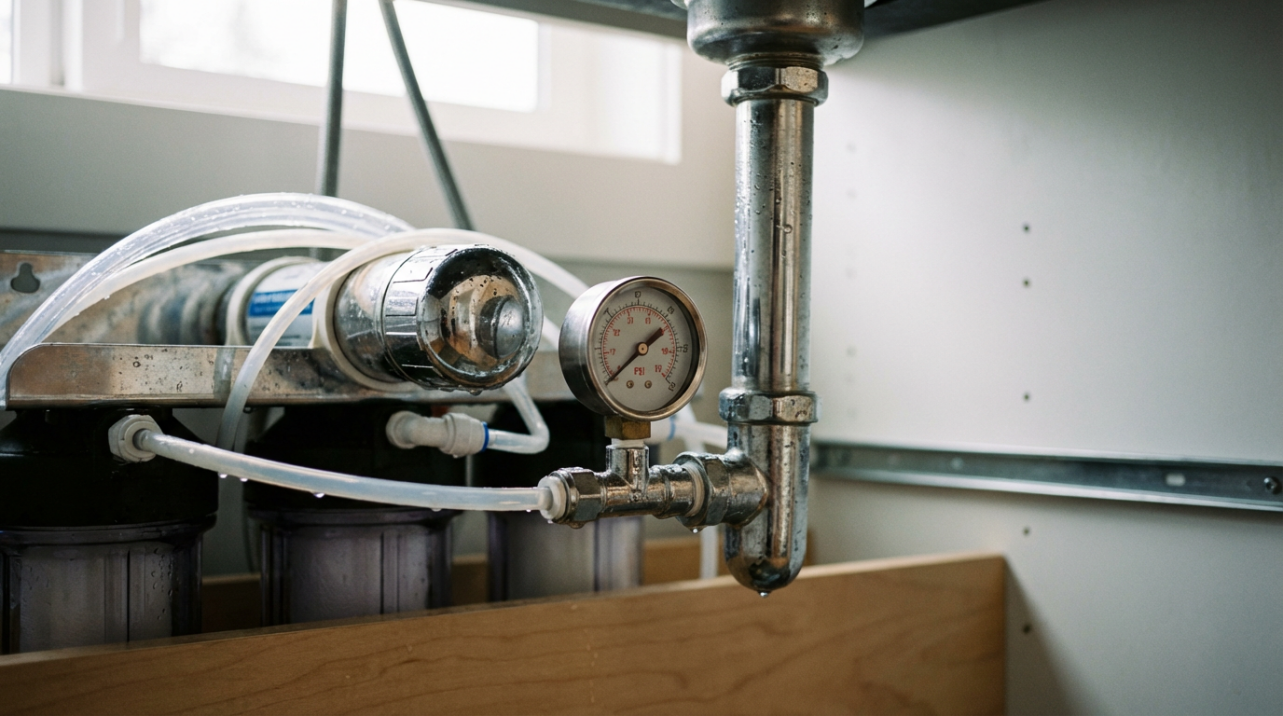
If your reverse osmosis (RO) system feels painfully slow, the glass fills in drips instead of a steady stream, or your TDS meter shows creeping numbers, you are almost certainly dealing with a pressure problem, not “just a bad filter.” As a smart hydration specialist who spends a lot of time under kitchen sinks and in utility rooms, I see this pattern over and over: once the pressure is right, the RO suddenly behaves like a completely different system.
In many modern setups, especially in homes with low municipal pressure, cold well water, or high total dissolved solids (TDS), installers talk about “boosting to 0.6 MPa.” That sounds technical, but it simply means running the RO around 87 psi, toward the upper end of what many residential membranes are designed to handle.
This article unpacks why pressure matters so much to RO performance, what 0.6 MPa actually represents, when it is helpful, and where the risks and limits are so you can make a science‑backed, health‑focused decision for your own drinking water system.
Reverse Osmosis in Plain Language
Reverse osmosis is a pressure‑driven filtration process. Nebraska Extension’s NebGuide on drinking water treatment explains it as pushing water through a semi‑permeable membrane that has extremely tiny pores, around 0.0001 microns. Clean water molecules slip through to the “treated” side, while most dissolved solids, metals, and microscopic particles are rejected and flushed away as a concentrated wastewater stream.
Household RO units are usually point‑of‑use systems under the kitchen sink. They rely on a sequence of stages: a sediment prefilter to catch grit, a carbon prefilter to remove chlorine and many organic chemicals, the RO membrane itself, and often a carbon postfilter to polish taste. Most home units produce on the order of 10 to 35 gallons of purified water per day and store it in a small pressure tank, commonly 2 to 5 gallons.
Two performance concepts matter for this pressure discussion:
Recovery is the share of feed water that becomes drinking water. Many home systems are built around roughly 20 to 30 percent recovery, meaning something like 20 gallons of treated water for 100 gallons of feed, with the rest going to drain.
Rejection is how much of a given contaminant the membrane blocks. For example, NebGuide notes that an 85 percent rejection of nitrate can be enough for one home if the starting concentration is moderate, but not for another if the raw water is heavily contaminated, even though the percentage is the same.
Both recovery and rejection are strongly influenced by pressure, along with water temperature and chemistry. Pressure is the main “engine” that makes reverse osmosis work at all.
Why Pressure Is the Engine of RO Filtration
Reverse osmosis has to overcome natural osmotic pressure, which tends to pull water toward the more concentrated side of the membrane. To reverse that flow, you apply external pressure on the feed side that is higher than the osmotic pressure. The higher that applied pressure (within limits), the more strongly you push water molecules through the membrane.
Multiple technical and manufacturer sources converge on the same core message: pressure drives almost everything that matters in RO.
Residential‑focused guidance from NU Aqua Systems, Ultra Pure Water Technologies, Watts Water, and others describes several pressure effects that are consistent with each other:
Adequate pressure increases production rate because more water per unit time passes through the membrane. NU Aqua notes that RO systems typically operate efficiently in a band around 45 to 80 psi, and Ultra Pure highlights about 60 psi as an ideal target for many systems.
Correct pressure improves contaminant removal. When pressure is too low, the rejection rate drops, TDS in the treated water rises, and the water can taste “flat” or slightly salty, as described in independent RO efficiency discussions and manufacturer blogs.
Low pressure increases waste. With a weak pressure differential, more water is diverted to the drain stream to carry away salts, and the waste‑to‑product ratio rises. NU Aqua and other manufacturers explicitly point out that low pressure tends to increase wastewater volume per gallon of purified water.
Too high pressure also causes trouble. Industry articles on RO efficiency and performance explain that excessively high pressure can erode the membrane surface, accelerate wear, reduce rejection of the smallest ions (like sodium), and stress housings, fittings, and tubing. Technical notes from companies such as Morui Water describe physical damage modes like membrane compaction and telescoping when mechanical limits are exceeded.
In other words, RO systems operate best in a pressure “sweet spot.” Too little, and you get slow output, weaker purification, and more waste. Too much, and you risk shorter membrane life, leaks, and in some cases worse contaminant rejection.
Making Sense of 0.6 MPa (About 87 PSI)
The figure 0.6 MPa comes from metric engineering practice. One megapascal is about 145 psi, so 0.6 MPa translates to roughly 87 psi.
That number matters because it sits close to the upper end of what many residential RO systems are designed to handle. An RO performance article focused on membrane pressure notes that typical home RO units target somewhere around 50 to 80 psi in normal operation, with a minimum around 40 psi and an upper design limit near 90 psi. The same source explains that commercial units often run around 100 to 150 psi, while industrial and seawater systems can be in the hundreds of psi.
Other guidance helps anchor that range:
Watts Water’s RO FAQ describes about 60 psi as ideal operating pressure, and calls pressures below 40 psi “generally insufficient” without a booster.
Ultra Pure Water Technologies similarly points to about 60 psi as a practical target for many applications, while warning that pressures below roughly 40 psi can make RO essentially ineffective.
An aquarium water‑treatment specialist notes that membranes rated at 65 psi often operate most efficiently around 80 psi, and that dropping to 50 psi can cut output by about a third compared with rated conditions.
Taken together, this paints a consistent picture: most home RO systems are happiest in the broad band of roughly 50 to 80 psi, with performance falling off below about 40 psi, and many manufacturers keeping absolute limits near 90 psi. Boosting toward 0.6 MPa means intentionally running near that upper end, around 87 psi, rather than in the middle of the range.
How Pressure Translates into Flow, Purity, and Wastewater
To decide whether aiming toward 0.6 MPa makes sense, it helps to connect the science to everyday symptoms at your sink.
When inlet pressure is too low, residential RO systems show a familiar set of behaviors. NU Aqua, Watersense‑style performance discussions, and multiple manufacturer blogs describe these same issues from slightly different angles.
Flow becomes slow, and the storage tank fills painfully slowly. Because pressure is the driving force through the membrane, low pressure simply means fewer water molecules cross per unit time. Under‑sink units already produce water relatively slowly, so cutting that production further is very noticeable when you are trying to fill a pitcher.
Contaminant rejection declines. Articles on RO membrane pressure and efficiency describe how low pressure leads to higher TDS in the treated water, and noticeable taste changes. The water may lose its crispness, or may taste faintly mineral or salty. That is a direct reflection of lower rejection of dissolved solids.
Waste‑to‑product ratio gets worse. NU Aqua and other manufacturers emphasize that with inadequate pressure, more water is required to carry away the same amount of dissolved solids, so you send more water down the drain for each gallon of purified water.
Maintenance burden rises. Ultra Pure Water Technologies notes that low pressure encourages premature fouling, because contaminants are not swept away as effectively and accumulate on the membrane. That means more frequent cleaning, shorter membrane life, and higher ownership cost.
On the other side, if pressure is pushed too high, different problems appear. A technical piece on RO membrane pressure warns that excessive pressure can accelerate wear, roughen the membrane surface, and actually lower rejection for some small ions and chemicals. Morui Water’s engineering piece on pressure effects explains that very high pressure can compact thin‑film membranes, permanently reducing water permeability, and can create mechanical damage called telescoping, where the spiral‑wound leaves of the element shift and deform. System components like housings and fittings also experience more mechanical stress and are more likely to leak.
The goal is not to push pressure as high as possible, but to sit in a window where you have strong driving force through the membrane without overstressing it.

How Temperature and TDS Change the “Right” Pressure
Pressure does not act alone. Temperature and dissolved solids level strongly modify how much pressure your RO actually needs.
Nebraska Extension notes that household RO units are often rated at about 77°F and that output drops by roughly 1 to 2 percent for every degree below that. Well water around 45°F can produce only about half as much treated water as the same system at 77°F. That means the same 60 psi that works beautifully in summer may feel sluggish in winter if your source water is cold.
DuPont’s FilmTec technical fact sheet on RO performance echoes that colder water sharply reduces permeate flow at a given pressure, and that operators need to consider both temperature and salinity when estimating actual performance versus nameplate ratings.
Total dissolved solids play a similar role. An aquarium water‑treatment article reports that higher TDS increases osmotic pressure, reducing net driving pressure, and that each increase of about 100 ppm TDS reduces output by roughly 1.5 percent. High TDS also shortens membrane life, particularly at elevated pressure, because scaling and fouling increase.
Another industry analysis on RO pressure in high‑TDS regions explains that brackish water, at several thousand milligrams per liter TDS, requires significantly higher operating pressures than ordinary tap water, and that seawater at around 40,000 mg/L needs extremely high pressures in the hundreds of psi range.
The practical takeaway for a home system is that cold and high‑TDS water both “eat up” some of your effective pressure. If your inlet pressure is marginal to begin with, those factors make a booster pump and a higher set‑point much more relevant.
Typical RO Pressure Ranges at a Glance
Here is a simplified view of pressure ranges and behaviors drawn from residential and commercial guidance.
Pressure at RO (psi) |
Common description from industry sources |
Typical behavior and concerns |
Below about 40 |
Generally insufficient for residential RO; noted by manufacturers and FAQs as problematic |
Very slow or no production, poor contaminant rejection, higher waste ratio, premature fouling |
Around 50–60 |
Practical “sweet spot” for many home systems; highlighted by Watts and commercial service firms |
Good production, strong rejection, reasonable waste‑to‑product ratio when other conditions are normal |
Around 65–80 |
Often near rated or “most efficient” zone for thin‑film membranes, according to performance blogs |
Higher output and strong rejection, especially useful when water is colder or slightly higher in TDS |
Around 80–90 |
Upper residential design band; roughly aligns with 0.6 MPa at the high end |
Can restore performance in challenging conditions, but must stay within manufacturer limits and watch for stress or leaks |
Hundreds of psi |
Typical for brackish and seawater industrial systems |
Outside home RO scope; used where feedwater salinity and osmotic pressure are extremely high |
For a homeowner or small business, boosting toward 0.6 MPa means deliberately operating near that 80–90 psi band, not the lower 50–60 psi band, in order to compensate for difficult feed conditions or plumbing realities.
When Boosting Toward 0.6 MPa Makes Sense
In my field work, I almost never recommend chasing 0.6 MPa just because “more seems better.” The situations where a higher pressure set‑point is truly justified share some clear characteristics that are well described in the technical and consumer literature.
One situation is chronically low inlet pressure. NU Aqua points out that some systems are designed to work down to around 45 psi only when they include a booster pump, and several sources agree that pressures below about 40 psi are generally not sufficient for reliable RO operation. If your home’s static pressure sits around 35 to 40 psi and drops further during peak usage, your RO will always feel weak unless you boost it. In such cases, setting the booster so the system operates closer to the upper design band can give you a practical safety margin when pressure dips during the day.
Another situation is high TDS or hard water. Aquarium and water‑treatment sources describe how high TDS reduces output and stresses membranes. RO systems in regions with very mineral‑rich water or elevated salts need more net driving pressure to achieve the same flux as systems treating low‑TDS water. A higher pressure set‑point can help maintain both output and rejection, provided pretreatment for hardness and scaling is in place and the system stays within its rated limits.
Cold water is another trigger. As NebGuide and DuPont both emphasize, colder water substantially reduces permeate flow. In homes with very cold well water or in climates where incoming supply drops well below 77°F for extended periods, boosting pressure toward the upper end can be a tool to keep production acceptable during winter without changing equipment.
A final driver is high demand on a compact system. Some households expect an under‑sink RO to supply daily drinking, cooking, a refrigerator dispenser, and an ice maker from a membrane that might be rated only 50 or 75 gallons per day under ideal lab conditions. Service articles show that in real‑world conditions—cold water, moderate TDS, a partially clogged prefilter—the practical output can be far lower. Raising operating pressure can help that single system keep up with demand, again as long as everything stays within manufacturer specifications.
In all of these cases, boosting toward 0.6 MPa is not about “overclocking” your RO; it is about restoring the kind of net driving pressure the membrane was already tested and rated for under ideal 77°F water and moderate TDS, even though your actual feed conditions are harsher.
The Risks of Over‑Boosting
The science and field experience are very clear that there is a cost to pushing pressure too hard.
A residential RO pressure article warns that excessively high pressure can reduce membrane life by eroding the surface, creating micro‑tears, and lowering rejection for small ions and certain chemicals. Instead of acting like a tighter sieve, an over‑stressed membrane can let more small species sneak through.
Morui Water’s engineering piece on pressure effects describes membrane compaction, where the structure of a thin‑film composite membrane becomes denser under sustained high pressure. That permanently reduces water flux, meaning you may need even higher pressure later just to maintain the same production, which is the opposite of what you want.
Mechanical damage is another concern. Field‑oriented engineering notes describe telescoping, a failure mode where the spiral‑wound leaves of an element shift under high thrust forces, damaging the element and potentially allowing bypass paths. High pressure also magnifies any weaknesses in housings, connectors, or tubing, increasing leak risk.
Long‑term high pressure and frequent pressure cycling create fatigue in components. Engineering sources recommend slow ramp‑up and ramp‑down procedures in larger systems to minimize these stresses. The same principle applies, on a smaller scale, to a booster pump on a household unit.
For health‑focused home hydration, those risks translate into three practical rules. Always confirm the maximum operating pressure for your specific RO system and membrane. Avoid “set and forget” boosts that push near or beyond that limit. And treat 0.6 MPa as an upper‑band tool for challenging water, not a default target for every installation.
How to Evaluate Your Own System Before Chasing 0.6 MPa
Before thinking about booster settings, it is important to confirm whether pressure is truly your bottleneck, or whether other issues are to blame.
Several RO performance guides recommend starting with a simple pressure gauge. Attach it to a hose bib or a point in the plumbing that sees the same feed as your RO and read the pressure in psi. Compare it to the range recommended by your RO manufacturer and to general guidance, which often points to a desirable band around 50 to 80 psi for home units.
Next, observe pressure while the RO is actually running, not just at rest. NU Aqua and other manufacturers emphasize that dynamic pressure under flow can be several psi lower than static pressure because of pressure drop in plumbing and prefilters. If a gauge drops from, say, 55 psi static to 40 psi when the RO is filling its tank, you effectively have borderline pressure at the membrane.
At the same time, check basic maintenance. Multiple sources, including Nebraska Extension and consumer maintenance articles, remind users that sediment and carbon prefilters, as well as the membrane, need periodic replacement. A clogged prefilter or a heavily fouled membrane can mimic low pressure by restricting flow; boosting pressure on top of that simply forces water through a clogged system.
Storage‑tank air pressure also matters. A Nelson Water article on slow RO flow explains that the air side of a bladder‑type RO storage tank should be around 7 to 8 psi when the tank is empty. If the air charge is too low, the tank will not push water to the faucet efficiently even if the membrane is working well. In that case, you restore the air charge rather than chase higher feed pressure.
Finally, measure water quality. Quick checks with a handheld TDS meter before and after the RO give an informal sense of rejection. If your pressure is healthy, filters are fresh, and TDS reduction is strong, a booster that pushes you toward 0.6 MPa is unlikely to make a meaningful difference and may only add stress and noise.
Pros and Cons of Boosting RO Pressure Toward 0.6 MPa
From a smart hydration perspective, boosting operating pressure from the mid‑range up toward about 87 psi has both advantages and trade‑offs.
On the plus side, higher pressure in the allowed range typically increases production rate, which means faster tank refills and better ability to serve multiple points such as a sink and refrigerator. Technical articles on RO efficiency consistently show that flux rises with pressure until other limits, such as concentration polarization, kick in.
Higher pressure also tends to improve rejection of many contaminants, including salts and heavy metals, as long as you stay within membrane design limits. That can be especially important when you rely on RO to reduce nitrate, arsenic, or other health‑relevant contaminants to below regulatory thresholds.
Efficiency can improve as well. NU Aqua and other sources explain that low pressure increases the waste‑to‑product ratio. Running at a more robust pressure can reduce the amount of water discarded per gallon of treated water, especially when the system design includes high‑efficiency components such as permeate pumps and well‑selected flow restrictors. EPA WaterSense data show that efficient point‑of‑use RO systems can dramatically reduce waste compared with typical units, and while that program focuses on overall system design rather than a specific pressure value, correct pressure is a key supporting factor.
On the downside, operating near the upper end of the pressure range puts more mechanical stress on the membrane and hardware, as described in industry blogs and technical bulletins. This can shorten membrane life, increase the chance of leaks, and in some cases reduce the rejection of the smallest dissolved species.
Higher pressure also tends to mean higher pump energy use and potentially more pump noise, which may be a consideration in quiet kitchens or apartments where the RO is close to living space.
For most households, the most hydration‑friendly approach is to use the lowest pressure that still delivers adequate flow, strong rejection, and acceptable waste levels for your specific water conditions. In challenging conditions, that “lowest effective pressure” may indeed be close to 0.6 MPa.
Practical Steps for Safely Boosting RO Pressure
If your evaluation suggests that pressure truly is the limiting factor, you can work with a professional or, in simpler cases, on your own to adjust the system toward a higher set‑point safely.
Articles from NU Aqua and other manufacturers recommend starting by measuring existing pressure accurately, then selecting a booster pump that is compatible with your RO membrane size and flow restrictor. Booster pumps are typically installed on the feed line before the membrane and controlled by pressure switches that shut the pump off when the storage tank is full.
Where inlet pressure is already high, a pressure regulator may be needed to prevent overshooting the manufacturer’s maximum. NU Aqua and similar sources call out regulators as the solution when line pressure exceeds the desired band.
Membrane compatibility is critical. Nebraska Extension notes that thin‑film composite membranes generally offer higher rejection and durability but are more sensitive to chlorine and operate under specific pH and pressure limits. Any decision to run near 0.6 MPa should be cross‑checked with the membrane’s technical sheet, not just the housing’s pressure rating.
Pre‑treatment and maintenance need to be dialed in before boosting. DuPont’s FilmTec guidance and multiple industry blogs emphasize that adequate pretreatment for sediment, chlorine, hardness, and other foulants is essential to avoid rapid scaling and fouling at higher flux. Running at high pressure through a poorly pretreated system is a recipe for short membrane life and inconsistent water quality.
Finally, build monitoring into your routine. Track approximate production time for your storage tank, and periodically check TDS before and after the RO. If you notice declining performance or rising differential pressure, it may be better to step back on pressure and address fouling rather than pushing harder.
Short FAQ
Is 0.6 MPa safe for my home RO system?
It depends entirely on your specific system’s ratings. Industry sources show that many residential RO units are designed to operate efficiently between about 50 and 80 psi, with some guidance suggesting an upper limit near 90 psi, which is close to 0.6 MPa. You should only run near that upper band if both the membrane and housings are explicitly rated for it and if pretreatment and maintenance are in good shape.
Will higher pressure always improve my water quality?
Higher pressure within the recommended range usually improves production rate and rejection for many contaminants, but beyond a point it can actually reduce rejection for some small ions and shorten membrane life. Research on membrane performance has also shown that selectivity can appear better at some pressures than others, which is why standardized test pressures are used in the lab. In practice, the goal is to reach a pressure where your TDS readings and any specific contaminant targets are consistently met, not simply to maximize pressure.
Do I always need a booster pump to get good RO performance?
Many homes with normal municipal pressure in the 50 to 70 psi range, moderate TDS, and typical temperature do not need a booster pump at all. A booster becomes important when static pressure is low (often around or below the 40 psi mark), when water is unusually cold or high in dissolved solids, or when one small system is expected to serve unusually high demand. Evaluating your actual pressure and water conditions is the first step before considering a pump.
Clean, well‑balanced hydration is not just about having an RO membrane under your sink; it is about running that system in its ideal operating window. By understanding how pressure, temperature, and water quality interact, and by treating 0.6 MPa as a carefully chosen tool rather than a default setting, you can unlock faster flow, more reliable purity, and a healthier, more enjoyable drinking experience at home.
References
- https://www.epa.gov/watersense/point-use-reverse-osmosis-systems
- https://pubmed.ncbi.nlm.nih.gov/36186741/
- https://extensionpublications.unl.edu/assets/html/g1490/build/g1490.htm
- https://wqa.org/wp-content/uploads/2022/09/Article-4-POU-RO-Performance-and-Sizing.pdf
- https://www.aquariumwaterfilters.com/RO-Membrane-Output-Versus-Temperature-Water-Pressure-TDS_b_46.html?srsltid=AfmBOopdXlL5SbxuTMO_6np9s2CN2XRmkDkVDv7AfQjjuC1bNGNtG100
- https://interiorredoux.com/how-ro-membrane-pressure-affects-filtration-efficiency/
- https://www.moruiwater.com/knowledge/how-does-the-pressure-affect-the-reverse-osmosis-process
- https://www.membracon.co.uk/blog/factors-that-affect-the-performance-of-reverse-osmosis-membrane-filters/
- https://www.membranechemicals.com/faqs/what-is-the-expected-differential-pressure-%CE%B4p-in-the-first-and-second-stages-of-a-reverse-osmosis-ro-system-if-the-feed-pressure-is-8kg-cm2-113-8-psi-what-range-of-differential-pressure-is/
- https://nelsonwater.com/blog/the-5-reasons-your-reverse-osmosis-system-has-a-slow-flow-rate/

Share:
Understanding the Importance of pH Range for RO Membrane Functionality
Optimizing Double Reverse Osmosis Systems for Enhanced Water Production