

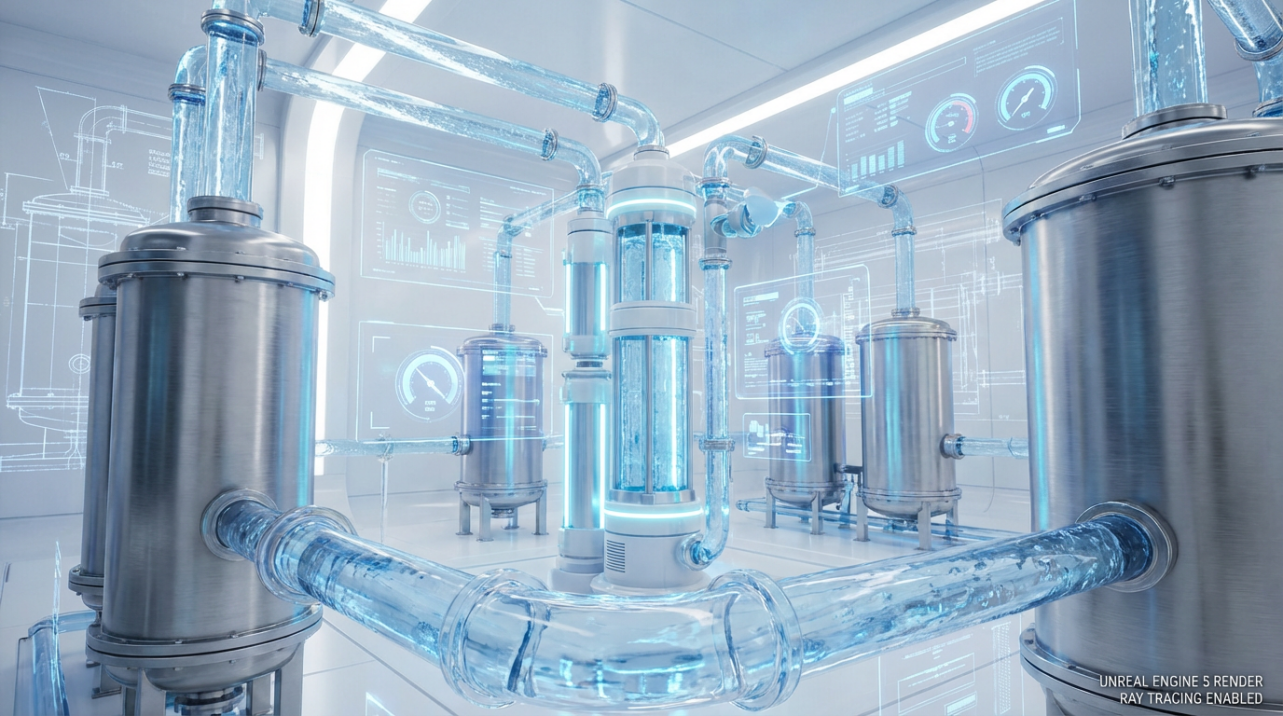
As a smart hydration specialist, I often see the same pattern in homes, wellness spaces, and small facilities that “graduate” from basic filtration to double reverse osmosis (double RO). The motivation is always sound: ultra-clean water for hydration and cooking, more production capacity, less waste, and longer equipment life. The challenge is that double RO systems are unforgiving if they are not designed and operated carefully. Pushing them harder for more output can either be a beautiful optimization or a fast track to fouled membranes, poor taste, and expensive repairs.
In this guide, I will walk through how double RO systems work, why pressure and pretreatment matter so much, and how to tune configuration and operation so you can safely boost water production without sacrificing quality or membrane life. The perspective is grounded in industrial best practices from sources such as AXEON Water Technologies, Puretec Industrial Water, and EPA- and DOE-style optimization guidance, translated into practical strategies for home and light commercial hydration systems.
What “Double Reverse Osmosis” Really Means
Before you can optimize a double RO system, it helps to clarify what configuration you actually have. In practice, “double reverse osmosis” usually means one of two architectures.
The first common design is a double-pass system. The permeate from the first RO pass becomes the feed to the second pass. This approach is widely used when you need extremely low dissolved solids, for example in certain laboratories, microelectronics, or very specialized beverage applications. The second pass does not usually aim for much extra recovery; instead, it aims for a big jump in purity, building on the 95–99% salt rejection typical of well-designed single-pass systems described by AXEON.
The second design is a high-recovery configuration that uses a second RO stage to treat the concentrate (brine) from the first stage. Puretec Industrial Water describes this strategy for industrial and data center water reuse: a secondary or “concentrate” RO stage can push total recovery from roughly 75% into the 85–95% range, reducing both raw water use and wastewater volumes. This is often the most attractive way to increase output from an existing skid without installing a whole new train.
In home or small commercial hydration, installers sometimes blend these ideas. A compact double-pass unit might be used to polish water for drinking or coffee, while a secondary stage on the concentrate stream targets better overall recovery to cut waste. The key point is that double RO is not just “two filters in a row.” It is an intentional hydraulic design that either magnifies purity, recovery, or a balance of both.
The Science: Why Pressure and Flow Drive Performance
Reverse osmosis is fundamentally a pressure-driven process. A study led by Yale and partner universities showed that at the molecular level, water travels through RO membranes as clusters moving through a network of pores, driven by pressure differences inside the membrane rather than just concentration differences. That reinforces what field practitioners have known for decades: if you do not manage pressure correctly, you will never get the performance you paid for, especially in a double RO.
Residential and light commercial guidance from NU Aqua and others points to a typical desirable pressure range of about 45 to 80 psi on the feed. Within that healthy band, higher pressure generally increases permeate production and improves contaminant removal, up to the limits of what the membranes and housings are rated to handle. If pressure sags below the recommended range, production slows to a trickle and the ratio of waste water to product water gets worse. If pressure is driven too high, you risk leaks, membrane damage, and premature component failure.
Temperature and viscosity are crucial as well. As Waterdrop notes, warmer water (within the manufacturer’s limits) flows more readily through the membrane, increasing production, while very cold water thickens, slows permeation, and makes a system feel “undersized” in winter even though nothing broke. An engineering forum case described an RO unit whose duty cycle jumped sharply in winter, simply because colder inlet water reduced flux; one proposed fix was to gently preheat the feed to stabilize output.
In a double RO, these physics are amplified.

The second stage sees either lower pressure (when fed by permeate) or higher salinity (when fed by concentrate). In both cases, pressure and flow must be carefully matched to membrane area and water chemistry. The more aggressively you push recovery or production, the more your design and operation become about managing these hydraulic realities rather than just “adding another filter.”
Why Pretreatment Is the First Lever for More Output
When a double RO system underperforms, the root cause is frequently upstream of the membranes. EAI Water emphasizes that RO membranes are highly vulnerable to fouling, scaling, chemical attack, and biofouling. Inadequate pretreatment forces you to run at higher pressure for the same flow, which increases energy use, reduces flux, and eventually cuts permeate production. In worst cases, cleaning frequency jumps from multi-year intervals to every few months.
Fouling happens when particulates, microorganisms, and organic matter accumulate on the membrane surface, creating a resistance layer. Scaling happens when minerals such as calcium carbonate, silica, or barium compounds precipitate as you concentrate the water, especially at high recovery. Chemical attack, particularly from oxidants like chlorine, can permanently damage many RO membranes if not fully removed ahead of time. Biofouling forms stubborn biofilms that are very difficult to clean and often force more frequent downtime.
Proper pretreatment addresses these threats directly. Filtration steps such as multi-media, cartridge, or ultrafiltration can remove suspended solids down to roughly 1–5 microns. Softening or similar conditioning steps bring the Langelier Saturation Index into a safer range and cut hardness scaling. Activated carbon or similar media strips chlorine and many organics. Carefully dosed antiscalant, designed using projection software from vendors such as Avista or using tools like ROSA, can allow higher recovery without crossing critical scaling thresholds.
AXEON and DOE-style optimization guidance also stress measuring silt density index (SDI) and performing a thorough water analysis that includes particulates, organics, inorganics, and microbiology. This gives you a real picture of fouling and scaling potential rather than working blindly. For larger or more challenging systems, EAI recommends pilot testing tailored combinations of multimedia filtration, ultrafiltration, softening, and chemical treatment to achieve stable long-term performance.
In a double RO, pretreatment must be even more robust than for a single pass, because you are asking the membranes to do more work.

If you want higher recovery or higher purity from an existing double RO setup, improving pretreatment is often the safest way to unlock more production without increasing fouling risk.
Pumping, Pressure Stability, and Energy Efficiency
Pumps are the heart of any RO plant. Iwaki Americas underscores that without properly sized, reliable pumps, both production volume and water quality decline sharply. In a double RO, you may have separate high-pressure pumps for each stage or one main pump plus recycle and control valves that fine-tune flows. In all cases, three goals matter: achieving adequate pressure, maintaining stable operation, and avoiding unnecessary energy use.
Inlet pressure fluctuations are a common culprit when users complain that their double RO “used to be fine, but now we are always running out of water.” NU Aqua notes that real-world factors such as building height, long piping runs, and peak demand times can lower pressure. On the RO skid, malfunctioning regulators, sticky valves, or pump capacities that do not match variable demand can cause unstable pressure at the membranes. That instability can stress components and make it harder to keep recovery and salt rejection on target.
Smart pumping strategies include using dedicated high-pressure pumps sized to the membranes and target recovery, adding booster pumps when line pressure is consistently low, and deploying variable frequency drives so pump speed tracks real-time demand. Iwaki highlights that pumps with VFDs can significantly reduce energy use by avoiding unnecessarily high pressure when demand is low, while still meeting peak needs.
Energy recovery devices and thoughtful recycle loops, described by Puretec and AXEON in industrial contexts, can further improve efficiency. In a double RO where the second stage treats concentrate, carefully designed recycle and throttling can keep the first stage in its sweet spot while feeding the second stage at the right combination of pressure and salinity. Done well, this yields more permeate per gallon of feedwater with less wasted pressure and lower operating cost per gallon of drinking water.

High Recovery and Double RO: Pushing Output Without Pushing Too Far
The most tempting way to get more water from a double RO is to crank up recovery. Puretec explains that conventional RO systems often run around 75% recovery, while high-recovery designs target about 85–95%. That extra recovery directly reduces raw water purchases and brine disposal volumes. For homes and small facilities with expensive or scarce water, or strict wastewater limits, these gains are very attractive.
However, higher recovery is not free. As you convert more of the feed into permeate, salts and other solutes build up in the concentrate stream. This increases the risk of mineral scaling and fouling, particularly in the final elements of each pressure vessel and in any second-stage membranes fed with concentrate. If scaling is not fully controlled, the compressed mineral deposits can damage membrane fibers and drastically shorten membrane life.
A technical discussion on ResearchGate illustrates one approach: operating in a semi-closed circuit by recirculating concentrate back to the inlet. This can drastically reduce discharged volume, but each pass increases total dissolved solids in the loop. For typical domestic or small professional systems, a concentrate upper limit on the order of 1,000 ppm is sometimes cited as a practical boundary, beyond which performance and membrane life can suffer unless you switch to industrial-grade designs.
In practice, optimizing a double RO for enhanced production is a balancing act. You start by understanding your water chemistry in detail, then use design software and vendor input to set a realistic recovery target that your membranes and antiscalant program can handle. Puretec notes that in many facilities, the most cost-effective path to higher recovery is adding a secondary RO stage on the concentrate stream rather than forcing the first stage beyond its safe limits. The same logic applies in scaled-down form for advanced residential or point-of-use systems: a modestly loaded first pass with robust pretreatment and a carefully controlled second stage usually outperforms a first pass pushed too hard.
Seasonal variations matter here as well. As Waterdrop points out, colder feedwater reduces permeate flux. An engineering forum example described how a gas-turbine makeup water RO saw its duty cycle creep up toward half-time operation in winter because performance dropped with colder inlet temperatures. Proposed optimizations included installing a membrane element in an unused pressure vessel position to add area and preheating feedwater to maintain warmer, consistent temperatures. In your own double RO, expect winter production to be lower unless you compensate with pressure, temperature, or membrane area.
Accurate Chemical Dosing: Small Volumes, Big Impact
Chemical dosing in the pretreatment train is one of the most powerful and underestimated tools for keeping a double RO running at peak production. Mixtron emphasizes that filtration dosing systems inject precise amounts of antiscalants, biocides, and dechlorinating agents to protect membranes and maintain performance.
Antiscalants help prevent mineral salts such as calcium carbonate and barium sulfate from precipitating on membrane surfaces. Biocides inhibit biofilm formation that would otherwise clog flow channels and increase pressure drop. Dechlorinating agents such as sodium metabisulfite neutralize residual chlorine that would otherwise attack polyamide membranes.
The key is accuracy. Under-dosing leaves you exposed to scaling and biofouling, leading to more frequent and costly cleanings. Over-dosing increases chemical costs and can alter water chemistry in ways that affect both membrane behavior and downstream taste. Modern proportional volumetric dosing pumps, often integrated with flow sensors and automatic controls, can track real-time feed flow and adjust chemical injection on the fly. For double RO systems running at higher recoveries or with staged concentrate treatment, this level of control helps keep both stages operating in their safe envelope as conditions change.
Monitoring, Cleaning, and Data-Driven Optimization
Once pretreatment, hydraulics, and dosing are in good shape, the next lever for more production is disciplined monitoring and cleaning. AXEON and DOE-style optimization guidance converge on a core set of performance metrics: recovery rate, salt rejection, permeate flow, and differential pressure between feed and concentrate.
Recovery rate, defined as permeate flow divided by feed flow, tells you how efficiently you are using each gallon of source water. Brackish water RO systems often operate at 60–85% recovery; high-recovery designs can reach 85–95% in favorable chemistries according to Puretec. Salt rejection expresses how well the membrane is removing dissolved solids; well-designed RO systems typically achieve about 95–99% rejection, which is a benchmark for high-quality permeate.
Normalized permeate flow and differential pressure give you early warning of fouling or scaling. As membranes foul, permeate flow drops and differential pressure rises. AXEON and Kurita’s best-practices guidance recommend initiating chemical cleaning when normalized performance has deteriorated by about 10–15%, or before a 15% increase in feed-to-concentrate pressure drop or equivalent decrease in normalized permeate flow. EAI notes that with proper pretreatment and conservative operation, some systems can run three to four years between cleanings; without it, you may be cleaning every three to six months.
Cleaning itself should be tailored to the foulant. Kurita describes the standard approach: high-pH (alkaline) cleaners target clay, silt, biological, and organic contamination, while low-pH (acidic) cleaners specialize in inorganic scales and metal oxides. For many real-world double RO systems, both types of cleaners are used sequentially in a cleaning-in-place (CIP) process. If fouling is allowed to progress too long, deposits can stabilize and block flow channels, making complete cleaning impractical and accelerating membrane replacement.
For a double RO, plotting normalized permeate flow and salt passage for each pass separately is especially useful. For example, if the first pass looks healthy but the second pass shows a steady rise in differential pressure and declining flow, you may be pushing recovery or temperature in that stage too hard or under-dosing antiscalant for its higher salinity. Data trends help you adjust operating pressure, stage recovery splits, cleaning frequency, and chemical dosing in a controlled, evidence-based way rather than guessing.
Storage, Tubing, and Real-World Flow at the Faucet
Even when the RO train itself is optimized, user experience at the tap is shaped by storage and distribution. WaterStore Midland points out that in typical drinking-water systems, the storage tank and its air bladder largely determine faucet flow. A full tank has higher pressure and gives you fast flow initially; as water is drawn down, tank pressure drops and the stream slows.
Several practical upgrades can make a double RO feel much more responsive in daily use. Replacing standard 1/4 inch tubing with 3/8 inch tubing from the tank through the final filter to the faucet reduces friction loss and noticeably increases flow. Locating the tank as close as possible to the faucet, with shorter and flatter tubing runs, also reduces resistance and improves performance. Adding a second storage tank or upgrading to a larger tank increases available volume and maintains higher pressure for longer, which is particularly valuable when a double RO’s net production rate is lower than a simpler single-pass unit.
On the quality side, Osmotics emphasizes that output is both how much water you can produce and how clean that water is. Regular replacement of sediment and carbon prefilters, periodic membrane cleaning, and the use of a simple total dissolved solids (TDS) meter at the faucet help ensure that gains in flow and storage capacity do not come at the expense of purity.
Pros and Cons of Double Reverse Osmosis for Higher Production
When tuned correctly, double RO can deliver impressive performance. At the same time, it is not always the right tool for every home or facility. The table below summarizes the main advantages and trade-offs.
Aspect |
Advantages |
Drawbacks |
Water purity |
Double-pass designs can drive salt rejection beyond typical single-pass levels, supporting very low-TDS water for sensitive applications. |
For everyday drinking, ultra-low TDS may not be necessary and can require remineralization for taste and balance. |
Water recovery |
Secondary RO on concentrate, as described by Puretec, can raise overall recovery toward 85–95%, cutting raw water use and wastewater volumes. |
Higher recovery raises scaling and fouling risks, so pretreatment, antiscalant dosing, and monitoring must be more sophisticated. |
Use of existing equipment |
A second stage can increase output from an existing skid without a full new train, aligning with the retrofit approach discussed in Environmental Science & Engineering Magazine. |
Retrofitting without a full design review can unbalance the system, overloading pumps or membranes not sized for new conditions. |
Operating costs |
In water-scarce or high-cost regions, higher recovery and reduced brine handling can lower life-cycle costs, as DOE and Puretec style guidance emphasize. |
Capital cost, pump energy, and chemical use generally increase; poor optimization can make double RO more expensive per gallon than a simpler system. |
System complexity |
Double RO offers flexibility to fine-tune purity, recovery, and redundancy, especially when controlled with good automation and performance data. |
More stages mean more valves, controls, and failure points, requiring higher operator skill and better data logging to avoid invisible problems. |
For many homeowners or small businesses, the sweet spot is a carefully designed single-pass RO with strong pretreatment, good storage, and a booster pump, reserving double RO for situations where you truly need either exceptional purity, much higher recovery, or both.
A Practical Optimization Path for Your Double RO
If you already have a double RO system and want more production without sacrificing water wellness, it helps to think in a clear sequence rather than making random tweaks.
Begin by documenting your baseline. Measure feed, permeate, and concentrate flows for each stage, along with feed and concentrate pressures, permeate conductivity or TDS, and temperature. Calculate overall and stage-by-stage recovery and salt rejection. This is your before picture.
Next, evaluate pretreatment in light of your source water. Review filtration down to the 1–5 micron range, softening or conditioning for hardness and silica, carbon for chlorine removal, and antiscalant selection and dosing. If you are seeing rapid fouling, high SDI, or frequent cleanings, upgrading pretreatment is almost always a better first move than increasing pressure or recovery.
Then review pumping and pressure stability. Confirm that inlet pressure to the RO units sits within your system’s recommended range, often around 45 to 80 psi for residential and small commercial feed as NU Aqua suggests, with appropriate high-pressure boost on the RO train. Investigate any significant pressure fluctuations and consider variable-speed drives or better regulation if demand is highly variable.
Once hydraulics and pretreatment are under control, revisit your recovery targets and staging. In many cases, backing the first pass off slightly from an aggressive recovery to reduce scaling risk, while using the second stage more effectively on concentrate, can yield a better blend of production, reliability, and membrane life. Here, guidance from vendors and projection software that account for your specific water chemistry is invaluable.
Finally, optimize your cleaning strategy and distribution-side experience. Set clear performance thresholds for initiating cleaning, following the 10–15% normalized change guidance from AXEON and Kurita. Verify that tank sizing, tubing diameter, and layout are not throttling the user experience at the faucet. Consider modest upgrades such as a second tank or larger-diameter tubing where appropriate.
Short FAQ
Do I really need a double RO system for healthy drinking water at home?
For most homes, a well-designed single-pass RO with good pretreatment produces more than enough purity for safe, great-tasting drinking water. Double RO is typically justified when you have very challenging water chemistry, highly sensitive downstream uses, or strong reasons to push recovery and reduce wastewater. From a hydration standpoint, water quality is about consistency, safety, and taste; you do not automatically gain wellness benefits just by driving TDS as low as possible.
Can I turn my existing single RO into a double system to get more water?
Simply adding another RO unit in series without rethinking pretreatment, pumps, and recovery is risky. Industrial guidance from Puretec and DOE-style optimization resources shows that successful high-recovery retrofits rely on detailed water analysis, careful sizing, and robust monitoring. If your current single-pass system is already fouling quickly or running near its pressure limits, adding another stage may make things worse rather than better. Often, optimizing pretreatment, pressure, and storage on the existing unit yields surprisingly large gains.
How do I know if I am pushing my double RO too hard?
Warning signs include steadily rising differential pressure across either stage, declining normalized permeate flow, more frequent membrane cleanings, and any noticeable deterioration in taste or TDS at the faucet. If you are needing cleanings every few months despite having reasonable pretreatment, or if salt rejection drops significantly, you are likely operating above a sustainable recovery or flux for your water chemistry. In that case, the safest response is to reassess pretreatment, pressure, and recovery targets with your equipment provider rather than continuing to raise pressure or accept higher fouling rates.
As you refine your double reverse osmosis system, think of it as tuning a living hydration ecosystem rather than just turning a bigger pump on and hoping for the best. When pretreatment, pressure, recovery, and maintenance are aligned, double RO can deliver abundant, reliable, and exceptionally clean water that supports both your daily hydration and your long-term wellness goals, without wasting water or wearing out membranes before their time.
References
- https://www.energy.gov/femp/articles/reverse-osmosis-optimization
- https://engineering.yale.edu/news-and-events/news/upending-decades-long-theory-reverse-osmosis-water-desalination
- https://www.epa.gov/system/files/documents/2022-06/ws-I2SL-Laboratory-Water-Efficiency-Guide.pdf
- https://do-server1.sfs.uwm.edu/key/$E4C3754903/pub/E3C0210/chapter+reverse+osmosis.pdf
- https://www.researchgate.net/post/What_modifications_can_be_done_in_RO_purifier_to_reduce_the_volume_of_waste_water_during_water_purification
- https://www.ultimatereef.net/threads/how-to-make-my-ro-unit-more-efficient.771630/
- https://eaiwater.com/reverse-osmosis-pretreatment/
- https://espwaterproducts.com/pages/why-reverse-osmosis-water-flow-is-slow?srsltid=AfmBOopbDMeRcW-fIY_0pcovC2DkfKiWWDJfQVjfPWkpnZ4EIvuOuCVA
- https://www.finehomebuilding.com/forum/increasing-output-pressure-ro-water
- https://www.kuritaamerica.com/the-splash/reverse-osmosis-ro-best-practices-standards

Share:
Understanding the Importance of pH Range for RO Membrane Functionality
Understanding When and Why to Boost RO Pressure Toward 0.6 MPa (About 87 PSI)