

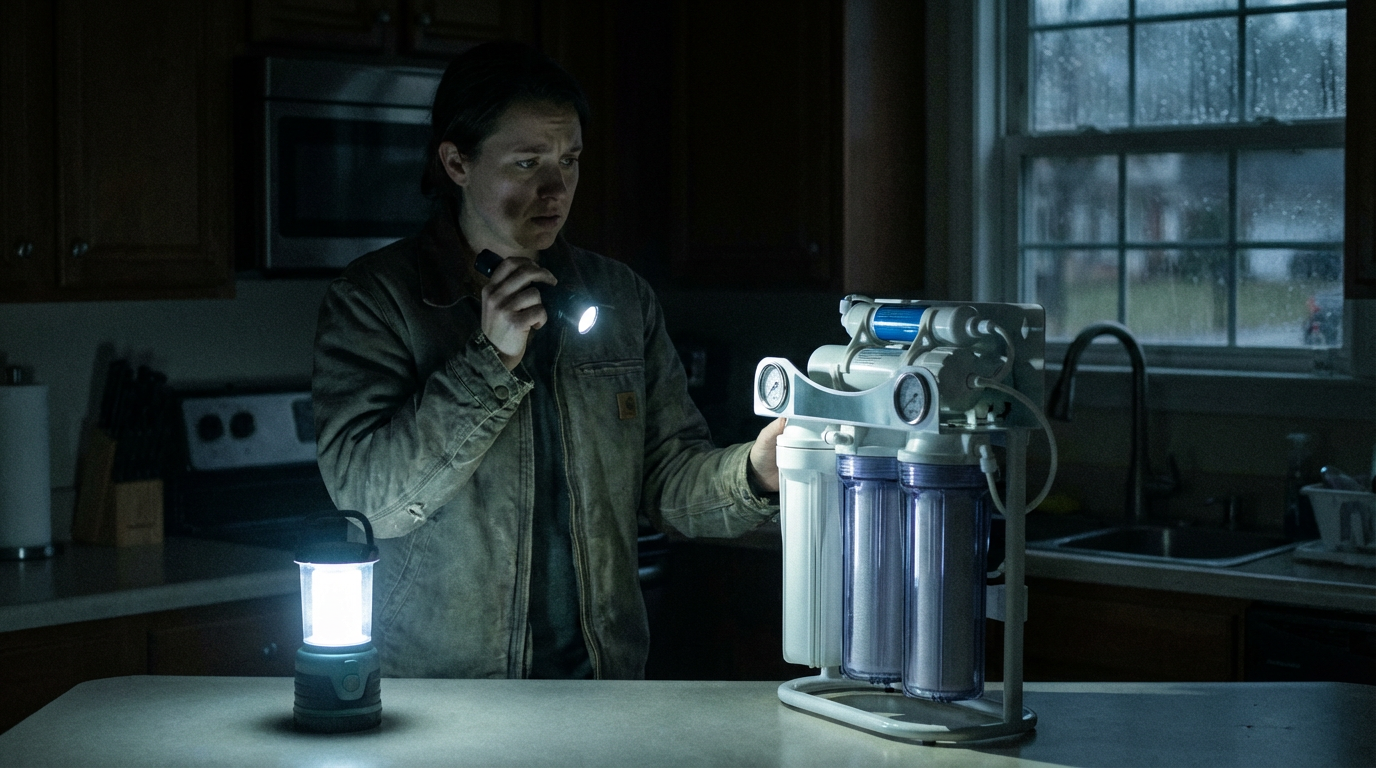
Reverse osmosis has become the backbone of safe drinking water for many homes, clinics, and small businesses. When a storm or grid failure cuts power for hours or days, the first concern is usually lighting and refrigeration. As a Smart Hydration Specialist and Water Wellness Advocate, I want you to add one more critical system to that mental checklist: your reverse osmosis (RO) water purifier.
Extended power outages do not just pause water production. They can quietly shorten RO membrane life, degrade performance, and, in the worst cases, compromise water quality if the system is restarted carelessly. The good news is that with a basic understanding of how RO membranes behave during downtime, you can protect your system and keep your drinking water safe.
This article walks through what happens inside an RO system during prolonged power loss, how that affects membrane performance, and practical steps you can take at home or in a facility to minimize damage and risk.
How RO Membranes Work And Why Outages Matter
Reverse osmosis is an advanced purification process. Pressurized water is forced through a semi‑permeable membrane that acts as a molecular sieve, rejecting dissolved salts, heavy metals, organic chemicals, PFAS, and many other contaminants. Well‑designed systems, as summarized by independent water treatment experts, routinely remove about 90–99% of many pollutants, giving consistently clean, low‑TDS water even when the feed quality fluctuates.
A typical RO purifier uses several stages. Pretreatment filters remove sediments and chlorine, the RO membrane handles fine dissolved contaminants, and post‑filters polish taste and odor. The membrane itself is usually a thin‑film polyamide composite inside a pressure vessel, and it relies on pumps and control valves to maintain the correct pressure, flow, and recovery.
That means electricity is part of the health story. As articles on industrial and home RO systems from companies such as DrinkPrime, Yokogawa, and AXEON describe, pumps, control panels, instruments, and dosing equipment all depend on stable power. Voltage swings and frequent outages can trip protection devices, stall pumps, and push systems out of their design conditions, shortening component life. On top of that, several technical reviews point out that membrane replacement is one of the largest operating costs in RO plants, which makes protecting membrane life during abnormal events like outages economically and environmentally important.
Most of the time, RO membranes fail for four familiar reasons: fouling, scaling, mechanical damage, and chemical attack.

WaterTech USA and other engineering sources describe how suspended solids and biofilm clog feed channels, minerals crystallize as hard scale, pressure shocks telescope elements, and oxidants such as chlorine slowly damage the polyamide layer. Extended power outages interact with all four mechanisms by changing how water sits in the system and how pressure returns when power comes back.
What Actually Happens During A Power Outage
In the first minutes after power fails, an RO system does something very simple: it stops.
Pumps shut down, solenoid valves close, displays go dark, and water production pauses. In some water softeners and control valves, manufacturers note that a small buffer battery keeps the program memory intact so the unit can resume its cycle once power returns. For many RO units, the same idea holds: short interruptions of minutes to a couple of hours usually do not harm the membrane by themselves.
The complications start when a short interruption stretches into an extended outage.
Stagnant, Concentrated Water In The Membrane
When the high‑pressure pump stops, the feed and concentrate streams slow and then stall. Highly concentrated brine remains inside the spiral‑wound membrane elements and the connecting piping. A technical review of shutdown behavior by membrane specialists at Rotec emphasizes that this idle brine is a perfect environment for several damaging processes:
Stagnant water allows bacteria and fungi to grow and form biofilm on membrane surfaces. Concentrated salts can become supersaturated, crystallize, and form scale. If downtime is long enough and the membrane is not kept properly wet and pressurized, mechanical deformation and dehydration can occur inside the element.
Aqualitek, in its guidance on restarting RO systems after sudden shutdowns or power outages, warns that systems left shut down for more than about eight to twelve hours should be forward‑flushed before going back to production to clear stagnant water and minimize biofouling. In the industrial world, shutdowns beyond roughly three days are often treated as long‑term storage and call for a full cleaning and preservation protocol, not just a simple restart.
In other words, once an outage pushes your system into many hours or days of idle time, the way you handle that interval has a direct impact on how your RO membrane performs afterward.

Key Risks To RO Membranes During Extended Outages
The main risks fall into four categories: biological fouling, mineral scaling, physical damage, and chemical stress. They interact with each other, and in many systems they are made worse by electrical instability when power returns.
Biofouling: Microbial Bloom In Idle Water
Biofouling is one of the most stubborn problems in membrane systems. A mini‑review on end‑of‑life RO membranes describes how residual microorganisms and their extracellular products clog feed channels and form biofilms that are difficult to remove even with aggressive chemical cleaning. Rotec’s shutdown guidance highlights that idle, nutrient‑containing water in the pressure vessels promotes exactly this sort of microbial growth.
During a prolonged outage, that stagnant water is not being refreshed or disinfected. Many potable water systems remove free chlorine before the RO unit to protect the membrane from oxidation, which means the water sitting in the module may have little residual disinfectant. The result is an environment where bacteria can multiply, attach to the membrane surface, and begin building a slime layer.
Once biofilm forms, it typically lowers permeate flow, increases differential pressure, and raises salt passage. Elemental Water Makers notes that operators should investigate when production drops more than about fifteen percent from baseline or when salt passage exceeds normal limits, because those are classic signs of fouling. In practice, biofouling after an outage may show up as a combination of lower water output and slightly higher TDS that does not fully recover after a basic flush.
From a health perspective, biofouling also matters because poorly maintained RO systems can allow microbial contamination to pass through. HellaWater’s review of RO benefits and risks makes this point clearly: if membranes and post‑treatment are not properly managed, microorganisms can break through the barrier. That is one reason medical facilities are so cautious about restarting water treatment after power disruptions, which the FDA’s guidance for hemodialysis clinics underscores.
Scaling: Crystallized Minerals On A Standing Membrane
While the system is running, antiscalants, pH adjustment, and careful design keep dissolved salts below their solubility limits at the membrane surface. When flow stops, local concentrations can spike and stay high for hours or days.
Kurita’s technical discussion on preventing scale formation in RO systems explains how, under normal operation, the reject stream concentrates salts and the tail elements in the array see the highest scaling risk. If solubility limits are exceeded, solid scale forms on the membrane surface or in the feed channels. Rotec’s article notes that during downtime this risk can increase because supersaturated brine remains in the vessels, and without regular flushing those crystals can grow undisturbed.
Scale raises the pressure required to maintain flow and can damage the membrane’s rejection layer. Kurita describes how silica and sulfate scales often resist standard acid cleaning and can force premature membrane replacement. After a long outage, if a system is restarted without flushing, operators may see elevated differential pressure, reduced permeate flow especially toward the end of the array, and in some cases a permanent loss of performance that cleaning cannot fully restore.
Dehydration, Creep, And Mechanical Stress
Extended shutdowns affect the physical structure of the membrane, not just its surface.
Rotec points out that during long downtime without proper preservation, membranes can partially dry and elements can experience “creep,” a slow deformation of internal layers and spacers. Excessive creep can permanently distort flow channels and weaken materials, leading to chronic flux loss and leaks.
Other mechanical stresses are linked to the way power returns. WaterTech USA describes how pump hard starts, sudden valve changes, and water hammer can telescope membrane elements, damage O‑rings, and create internal leaks. A detailed article on physical damage by eWaterMart clarifies that hydraulic shocks from sudden pump starts or abrupt valve movements can generate transient pressures far above design limits, cracking end plates and stretching membrane bags, sometimes without obvious external clues.
Combined with the structural weakening from dehydration, these restart shocks can turn a borderline element into a failed one. The typical symptom is a sudden jump in permeate flow coupled with sharply increased permeate conductivity as feed water bypasses the membrane barrier, exactly the pattern described for mechanical and seal failures.
Chemical Stress And Electrical Side Effects
Chemical attack of RO membranes is well documented. Pumps & Systems explains that thin‑film polyamide membranes are highly vulnerable to oxidants; free chlorine at very low levels can cumulatively damage the polymer, leading to higher permeate flow and lower salt rejection. Sodium bisulfite is commonly used to neutralize chlorine, but over‑ or under‑dosing carries its own risks, from insufficient protection to promoting slime‑forming bacteria.
Rotec’s article adds that during storage or extended shutdown, preservative chemicals that are incompatible or poorly controlled can themselves damage the membrane, especially if the system is not flushed properly before restart. Long‑term storage should therefore use carefully chosen concentrations and be monitored for pH and effectiveness, with solution changes every few weeks.
Extended outages also impact the electrical side of your water system. WaterLux points out that voltage instability and surges can cause RO booster pumps to stall or draw excessive current during startup, while Caine Electric highlights that overloaded or poorly grounded circuits can lead to malfunctions, regeneration failures, or incomplete treatment cycles. DrinkPrime’s guidance on home RO systems emphasizes that frequent outages and voltage swings shorten component lifespan and can interrupt critical processes, reinforcing the need for stable power and proper installation.
When power returns after a storm, the combination of stressed electronics, mis‑calibrated sensors, and membrane elements already weakened by biofouling or creep can quietly push your RO system into unsafe or damaging operating zones.
What Happens When Power Comes Back
From a membrane’s perspective, the moment of restart can be more dangerous than the outage itself.
Pressure Surges And Water Hammer
A sudden restart of high‑pressure pumps into closed or mis‑positioned valves is a recipe for water hammer. WaterTech USA describes how excessive differential or backpressure can telescope elements and rupture O‑rings, creating internal bypass paths that show up as high permeate conductivity. EWaterMart’s analysis gives a vivid description of these events, explaining that transient pressure spikes can crack or deform end plates and stretch membrane bags.
Aqualitek’s practical checklist for post‑outage restart stresses the importance of carefully releasing trapped pressure, verifying valve positions, and bringing the system up gradually. Their recommended sequence is to confirm power supply and protections, check the RO control panel for alarms, verify valve and piping positions, and ensure pretreatment is healthy before starting the feed pump. The concentrate valve should be opened slowly, and the high‑pressure pump should be ramped up in a controlled way, not slammed to full power. They advise monitoring flows and conductivity closely for about fifteen to thirty minutes, watching for leaks, abnormal noises, or unexpected readings.
Rotec’s shutdown guidance complements this with a focus on preservation flushing. Before restarting a system that has been stored with preservatives such as sodium bisulfite or glycerin, operators should thoroughly flush those chemicals from the membranes and ensure that concentrate‑side pressure is released to avoid backpressure damage. Only then should pressure be gradually increased back to operating levels.
Subtle Performance Drift You Might Miss
The more insidious problem after an outage is performance drift. DuPont, WaterTech USA, and Elemental Water Makers all emphasize that trending data over time, rather than relying on a single reading, is the most powerful way to detect membrane damage.
Key indicators include normalized permeate flow, salt rejection, and differential pressure. Pumps & Systems notes that cleaning is typically triggered when normalized permeate flow declines about fifteen percent from the clean baseline or when normalized pressure differential increases about twenty‑five percent. If proper cleaning does not restore performance, the membrane itself may be damaged.
WaterTech USA advises logging feed pressure, concentrate pressure, feed and permeate conductivity, flows, and temperature regularly so that these normalized metrics can be calculated and trended. A sudden jump in permeate conductivity from a single vessel may indicate a local O‑ring failure or element damage rather than a global membrane problem, and Pumps & Systems describes how conductivity profiling and probing can localize such issues for surgical replacement instead of a full array changeout.
After an extended outage, watching these indicators in the first days and weeks is critical.

Even if the system seems to be producing water, a creeping increase in permeate conductivity or a gradual loss of flow can signal that biofouling, scaling, or mechanical damage during downtime has shortened the membrane’s effective life.
Why Medical And Industrial Facilities Treat Restarts As High‑Risk
The stakes are especially high in medical applications such as hemodialysis. The FDA’s guidance on reopening dialysis clinics after restoration of power and water states plainly that dialysis‑quality water must be revalidated before treating any patients. If the municipal supply or on‑site water treatment has been disrupted, facilities must flush, adjust, and disinfect the system; replace contaminated components; and verify water quality against strict chemical and microbiological standards.
This level of caution illustrates how seriously experts view the interaction between power outages and water treatment safety. While a home RO unit does not face the same regulatory framework, the underlying physics and microbiology are the same. If a clinic must fully recheck its RO system before delivering life‑sustaining treatments after an outage, it is reasonable for a health‑conscious household to be cautious about immediately drinking from an RO tap after a long blackout.
Practical Strategies To Protect RO Membranes Through Outages
The most effective protection combines electrical resilience, smart shutdown practices, careful restart procedures, and continuous monitoring. You do not need to be an engineer to apply the core ideas.
Strengthen Electrical Resilience Before The Next Storm
Electrical reliability is a water quality issue. Caine Electric’s safety review explains that filtration and softening systems now rely on powered components, including backwash cycles, flow controls, and UV disinfection. If the electrical supply is unstable, systems may stop regenerating correctly, lose programming, or allow untreated water to pass through.
They recommend dedicated, properly grounded circuits for filtration systems, panel‑level surge protection to shield sensitive control boards and timers, and, where practical, backup generators for homes on wells or in outage‑prone regions. WaterLux similarly notes that RO booster pumps and electronics perform best when supplied from a stable 110–120 V AC source with appropriate surge protection and overload safeguards.
For home RO purifiers, DrinkPrime advises installation and service by qualified technicians who follow manufacturer guidance and emphasizes that a stable power supply reduces premature failures. Treat your RO purifier as an appliance that deserves its own safe, reliable power path, not just another plug on an already overloaded outlet strip.
Managing Different Outage Durations
Extended outages are not all the same. The risks and recommended actions vary with duration.
Outage Duration |
Typical Risks To Membranes |
Recommended Focus |
A few hours |
Minimal biofouling or scaling; mainly electronic resets |
Confirm power quality, run a short flush, check for alarms or leaks |
Roughly 8–72 hours |
Early biofilm growth, stagnant concentrated brine, pressure traps |
Forward flush before production, inspect pretreatment and valves |
More than about 72 hours |
Biofouling, scaling, dehydration/creep, chemical degradation |
Treat as shutdown: clean, preserve, and carefully flush before restart |
This framework draws on Aqualitek’s advice to perform a full forward flush if an RO system has been idle more than about eight to twelve hours, together with Rotec’s distinction between short shutdowns and long‑term storage that require dedicated preservation measures.
Restarting Safely After Power Returns
When power comes back on after a major event, take a breath before you simply open the RO faucet and drink.
For home and light‑commercial systems, an outage restart can be approached in three stages.
First, verify electrical safety. Check for tripped breakers, reset ground‑fault outlets if present, and look for obvious damage such as scorched outlets or wet equipment. WaterLux recommends confirming outlet voltage within its expected range and watching for signs such as humming transformers or flickering control panels, which suggest wiring issues that need professional attention.
Second, stabilize the water side. Close the RO faucet, make sure storage tanks and valves are in their normal positions, and slowly restore feed water. If your system has been off longer than about eight to twelve hours, let it perform a full forward flush or manually run it to drain for a while before sending water to your drinking faucet. Aqualitek’s industrial perspective is to start pretreatment, then the feed pump, open the concentrate valve gradually, and only then start the high‑pressure pump, monitoring flows and conductivity for at least fifteen to thirty minutes. For a home unit, the equivalent is to let the system run and discard the first tank or two of water after a prolonged outage.
Third, watch for abnormal performance. Listen for unusual noises from pumps, look for drips around housings, and if you have a handheld TDS meter, check whether purified water quality is similar to pre‑outage readings. If TDS is dramatically higher or if the water tastes or smells off, do not drink it until the system has been inspected.
Monitoring Membrane Health After An Outage
Even if the water looks and tastes fine, your membrane may have suffered some damage during the outage. Monitoring over the next days and weeks helps you catch early failures before they become health problems.
Industrial best practice, as described by WaterTech USA and DuPont, is to maintain log sheets or digital records of key variables and to trend normalized permeate flow, salt rejection, and differential pressure. Elemental Water Makers recommends investigating when production drops more than about fifteen percent from baseline or when pressure differentials and salt passage climb.
For a homeowner, a simplified approach is still useful. Periodically check how quickly your storage tank refills compared with normal, note any recurring odors, and, if possible, measure permeate TDS occasionally. If you see a persistent trend toward slower production and higher TDS, especially after one or more long outages, your membrane may be approaching the end of its useful life earlier than expected.
DrinkPrime suggests that under good water quality and proper maintenance, a home RO membrane often lasts about two to three years, with the overall purifier lasting around three to five years. DuPont reports that industrial RO membranes can reach roughly six years with robust pretreatment and maintenance. Frequent extended outages, poor electrical quality, and inadequate post‑outage handling can shorten these benchmarks significantly.
Home Hydration Safeguards During Outages
From a hydration and health perspective, the safest plan is to assume that your RO system may not be available during a long outage and to prepare a backup.
Waterdrop’s guidance on drinking water during power outages emphasizes both preparedness and practical treatment. They recommend building an emergency kit and stocking non‑perishable food and bottled water ahead of storms, noting that store shelves may empty quickly in a crisis. Bottled water is simple but has its own drawbacks, including potential plastic leaching over time, which is why agencies such as the Department of Homeland Security suggest rotating stored emergency water roughly twice a year.
As an in‑home backup for extended outages, Waterdrop promotes ultrafiltration systems with very fine (around 0.01‑micron) membranes that can operate without grid power, sometimes using small batteries, and can retain beneficial minerals such as calcium, magnesium, sodium, and potassium. While this type of system does not replicate the extremely high contaminant removal of RO, it can be a practical option to continue filtering water when electricity is unavailable.
Boiling remains an important last‑resort method. The same article notes that bringing water to a rolling boil at about 212°F and maintaining it for at least one minute (or three minutes at elevations above about 5,000 ft) inactivates many pathogens. Cloudy water should be allowed to settle and then poured through a clean cloth or coffee filter before boiling. Boiling is labor‑intensive and fuel‑hungry and does not remove chemical contaminants, but it is a valuable tool if both grid power and your RO system are down.
Given the ongoing discussion about demineralized RO water, such as the HellaWater review of potential long‑term mineral balance implications, combining RO with a backup that preserves minerals can be a sensible approach. During normal operation, remineralized or well‑balanced RO water offers excellent protection against contaminants. During outages, a non‑electric filter plus boiled water and some stored supplies protect you from dehydration and acute contamination.
Environmental And Cost Considerations
Extended outages that shorten membrane life have a cost beyond your kitchen.
A mini‑review of end‑of‑life RO membranes notes that about one and a half million spent membrane modules are generated annually worldwide, with projections exceeding two million modules per year by 2025. Many of these, amounting to thousands of tons, end up in landfills. The review highlights that in many cases the polymer structure remains intact and membranes can be recycled into lower‑pressure nanofiltration or ultrafiltration applications, offering both cost savings and environmental benefits.
Membrane replacement is one of the major operating costs in RO systems. When power outages and improper restart practices cause avoidable membrane failures, that cost increases, and more modules are discarded prematurely. Following shutdown and restart best practices, maintaining pretreatment and electrical reliability, and considering options for membrane regeneration or recycling where available all help move your water system toward a more circular, sustainable model.
Pros And Cons Of RO In Outage‑Prone Areas
Living in an area with frequent storms or grid instability does not mean you should avoid RO altogether. Instead, it is a call to plan.
On the plus side, RO provides very high contaminant removal, which is particularly valuable in regions with industrial pollution, high nitrate, heavy metals, or PFAS, as described in HellaWater’s analysis. For families with infants, children, pregnant women, or immunocompromised members, this level of protection can be worth the added complexity and cost.
However, RO’s dependence on electricity and its sensitivity to shutdown and restart conditions are real drawbacks in outage‑prone areas. Outages can interrupt water availability, stress pumps and electronics, and accelerate membrane aging via biofouling, scaling, and mechanical shocks. RO also wastes more water than simpler filters and requires more involved maintenance.
Some industrial and remote installations address this by pairing RO with renewable energy and smart controls. Elemental Water Makers reports that modern solar RO systems with energy recovery devices can significantly cut energy use per gallon of permeate and use remote monitoring to detect fouling trends and optimize operation. While a full solar RO plant is beyond the scope of most homes, the principle of building resilience into both the electrical and water treatment sides of your system still applies.
In practice, the decision is not RO versus no RO, but rather whether you are willing to combine RO with good electrical design, thoughtful outage planning, and simple backups. If you are, RO remains one of the most powerful tools for protecting your household’s hydration in a changing climate.
FAQ
Does a power outage automatically ruin my home RO system?
A brief outage of a few hours by itself usually does not ruin an RO system. Manufacturers of control valves and softeners even note that simple power loss typically only pauses operation without causing damage. The risks increase as the outage lengthens, because stagnant, concentrated water in the membrane promotes biofouling and scaling, and long downtime without proper preservation can lead to mechanical deformation. Careful flushing and a gentle restart after power returns go a long way toward preventing permanent damage.
Is it safe to drink RO water immediately after power comes back?
If the outage has lasted many hours or days, it is wise to be cautious. Industrial guidance from Aqualitek and strict medical protocols from the FDA for dialysis clinics both emphasize flushing and revalidating water quality before resuming use. At home, the practical approach is to let the system run and discard at least the first full tank or two of RO water after a long outage, then check for normal taste and, if available, TDS levels. If there is any doubt, rely on stored or boiled water and have the system inspected.
Will frequent outages shorten my RO membrane’s lifespan?
Frequent outages can shorten membrane life indirectly by increasing the number of idle periods and restarts, each of which brings some risk of biofouling, scaling, and mechanical stress. DrinkPrime’s benchmarks of about two to three years for a home RO membrane and three to five years for a purifier assume proper maintenance and relatively stable operation. Outage‑related stresses, poor pretreatment, and voltage instability can lower those numbers. Strengthening electrical resilience, following good shutdown and restart practices, and monitoring performance after outages help you stay closer to the upper end of typical membrane life.
Your RO system is one of the quiet guardians of your family’s hydration. With a bit of planning for power outages and a science‑grounded approach to shutdowns and restarts, you can protect both membrane performance and water wellness, even when the grid has other plans.
References
- https://www.fda.gov/medical-devices/emergency-situations-medical-devices/reopening-dialysis-clinics-after-restoration-power-and-water
- https://pmc.ncbi.nlm.nih.gov/articles/PMC12300567/
- https://wqa.org/wp-content/uploads/2022/09/2019_RO.pdf
- https://www.aqualitek.com/best-first-steps-to-check-after-a-sudden-power-outage-or-ro-system-shutdown-insights-by-aqualitek.html
- https://www.ewatermart.com/in-addition-to-fouling-pollution-the-physical-damage-caused-by-reverse-osmosis-is-even-more-deadly.html
- https://www.pumpsandsystems.com/life-reverse-osmosis-membrane-part-2
- https://www.totalwaterllc.com/hidden-dangers-with-your-reverse-osmosis-system
- https://www.watertechusa.com/reverse-osmosis-troubleshooting
- https://www.alfiltra.com/connection-setting/what-happens-to-my-water-treatment-system-in-a-power-outage
- https://www.chunkerowaterplant.com/news/what-happens-if-the-reverse-osmosis-membrane-does-not-work

Share:
Maintenance Frequency for RO Systems in Dust Storm Areas
Wastewater Reduction Techniques Using Concentrated Water Circulation Technology