

Why Wastewater Reduction Now Touches Every Tap
When people think about hydration, they usually picture a glass of clear drinking water, not the hidden loops of pipes, cooling towers, and treatment plants that make that glass possible. Yet those invisible systems decide whether your home, building, or data center will have reliable, high‑quality water in the years ahead.
Global data assembled by groups such as the United Nations and the World Economic Forum show why this matters. Less than about one percent of the planet’s water is accessible fresh water. At the same time, around four out of five gallons of wastewater worldwide are still discharged untreated, and only a small fraction of domestic and industrial wastewater is reused. Water treatment already consumes roughly four percent of global electricity, so simply “treating more and dumping more” is not a sustainable path.
In parallel, new water‑hungry sectors are growing quickly. A medium‑sized data center can use around 110 million gallons of water per year for cooling. Large facilities may consume up to five million gallons per day, similar to a town of tens of thousands of people. Across thousands of U.S. data centers, one estimate places direct on‑site water use at more than 160 billion gallons per year, and that does not include the extra water used to generate their electricity.
From a hydration perspective, every gallon wasted or discharged unnecessarily is a gallon that does not support safe drinking water, healthy rivers, or resilient communities. That is why the conversation has shifted from “How do we dispose of wastewater?” to “How do we keep water circulating in useful loops, reduce what we waste, and protect health at every stage?”
Concentrated water circulation technology sits at the center of that shift.
What “Concentrated Water Circulation” Really Means
In practical terms, concentrated water circulation is any strategy that keeps water moving in controlled loops instead of using it once and sending it down the drain. As water circulates, heat transfers and small amounts evaporate or are consumed, so the remaining water becomes more concentrated in minerals or contaminants. Smart systems treat and manage that concentrated water, then keep the bulk of the water in circulation instead of dumping it as wastewater.
Several technologies in the research you provided illustrate pieces of this concept.
Closed recirculating cooling systems, described in industrial water handbooks, circulate water in sealed circuits that do not contact air. Heat from engines, compressors, or process equipment is rejected through a heat exchanger to a separate system that discharges to the atmosphere. Because the closed loop is sealed, makeup and evaporation losses are very low. That is a textbook example of concentrated water circulation: most of the water stays in motion, while only a small fraction ever leaves as blowdown or leaks.
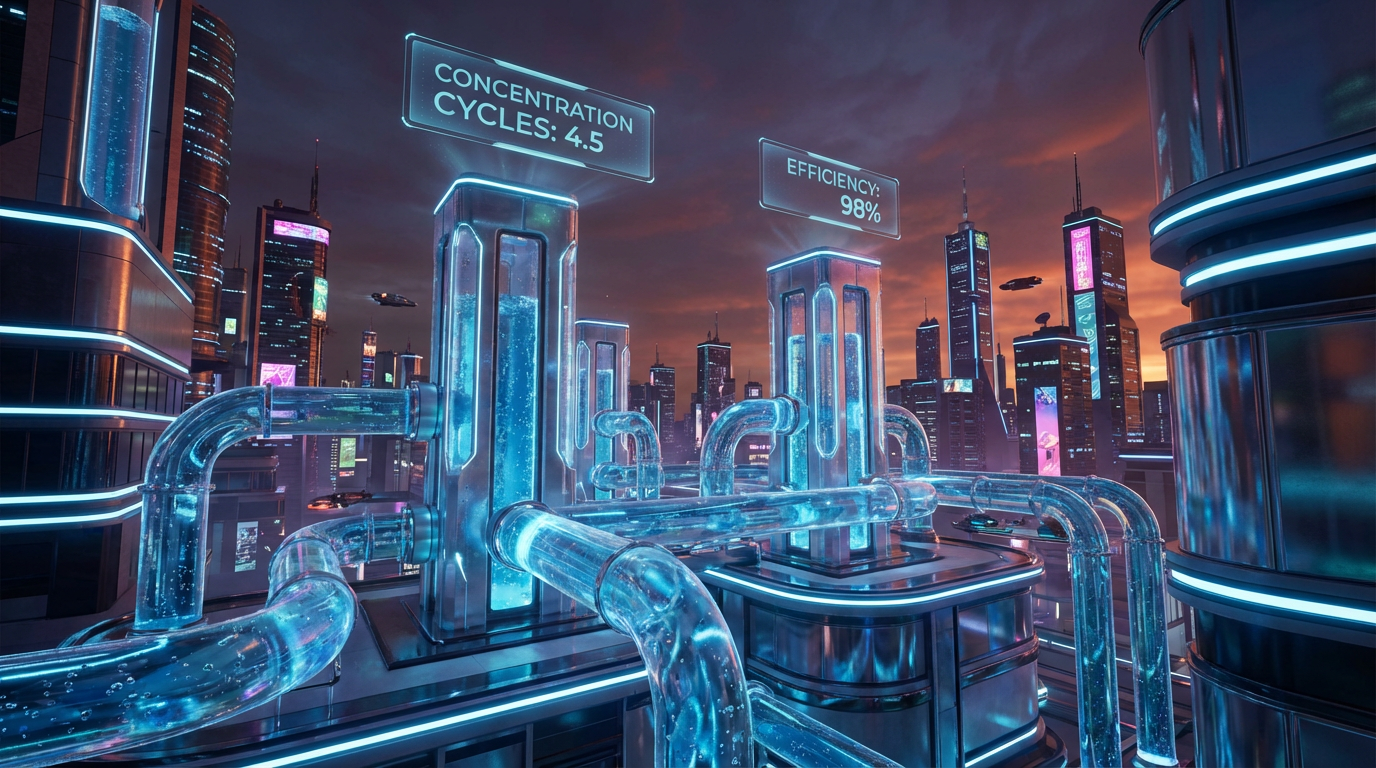
Open cooling towers work differently but follow the same principle. In guidance from industrial water experts such as ChemTreat and the U.S. Department of Energy’s Federal Energy Management Program, cooling tower water leaves mainly through evaporation and a controlled discharge called blowdown. Evaporation is the primary function; it carries heat away. As water evaporates, dissolved solids like calcium and chloride become more concentrated in the remaining recirculating water. This concentration is tracked as cycles of concentration, the ratio of dissolved solids in recirculating water to those in the makeup water. By carefully managing cycles of concentration and blowdown, operators can keep most of the water in circulation with minimal waste.
Water utilities and engineering firms extend this idea to entire supply and wastewater systems. One water‑environment company explicitly describes its goal as “water circulation technology” for next‑generation management. It uses advanced ceramic membrane filtration and ozone treatment on both drinking water supplies and wastewater, then applies intelligent chemical dosing control so water can be regenerated and reused, not just treated and discharged.
At the building and city scale, circular water solutions do something similar. Case studies from innovators highlighted by the World Economic Forum and other sources show systems that collect and treat greywater, stormwater, or even blackwater on site, then circulate it back for non‑drinking uses: irrigation, toilet flushing, cooling, and industrial processes. In some projects, such as One Bangkok in water‑stressed Thailand, integrated treatment systems for stormwater and tertiary wastewater are designed to reuse roughly 320,000 to 400,000 gallons of water per day initially and ultimately treat and recycle on the order of 2.6 million gallons per day.
In every one of these examples, wastewater reduction comes from the same core move: keep water flowing in loops, let dissolved and suspended materials become concentrated in much smaller side streams, treat those streams intelligently, and reserve the highest‑purity water for the taps that people drink from.
How Concentrated Circulation Shrinks Wastewater Streams
Managing Cycles of Concentration and Blowdown
In evaporative cooling towers, a relatively small fraction of circulating water needs to be evaporated to remove a large amount of heat. One widely used example shows that a system circulating about 150,000 gallons per minute and cooling water by roughly 15°F can achieve that cooling with only about 1,800 gallons per minute evaporated, just over one percent of the recirculating flow.
The challenge is that every gallon evaporated leaves its minerals behind, so the remaining water becomes progressively more concentrated. If operators do nothing, scale deposits form on heat transfer surfaces, corrosion accelerates, and microbiological problems emerge. To prevent this, facilities intentionally discharge some recirculating water as blowdown and replace it with fresh makeup water.
Best‑practice guidance from the Department of Energy and industrial water specialists emphasizes that blowdown control is the main lever for water conservation in cooling towers. Cycles of concentration act as the guide. Higher cycles mean more reuse of the same water and less blowdown, but only up to the point where scale or corrosion risk becomes unacceptable. Typical towers operate at about four to six cycles. Beyond that range, extra water savings become marginal, while water chemistry control becomes more difficult, especially in arid regions.
Here is where concentrated water circulation shines. With good makeup water quality, effective filtration, and appropriate chemical treatment, operators can safely run higher cycles of concentration, minimizing blowdown and makeup demand. Softened water, for example, removes hardness minerals like calcium and magnesium that drive scale. Industrial case studies on water softening show that preventing scale protects boilers, cooling towers, and heat exchangers, improves heat transfer, reduces blowdown frequency, and lowers fuel and maintenance costs. In some programs, switching to softened water and optimized treatment has reduced chemical use by around twenty percent or more.
In other words, by conditioning the water in the loop, you can afford to let it become more “concentrated” before you discard any of it. That directly reduces wastewater volumes and fresh water withdrawals.
Closed Recirculating Systems: Keeping Water in the Loop
Closed recirculating cooling systems take this idea even further. Because the water circulates in a sealed circuit without contacting air, evaporation losses are minimal, and makeup volumes are very small. Operators can use high‑quality makeup water such as condensate or properly softened water, which greatly reduces scale formation and biological fouling. With good treatment, corrosion and corrosion‑product buildup can be nearly eliminated.
The tradeoff is that closed systems impose their own discipline. Over time, corrosion products or accidental contaminants can accumulate because there is no routine bleed‑off. High temperatures can still cause aggressive localized corrosion if dissolved oxygen enters during shutdowns. These systems often contain multiple metals—steel, copper, aluminum, and others—so galvanic corrosion is a concern. Carefully selected corrosion inhibitors, such as molybdate‑ or nitrite‑based blends, along with controlled pH, are needed to protect mixed‑metal systems while staying within environmental regulations.
From a wastewater perspective, though, closed loops are powerful. They dramatically reduce the volume of water that ever becomes wastewater. Instead of continuously discharging a portion of flow as blowdown, facilities focus on occasional, targeted maintenance drains and small leak repairs.
Process Water Treatment and Reduced Blowdown
Boiler and process water systems tell a similar story. In a boiler, as steam forms and leaves the system, pure water departs while minerals and impurities stay behind, increasing their concentration in the remaining water. If operators allow that concentration to rise unchecked, foaming, carryover, and under‑deposit corrosion can damage equipment and force expensive downtime.
Blowdown is the operational safety valve: operators bleed off mineral‑rich water and replace it with makeup water. Articles on industrial process water treatment emphasize that proper treatment—involving methods such as demineralization, dealkalization, nanofiltration, and ultraviolet disinfection—can significantly reduce the volume of blowdown required. When the feedwater is cleaner and less scale‑forming, operators can run boilers at higher internal concentrations without crossing into damage‑risk territory.
That again is concentrated water circulation in action. The system allows minerals to concentrate to a controlled level, uses targeted treatment to keep that level safe, and minimizes how much water is ultimately discharged. The benefits are both environmental and economic: less water and energy are wasted, and assets last longer.
Circular Cooling for Digital Infrastructure
Data centers combine cooling towers, closed loops, and advanced process water treatment at massive scale. According to analysis compiled by the Environmental and Energy Study Institute, roughly eighty percent of the water withdrawn on‑site for cooling in many centers evaporates, with the remainder discharged to municipal wastewater systems that may struggle with high volumes.
More efficient designs are emerging. Closed‑loop cooling systems that reuse water multiple times and rely on recycled or non‑potable water sources can cut freshwater use by up to about seventy percent compared with conventional cooling in some applications. Liquid cooling methods, where coolants remove heat directly from chips or servers, can minimize evaporative losses even further.
Related guidance from the World Economic Forum on circular water solutions for data centers defines circular water management as reusing and recycling water in closed or semi‑closed loops, such as closed‑loop cooling, wastewater recycling, and rainwater harvesting, to reduce withdrawals and discharges. When these strategies are combined with metrics like Water Usage Effectiveness and with non‑water‑cooled renewable energy sources, operators can dramatically shrink the water footprint of digital infrastructure.
From a home hydration standpoint, this matters because data center clusters increasingly draw from the same rivers and aquifers as nearby communities. Circular cooling frees more of that water to remain available for households, agriculture, and ecosystems.
Building‑Scale Reuse: Keeping Greywater and Blackwater Local
At the scale of individual buildings and neighborhoods, on‑site reuse is one of the most direct wastewater reduction tools. Several technologies highlighted in your research take shower, bath, laundry, and even toilet water, treat it on‑site, and send it back for non‑drinking uses.
HydraLoop’s modular systems, for example, recycle greywater from showers, baths, and washing machines for uses such as toilet flushing, washing, and heating. That means a large share of the water that would have gone to the sewer now circulates within the building. Rainstick’s shower system goes further by capturing, purifying, and recirculating water in real time while you shower, dramatically reducing water use without sacrificing comfort.
Epic Cleantec’s distributed on‑site systems can recycle up to about ninety‑five percent of a building’s black and grey water using ultrafiltration and advanced disinfection, in a compact footprint. Treated water is reused for non‑potable purposes, and solids can be turned into soil products.
Independent of brand names, the pattern is clear. When you treat greywater where it is generated and reuse it in the same building, you reduce both the volume of wastewater leaving the site and the volume of fresh drinking‑quality water that has to be piped in. That frees utilities to focus their highest‑quality treatment capacity on true hydration uses: drinking, cooking, and hygiene.
Water Circulation at the Utility Scale
Municipal utilities are applying similar principles at regional scale. The Upper Occoquan Service Authority in Northern Virginia has, since the late 1970s, treated wastewater to meet clean‑water standards and then used it to augment a drinking water reservoir. Today, the same facility burns biogas for energy, recovers carbon dioxide, and provides biosolids as fertilizer. That is water circulation at basin scale, complementing the 3R principles of reuse, recycle, and reduce consumption.
In California, the Pure Water Monterey project blends wastewater, stormwater, food and industrial waste, and impaired surface water. Advanced treatment produces water that can be used for domestic supply in coastal communities and for irrigating agriculture in the Salinas Valley. That reduces reliance on overdrawn groundwater and helps close the loop in a region facing chronic drought.
Water‑environment companies are also redesigning conventional treatment plants into “Ecofactory” facilities: low‑carbon, energy‑positive plants that treat wastewater while producing biogas, heat, fertilizers, and treated water for reuse. Instead of being endpoints, these facilities become resource hubs for their communities.
Smart Sensing and Digital Twins: The Brain Behind the Loops
Concentrated water circulation only works safely when operators know what is happening inside their loops. That is where smart sensors, Industry 4.0 automation, and digital twins come in.
Modern smart water systems combine cyber‑physical infrastructure, Internet‑connected sensors, and data analytics to monitor key parameters in real time. Research on autonomous water treatment systems shows how calibrated pH and conductivity sensors, temperature probes, and flow and pressure monitoring can track total dissolved solids, pH, and other indicators, with data sent to cloud platforms for remote supervision and automatic shutdowns when needed.
In wastewater and distribution networks, smart sensor technologies integrated via IoT continuously monitor flow, chemical concentrations, and pathogen levels. They support rapid anomaly detection, predictive maintenance, and resource optimization. AI and machine learning models analyze these datasets to detect patterns, forecast equipment failures, and optimize control of aeration, chemical dosing, and pumping.
Digital twins are one of the most promising tools. A digital twin is a virtual replica of a physical plant or network, fed with real‑time sensor data. Companies such as Veolia describe digital twins as true three‑dimensional models of plants and networks that simulate current conditions and predict future evolution. With advanced algorithms, they generate optimal setpoints for control parameters and actionable insights for operations teams, enabling early leak detection, preventive maintenance, and optimized crisis management.
Startups in the World Economic Forum’s innovation programs use digital twins of water networks to detect leaks and anomalies and reduce losses in systems with intermittent supply. Others deploy self‑powered sensing devices that generate their own energy from water flow, providing continuous visibility into network dynamics and helping utilities cut “non‑revenue water,” often around thirty percent of piped water lost before it reaches customers.
At the policy level, smart sensors and AI tools also enable real‑time monitoring for regulatory compliance, better enforcement, and more transparent public reporting. Studies on digital water transformation in European countries show that digital tools can reduce non‑revenue water in regions where forty to sixty percent of water is otherwise lost before reaching consumers.
The result is a smarter circulation loop from source to tap and back again, with far fewer surprises—and far less wasted water.

Health and Quality: What Circulation Means for the Water You Drink
As a hydration specialist, I pay as much attention to what stays in the water as to how many times the water is reused. Concentrated water circulation is only a win if human health and taste are protected at every stage.
Advanced physical and chemical treatment technologies are central to this. Ceramic membrane filtration, promoted by water‑environment engineering firms, provides fine physical filtration that removes particles and many contaminants more effectively than conventional methods. Ozone generation systems act as powerful oxidizing and disinfecting steps, enhancing water safety and taste while breaking down many organic pollutants and micro‑contaminants.
Industry 4.0 treatment trains tested in research settings typically combine multi‑stage filtration, activated carbon, ultraviolet disinfection, and reverse osmosis. In controlled studies, these systems have consistently reduced total dissolved solids and brought pH and conductivity into ranges compatible with World Health Organization drinking water guidelines, across different raw water sources such as ponds, rivers, and artificially contaminated water. Narrow confidence intervals and statistically significant improvements in key water quality parameters suggest that, when designed properly, these systems are both robust and reliable.
Persistent chemicals like PFAS require special attention. PFAS compounds are used in many heat‑, oil‑, and water‑resistant products and are sometimes called “forever chemicals” because they do not readily degrade. According to technology reviews, PFAS accumulate in water supplies and can cause serious human and ecological health impacts at sufficient levels. Emerging treatment technologies target PFAS for destruction rather than simple capture. Some use ultraviolet light to break carbon–fluorine bonds and convert PFAS into water, fluoride, and simple carbon compounds. Others use electrochemical processes on specialized anodes to mineralize PFAS while also treating ammonia and organic load.
These advanced treatments illustrate a key principle: as you circulate water and allow contaminants to concentrate in smaller volumes, you can justify more sophisticated, energy‑intensive treatment on those difficult streams while keeping the main circulation loops focused on efficient filtration and disinfection. That balance is essential if we want the water in your glass to stay safe and pleasant even as the system behind it becomes more circular.
Pros and Cons of Concentrated Water Circulation Approaches
No technology is perfect. Concentrated water circulation offers powerful wastewater reduction benefits, but it also introduces new design, monitoring, and governance challenges. The table below summarizes key points, grounded in the research you provided.
Aspect |
Advantages for wastewater reduction |
Limitations and risks |
Cooling towers with higher cycles of concentration |
Less blowdown, lower makeup demand, reduced discharge volumes; better use of each gallon before it leaves the system |
Greater risk of scale and corrosion if water chemistry is not carefully controlled; diminishing water savings beyond moderate cycles |
Closed recirculating cooling systems |
Very low makeup and evaporation losses; minimal biological fouling; more stable water quality; fewer unplanned drains |
Higher initial capital cost and pumping energy; contaminant buildup if not managed; risk of localized corrosion, especially in mixed‑metal systems |
Advanced process water treatment and softening |
Reduced blowdown in boilers and process loops; improved heat transfer; lower maintenance and chemical use; extended equipment life |
Requires specialized equipment and ongoing monitoring; chemical handling and disposal must be managed responsibly |
Building‑scale greywater and blackwater reuse |
Large reduction in wastewater outflow and fresh potable water demand; increased local resilience and reduced sewer load |
Requires proper design, maintenance, and monitoring to avoid odor and hygiene issues; upfront cost and regulatory approval can be barriers |
Utility‑scale reuse and Ecofactory‑style plants |
Turn wastewater from a disposal problem into a resource stream; produce reclaimed water, energy, and fertilizers; reduce pollutant loads on rivers and coasts |
Need long‑term investment, regulatory frameworks, and public acceptance, especially for potable reuse; require skilled operation |
Smart sensors, AI, and digital twins |
Real‑time leak detection, anomaly spotting, and predictive maintenance cut losses and overflows; better targeting of treatment and circulation upgrades |
Dependence on reliable data networks and cybersecurity; technology and skills gaps in some utilities; upfront integration complexity |
For households and building occupants, the main takeaway is reassuring. When these systems are designed and run well, they reduce wastewater, strengthen supply security, and support consistently high water quality at the tap. The tradeoffs happen mostly behind the scenes in engineering and operations.
Practical Guidance for Homes, Buildings, and Facilities
If you manage a facility or simply care about the sustainability of the water that fills your glass, there are practical steps you can look for or encourage, all grounded in the techniques described above.
In facilities with cooling towers, pay attention to how cycles of concentration and blowdown are managed. Ask whether conductivity is monitored continuously and whether blowdown valves respond automatically to setpoints. Explore whether your tower can safely operate at higher cycles with better pretreatment or softened makeup water. Guidance from energy and water experts is clear that this is often the single most important step for reducing cooling tower water waste.
Where high‑value equipment depends on stable cooling, such as engines, compressors, or servers, consider whether closed recirculating loops are appropriate. They require thought about corrosion control and inhibitor chemistry, but they dramatically reduce water losses and help protect expensive assets from thermal stress and scaling.
In industrial settings with boilers or high‑purity process water, evaluate whether advanced treatment—demineralization, nanofiltration, or electrodeionization—could reduce blowdown and stabilize operations. Remember that every gallon of blowdown contains energy and treatment chemicals that you paid for; reducing that stream is both an environmental and a financial win.
At the building level, especially in multi‑unit housing or commercial properties, look at onsite reuse options. Greywater systems that recycle shower and laundry water for toilet flushing or irrigation can cut potable water demand significantly. Recirculating shower technologies can maintain comfort while using far less water per shower. On the management side, platforms that reveal real‑time water use and detect leaks have already shown their value in reducing damage and unexpected water bills in commercial buildings.
For utilities and communities, supporting circular wastewater systems—whether through projects like reservoir augmentation, agricultural reuse, or Ecofactory‑style treatment plants—creates a foundation where every drop is used thoughtfully. Public education matters here. Surveys on wastewater reuse show that people are generally comfortable with treated wastewater for household uses, irrigation, and industry, but direct drinking reuse still triggers hesitation. Clear explanations of how advanced treatment works, and where extra barriers are in place for drinking water, can build the trust needed to close water loops safely.
As reuse expands, home hydration systems have a complementary role. High‑quality point‑of‑use filtration and disinfection, properly maintained, provide an additional safety net and taste improvement for households, particularly in regions where utilities are adding new reuse streams or where distribution infrastructure is aging.
FAQ
Does concentrated water circulation mean I am drinking “used” water?
In a circular water system, the same water molecules move through many uses over time. That is already true today, even in regions without explicit reuse projects. What concentrated water circulation changes is how transparently and efficiently those loops are managed. Advanced treatment trains using membranes, activated carbon, ozone, ultraviolet light, and sometimes reverse osmosis can bring reused water to drinking standards, as demonstrated in projects such as reservoir augmentation in Virginia and integrated reuse in California. When that treated water reaches your tap, it has passed stricter controls than many traditional sources.
Are closed and recirculating systems always better for the environment?
They are powerful tools, but not a free pass. Closed loops and high cycles of concentration can reduce water withdrawals and wastewater volumes, which is crucial in water‑stressed areas. However, they require careful management of corrosion, scaling, and chemical use, as well as good energy efficiency design. The most sustainable solutions combine circular water strategies with energy‑efficient operation, resource recovery, and smart monitoring.
What should I ask my building or facility manager about water?
Useful questions include how cooling towers are controlled, whether any greywater or reclaimed water is used for non‑drinking purposes, how leaks are detected and addressed, and what treatment steps your drinking water passes through before reaching indoor taps. Answers that mention real‑time monitoring, optimized blowdown, reuse systems, and advanced filtration are signs that concentrated water circulation is being used thoughtfully to reduce waste and protect water quality.
Closing Thoughts from a Hydration Perspective
Every time we turn on a tap, we rely on a complex set of decisions about how water is circulated, treated, and reused. Concentrated water circulation technology—whether in a cooling tower, an Ecofactory‑style treatment plant, or a recirculating shower—allows us to do more with each gallon while keeping the water you drink clean, safe, and enjoyable. When we combine smart circulation with strong treatment and honest communication, we move toward a future where wastewater is the exception, not the rule, and high‑quality hydration is available without exhausting the sources that sustain us.
References
- https://www.energy.gov/femp/best-management-practice-10-cooling-tower-management
- https://pmc.ncbi.nlm.nih.gov/articles/PMC11945880/
- https://www.vwrrc.vt.edu/2024/05/21/did-you-know-wastewater-systems-for-sustainable-consumption/
- https://www.eesi.org/articles/view/data-centers-and-water-consumption
- https://books.rsc.org/books/edited-volume/2319/chapter/8531591/Revolutionizing-Wastewater-Management-The
- https://www.weforum.org/stories/2024/01/technology-innovation-zero-water-waste-future/
- https://clearwatershelton.com/benefits-of-water-softener/
- https://ecommercefastlane.com/benefits-of-water-conditioning-in-industrial-settings/
- https://www.racoman.com/blog/the-ultimate-guide-to-emerging-technologies-for-operators-in-the-wastewater-industry?srsltid=AfmBOorkOFBDQuuT6Y6FpaN_TIJQYtaiwhF9SsGhOFwcKICY-r7uN12f
- https://www.resourceoptions.com/water-treatment-innovations-the-future-of-wastewater-management/

Share:
Maintenance Frequency for RO Systems in Dust Storm Areas
Surviving the Sahara Desert with Solar-Powered RO Systems