

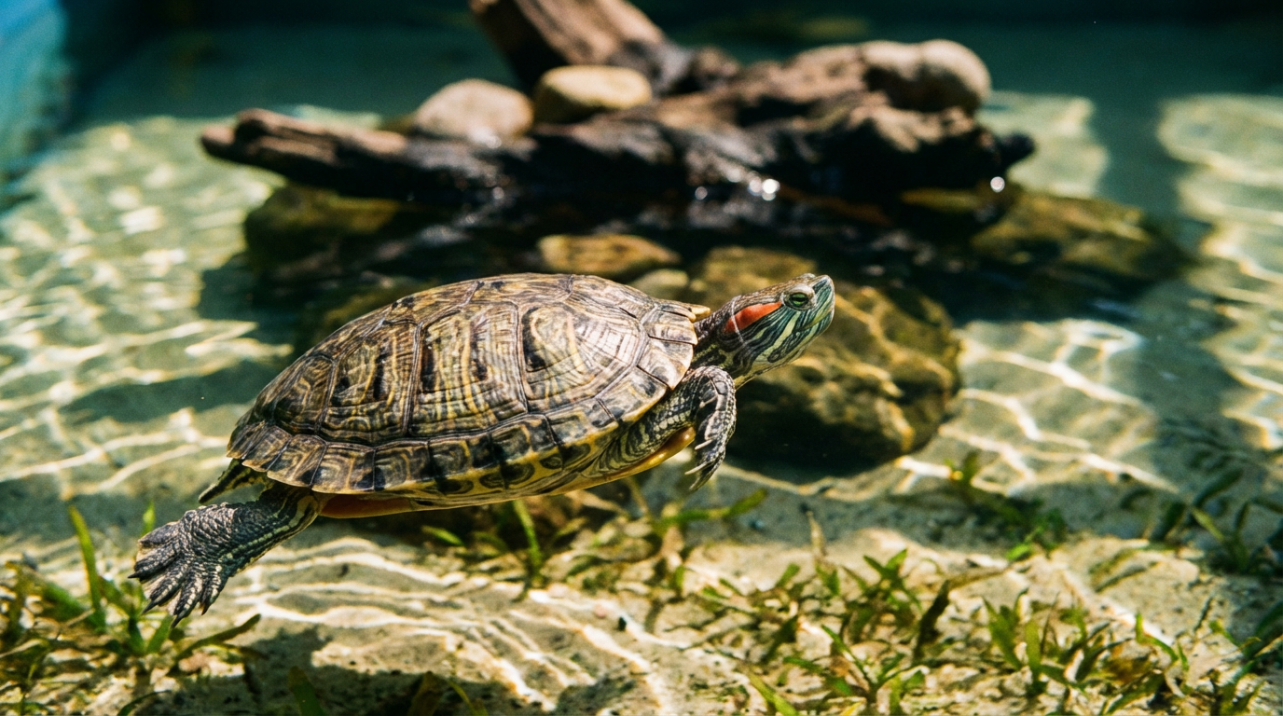
When people ask me what “living water” means for turtles, I always remind them that your turtle is not just swimming in that water. They are eating, excreting, drinking, and breathing air right above it every single day. For an aquatic turtle, water is both home and hydration system, and it either supports a long, healthy life or quietly erodes it.
Wildlife biologists at the University of Florida describe turtles as ectothermic reptiles with living shells that feel touch and absorb UV light needed to make vitamin D. Veterinary care sheets from PetMD and rescue groups add that most aquatic species, like red‑eared sliders and painted turtles, routinely live 20–40 years when their water and habitat are right. Most of the problems vets see in these turtles trace back to water quality, filtration, and hygiene, not to a single bad meal.
In this guide, I will walk you through the key factors that turn simple tank water into “living water” for turtles. We will look at what water chemistry really matters, how much volume and filtration your turtle actually needs, how temperature and layout shape their health, and how to maintain that system week after week without burning out.
Understanding Turtles and Their Relationship With Water
Freshwater turtles and terrapins are not fish that happened to grow shells. They are air‑breathing reptiles that split their time between water and land. Husbandry groups point out that they need deep water to swim, a completely dry basking area, and strong overhead heat and UVB light to mimic sun. Their shells are made from modified ribs and vertebrae, covered in living tissue that can feel pressure and pain, and that absorbs UV to fuel vitamin D and calcium metabolism.
Because shells and skin are alive, they show the first signs when water is wrong. General terrapin care guides and PetMD’s aquatic turtle sheet both link dirty or poorly filtered water to shell rot, skin and eye infections, and respiratory disease. A rescue organization like Central Mississippi Turtle Rescue looks at habitats through this same lens: their adoption guidelines demand enough water volume, robust filtration, and shade so that turtles are not sitting in warm, polluted water.
Thinking like a hydration specialist means seeing your turtle’s tank the way you would see your own household drinking water. Clarity is only a small part of the story. The real question is whether the water chemistry, temperature, and flow are in the right ranges and remain stable over time.
To make this practical, I will organize the rest of this article around four decisions every turtle keeper faces: how clean the water must be, how much water and filtration are needed, how warm and structured the habitat should be, and how to maintain the system without constant crisis.
Water Chemistry: The Foundation of “Living” Turtle Water
The first decision is not which filter to buy, but what you are actually trying to achieve in the water. Several independent sources, including a turtle water‑quality guide from Viomi’s Hydration Lab, PetMD’s aquatic turtle care sheet, and long‑running keeper communities, converge on the same message: you must manage nitrogen waste, pH, and contaminants if you want healthy turtles.
The nitrogen cycle and turtle waste
One of the most important differences between fish and turtles is the waste load. Viomi’s guide notes that a single turtle can produce more waste in a day than a fish does in a week. That waste breaks down into ammonia, a compound that is highly toxic even at low levels. In a mature, cycled system, beneficial bacteria convert ammonia into nitrite (still toxic) and then into nitrate, which is less toxic but still needs to be kept in check through water changes and plant uptake.
Turtle keepers often underestimate how quickly these nitrogen compounds build up. Viomi’s guidance, PetMD’s water‑quality recommendations, and water‑change advice from ReptiFiles all stress the same targets: ammonia should be undetectable, nitrite essentially zero, and nitrate kept at or below roughly 40 parts per million. A red‑eared slider forum that focuses on water chemistry agrees on zero ammonia and nitrite and suggests that keeping nitrate under about 50 parts per million helps control algae and reduce long‑term stress.
If your test strip shows any measurable ammonia or nitrite, your turtle is effectively living in its own waste. That usually means the filter is immature or over‑cleaned, the tank is overstocked, or your water‑change schedule is too weak for the amount of waste being produced.
pH, hardness, and stability
pH measures how acidic or alkaline the water is. Viomi’s water‑quality guide and PetMD’s care sheet both note that most common North American aquatic turtles tolerate a broad pH range from about 6.0 to 8.0. The redearedslider care forum adds that a narrower band around 7.0–7.8 works well for many pond‑type sliders. Across these sources, there is a shared theme: stability matters more than chasing a single “perfect” number.
Carbonate hardness (KH) and general hardness (GH) help buffer pH. The redearedslider chemistry discussion points out that KH in the ballpark of 100–200 parts per million tends to stabilize pH, while very high GH can encourage algae, especially if you are also trying to keep live plants. In a real‑world example posted on Aquarium Co‑Op’s forum, a turtle keeper measured very hard water (GH around 300 ppm) but a reasonable pH of 6.8 and zero ammonia and nitrite. The focus there was not on forcing hardness into a specific target, but on watching that pH stayed stable and compatible with both turtle and planned tankmates.
Viomi’s guide goes a step further and notes that slightly acidic water near pH 6.2 may help reduce shell infections in some hard‑shelled species, but only if pH adjustments are done slowly and guided by regular testing. Rapid swings can stress turtles and disrupt the nitrogen cycle, so “living water” is less about tweaking bottles of “pH up/down” and more about building a system that maintains a comfortable, steady range.
Key parameter targets at a glance
To bring this together, here is a simple reference that combines guidance from Viomi’s Hydration Lab, PetMD’s aquatic turtle care sheet, the red‑eared slider chemistry forum, and other husbandry sources:
Parameter |
Practical target for common aquatic turtles |
Why it matters for “living water” |
Ammonia (NH₃/NH₄⁺) |
0 ppm |
Highly toxic; should always read as zero |
Nitrite (NO₂⁻) |
0 ppm |
Also toxic; indicates immature filtration |
Nitrate (NO₃⁻) |
Ideally ≤ 40–50 ppm |
Chronic stress and algae above this range |
pH |
About 6.0–8.0, kept stable |
Comfort zone for many sliders and cooters |
Carbonate hardness |
Roughly 100–200 ppm |
Buffers pH against large swings |
Temperature (water) |
Mid–upper 70s °F for most species |
Drives metabolism and immune function |
Imagine an example: your test kit reads 0 ammonia, 0 nitrite, and 25–30 ppm nitrate, with a stable pH around 7.2. That is what I would call “quiet” water for a typical adult slider or painted turtle. On the other hand, if nitrate creeps to 40–50 ppm between changes, Viomi’s guide and PetMD both suggest that it is time to increase the size or frequency of partial water changes.
Tap water, conditioners, and contaminants
Most turtle keepers start with tap water. According to Viomi’s guide, that water often carries chlorine, chloramine, copper, and fluoride. PetMD’s care sheet agrees that untreated tap water can irritate sensitive turtle tissues and kill the beneficial bacteria in your filter.
The shared recommendation is clear: either age tap water for roughly 12–24 hours to allow simple chlorine to dissipate or, more reliably, treat new water with an aquarium conditioner that neutralizes chlorine and chloramine and binds the ammonia released when chloramine is broken down. For large tanks and especially for municipal systems that use chloramine, the conditioner route is more consistent.
In practical terms, “living water” starts with safe source water and then keeps nitrogen waste and pH within the comfortable ranges above. Everything else in your setup exists to support that chemistry.
Volume and Filtration: Giving Water Room to Work
Once you know what you are aiming for chemically, the next decision is how much water your turtle actually needs and how to move that water through filtration.
How much water does a turtle need?
Multiple independent care sources, including PetTerrarium’s freshwater turtle aquarium guide, PetMD’s aquatic turtle care sheet, Viomi’s water‑quality article, and Central Mississippi Turtle Rescue’s adoption guidelines, all repeat the same rule of thumb: plan for about 10 gallons of water per inch of turtle shell length, measured from behind the head to the base of the tail. PetMD also emphasizes that the tank should be at least four to five times the turtle’s length and three to four times its width, with water depth about one and a half to two times the turtle’s length to allow comfortable swimming and surfacing.
For outdoor ponds, a pond‑turtle habitat guide recommends at least about 6 feet of diameter and 2–3 feet of depth with varied shallow and deep zones. Those depth transitions create cooler refuges and basking shallows and give the water body more thermal and chemical stability.
Here is a simple indoor example. A red‑eared slider that will reach around 6 inches of shell length should have a system that can provide roughly 60 gallons of water. If you buy a “60‑gallon” tank but only fill it halfway to create a basking area, you effectively have 30 gallons of water volume. That means waste builds up twice as fast, and suddenly your filter and water‑change schedule need to be twice as aggressive to stay within the safe ammonia and nitrate ranges described earlier. Planning for adult size and true filled water volume from day one prevents that trap.
Choosing and sizing filtration for turtle bioload
Turtle keepers quickly learn that the filter that worked fine on a fish tank is overwhelmed by a single turtle. Viomi’s guide recommends using filters rated for about two to three times the tank’s actual volume for turtles, and PetTerrarium echoes this advice, as does Zilla’s aquatic habitat guide. Central Mississippi Turtle Rescue explicitly requires filtration rated for at least twice the number of gallons in a turtle pond or tank.
On top of that, PetMD’s aquatic turtle care sheet advises that the filter should process at least four full tank volumes per hour. For a 40‑gallon tank, that means at least about 160 gallons per hour of flow, and choosing the higher flow option is recommended if you are in doubt. Combining these two ideas gives a clear practical message: oversize the filter and aim for strong turnover, because turtles simply produce more waste than fish.
Different filtration types play complementary roles. A turtle‑filter buying guide from Talis US and PetMD’s article on choosing turtle filters outline three core stages. Mechanical filtration physically traps solid debris such as feces and leftover food. Biological filtration provides surface area for beneficial bacteria to convert ammonia and nitrite into nitrate. Chemical filtration, often using activated carbon or similar media, adsorbs dissolved impurities and odors. Many modern turtle filters integrate all three, and some systems add UV sterilizers that pass water past ultraviolet light to help control pathogens and algae.
The choice between internal and external filters matters for maintenance. PetMD notes that internal filters sit inside the tank and can be hidden in faux rock structures that also act as haul‑out or basking spots, but they must be serviced in the water, which can be messy. External canister filters sit outside the tank with intake and return hoses; high‑quality models support large volumes, combine mechanical, biological, and chemical stages, and are easier to service in a sink or tub.
For medium tanks in the 20–55 gallon range, PetMD actually recommends using two turtle filters in parallel rather than relying on a single unit, both to improve water quality and to reduce how often you need to change water. For larger turtles in the 75–125 gallon range, they suggest a large canister filter sized for tanks up to around 150 gallons. That aligns well with Central Mississippi Turtle Rescue’s insistence on filters rated for at least twice the water volume.
Imagine a full‑grown slider in a 75‑gallon tank that is actually holding 60 gallons of water. Following these guidelines, you would look for one or two filters that together are rated for roughly 120–180 gallons and provide at least about 240 gallons per hour of flow. That combination of volume and turnover gives your biological filter the breathing room it needs to keep ammonia and nitrite at zero while nitrate climbs slowly between water changes.

Outdoor ponds follow the same principles. The pond‑turtle habitat article recommends matching the filter to both tank size and turtle bioload and adding aeration through fountains or aerators to keep water clear and well oxygenated. Under‑sizing filtration is one of the fastest ways to turn a clear pond into a murky, unhealthy basin.
Temperature, Depth, and Basking: Designing a Hydration‑Friendly Habitat
Water chemistry and filtration keep the invisible side of hydration healthy. Temperature, depth, and basking design determine how that water feels and functions to your turtle’s body.
Water temperature and thermal gradients
Because turtles are ectothermic, their body temperature and metabolism are set by the water they swim in and the basking heat they absorb. Viomi’s turtle water‑quality guide notes that wild habitats often sit around the high 50s to high 60s °F, with daily swings, but that indoor tanks are usually maintained in the mid‑70s. Viomi and PetMD both recommend keeping many common aquatic turtles in water around the mid‑to‑upper 70s °F, with Viomi suggesting roughly 78 °F as a central target for adults and slightly warmer water, around the low 80s °F, for hatchlings. PetTerrarium’s tank‑setup guide and Zilla’s habitat article suggest similar ranges, roughly 73–84 °F for water, adjusted by species.
The red‑eared slider chemistry forum adds more detail: about 75–77 °F for adults and 77–79 °F for juveniles, always cooler than the basking area so that turtles can thermoregulate by moving between zones. All of these sources agree on one point: water that is too cold depresses appetite and immune function, and temperatures that swing wildly are stressful.
PetTerrarium’s setup article suggests dividing the tank into functional zones. A warm water zone around 75–80 °F supports active swimming, a slightly cooler resting zone around 70–75 °F allows turtles to cool down, and a basking platform provides a much warmer, dry area for heat loading.
Basking, UVB, and shell health
Turtles cannot live in water alone. Their shells and bones depend on both heat and UVB light. PetTerrarium, Zilla, and PetMD all recommend basking spots around 85–90 °F, with PetMD’s care sheet allowing up to about 95 °F for some species, measured with a reliable thermometer. UVB lighting should be provided for about 10–12 hours per day. Zilla’s guidance suggests a UVB bulb that covers at least half the tank’s length and is positioned roughly 10–12 inches above the basking area. PetMD notes that UVB bulbs should usually be replaced about every six months because their ultraviolet output declines long before they visibly burn out.
The University of Florida’s turtle biology overview adds an important insight: the shell itself absorbs UV light and uses it to produce vitamin D, and because the shell is living tissue with nerves, it can be damaged by paint, drilling, carving, or other modifications. For “living water,” this means your design must allow turtles to climb completely out of the water onto a dry, stable platform where both shell and skin can dry under heat and UVB. That dryness is one of your best defenses against shell rot and fungal infections that thrive on constantly damp scutes.
As a simple design example, consider a 5‑inch turtle in a 40‑gallon tank. PetMD recommends water depth of about one and a half to two times turtle length, so water would be roughly 7.5–10 inches deep. They also suggest sizing heaters at about 2.5–5 watts per gallon. For a 40‑gallon tank, that translates to about 100–200 watts of heating power, with the lower end appropriate for a warm room and the higher end for cooler spaces. Combining that heater with a basking lamp that keeps the platform in the high 80s °F gives the turtle a full thermal gradient to move through.
Outdoor ponds: depth, shade, and weather
The pond‑turtle habitat guide recommends ponds at least about 6 feet across and 2–3 feet deep, with a mix of deep and shallow areas. Deeper zones create thermal stability and safe overwintering spots in colder climates, while shallow shelves and marginal zones allow basking, feeding, and plant growth.
Central Mississippi Turtle Rescue adds that outdoor habitats must provide shade over at least a third of the pond or tank and that keepers should monitor water temperature regularly to ensure turtles are not overheating. They also require drains in outdoor tanks and ponds so that heavy rain does not flood the habitat and compromise water quality.
Taken together, these sources suggest thinking of outdoor turtle ponds as layered thermal and hydration systems: deep, stable water as a buffer, shallows for active use, and shaded and sunny zones so turtles can choose their comfort level.
Maintenance Routines: Keeping Water Stable Week After Week
Even the best‑designed system will fail if maintenance does not keep up with the turtles’ waste load. Filtration and volume buy you time and stability, but partial water changes and routine cleaning are what turn that capacity into consistently “living” water.
How often to change water, and how much
ReptiFiles’ water‑change guide for red‑eared sliders asks a simple question: if you already have a filter, why bother doing water changes at all? Their answer, backed by Viomi’s nitrogen‑cycle overview and PetMD’s care sheet, is that water changes physically remove dissolved pollutants and restore trace minerals that filters cannot fully manage.
For pond sliders, ReptiFiles recommends partial water changes about every one to two weeks, replacing roughly 30 percent of the tank or pond water each time. They give a concrete example: in a 90‑gallon tank, that means changing about 27 gallons. PetMD’s aquatic turtle care sheet offers a slightly more flexible schedule: change about 25 percent of the water weekly or 50 percent every other week with dechlorinated, temperature‑matched water. Zilla’s habitat article suggests changing 25–50 percent of the water every two to four weeks, paired with good filtration and water conditioner to remove chlorine and chloramines.
When you combine these sources, a clear pattern emerges: for a heavily filtered, appropriately sized turtle tank, replacing roughly a quarter to a third of the water each week is a solid baseline. If nitrate still climbs toward 40–50 ppm between changes or if you keep multiple turtles, you move toward the higher end of those ranges in either volume or frequency.
Tools, technique, and hygiene
Because turtle systems are large, ReptiFiles suggests using a siphon system designed for aquariums rather than carrying buckets back and forth. They point to “no‑spill” style systems that hook to a faucet to both drain and refill. Regardless of the tool, they strongly warn against starting a siphon with your mouth because turtle water frequently carries Salmonella.
ReptiFiles also emphasizes where not to dump turtle water. Dirty turtle water can be a boon for ornamental plants as a natural fertilizer, but it should never be used on edible plants and should not be drained into sinks used for food preparation or dishwashing, such as kitchen sinks. Any sink or tub that contacts turtle water should be disinfected afterward with a suitable cleaner such as a bleach solution or veterinary disinfectants like chlorhexidine or F10SC, allowed to sit for an appropriate contact time, and then rinsed thoroughly.
Public health concerns about Salmonella are serious enough that, as PetTerrarium’s article notes, the United States banned the sale of turtles under 4 inches in 1975, largely to reduce infections in children. OATA’s general terrapin care guidance and PetMD both remind keepers that all reptiles can carry Salmonella and that careful handwashing after any contact with the turtle or its water is non‑negotiable.
Filter maintenance and deep cleaning
Filters themselves need regular care. Talis US’s filtration guide recommends weekly inspection to clear clogs and verify water level, with monthly deeper cleaning that includes checking or replacing media. PetTerrarium’s setup guide lays out similar routines: canister filters rinsed about every four weeks using tank water (not tap, to protect bacteria), sponge filters squeezed clean every couple of weeks, and internal or hang‑on‑back filters checked weekly. Zilla suggests replacing filter cartridges roughly once a month to maintain good mechanical and chemical performance.
PetMD’s aquatic turtle care sheet extends maintenance to the entire tank. They recommend daily removal of uneaten food, partial water changes as discussed above, and a deep clean at least every three to four weeks. Deep cleaning means moving the turtle to a temporary container, draining the tank, scrubbing glass and décor with a reptile‑safe cleaner or a dilute bleach solution (around three percent), letting that solution sit on surfaces for at least ten minutes, then rinsing thoroughly until no cleaner or bleach smell remains before refilling and restarting equipment.
Viomi, PetTerrarium, and several other sources encourage keepers to track water tests, filter maintenance, and behavior in a simple journal. In my experience, that small habit makes it much easier to connect a spike in nitrate or a sudden algae bloom to a missed filter cleaning or an extra turtle added to the system.

Design Choices That Protect Water Quality
The last set of decisions concerns everything else that shares the water with your turtle: substrate, plants, botanicals, tankmates, and even other turtles. These choices can either support your water‑quality goals or quietly fight against them.
Substrate, décor, and botanicals
Central Mississippi Turtle Rescue’s guidelines are blunt about substrate: absolutely no small pebbles that can fit in a turtle’s mouth. If a rock can be swallowed, it is too small and can cause dangerous intestinal impaction. Thoroughly rinsed sand is acceptable, and many sources, including PetTerrarium, PetMD, and Zilla, suggest either bare‑bottom tanks, large smooth river rocks, or coarse sand that cannot be eaten. Softshell turtles, as PetTerrarium notes, have especially delicate skin and benefit from very soft, non‑abrasive substrates.
Décor should balance enrichment with safety and flow. PetTerrarium and Zilla both recommend using driftwood, PVC pipes, and sturdy hides to create shelter and reduce stress while arranging décor mostly along the tank edges to preserve open swimming space. Sharp rocks, unstable stacks, and heavy items that could be knocked over by a strong, inquisitive turtle should be avoided or firmly secured.
Some keepers like to add botanicals such as boiled leaf litter or sphagnum moss. An Aquarium Co‑Op forum discussion describes a turtle tank with sand, sphagnum, and boiled leaves that developed a clear, mulmy film on some of the botanicals, prompting concern about whether it was normal biofilm or a health risk. The key lesson from that case is not that botanicals are inherently bad, but that they add organic load and can influence pH. If you experiment with them, you must be prepared to test water frequently for ammonia, nitrite, nitrate, and pH and to adjust your cleaning routine if parameters drift or your turtle shows irritation.
Viomi’s guide notes that plants can help consume nitrate as part of the nitrogen cycle, and pond‑turtle habitat advice recommends native aquatic plants such as lilies, reeds, and submerged oxygenators both for habitat and for natural filtration. Whether indoors or out, using live plants as part of your “hydration system” often gives you a small but meaningful buffer against rising nitrate.
Tankmates, multiple turtles, and bioload
Viomi’s water‑quality guide stresses that even a single turtle represents a dense stocking level in a typical aquarium, and adding fish or invertebrates significantly increases waste, oxygen demand, and disease risk. The Aquarium Co‑Op forum example shows this in practice: the keeper was already dealing with very hard water and heavy turtle bioload and was carefully considering whether to add a trio of small Endler livebearers, knowing that co‑housing fish demands closer attention to pH and nitrogen levels.
PetMD’s care sheet and Central Mississippi Turtle Rescue’s guidelines focus on the social side of stocking. Both caution against housing male aquatic turtles together because they usually fight. Central Mississippi Turtle Rescue notes that turtles are not social animals and do not enjoy being kept together and that aggression can occur even between females. Their policy is that males should either live alone or with at least three females, and any plan to house a male with females must address potential offspring, since they do not adopt out turtles for breeding. PetMD adds that different turtle species should not be mixed in the same tank and that each individual still needs roughly 10 gallons of volume per inch of body length.
Every extra animal you add multiplies the water‑quality challenge. In a 75‑gallon tank already supporting one adult slider, PetMD’s advice to increase tank size by about 25 percent per additional turtle means that adding a second turtle in a biologically appropriate way would require moving up to something like a 90–100 gallon system, along with correspondingly larger filtration and heavier maintenance. For most keepers who are serious about water quality and long‑term health, that calculus makes single‑turtle setups or very carefully managed ponds the most realistic path to truly “living water.”
Outdoor ponds introduce wild tankmates as well. The pond‑turtle habitat guide recommends predator protection on all sides and overhead, including fencing, seasonal netting, and protected nesting areas. Central Mississippi Turtle Rescue’s outdoor guidelines mirror this and also insist that ponds be completely escape‑proof. Pet turtles released into the wild can die slowly, spread disease to native turtle populations, or become invasive, as has happened with red‑eared sliders in many regions according to conservation articles from Florida wildlife agencies.
A Hydration Specialist’s Closing Thoughts
When you look at all of these sources side by side—veterinary care sheets, rescue guidelines, filtration experts, and long‑time keepers—the picture is remarkably consistent. Living water for turtles is spacious, well filtered, chemically stable, and kept in motion with thoughtful temperature zones and basking design. It is refreshed regularly through partial water changes, treated to neutralize tap‑water chemicals, and protected with good hygiene.
If you commit to those fundamentals, your filter, heater, and test kit stop being emergency tools and start working together as a smart hydration system for a reptile that may share your home for decades.
References
- https://www.mass.gov/doc/guidelines-for-creating-turtle-nesting-habitat/download
- https://blogs.ifas.ufl.edu/sarasotaco/2024/05/17/wildsarasota-turtletalk/
- https://ornamentalfish.org/what-we-do/advice-information/care-sheets/caresheets-aquatic-animals/how-to-look-after-terrapins-freshwater-turtles/
- https://www.centralmsturtlerescue.com/-aquatic-turtle-habitat-guidelines.html
- https://www.petmd.com/how-pick-right-turtle-tank-filter-and-tank
- https://www.amazon.com/turtle-tank-filter/s?k=turtle+tank+filter
- https://petterrarium.com/freshwater-turtle-aquarium/
- http://www.redearslider.com/forum/viewtopic.php?f=5&t=33399
- https://www.thebiodude.com/collections/aquarium-filters?srsltid=AfmBOor7PT72I5CH0SruRvtWN3ThNSHJ99sv98t5pzahLFXZAVe6PyOA
- https://www.zillarules.com/articles/setting-up-an-aquatic-turtle-habitat

Share:
How to Dilute Essential Oils with Purified Water for Fragrance Blending
Essential Water Quality Standards for Homebrewing Craft Beer