

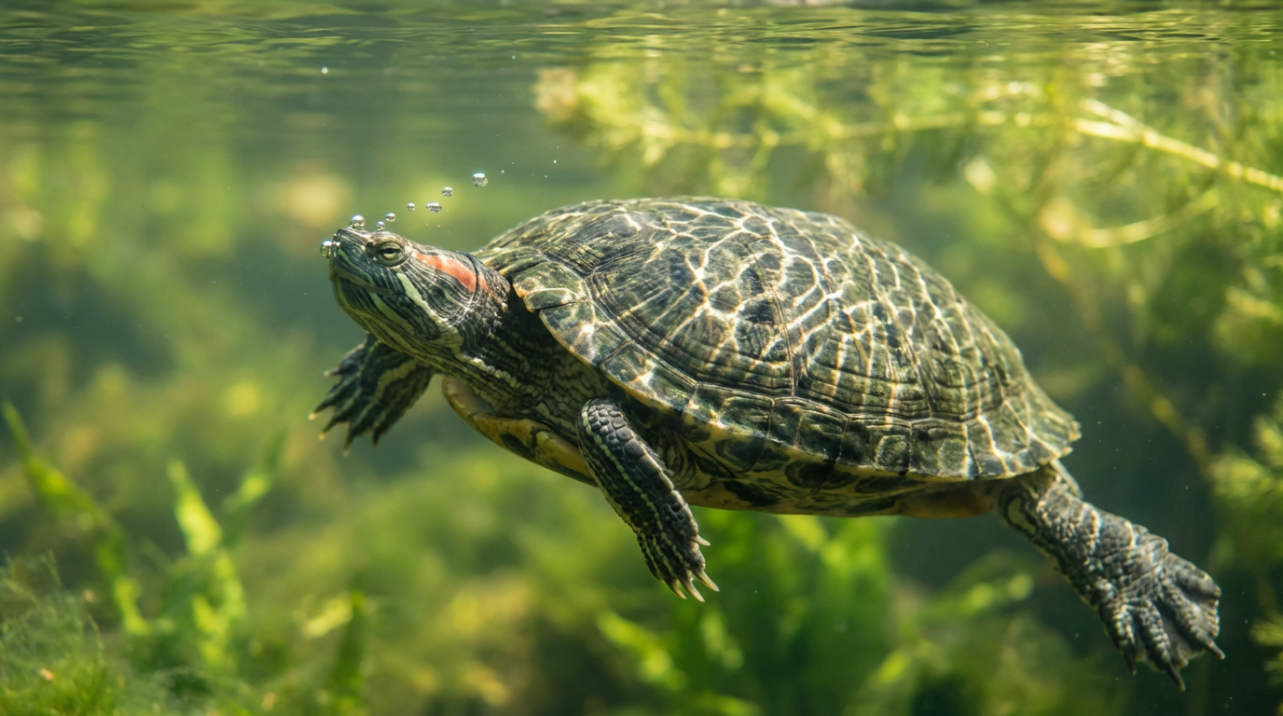
As a smart hydration specialist, I like to say that a turtle tank is a living drinking fountain. Your turtle swims in it, eats in it, breathes above it, and drinks from it all day long. When the water is clean and stable, turtles thrive for decades. When it is dirty or unstable, problems show up quickly as shell infections, eye irritation, lethargy, and repeated vet visits.
Animal welfare groups such as the RSPCA and veterinary sources like PetMD and MedVet all converge on the same idea: most health issues in captive aquatic turtles trace back, in one way or another, to water quality. In this guide, I will translate the science behind water quality into practical, daily habits, and I will tie those to the kind of filtration, monitoring, and routine you can realistically maintain at home.
I will focus on common freshwater aquatic turtles such as red‑eared sliders, painted turtles, and similar species. Always confirm species‑specific needs with a qualified reptile veterinarian, but you can treat this as your blueprint for understanding what “good water” really means for your turtle.
Why Water Quality Matters So Much For Pet Turtles
Aquatic turtles are not fish with shells. They are long‑lived reptiles that can spend decades in the same home, and they do almost everything in the water. They eat there, they excrete there, and they often sleep there. Because of that, the tank becomes a dense soup of organic waste unless you actively manage it.
The RSPCA notes that most disease problems in captive turtles are linked in some way to poor water quality. Veterinary guidance from PetMD and MedVet makes the same point: clean, stable water is just as important as diet and UV lighting. Even when the water looks clear, dissolved waste such as ammonia and nitrite can quietly rise to irritating or toxic levels.
Compared with fish, turtles are heavy polluters. Austin’s Turtle Page points out that a turtle can easily produce more waste in a day than a fish does in a week. That is why fish‑grade equipment is often undersized for turtles and why strong filtration and regular water changes are non‑negotiable. If the tank smells “turtley,” the water is already overdue for maintenance.
When you understand the chemistry and biology behind that smell, it becomes much easier to design a system — and a weekly routine — that keeps your turtle and your home environment healthier.

Core Water Quality Parameters You Must Understand
The Nitrogen Cycle: From Waste To Relatively Safer Nitrate
Every time your turtle eats, two things happen to your water: food goes in, and nitrogen‑rich waste comes out. As leftover food and feces break down, they release ammonia. Both Austin’s Turtle Page and the RSPCA describe ammonia as a primary “bad stuff” in aquatic systems: it is highly toxic even at low levels and can irritate skin, eyes, and internal organs.
In a mature aquarium, beneficial bacteria colonize the filter and surfaces. The Spruce Pets and the RSPCA describe the sequence this way. First, one group of bacteria converts ammonia into nitrite, which is still toxic. Then another group converts nitrite into nitrate, which is much less toxic but still harmful in high concentrations. Plants and regular water changes then remove nitrate from the system.
This chain of conversions is called the nitrogen cycle. When it is stable, water stays clearer, smells better, and is much safer. When it is immature or disrupted, levels of ammonia and nitrite spike and the tank often turns cloudy. That is why both fish and turtle care resources emphasize establishing and protecting this bacterial community instead of constantly “resetting” the tank with full, emergency water changes.
Ammonia, Nitrite, and Nitrate Targets
Veterinary care sheets from PetMD give practical targets for common freshwater turtles. For a typical pet slider or similar species, aim for zero detectable ammonia and essentially zero nitrite. For nitrate, a level at or below about 40 parts per million (ppm) is considered acceptable, with lower generally being better as long as the system is stable.
You cannot see these numbers with your eyes. Turtles will sometimes survive in elevated levels for a while, but irritation, infections, and chronic stress mount over time. That is why multiple sources, including Chewy’s veterinary articles and The Spruce Pets, recommend using aquarium test kits to monitor ammonia, nitrite, and nitrate. Dip strips offer quick, user‑friendly readings; liquid master kits are more precise but a bit more involved. Either is better than guessing.
If ammonia or nitrite shows up at more than trace levels, it is a sign that the tank is overstocked, the filter is not established or is being over‑cleaned, or your water change routine is not keeping up.

When nitrate creeps above roughly 40 ppm between changes, that is your cue to increase the volume or frequency of partial water changes.
pH: Acid–Base Balance And Species Nuance
pH describes how acidic or alkaline the water is. A pH of 7.0 is neutral; values below 7 are acidic, and above 7 are alkaline. Austin’s Turtle Page notes that most tap water in many regions falls around 7.5–8.5, which is slightly alkaline.
For common freshwater North American turtles, PetMD and The Spruce Pets describe a pH range around 6.0–8.0 as generally acceptable, with stability being more important than chasing a “perfect” number. The Spruce Pets specifically notes that red‑eared sliders are tolerant of modest pH variation as long as it stays in that broad window.
There are species‑specific nuances. Austin’s Turtle Page points out that some species such as Diamondback terrapins prefer water near pH 7.5, while certain South American turtles like Mata Matas thrive in more acidic water, around pH 5.0. It also suggests that very slightly acidic water, around pH 6.2, can help reduce shell infections in many hard‑shelled North American species, but warns that softshell turtles should not be kept below about pH 6.5 to avoid “burning” their delicate skin.
Commercial “pH up” or “pH down” products and so‑called blackwater extracts can adjust pH, and Austin’s Turtle Page notes that gently lowering pH can also reduce ammonia toxicity. However, every adjustment should follow a clear test result and manufacturer guidelines, because sudden swings stress turtles and destabilize the nitrogen cycle. If your pH is within the species‑appropriate range and stable, most veterinary and welfare sources recommend focusing your energy on ammonia, nitrite, nitrate, and cleanliness instead of constantly tinkering with pH.

Chlorine, Chloramine, and Metals in Tap Water
Tap water is very convenient, but it is not neutral from your turtle’s perspective. The RSPCA points out that town water can contain chlorine, copper, and fluoride, all of which may be harmful to turtles or to the beneficial bacteria in your filter. The Spruce Pets adds that many municipalities also use chloramine, a more stable disinfectant that does not dissipate quickly on its own.
There is some debate in hobby circles about whether turtles are as sensitive to chlorine as fish, but both the RSPCA and The Spruce Pets lean toward caution. Chlorine and chloramine can irritate sensitive tissues such as eyes and can damage or kill the bacteria that run your nitrogen cycle. For that reason, both sources recommend either aging the water in a separate container or using commercial water conditioners designed for aquariums and turtles.
The RSPCA describes one option: letting tap water stand for roughly 12 hours (optionally with an airstone) before use, which allows chlorine to dissipate. The Spruce Pets clarifies that while chlorine may evaporate within about 24 hours, chloramine does not; in areas that use chloramine, you need a conditioner explicitly formulated to neutralize chlorine, chloramine, and the ammonia released when chloramine is broken down.
Because municipal water chemistry varies, it is worth reading your local water quality report or asking your water provider which disinfectants are used.

Then you can match your conditioner accordingly.
Temperature and Dissolved Oxygen
Turtles are ectotherms, meaning they rely on external heat to regulate body temperature. Water that is too cold slows their metabolism and immune system; water that is too warm holds less oxygen and can stress both turtles and beneficial bacteria.
The RSPCA notes that natural turtle habitats often sit around 59–68°F with only about a 5°F daily swing, while indoor turtle tanks typically run warmer, around 73–79°F. Mazuri and MedVet recommend targeting roughly 78°F for many aquatic species, with MedVet offering more detail: about 82–85°F for hatchlings and about 75–80°F for adults, maintained with a reliable submersible heater.
Zilla adds that a range around 73–84°F is common for aquatic species, provided you avoid rapid swings. All of these sources emphasize gradual, controlled heating and the use of thermometers or infrared temperature guns to confirm both water temperature and basking‑area temperatures.
Dissolved oxygen depends heavily on water movement and cleanliness. The RSPCA explains that oxygen enters from the air at the water surface and is increased by rippling from devices like air stones or spray bars. High temperatures, decaying food, excessive plant load, and overstocking all sap oxygen. That is one reason strong filtration and regular water changes are so important; they support not just chemistry but also gas exchange.

Filtration Requirements for Turtle Tanks
Why Turtle Tanks Need Oversized Filters
Turtles produce a heavy bioload. Their strong appetites lead to large amounts of solid waste and leftover food. Austin’s Turtle Page and multiple forum‑based care discussions highlight a simple reality: filters that are adequate for fish at a given tank size are often underpowered for turtles.
The Spruce Pets suggests choosing a filter rated for roughly two to three times the actual volume of your turtle tank. In other words, if you have a 20‑gallon turtle tank, you might use a filter marketed for 40–60 gallons. PetMD recommends aiming for filtration that turns over the full tank volume at least four times per hour, and notes that canister filters are often preferred because they combine strong mechanical, biological, and chemical filtration without using up swimming space.
In practice, this means that “bigger is better” is not just a slogan. Mazuri and Zilla both encourage generous filtration and stress that clean, well‑filtered water is central to long‑term shell and bone health.
Mechanical, Biological, and Chemical Filtration
Most modern aquarium filters combine three functions, sometimes in separate media.
Mechanical filtration physically traps particles like uneaten food, feces, and plant debris. Sponges, pads, and fine floss fall into this category. The benefit is obvious: clearer water and less debris. The trade‑off is that mechanical media clogs and must be rinsed regularly or it turns into a source of decaying waste and nitrate.

Biological filtration is the heart of the nitrogen cycle. Porous media such as ceramic rings, bio‑balls, and specialized biospheres provide surface area for beneficial bacteria. The RSPCA and Austin’s Turtle Page both emphasize that these bacteria are your allies, not pathogens; products sold as “beneficial bacteria” are intended to seed and support this community. The advantage is that biological media convert highly toxic ammonia and nitrite into more manageable nitrate. The downside is that these media take time to mature and can be damaged by harsh cleaning or certain chemicals.
Chemical filtration, often in the form of activated carbon, adsorbs dissolved organic compounds and some medications. Aquarium Coop forum discussions and Austin’s Turtle Page note that activated carbon helps reduce odors and remove the slight tint that turtle water often develops. The strength of chemical filtration is polishing the water and removing compounds mechanical and biological media miss. The trade‑off is that carbon saturates; once full, it stops working and effectively becomes additional biological media. It must be replaced on a schedule recommended by the manufacturer.
Designing a system that uses all three types gives you more levers to pull. You can rinse mechanical media to keep flow high, protect biological media to preserve the nitrogen cycle, and rotate chemical media to manage odor and color.
Maintaining the Filter Without Killing Good Bacteria
Many well‑meaning turtle keepers accidentally wipe out their filter’s bacterial colony by cleaning too aggressively. The RSPCA is explicit about this risk: if you rinse filter media under untreated hot tap water, you may kill the very bacteria that keep ammonia and nitrite under control and trigger “ammonia shock.”
The safer approach, supported by both the RSPCA and Austin’s Turtle Page, is to clean filter sponges and other reusable media in a bucket of tank water you have just removed during a water change. This removes sludge but keeps temperature and chemistry similar enough that bacteria survive. Replace only part of the mechanical media at a time, and avoid replacing all biological media at once unless you are prepared to re‑cycle the tank with careful monitoring.
Chlorinated tap water is a double risk: it can harm both turtles’ eyes and the bacterial biofilm. Always dechlorinate replacement water before it passes through the filter, and avoid pouring unconditioned tap water directly into the filter itself when you refill.

Tank Size, Water Volume, and Stocking Density
Water quality is not just about chemistry and filters; it is about volume. PetMD, apifishcare, and The Spruce Pets converge on a widely used rule of thumb: plan for about 10 gallons of water per inch of turtle shell length, with a minimum of around 40 gallons for a typical adult of common pet species. A five‑inch turtle, for example, fits best in roughly a 40–55 gallon tank, as MedVet notes.
This rule assumes the tank is mostly full. In real homes, many turtle tanks are only partially filled. The Aquarium Coop community highlights that a 55‑gallon tank filled only one‑third of the way holds far less water than its nameplate volume, which makes waste more concentrated and chemistry less forgiving. If you raise the water level, it becomes crucial to use a secure lid and a well‑designed basking platform so the turtle can haul out and dry in safety.
The RSPCA cautions that even a single turtle in a tank is far more densely stocked than it would be in nature. Adding feeder fish or crustaceans increases oxygen demand, waste production, and disease transmission risk. Sea turtle husbandry manuals used in professional facilities take the same conservative stance on stocking density, emphasizing that more animals in the same volume require much more robust filtration and monitoring.
For many homes, this means that the most powerful water‑quality upgrade is not a new chemical product but either a larger water volume, a stronger filter, or both.

Source Water Choices and Treatment
Making Tap Water Turtle‑Safe
For most keepers, conditioned tap water is the practical starting point. As already discussed, it needs to be dechlorinated and, where applicable, dechloraminated. The RSPCA suggests either letting water stand for about half a day before use or treating it with commercial conditioners that bind chlorine and metals such as copper. The Spruce Pets adds that, in areas with chloramine, you must select a conditioner that also handles chloramine and the ammonia released when it is neutralized.
It is wise to test your tap water before you ever pour it into the tank. Commercial test kits recommended by the RSPCA and Chewy’s veterinary authors allow you to check pH, hardness, chlorine, and sometimes metals. Knowing your baseline lets you decide whether simple conditioning is enough or whether you need additional steps.
Thinking About Home Filtration Systems
If your household already uses a whole‑home filter, water softener, or drinking‑water filtration device, it naturally raises the question of whether that water is better for your turtle. Because different systems change water chemistry in different ways, there is no single rule that fits every home. Some systems remove heavy metals, which is helpful; others dramatically lower mineral content, which can affect pH and hardness.
In a smart‑hydration mindset, the safest approach is to treat your turtle’s tank as its own mini‑water system. Use your existing household filtration if your veterinarian agrees it is appropriate for your species and local water, but still dechlorinate and still test regularly. Conditioned tap water that is verified with a test kit often provides a very workable, cost‑effective base.
Practical Maintenance: Water Changes, Testing, and Everyday Habits
Water Change Schedules That Actually Work
Different reputable sources offer slightly different water‑change routines, and they can all be correct depending on tank size, filtration, and stocking.
The RSPCA recommends replacing roughly 4–10 percent of the aquarium water each week with aged or treated water. This slow and steady approach lowers nitrate while preserving the nitrogen cycle and is particularly useful for larger, stable systems.
PetMD suggests partial changes of around 25 percent weekly or about 50 percent every other week for many home setups, combined with deep cleaning every three to four weeks, especially in more heavily stocked tanks. Zilla recommends changing about 25–50 percent of the water every two to four weeks in many filtered turtle habitats.
MedVet describes a routine where partial water changes occur about once a week and full water changes about once a month, paired with feeding strategies that reduce how dirty the water becomes.
Chewy and The Spruce Pets emphasize a slightly different angle: let test kits and your nose guide you. If ammonia, nitrite, or nitrate readings are creeping up faster than expected, or if the tank starts to smell, water changes are overdue. Many keepers of messy turtles end up doing smaller partial water changes more frequently, sometimes two or three times per week, especially if they feed rich protein diets in the tank.
The common thread is consistency. Whatever schedule you choose, build it around partial changes using dechlorinated, temperature‑matched water. Avoid frequent complete tear‑downs, because they erase your biological filtration and force the tank through new cycles of instability.
Testing: Your Water‑Quality Dashboard
Water test kits appear in almost every credible source on turtle care. The RSPCA recommends checking at minimum temperature, pH, ammonia, nitrite, nitrate, and hardness every one to two weeks and after each water change. Chewy and The Spruce Pets highlight dip‑strip kits as fast, user‑friendly tools that help you spot rising toxins before your turtle shows symptoms. Liquid master kits offer more precise readings and are useful when you are dialing in a new filtration system or troubleshooting persistent issues.
From a smart‑water perspective, think of these kits as your home’s version of a control panel. You do not need to test every single day in a stable tank, but you should test often enough that you see trends. Recording results in a simple log or app helps you see, for example, that nitrate tends to hit 40 ppm by day five, which tells you your system needs either more filtration, less feeding, more water volume, or slightly more frequent water changes.

Feeding Practices That Protect Water Quality
How and where you feed your turtle drives how quickly the water fouls. MedVet and The Spruce Pets both discuss feeding in a separate container as an effective way to cut down on tank waste. The method is straightforward: fill a smaller tub with warm water from the tank, move the turtle into it for feeding, then discard that water afterward and top off the main tank with fresh conditioned water. Many turtles defecate shortly after eating, so this technique removes a significant amount of waste before it ever reaches your main system.
The advantage is cleaner water and easier maintenance. The trade‑off is extra work and more handling, which some turtles find stressful. Many owners therefore adopt a hybrid approach described by The Spruce Pets: feed especially messy or high‑protein meals in a separate tub, and offer cleaner foods such as greens in the main tank, while still scooping uneaten food and scheduling water changes appropriately.
Regardless of where you feed, avoid overfeeding and always remove uneaten food promptly. PetMD and Mazuri both connect overfeeding and high‑protein diets with more rapid water fouling and long‑term health problems such as obesity and shell deformities.
Substrate, Plants, and Decor
What sits on the bottom of the tank shapes how easy it is to keep the water clean. The Spruce Pets notes that skipping substrate entirely and leaving the glass bare makes it much easier to see and siphon waste. Rocks or large gravel can be attractive, but apifishcare and Zilla stress that any gravel must be large enough that the turtle cannot swallow it, to avoid intestinal impaction.
Austin’s Turtle Page and Aquarium Coop contributors add another angle: live plants, especially emergent species with roots in water and leaves above the surface, can help absorb nutrients and improve water clarity. Plants such as pothos and peace lily, when used properly and safely, act like mini wetlands filters. The benefit is biological nutrient export and a more natural look. The trade‑off is that turtles may nibble floating plants, and plant debris adds to the cleaning workload.
In a smart‑filtration mindset, you can treat substrate and plants as part of your nutrient management system. Bare‑bottom tanks plus strong filtration and routine siphoning offer maximum control. Lightly planted tanks, with carefully chosen safe species, offer biological support and enrichment with slightly more maintenance.
Putting It Together: An Example Water Quality Plan
To make this concrete, imagine you are setting up a home for a five‑inch red‑eared slider. MedVet notes that a turtle of this size needs about a 40–55 gallon tank, with water depth one and a half to two times the shell length. Following the common “10 gallons per inch” guideline, you decide on a 50‑gallon aquarium filled close to the full mark, with a secure basking platform and screen top.
Because turtles are messy, you select an external canister filter rated for roughly 100 gallons, which aligns with The Spruce Pets’ recommendation to use a filter rated for about two times the tank volume. The filter is loaded with mechanical sponges, a large basket of ceramic biological media, and a pouch of activated carbon. You set the return to ripple the surface for better oxygenation.
For heat, you install a submersible heater sized according to the RSPCA’s rule of roughly 2–4 watts per gallon, which puts you in the neighborhood of a 150‑ to 200‑watt heater for this tank. You set it to maintain water around 76–78°F, within the adult range described by MedVet and Mazuri, and you verify with a reliable thermometer. Above the basking platform, you mount a heat bulb that keeps the basking spot around 85–90°F and a UVB bulb on a timer for about 10–12 hours a day.
You test your tap water and find that it contains chlorine and chloramine. Based on RSPCA and Spruce Pets guidance, you choose a conditioner labeled to handle both, plus the resulting ammonia, and you treat all new water before it ever touches the tank.
For maintenance, you adopt a routine inspired by PetMD and MedVet. Once a week, you siphon about 25 percent of the water, using a gravel vacuum to pull detritus from the bottom, and replace it with dechlorinated, temperature‑matched water. Once a month, you do a somewhat larger change and gently rinse mechanical filter media in a bucket of old tank water. You never rinse biological media under hot tap water and never change all media at once.
Every week or two, you dip a test strip and periodically run a liquid test kit. Ammonia and nitrite stay at zero; nitrate climbs but stays under about 40 ppm between changes. pH sits steadily around 7.4, well within the 6–8 range described for red‑eared sliders. When nitrate creeps up faster than usual, you know it is time to increase water change volume or double‑check feeding and cleanup.
In this setup, you have essentially built a small, smart water‑treatment plant in glass form. Your turtle enjoys stable, clean water; your home enjoys less odor and clearer viewing; and you enjoy a routine that feels proactive instead of reactive.
Here is how key targets from the sources mentioned above come together for a typical freshwater turtle like a slider or painted turtle.
Parameter |
Typical goal for common freshwater pet turtles |
Why it matters |
Water temperature (adult) |
Around 75–80°F, stable |
Supports metabolism and immune function without overheating or oxygen loss. |
Water temperature (hatchling) |
Around 82–85°F |
Extra warmth helps young turtles grow and digest properly. |
pH |
Roughly 6.0–8.0, species‑appropriate and stable |
Extreme or rapidly changing pH stresses turtles and affects ammonia toxicity. |
Ammonia |
0 ppm detectable |
Highly toxic even at low levels; can irritate eyes, skin, and internal organs. |
Nitrite |
0–0.5 ppm, ideally near zero |
Also toxic; spikes signal an immature or disrupted nitrogen cycle. |
Nitrate |
At or below about 40 ppm |
Less toxic but harmful chronically; controlled by water changes and plants. |
Chlorine / chloramine |
0 after conditioning |
Disinfectants that can irritate turtles and kill beneficial bacteria. |
Values in this table are drawn from PetMD, MedVet, the RSPCA, The Spruce Pets, and related husbandry guidance for common freshwater species.
Short FAQ on Turtle Tank Water Quality
How often should I test my turtle’s water?
The RSPCA recommends testing at least every one to two weeks and after each water change for core parameters such as temperature, pH, ammonia, nitrite, nitrate, and hardness. In my own systems and in many vet‑authored guides, weekly testing is a good starting point for new setups or when you are still learning how fast waste accumulates. Once your tank is mature and stable, you might stretch to every other week, but it is still wise to test whenever you notice changes in smell, clarity, or your turtle’s behavior.
My turtle’s tank smells bad even though the water looks clear. What does that mean?
A strong odor is a warning light on your water‑quality dashboard. The Spruce Pets and PetMD both emphasize that even apparently clear water can hold elevated levels of dissolved waste such as ammonia, nitrites, and nitrates. Smell indicates that organic material is decaying faster than your filtration and water‑change routine can handle. In practical terms, you should test immediately, remove accumulated debris, increase the volume or frequency of partial water changes, and review feeding and filter maintenance. Adding or upsizing filtration often helps, but it should be paired with better housekeeping rather than used as a substitute for water changes.
How deep should the water be, and can turtles drown?
MedVet advises that water depth in an aquatic turtle tank should be at least about one and a half to two times the turtle’s shell length, provided there is easy access to a basking platform or resting areas where the turtle can reach the surface comfortably. Mazuri also notes that water must not be so deep or cluttered that a weak or young turtle struggles to reach air. Healthy turtles are excellent swimmers and do not drown in appropriate setups, but sick, stressed, or very young individuals can tire. That is why combining adequate depth with strong, accessible basking platforms and stable temperatures is so important.
Clean, stable water is the foundation of turtle wellness, just as safe drinking water is for the people in your home. When you pair a generous, well‑filtered tank with thoughtful water conditioning, routine testing, and a realistic maintenance schedule, you create a hydration system that works for both species. Your turtle gets decades of healthy swimming; you get clearer water, less odor, and the satisfaction of running a miniature, science‑backed water‑treatment plant right in your living room.
References
- https://6857simon.csail.mit.edu/turtle-pet-care
- https://digitalcommons.library.umaine.edu/cgi/viewcontent.cgi?article=1651&context=honors
- https://research.ucdavis.edu/wp-content/uploads/SC-36-400.pdf
- https://ufdcimages.uflib.ufl.edu/AA/00/01/19/19/00001/Bluvias_and_Eckert_Sea_Turtle_Husbandry_Manual_2010.pdf
- https://ornamentalfish.org/what-we-do/advice-information/care-sheets/caresheets-aquatic-animals/how-to-look-after-terrapins-freshwater-turtles/
- https://www.thesprucepets.com/keeping-water-in-your-turtle-tank-clean-1238362
- https://apifishcare.com/simple-care-guide/turtle
- http://www.austinsturtlepage.com/Care/waterquality.htm
- https://www.medvet.com/aquatic-turtle-care-recommendations/
- https://www.petmd.com/reptile/aquatic-turtle-care-sheet

Share:
Understanding the Adhesion Phenomenon in Milk Powder Solutions
Using Purified Water for Aquarium Water Changes Safely