

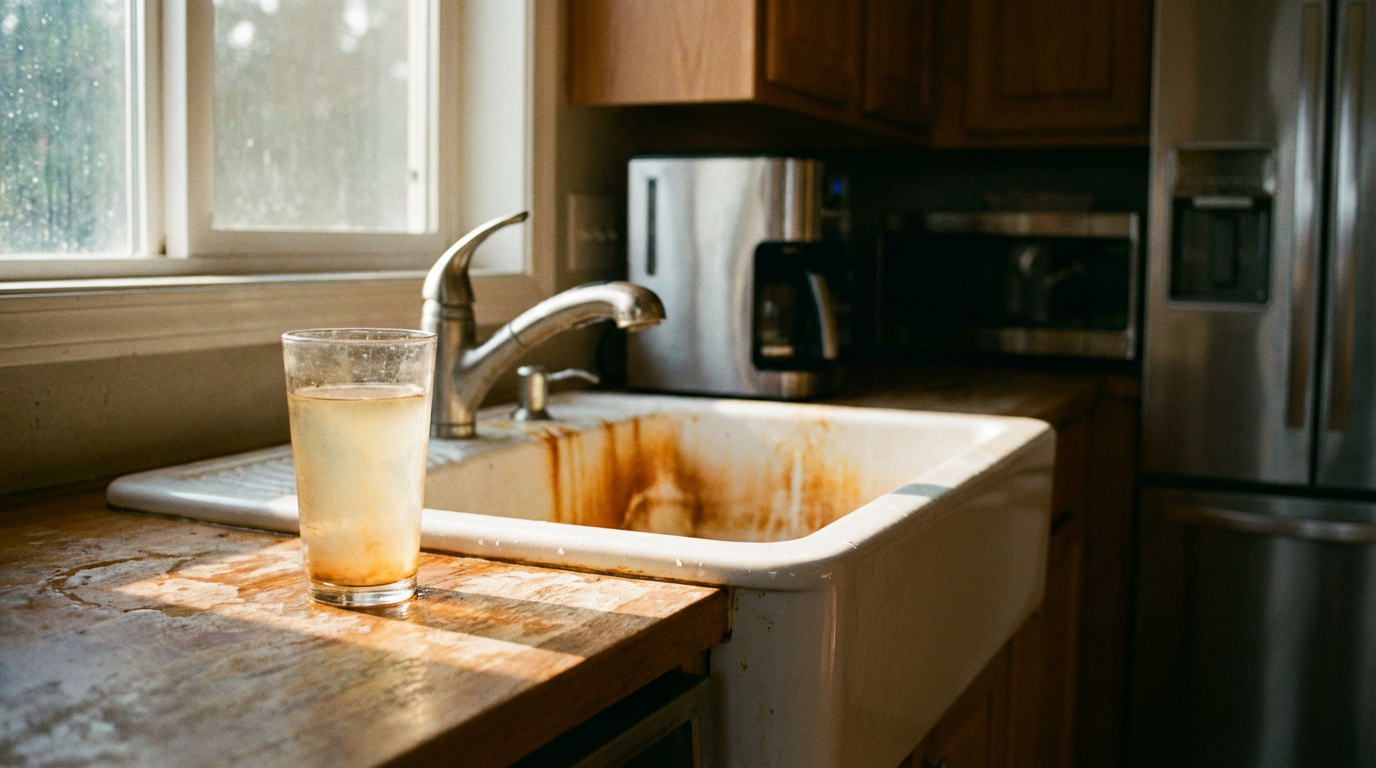
When you live in a rust-prone area, water is never “just water.” It is orange laundry, metallic-tasting coffee, stained fixtures, and a constant worry about what all that iron is doing to your pipes, appliances, and health. As a smart hydration specialist, I have walked into countless homes where families no longer trust their taps because every glass of water comes with a hint of rust.
The good news is that we know a lot about how rust behaves in water and how different filtration levels tackle it. The key is not buying the fanciest system you see in an ad, but matching filtration technology to your actual rust problem and to any other contaminants in your water.
In this guide, I will break down what “rusty water” really is, how testing should guide you, and how to think about filtration levels from simple sediment filters to advanced oxidation and reverse osmosis. Everything here is grounded in field experience and in science-backed information from water-quality organizations, treatment manufacturers, and independent testers.
What Rusty Water Really Is
The chemistry in plain language
Rust in water is essentially iron oxide. Iron dissolves from soil and rock into groundwater, or it flakes off corroding iron and steel pipes and well casings. When that iron reacts with oxygen, it forms rust particles that discolor water and stain anything they touch. Sources like American Home Water and SoftPro Water Systems note that this iron is usually more of an aesthetic and plumbing problem than an immediate toxin, but it can cause serious damage and may signal other contaminants.
Well water is especially vulnerable because it often travels through iron-rich geology and unlined steel components before it ever reaches your kitchen. Even homes on city water are not immune; aging municipal pipes can shed rust into the distribution system and into your plumbing.
Forms of iron you are dealing with
Understanding filtration levels starts with understanding which form of iron is actually in your water. Technical sources like Culligan and AquaClear describe three main forms, plus a fourth biological companion.
Ferrous iron is dissolved iron, often called “clear water iron.” Water can look clear as it leaves the faucet, but as ferrous iron meets oxygen in air, it oxidizes into rust. That is when your clear glass of water or freshly washed white shirt suddenly turns reddish-brown.
Ferric iron is already oxidized; it is essentially a rust particle suspended in water. This is sometimes called “red water iron” because the water itself is discolored right out of the tap, and you can often see visible flakes or cloudiness.
Organically complex iron is iron bound to organic matter in the water. This can give your water an orange, yellow, or brown tint that does not always look like classic rust streaks but still stains and tastes off.
Iron bacteria are microorganisms that feed on iron and create slimy, rust-colored films in toilets, tanks, and plumbing. They do not typically make people sick directly, but they make the aesthetic problems worse and can clog systems.
From a filtration standpoint, dissolved ferrous iron, oxidized ferric particles, and iron bacteria all behave differently. A cartridge that easily catches ferric particles may do very little for dissolved ferrous iron, and neither will reliably control iron bacteria without some type of disinfection.
Rust’s usual companions: manganese and sulfur
Iron rarely travels alone. Crystal Quest and other whole-house filter manufacturers point out that manganese is another naturally occurring metal in groundwater. Excess manganese can leave black specks or stains, contribute to bitter taste, and build up in water heaters and pressure tanks.
Hydrogen sulfide gas is another common partner in rust-prone wells, especially where dissolved oxygen and pH are low. It is what gives water the classic “rotten egg” odor. Crystal Quest notes that these same low-oxygen, low-pH conditions also dissolve iron and manganese, so you often see all three problems in the same well.
In a rust-water area, it is normal for a water test to show some combination of iron, manganese, and hydrogen sulfide rather than a single, isolated issue.

Nuisance vs health signal
American Home Water and SoftPro emphasize that iron oxide itself is usually considered a nuisance contaminant, not an acute poison. It discolors water, stains fixtures and laundry, causes metallic taste, and contributes to plumbing clogs and appliance failures. Long-term ingestion of very high iron levels can contribute to iron overload in rare cases, but the bigger concern is what rusty water might be hiding.
Well water with high iron often carries sediment, nitrate, nitrite, arsenic, and hydrogen sulfide, according to guidance summarized from Culligan and public health sources. Municipal water can carry “forever chemicals” such as PFAS, which organizations cited by Bevi describe as accumulating in the body and being linked to cancer and hormone disruption. In other words, if you see rust, you should not assume iron is the only issue.
How Rusty Water Shows Up In Daily Life
If you are in a rust-prone area, your home usually tells the story long before you read a lab report. American Home Water, Crystal Quest, Culligan, and SoftPro describe remarkably similar symptom sets.
You may see brown, red, or yellow water when you first run a tap or when hot water flows. Sinks, tubs, toilets, and even swimming pools can develop reddish or pinkish rings where water sits. Laundry that should be white comes out blotched with orange or yellow stains. Tea, coffee, and even potatoes may turn black, as noted by the Minnesota Department of Health and cited by Culligan.
The taste and smell are just as revealing. Many homeowners describe a metallic taste, sometimes joined by a rotten-egg odor when hydrogen sulfide is present. Appliances like dishwashers, washing machines, and water heaters may clog or lose performance. You might notice a steady drop in water pressure as iron deposits build up inside pipes and fixtures.
These aesthetic and functional issues are not trivial. American Home Water highlights that rust contamination can damage pipes and appliances, cause clogs, change water pressure, and even reduce home value. Addressing rust early is almost always cheaper than waiting for a major plumbing failure.

Testing: The Step Most People Skip
For all the attention we give to filters, the smartest money you will spend in a rust-water area is on testing. This is where I insist my clients start, whether they are in a rural farmhouse, a suburban home on a private well, or an older house on city water.
Culligan recommends that well owners test their water at least annually and whenever taste, odor, or staining changes. WaterFilterGuru stresses that private well users are effectively their own water utility; no agency is required to treat your water for you. American Home Water suggests both simple pH strips and professional testing when rust shows up.
A meaningful test looks at more than just “total iron.” In rust-prone regions, I look for:
Iron concentration in parts per million (ppm) or milligrams per liter (mg/L). Culligan notes that aesthetic and operational problems typically start above about 0.3 ppm of iron. AquaClear adds that standard water softeners cease to be a good option once iron exceeds about 8 ppm. Independent testing summarized by WaterFilterGuru reviews systems that treat up to 20 or even 30 ppm iron, which counts as very high.
Form of iron. Is it mostly dissolved ferrous iron, oxidized ferric particles, or a mix, possibly with iron bacteria present? That determines whether you need oxidation first, what media will work, and where sediment filters fit.
pH and hardness. American Home Water points out that acidic water accelerates corrosion, which means more rust from pipes and well casings. The Minnesota Department of Health notes that pH also affects how well softeners and media filters work. Hardness is important because many rust-control strategies are combined with water softening.
Co‑contaminants. In rust-prone wells, manganese and hydrogen sulfide are common. Culligan mentions that well water may also contain nitrate, nitrite, and arsenic. Bevi’s overview of filtration technologies adds that municipal water systems can still contain chlorine, chloramines, pesticides, VOCs, microplastics, and PFAS even when they meet older regulatory standards.
A basic home kit can give you a rough sense of iron, pH, and hardness, but if your water is heavily discolored, has strong odors, or stains everything it touches, it is wise to send a sample to a certified lab and work with a local water professional. That is also what manufacturers like Aquasana and Crystal Quest recommend when they help homeowners select whole-house systems.
When I talk about “mild,” “moderate,” or “severe” rust in this article, I am thinking in terms of that continuum: problems starting just above 0.3 ppm, softeners working up to a few ppm, manufacturer guidance suggesting other technologies above about 8 ppm, and high-end systems designed for 20–30 ppm. Your exact numbers will guide which filtration level makes sense.

Filtration Levels: Building A Layered Defense
Rusty water is rarely fixed with a single magic cartridge. The most reliable solutions use layers of filtration, each doing a specific job. Think of this as filtration levels rather than individual products.
To keep this clear, I will walk through the major levels from first-line defenses to high-end treatment, and then show how they fit together.
Level 1: Sediment pre-filtration
Sediment filters are the workhorses that take the first beating in a rusty system. Bevi and Aquasana describe these as simple mechanical filters that catch sand, silt, rust flakes, and debris before they reach finer stages like activated carbon or reverse osmosis.
In homes with rusty water from old pipes or wells, a whole-house sediment filter at the point of entry is almost non-negotiable. One example is a pleated, washable filter cartridge in a transparent housing with 1‑inch ports, as seen in well-water sediment systems sold through major retailers. The transparent housing lets you see the buildup and decide when to clean or change the cartridge.
Sediment filters are also used as pre-filters before under-sink systems and irrigation filters. SoftPro Water Systems describes these filters as the “bouncer” that removes larger rust particles and dirt so that finer filters and membranes are not overwhelmed. Typical costs for sediment housings and cartridges are in the tens of dollars rather than hundreds, according to SoftPro, which is why they are such a cost-effective first step.
The strengths of sediment filters are clear. They are inexpensive, simple, and essential for protecting downstream equipment. Their limitations are just as important: they do not remove dissolved ferrous iron, chemicals, or microbes. As Bevi notes, sediment filtration on its own does nothing for dissolved contaminants or bacteria. In a rust-heavy area, sediment pre-filtration is necessary but never sufficient.
Level 2: Iron-specific filters and media tanks
When iron is your primary problem and it shows up as visible rust or moderate dissolved iron, iron-specific filters become the next level. American Home Water describes iron and rust filters that work alongside softeners using ion-exchange resin, often in cartridge form. These cartridges typically need replacement every three to six months, especially in rusty areas.
For whole-house treatment, media tanks filled with specialized media are common. Crystal Quest uses a naturally mined manganese dioxide ore that has been used for more than 75 years to reduce hydrogen sulfide, iron, and manganese. The media acts as a catalyst that oxidizes these contaminants and traps them on its surface. Simple backwashing flushes the trapped rust and sulfur out of the system without chemical regeneration, and nothing is added to the treated water.
Independent tests summarized by WaterFilterGuru highlight systems that combine air injection with greensand or catalytic media to oxidize and filter iron, manganese, and hydrogen sulfide. In one case, an air-injection greensand system reduced iron from 2.37 mg/L to 0 in a well, eliminated metallic taste and rotten-egg odor, and maintained whole-house flows in the 10 gallon per minute range. Media lifetimes in these systems can range from roughly 10 to 25 years, with only a small sediment pre-filter needing replacement every six to nine months.
SoftPro’s overview notes that whole-house iron filters typically cost in the mid-hundreds of dollars, which is significantly less than the multi-thousand-dollar systems sometimes marketed to frustrated homeowners. The key is matching media to your contaminant mix rather than buying a generic “one size fits all” package.
Iron-specific media filters shine when you have moderate to high iron and, often, manganese and sulfur, but relatively normal levels of other chemical contaminants. They require more upfront investment and plumbing work than simple cartridges, but they protect your entire plumbing system and dramatically reduce staining.
Level 3: Water softeners with iron removal capability
Water softeners are designed primarily to remove hardness minerals like calcium and magnesium. However, multiple sources, including AquaClear and Culligan, note that some softeners are engineered to also remove a portion of dissolved ferrous iron.
For mild iron levels, a softener can provide a lot of benefit at relatively low cost. AquaClear describes softeners as a “common first step” that are relatively affordable and effective when iron concentrations are modest. Culligan, citing public health guidance, notes that certain softeners can help when ferrous iron is roughly in the 2 to 5 mg/L range.
There is a clear ceiling, though. AquaClear warns that standard water softeners are not recommended when iron exceeds about 8 ppm because the resin can foul quickly, performance becomes unreliable, and maintenance costs increase. In rust-heavy areas with higher iron, relying on a softener alone leads to chronic problems.
Softeners also have blind spots. They are not designed to remove ferric rust particles, iron bacteria, hydrogen sulfide, or complex organic contaminants. They use salt or other regenerants and discharge brine, which may be restricted in some regions. For many of my clients in mild-rust, hard-water areas, a softener combined with a basic iron filter cartridge and sediment pre-filter is a good starting level. In more severe cases, the softener becomes a supporting actor behind iron-specific media or oxidation systems.
Level 4: Oxidation plus filtration for serious rust
When iron is high or when iron mixes with hydrogen sulfide and manganese, you need to step up to oxidation-based systems. These systems convert dissolved ferrous iron into filterable ferric rust and often disinfect iron-feeding bacteria at the same time.
Several technologies fall into this level.
Air injection oxidation systems create a pocket of air at the top of a tank. As AquaClear and WaterFilterGuru explain, water passes through this air pocket, and the oxygen oxidizes dissolved iron, manganese, and hydrogen sulfide. The resulting particles are captured by media such as greensand or katalox. Automatic backwashing clears the buildup. These systems are marketed as chemical-free because they rely on air rather than added oxidizing chemicals, and they can also reduce metals like lead or manganese in some designs.
Hydrogen peroxide injection systems use a selective oxidizing action. AquaClear notes that they can handle high iron concentrations, cited up to about 20 ppm, and effectively address iron bacteria and hydrogen sulfide odor. WaterFilterGuru describes one peroxide-based system that treats up to 30 ppm hydrogen sulfide and 20 ppm iron and uses catalytic activated carbon to both capture oxidized contaminants and break down residual peroxide. These systems are powerful but more complex and more expensive than air injection. They require ongoing peroxide dosing and periodic media replacement, often every three to five years, with annual chemical and media costs in the low hundreds of dollars.
Chlorine injection systems are another oxidation option. American Home Water points out that chlorine-based systems are effective for many contaminants but operate well only within a narrower pH range than peroxide. In a typical configuration described in homeowner forums and manufacturer literature, chlorine is injected ahead of a retention tank, which gives the chlorine time to oxidize iron and disinfect water. A downstream carbon filter then removes chlorine taste and odor and captures oxidized particles. Chlorine systems are often less expensive upfront than peroxide systems but may be less flexible if your pH or contaminant mix is challenging.
Catalytic media like manganese dioxide, as used by Crystal Quest, can be combined with any of these oxidants. Manganese dioxide media accelerates the oxidation of iron, manganese, and hydrogen sulfide and then traps them. Oxidants such as chlorine, ozone, or aeration speed up the reactions, and simple backwashing removes the captured contaminants without chemical regeneration.
This oxidation-plus-filtration level is ideal for wells with high iron, rotten-egg odor, and manganese staining. It is also where thoughtful design really matters, because you must coordinate oxidant dose, contact time, media type, and backwash rates for your flow and contaminant levels.
Level 5: Reverse osmosis and polishing for drinking water
Reverse osmosis (RO) is not the right first-line tool for heavy rust, but it is arguably the gold standard for polishing drinking water after you control the bulk of your iron at the whole-house level.
Bevi describes RO as a process that forces water through a semipermeable membrane, removing roughly 95 to 99 percent of dissolved solids, including salts, nitrates, and fluoride, as well as many heavy metals like arsenic, lead, and chromium and many microorganisms. Aquaphor emphasizes that large bottled-water manufacturers rely on RO because it can remove contaminants that are difficult to separate by other means, including pesticides, nitrates, nitrites, and microbiological impurities.
For a home in a rust-prone area, RO’s role is to produce very high-purity water at one or a few taps for drinking and cooking, not to handle all of the iron for the entire house. Culligan cautions that too much iron in the feed water can plug RO membranes; that is why RO is often installed after whole-house filtration or at least after sediment and carbon pre-filters. A typical RO system includes a sediment pre-filter, activated carbon stage, the RO membrane, and a post-filter. Quality systems often remineralize the water after deep purification to improve taste.
Bevi also highlights trade-offs. Some RO systems waste several gallons of water for every gallon of purified water produced, and they remove beneficial minerals as well as unwanted ones. Upfront and maintenance costs are higher than for basic filter pitchers or single-stage under-sink filters. However, RO is a strong choice when you want a final barrier for dissolved contaminants beyond iron, such as nitrates, PFAS, or trace pesticides.
In practice, many homeowners in rust areas end up with a layered approach that includes a whole-house iron system plus an under-sink RO system for drinking water.

That aligns with user experiences shared in homeowner communities, where people report that combining whole-house filtration, dual cartridge filters, and RO virtually eliminated scale and improved taste.
Level 6: Disinfection and specialized technologies
Rust-heavy water is often microbiologically safe, but not always. Ultraviolet (UV) purification and some emerging industrial technologies sit at this top level.
UV disinfection uses high-frequency ultraviolet light to inactivate microorganisms such as bacteria, viruses, and protozoa. Bevi and Aquasana both describe UV as a final disinfection step that must follow other filtration: the water needs to be clear of sediment and color for UV light to penetrate effectively. UV does not remove rust, iron, or chemicals, and it requires a reliable power source, but it adds a strong layer of microbial safety, particularly for wells.
Electromagnetic filtration (EMF) is another specialized technique, mainly used in industrial settings. According to research published in engineering journals, EMF passes water through a packed bed of magnetizable elements like steel balls that are magnetized by an external magnetic field. This creates high-gradient local fields that capture micro- and nano-sized magnetic particles, including corrosion products. The process requires no added reagents, the filters are easily cleaned, and it can be economical for recirculating systems in mining, power, and similar industries.
Researchers have successfully modeled EMF efficiency using least squares support vector machine (LS-SVM) algorithms, achieving very high accuracy in predicting how changes in magnetic field, flow velocity, and filter geometry affect rust removal. While this technology is not commonly applied in residential systems today, it is part of the broader science that may influence future point-of-use or small-system designs for corrosion products.
UV and EMF do not replace the earlier filtration levels; they complement them. UV belongs at the end of a treatment train where rust and sediment have already been addressed. EMF sits more in the industrial design space, but it reinforces the principle that understanding particle behavior leads to smarter filtration.
Comparing Common Technologies In Rust-Water Areas
To orient all of these levels, it helps to see them side by side.
Filtration level |
Main technology |
Role in rust control |
Also helps with |
Key limitations in rusty areas |
Basic pre-filtration |
Sediment cartridges or housings |
Capture visible rust flakes, sand, and silt to protect downstream equipment |
General debris, turbidity |
Do not remove dissolved iron, chemicals, or microbes; cartridges often need replacement every 3–6 months |
Iron-specific media |
Manganese dioxide, greensand, catalytic media tanks |
Oxidize and filter dissolved and particulate iron and manganese, often plus hydrogen sulfide |
Rotten-egg odor, some taste issues |
Require correct sizing, backwashing, and sometimes upstream oxidation; higher upfront cost than simple cartridges |
Water softeners |
Ion-exchange systems with iron-handling resin |
Remove hardness and some dissolved ferrous iron at low to moderate levels |
Scale reduction in appliances and plumbing |
Not reliable above roughly 8 ppm iron; do not handle ferric particles or hydrogen sulfide; require salt and maintenance |
Oxidation systems |
Air injection, hydrogen peroxide, chlorine injection |
Convert dissolved iron to filterable rust, tackle iron bacteria and hydrogen sulfide |
Manganese reduction, disinfection (peroxide and chlorine) |
More complex plumbing and controls; peroxide and chlorine require chemical handling and ongoing cost |
Point-of-use polishing |
Reverse osmosis under-sink systems |
Remove residual iron particles and a wide spectrum of dissolved contaminants at a drinking tap |
Nitrates, PFAS, heavy metals, many microbes |
Not suitable as primary treatment for high iron; can waste water; removes beneficial minerals |
Disinfection |
UV light |
Inactivate bacteria, viruses, and protozoa after other filtration |
Microbial safety, especially for wells |
Does not remove rust, iron, or chemicals; needs clear water and reliable power |
Matching Filtration Levels To Your Situation
Once you have testing results and a sense of your rust pattern, you can decide which filtration level or combination makes sense.
If your iron is just above the 0.3 ppm aesthetic threshold and shows mainly as light staining and a faint metallic taste, a well-designed Level 1 and Level 2 combination can work very well. That might look like a whole-house sediment filter followed by an iron-specific cartridge and, if hardness is also high, a softener designed to handle modest iron. AquaClear and Culligan both note that softeners can play a useful role in this mild range, especially when paired with iron filters.
If you see strongly discolored water at the tap, heavy staining, and persistent rotten-egg odor, your test results will often show higher iron together with manganese and hydrogen sulfide. In that case, Level 4 oxidation plus filtration is almost always necessary. Independent comparisons at WaterFilterGuru show air injection systems combined with greensand or katalox media treating up to about 7 ppm iron, 8 ppm hydrogen sulfide, and 1 ppm manganese, while peroxide-based systems are designed for up to 20 ppm iron and 30 ppm hydrogen sulfide and help with iron bacteria. These are the situations where air injection or peroxide becomes the backbone of the system, not an optional add-on.
If your family cares deeply about taste, wants to minimize bottled water, or needs extra protection from nitrates, PFAS, or other emerging contaminants, Level 5 reverse osmosis at the kitchen tap is worth serious consideration. Bevi notes that advanced carbon filters and RO can remove chlorine, VOCs, pesticides, microplastics, and many microorganisms, dramatically improving taste and safety. Many of my clients in rust-heavy areas end up with a whole-house iron system and an under-sink RO unit for one or two taps, which is far more cost-effective than trying to run RO for the entire home.
If you also have microbial risk, such as a shallow well or a history of coliform bacteria, adding UV after the main filters is an appropriate Level 6 step. Aquasana’s well-water packages, for example, combine sediment filtration, activated carbon, copper-zinc media, and UV to address both chemical and microbial safety.
For irrigation-only rust, such as rusty well water that stains sidewalks, driveways, or greenhouse plastic, you may not need a full softener. Dedicated irrigation filters like the Terminox line are designed to remove iron, sulfur, manganese, and sediment from sprinkler water. They are chemical-free, salt-free, and marketed as nearly maintenance-free, with typical lifespans on the order of a few decades. A separate irrigation filter can protect your landscape and structures without affecting indoor drinking-water treatment.
Finally, do not forget the plumbing itself. Discussions among installers and homeowners show that if most of your rust is coming from old iron pipes, replacing those lines and adding a robust sediment pre-filter before a point-of-use RO system can be more effective than oversizing treatment for a relatively clean source water.
Practical Maintenance In Rust-Prone Areas
Rust-heavy water is tough on filters, so maintenance is not optional. Overused filters can become bacterial reservoirs or release trapped contaminants, as Bevi warns, so ignoring replacement schedules is counterproductive.
Cartridge filters, whether sediment or carbon, generally need replacing every three to six months in normal conditions. In severe rust conditions, the interval can be shorter. Transparent housings for sediment filters help you see when buildup is excessive, especially if you are using pleated washable cartridges.
Backwashing media systems, such as manganese dioxide or air-injection iron filters, rely on an automatic control valve to periodically flush out accumulated rust and regenerate the media surface. WaterFilterGuru’s testing notes that with properly sized systems, media lifespans can reach 10 to 25 years, with only routine backwashing and simple pre-filter changes every six to nine months.
Oxidation systems with chemicals, such as hydrogen peroxide or chlorine injection, need regular chemical replenishment and occasional injector cleaning. One peroxide-based system reviewed by WaterFilterGuru had estimated ongoing maintenance costs of a few hundred dollars per year for peroxide and media replacement every three to five years.
SoftPro suggests a practical maintenance rhythm: inspect plumbing monthly for early signs of corrosion or leaks, service water softeners roughly every six months, check air-injection systems annually, and replace cartridges on schedule. This kind of proactive schedule is what keeps iron from sneaking back and causing a new wave of stains.
From a hydration perspective, I also advise people to pay attention to taste and odor as a real-time early warning. If your water suddenly smells metallic again, shows orange streaks, or your RO water tastes flat or off, that is your cue to inspect filters and call your water professional, not to wait until the next calendar reminder.
FAQ: Common Questions In Rust-Water Areas
Is rusty water safe to drink?
Most technical sources, including American Home Water and SoftPro Water Systems, describe iron oxide in typical well-water concentrations as more of an aesthetic problem than a direct health hazard. It is certainly unpleasant, and it can ruin laundry and fixtures, but it is not treated like lead or arsenic.
However, rusty water can indicate that pipes are corroding or that your well is under chemical and microbial stress. Wells with high iron often also contain manganese, hydrogen sulfide, nitrate, nitrite, or arsenic, and municipal systems can carry PFAS and other emerging contaminants that regulations are only now catching up to. Because of that, I never recommend ignoring rusty water; I recommend testing broadly and then tailoring filtration so you can drink confidently from your tap.
Do I still need reverse osmosis if I install a whole-house iron filter?
Not everyone needs reverse osmosis, but many households in rust-prone areas benefit from it. Whole-house iron systems, manganese dioxide media, and air-injection filters are excellent at removing iron, manganese, and hydrogen sulfide, protecting plumbing and eliminating stains. They may not fully address dissolved salts, nitrate, PFAS, or some organic chemicals.
RO, as Bevi and Aquaphor explain, is designed to remove about 95–99 percent of dissolved solids and a wide range of contaminants, including many heavy metals, nitrates, nitrites, and microorganisms. For families who want bottled-water quality at the tap, an under-sink RO system after whole-house filtration is a strong choice. If your testing does not show elevated dissolved contaminants beyond iron and manganese, a high-performance carbon filter alone may be sufficient, especially if you choose advanced carbon rated to very fine particle sizes.
Should I choose a “chemical-free” air injection system or a peroxide or chlorine system?
Both approaches have their place. Air injection systems use oxygen from air to oxidize iron, manganese, and hydrogen sulfide. AquaClear and WaterFilterGuru describe them as ideal for homeowners who want to avoid chemical additives. They can be very effective for moderate iron and sulfur problems and are often simpler to maintain, since they rely on air and automatic backwashing.
Hydrogen peroxide and chlorine systems add chemicals, but they also expand the treatment envelope. Peroxide can handle higher iron and hydrogen sulfide levels and helps control iron bacteria. Chlorine offers strong disinfection and works well when pH and contact time are properly managed. American Home Water points out that peroxide works over a wider pH range than chlorine, but peroxide systems usually cost more and require more operator attention.
In practice, the right choice depends on your water chemistry, your tolerance for chemical handling, and your budget. That is why manufacturers like Crystal Quest and Aquasana and independent reviewers emphasize working with a local water professional who can interpret your lab report and size equipment correctly.
Closing
If you live in a rust-water area, you do not have to choose between stained fixtures and endless bottled water. With good testing and a clear understanding of filtration levels—from simple sediment filters to iron-specific media, oxidation systems, and reverse osmosis—you can build a system that matches your geology, your plumbing, and your hydration goals. The goal is not just clear water in the glass, but a home where every tap supports confident, everyday hydration.
References
- https://www.academia.edu/124368202/Evaluation_of_Electromagnetic_Filtration_Efficiency_Using_Least_Squares_Support_Vector_Model
- https://aquaphor.com/iron-removal-filters
- https://americanhomewater.com/effective-ways-on-how-to-get-rid-of-rust-in-your-well/
- https://www.aquasana.com/whole-house-water-filters/?srsltid=AfmBOor50NsRtPTtLzRibwHGeb1FSHI3-OicMpz_MdTorEGUbrOb3fag
- https://crystalquest.com/collections/iron-manganese-and-hydrogen-sulfide-removal?srsltid=AfmBOoqArY-0ZrE5UGZGWeV4fnhZYXy0akBivrf8VDLXeb9TnKWulfMi
- https://www.culligan.com/blog/a-guide-to-finding-the-right-iron-filter-for-well-water
- https://www.justanswer.com/plumbing/j4ndi-clean-rust-water-pipes-house.html
- https://mamavation.com/health/best-home-water-filters-toxic-pfas-forever-chemical-filtration.html
- https://waterfilterguru.com/best-whole-house-water-filter-for-well-water/
- https://waterfiltersofamerica.com/irrigation-water-filter-systems/?srsltid=AfmBOoqruQM0vAEOcGAuWj-2F-817qEhFXEahGTVgfq9UbZBTMecejlW

Share:
Maintenance Frequency for RO Systems in Dust Storm Areas
Wastewater Reduction Techniques Using Concentrated Water Circulation Technology