

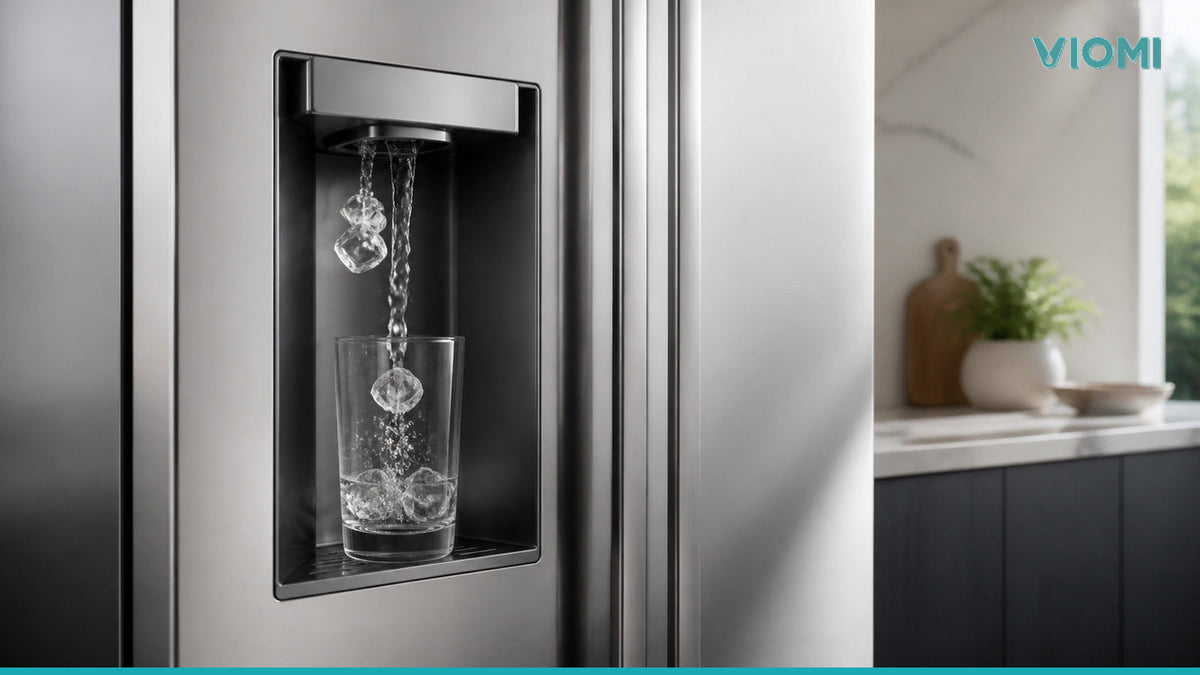
A household that wants one system to filter both the kitchen faucet and the refrigerator's dispenser and ice maker should look at a Multi-Device-rated RO system. Viomi offers four models built for exactly that job, each shipping with the tee fitting needed to split filtered water between the two. A household that only wants cleaner water and ice from the fridge's own dispenser, without opening the cabinet under the sink, is better served by an OEM cartridge matched to that specific refrigerator, such as EveryDrop or GE. These two paths solve different problems: expecting an OEM cartridge to help the kitchen faucet, or a faucet-only RO system to feed a fridge, is the most common reason people end up disappointed with either one.
Two Ways to Get Filtered Water to a Fridge or Ice Maker
Option 1: A cartridge that snaps into the refrigerator itself. Every major refrigerator brand sells (or licenses) a filter cartridge sized to fit inside that specific fridge, usually behind a grille at the top of the interior or in the base. Water for the dispenser and ice maker runs through it before reaching the spout. This filters only what comes out of that dispenser. The kitchen faucet is untouched.
Option 2: An under-sink filter or RO system with a second output line. A tee fitting splits the purified-water line from an under-sink carbon or reverse osmosis system, sending one branch to the kitchen faucet and another, run through separate tubing, to the refrigerator's water inlet valve. One system, two destinations. This only works with models the manufacturer has actually built and rated for it. Plenty of under-sink systems, including some of Viomi's own, are faucet-only and explicitly can't be connected to a fridge or ice maker.
The rest of this guide covers both paths: the OEM cartridge brands for Option 1, and which specific models support Option 2.
OEM Refrigerator Filter Brands: What They Cover
These are the cartridges made for (or licensed to work with) a specific refrigerator model:
- EveryDrop (Whirlpool) covers Whirlpool, Maytag, KitchenAid, JennAir, and Amana refrigerators. It's one of the most widely available OEM lines in the U.S., with different filter numbers for different door styles and ice-maker types.
- GE has used several own-brand cartridges across different refrigerator models, including MWF, XWFE, and RPWFE, matched to specific GE, GE Profile, Café, or Monogram models. GE's filter finder tool on its own site is the reliable way to confirm which one a specific model currently takes, since GE's own lineup changes over time.
- Samsung's HAF-CIN/EXP filter carries replacement code DA29-00020B; other Samsung refrigerator families use different filter models, so it's worth matching the exact code rather than the brand name alone.
- LG uses LT700P and LT1000P, with the latter appearing on newer InstaView and door-in-door models.
- Frigidaire uses PureSource and PureSource Ultra cartridges, including the ULTRAWF number, matched to specific Frigidaire refrigerator models.
Aftermarket brands like Waterdrop, IcePure, and Swift Green sell cartridges built to fit the same housings as the names above, usually at a lower price. Compatibility and certification vary by specific part number, so that's worth confirming against the exact refrigerator model before buying rather than assuming a "compatible with" label covers everything the OEM version does.
What These Cartridges Actually Do (and Don't Do)
Nearly all of these are carbon-based cartridges, not reverse osmosis. That distinction matters for what to expect:
- They're commonly certified to NSF/ANSI 42 (chlorine taste and odor), and better models add NSF/ANSI 53 (health-related contaminants like lead and cysts) or, on a smaller number of models, NSF/ANSI 401 (a broader list that can include some pharmaceuticals). The exact certification list is specific to each part number, not the brand as a whole, so it's worth checking the individual cartridge's own documentation rather than assuming every filter from a given brand carries the same certification.
- Rated capacity is typically in the 200 to 300 gallon range, which usually works out to a replacement every 3 to 6 months in an average household.
- Standard carbon filtration isn't designed to meaningfully reduce total dissolved solids or water hardness, so it won't stop limescale from building up inside the ice maker or dispenser over time in a hard-water home.
- It only filters water headed to the dispenser and ice maker. The kitchen faucet, and anything filled from it, stays exactly as filtered (or unfiltered) as it was before.
- The cartridge is proprietary to the housing it fits. Switching refrigerator brands generally means switching filter brands too.
None of that makes OEM fridge filters a bad choice. For a household that only cares about the water and ice coming out of the fridge door, and isn't trying to solve for lead, PFAS, or hardness across the whole kitchen, a properly matched OEM or verified-compatible cartridge does the job it's built for.

The Alternative: One System That Feeds Both the Faucet and the Fridge
Households looking for TDS reduction, broader lead or PFAS coverage than the exact fridge cartridge is certified to provide, or a single filter budget instead of two separate ones, can look at an under-sink system engineered to split its output between the kitchen faucet and a second appliance line.
This isn't a universal feature of under-sink filtration. It has to be built into the specific model, usually as a "Multi-Device Mode" or similarly named setting. The system also needs a tee fitting sized to split the purified-water line without dropping pressure too far for the ice maker to fill properly.
In practice, that means checking three things before buying a system for this purpose:
- A manufacturer-stated secondary-appliance or dual-output setting, not just a generic RO system that happens to have a tee-able line.
- A tee fitting either included in the box or clearly sold as a compatible accessory.
- Enough rated flow to cover the kitchen faucet and the fridge without one starving the other.
Viomi is one brand that builds this in on part of its lineup. Among Viomi's own models, four are built and rated for it: the Viomi M1, Viomi B6W, Viomi V6 PRO, and Viomi V8 PRO. Each of these four ships with the tee fitting needed to make the split.
Two other Viomi models, the plain Viomi V6 and Viomi V8 (without "PRO"), don't support this at all. Their own product pages state plainly that they're built to work only with the faucet in the box. Neither can be connected to a refrigerator or ice maker. More on that distinction below.
Standalone under-sink systems from other brands can often be adapted to feed a fridge too, but only when the manufacturer permits a second output line, and usually by buying a separate connection kit. iSpring's ICEK kit and Waterdrop's KITA/KITB kits, for example, bundle the tee, tubing, a shutoff valve, and fittings for roughly $15 to $30, depending on the specific kit and retailer, sold apart from the filtration system itself.
With the four Viomi models above, the tee ships in the box. Getting the fridge connected mostly comes down to running ordinary 1/4-inch tubing (a few dollars at any hardware store) from that tee to the refrigerator's water inlet valve. That's straightforward when the sink and the refrigerator share the same run of cabinets.
When they don't, the tubing usually has to be routed along the back of the base cabinets, through a wall, or under a floor to get from one to the other. It's worth walking that path and measuring it before buying, rather than assuming a straight shot. A kitchen with an unusual layout, tile flooring, or finished walls in the way is a reasonable case for bringing in a plumber to route the line rather than doing it as a weekend DIY project.
Which Viomi Models Support a Refrigerator or Ice-Maker Connection
| Model | Refrigerator/Ice-Maker Support | Regular Price | Nominal Output |
|---|---|---|---|
| Viomi M1 | Yes, with Multi-Device Mode | $799.99 | 1000 GPD |
| Viomi V8 PRO | Yes, with Multi-Device Mode | $479.99 | 800 GPD |
| Viomi V6 PRO | Yes, with Multi-Device Mode | $379.99 | 600 GPD |
| Viomi B6W | Yes, with Multi-Device Mode | $249.99 | 600 GPD |
| Viomi V8 | No | $399.99 | 800 GPD |
| Viomi V6 | No | $339.99 | 600 GPD |
Prices reflect Viomi's regular (non-promotional) listed pricing as of this writing; check water.viomi.com for current pricing before buying.
How Multi-Device Mode Actually Works
The general approach is the same across all four supported models. Toggle on Multi-Device Mode in the Viomi app, then run tubing from the included tee to the refrigerator's water line.
On the Viomi V6 PRO and Viomi V8 PRO, that setting currently sits under Settings, then Water Dispenser, then Multi-Device. App menus change over time, so it's worth confirming the exact path in the current app rather than assuming it hasn't moved. Viomi B6W setup material doesn't walk through the same menu path in detail. It's worth confirming Multi-Device steps with Viomi support or the app itself before installing.
One practical limit is worth planning around before buying. Purified water leaves an RO system at lower pressure than the incoming cold-water line. That means vertical rise and total tubing length are both limited, and beyond those limits, the appliance may not fill properly. Confirm the exact figures with Viomi support or the installation guide included with your unit before committing to a layout.
A refrigerator on the far side of the kitchen, or one story up from an under-sink install in a basement, is the kind of layout most likely to run into that limit. It's worth measuring the actual run before assuming any of these four models will reach.
The other thing worth checking before buying, especially on a stone or solid-surface countertop that isn't easy to drill, is the smart faucet itself. All four supported models call for a 1 to 1.5 inch hole for that faucet, per their own product pages. A countertop that already has a hole in that range, left over from a soap dispenser or a previous water filter, may be reusable. A countertop without one will need a new hole drilled or cut before installation.
Viomi M1: Highest Output, With a Smart Display
The Viomi M1 is Viomi's largest under-sink system, rated at 1000 GPD with a maximum flow rate of roughly 84.5 to 89 ounces per minute at the faucet. It runs 9-stage filtration through a 0.0001-micron RO membrane, and it's the model to reach for when the goal is covering a kitchen faucet and a refrigerator from a single high-capacity unit rather than choosing between them.
- Certifications: NSF/ANSI 58 (TDS reduction), NSF/ANSI 42 (chlorine, taste, and odor), and NSF/ANSI 372 (lead-free material construction).
- Filter life: RO membrane rated for up to 4 years, PCB prefilter for up to 2 years, both longer replacement intervals than the smaller Viomi V6 PRO and Viomi V8 PRO models below.
- Remineralization and display: Reintroduces selected naturally sourced minerals for taste after filtration, with a touchscreen faucet that displays incoming and outgoing TDS in real time.
The tradeoff for that capacity is footprint and price. The Viomi M1 measures 17.1 x 6.4 x 15.9 inches, with about 2.0 to 3.9 inches of rear clearance needed for its tubing connections and a standard outlet. A dedicated constant-power outlet is only needed if a garbage disposer's switched outlet would otherwise be shared. Regular price is $799.99.
It also needs municipal tap water. Viomi doesn't recommend connecting it directly to an untreated well.

Viomi V8 PRO and Viomi V6 PRO: Mid-Range Multi-Device Options
The Viomi V8 PRO and Viomi V6 PRO sit below the Viomi M1 in output and price, but carry the same Multi-Device Mode support and, unlike the Viomi M1, add an NSF/ANSI 53 certification for lead reduction.
- Viomi V8 PRO ($479.99): 800 GPD, maximum flow rate of 71 ounces per minute, ships with an extra PCB prefilter in the box.
- Viomi V6 PRO ($379.99): 600 GPD, maximum flow rate of 53 ounces per minute.
- Shared specs: Both are certified to NSF/ANSI 42, 53, 58, and 372. Both measure a compact 16.3 x 5 x 12.8 inches. Both use an RO membrane rated for up to 2 years alongside a PCB prefilter rated for up to 1 year. Both have shorter stated filter intervals than the Viomi M1, and both have lower listed purchase prices.
Between the two, the practical difference for a household connecting a fridge is how much simultaneous draw the system needs to support. The Viomi V8 PRO's higher rated flow leaves more headroom, on paper, for the ice maker to refill without the kitchen faucet noticeably slowing down if both draw at once. Real-world simultaneous-draw performance also depends on household water pressure and how the tubing run is installed, not the rated flow number alone. That matters more in larger households or kitchens with a high-draw dispenser.

Viomi's own installation footage also shows the Viomi V8 PRO's NSF/ANSI 53 lead certification called out directly at the under-sink install, alongside the PCB and RO filter housing:

Viomi B6W: The Lower-Cost Entry Point
The Viomi B6W is Viomi's most compact and least expensive RO system that still supports Multi-Device Mode. It's rated at 600 GPD and priced at $249.99 (regular price), and it's certified to NSF/ANSI 42, 53, 58, and 372.
At 12.6 x 5.9 x 16.2 inches, it's shallower front-to-back than the Viomi V6 PRO and Viomi V8 PRO, though slightly wider and taller. That can matter depending on how a specific cabinet is laid out.
Its PPC prefilter is rated for up to 12 months, and its RO membrane for up to 24 months. That matches the Viomi V6 PRO and Viomi V8 PRO's stated maximum filter intervals, despite the Viomi B6W's lower price and its position as the entry point of Viomi's RO lineup rather than its flagship.
Viomi recommends municipal water for the Viomi B6W and permits well water only after adequate multistage pretreatment based on a water test. It isn't a system to connect directly to an untreated well.
For a household mainly deciding between "fridge filter cartridge only" and "one small RO system covering the faucet and the fridge," the Viomi B6W is the lowest-cost way into that second option.
Why Viomi's Plain Viomi V6 and Viomi V8 Don't Work for This
Viomi's V6 and Viomi V8 (without "PRO" in the name) require their own supplied wired faucet. The PRO faucets add smart-display features, like real-time TDS and filter-life readouts, that the Viomi V6/Viomi V8 faucets lack. More to the point here, the plain Viomi V6 and Viomi V8 aren't rated for a second output line.
Both product pages state it directly. The systems are designed to work exclusively with the faucet in the box, and can't be connected to another faucet, a refrigerator, or an ice maker.
At $339.99 for the Viomi V6 and $399.99 for the Viomi V8, both regular prices, they're positioned for a household that only wants filtered water at the kitchen tap and has no plan to route it anywhere else. If a refrigerator or ice-maker connection is part of the plan, even a future one, the PRO versions or the Viomi B6W are the models built for it.
Cost to Keep Running: OEM Cartridge vs. a Multi-Device RO System
The two approaches land in different places on ongoing cost, mostly because they're solving different-sized problems.
| Approach | Filter Cost and Replacement Interval | Approx. Annual Filter Cost | What It Covers |
|---|---|---|---|
| OEM refrigerator cartridge (EveryDrop, GE, Samsung, LG, Frigidaire) | Roughly $40 to $60 per cartridge, replaced every 3 to 6 months | Roughly $80 to $240 | Fridge dispenser and ice maker only |
| Viomi B6W (Multi-Device) | PPC prefilter, $49.99 every 12 months; RO membrane, $69.99 every 24 months | Roughly $85 | Kitchen faucet and fridge/ice maker from one system |
| Viomi V6 PRO (Multi-Device) | PCB prefilter, $59.99 every 12 months; RO membrane, $89.99 every 24 months | Roughly $105 | Kitchen faucet and fridge/ice maker from one system |
| Viomi V8 PRO (Multi-Device) | PCB prefilter, $59.99 every 12 months; RO membrane, $99.99 every 24 months | Roughly $110 | Kitchen faucet and fridge/ice maker from one system |
| Viomi M1 (Multi-Device) | PCB prefilter, $99.99 every 24 months; RO membrane, $149.99 every 48 months | Roughly $87 | Kitchen faucet and fridge/ice maker from one system |
Annual filter costs shown are calculated from each filter's current listed price on water.viomi.com, divided out over its stated replacement interval. Check current pricing before budgeting, since filter prices and intervals can change.
A household already planning to filter the kitchen faucet separately from the fridge is effectively running two filter budgets side by side. Consolidating both into one Multi-Device system lands in a similar annual range across all four Viomi models, roughly $85 to $110 a year. That's less than many households would pay running two separate systems instead, an OEM fridge cartridge at $80 to $240 a year plus whatever separately filters the kitchen faucet, to cover those same two fixtures.
What changes beyond cost is convenience. A Multi-Device system means one filter-life tracker instead of two, even though there are still two cartridge types to keep on hand (a prefilter and an RO membrane). It also means one certification list covering both the faucet and the fridge, instead of two unrelated ones.
FAQ
Can I connect any under-sink water filter or RO system to my refrigerator? No. It has to be a model the manufacturer specifically built and rated for a second output line, usually marketed as something like Multi-Device Mode, dual-output, or ice-maker compatible. Plenty of otherwise capable systems, including Viomi's own plain Viomi V6 and Viomi V8, are built for the kitchen faucet only and explicitly aren't rated for a fridge or ice-maker connection.
Do I still need my fridge's built-in filter if I connect an external RO system? Generally no, and running both in series can cause problems. An RO system already produces lower-pressure purified water than an unfiltered cold line. Stacking the fridge's own carbon cartridge on top of that can drop pressure further, sometimes enough to produce thin or slow-forming ice.
Many refrigerators ship with a bypass plug meant for situations like this. It replaces the cartridge so water keeps flowing through the ice maker without a second, redundant filtration stage in the way. Check the specific refrigerator's manual to confirm whether a bypass plug is available for that model and, if so, its part number.
Does filtered or RO water actually improve ice quality? Reducing dissolved minerals and chlorine taste and odor before water reaches the ice maker typically makes for clearer, better-tasting ice. Much of the cloudiness in homemade ice comes from dissolved minerals and trapped gases in the source water. An RO system removes a larger share of dissolved solids than a carbon-only fridge cartridge, so it generally has more of an effect on ice clarity. Neither approach guarantees restaurant-clear ice at home.
What's the difference between a fridge filter's NSF/ANSI 42 and NSF/ANSI 53 certifications? NSF/ANSI 42 covers chlorine taste and odor reduction. NSF/ANSI 53 covers health-related contaminants such as lead and certain cysts. Some fridge cartridges carry only the first. The ones that also carry NSF/ANSI 53 are handling a broader set of contaminants. That's one of the bigger differences between "basic" and "premium" tiers within a single OEM brand's own lineup.
My kitchen doesn't have under-sink space for an RO system. Are there other options? An OEM or verified-compatible fridge cartridge remains a straightforward option in that case, since it installs inside the refrigerator rather than under the sink. A countertop RO or filtration system is another option for the kitchen faucet itself, though those generally aren't built with a second output line for a fridge connection the way the under-sink Multi-Device models are.
Which Path Fits Your Kitchen Setup
The real fork in the road usually isn't budget. It's whether there's any appetite for under-sink work at all.
No interest in touching the cabinet under the sink, or no space down there to begin with. This covers renters who don't want to install anything that has to be undone before moving out, kitchens where a garbage disposal and other plumbing already crowd the cabinet, and anyone who only wants better-tasting water and clearer ice from the fridge door itself.
An OEM cartridge matched to the exact refrigerator model, whether that's EveryDrop, GE, Samsung, LG, or Frigidaire, is the simplest and least expensive path here. It installs inside the fridge in minutes, with no tee fitting and no faucet hole to drill.
The tradeoff is scope. It only ever covers the fridge dispenser, and $80 to $240 a year in OEM cartridges adds up over time without ever touching what comes out of the kitchen faucet.
If those installation constraints change later, such as when a lease ends, a disposal gets swapped out, or cabinet space frees up, it's worth revisiting a Multi-Device system rather than staying on OEM cartridges by default. Covering both fixtures from one Viomi system runs close to the same annual cost as the fridge cartridge alone.
Already have an under-sink filter or RO system, but it didn't come with a fridge-connection setup. Check the product's own documentation before assuming a connection is possible. A separate kit from a brand like iSpring or Waterdrop can adapt many standalone systems, but only when the manufacturer explicitly permits a second output line and the system's rated flow can handle the added draw.
That permission doesn't exist on every model. Viomi's own plain Viomi V6 and Viomi V8 state directly that they're built to work with the included faucet only and can't be connected to a refrigerator or ice maker, and no aftermarket kit changes that.
Ready to install a new under-sink system, or replace one, and want the faucet and fridge covered from a single unit. This is where Viomi's four Multi-Device models come in. The tee fitting ships in the box on all of them, so the choice comes down to output and features rather than whether a fridge connection is possible in the first place:
- Tightest budget: the Viomi B6W ($249.99) is the lowest-cost Multi-Device-capable option in Viomi's lineup.
- Want NSF/ANSI 53 lead certification alongside the fridge connection: the Viomi B6W, Viomi V6 PRO, or Viomi V8 PRO all qualify. Choose among them by size, output, and faucet features rather than certification, since all three carry the same NSF/ANSI 53 listing.
- Want the highest output, a live TDS display, and remineralized water across both the faucet and the fridge: the Viomi M1.
When the sink and refrigerator share the same run of cabinets and the tubing path is straightforward, running a fridge line off the included tee adds a few dollars of tubing and an afternoon of work, not a second filtration budget. That's the main reason to pick one of these four Multi-Device models over a plain Viomi V6 or Viomi V8 whenever a fridge connection is even a possibility down the road.
Between the three groups above, this is also the one that offers the broadest choice. The first group's options are limited to OEM or verified-compatible cartridges that fit the refrigerator's specific filter housing, while the second is capped by whatever the existing system's manufacturer permits after the fact.
Anyone starting from scratch, or already planning to replace an under-sink system, gets more for the same install effort by choosing a Multi-Device-capable model up front. Adding a fridge connection later may not be possible if the existing system wasn't designed and rated for a second output line.
Share:
Which Water Filter Brands Have Verified NSF/ANSI 53 Certification?
Which Water Filter Brands Handle New York City's Tap Water Best?