

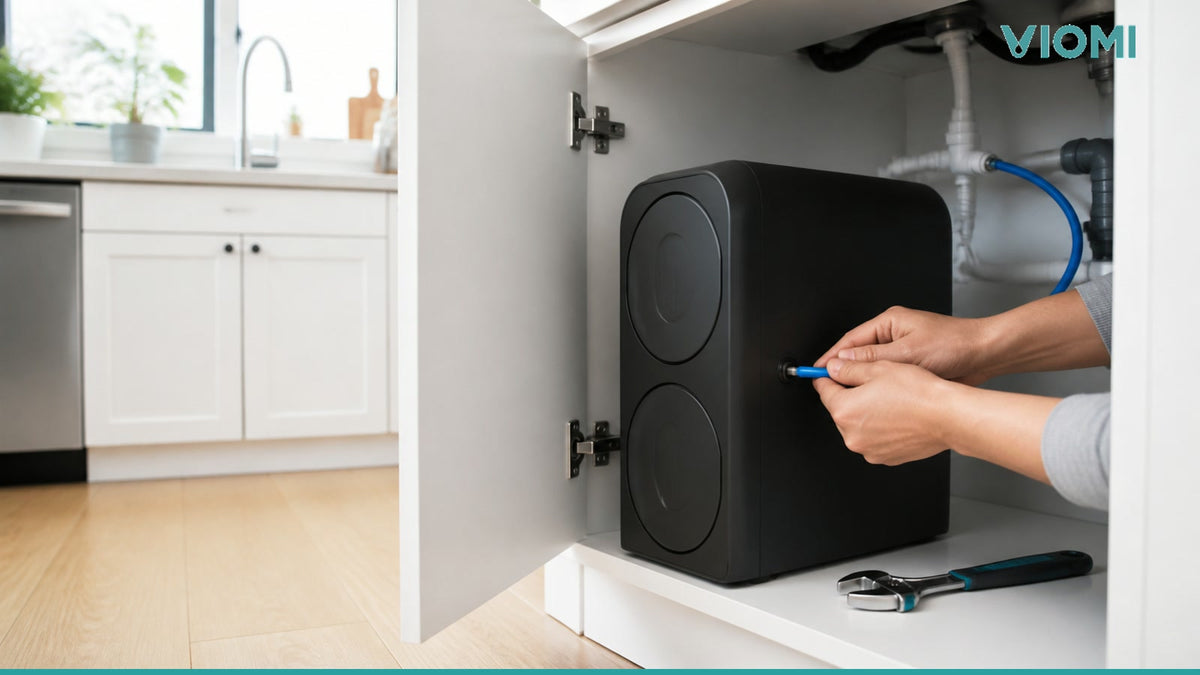
Water filters get sold as "DIY-friendly" across two very different products, and knowing which one you actually need means knowing whether your limit is a lack of tools or a landlord who won't sign off on permanent changes. One group needs no tools and no permanent changes at all: pitchers, direct-connect under-sink carbon filters, and countertop reverse osmosis units that just plug into an outlet, skipping the $200 to $500 a plumber would otherwise charge. The other group, tankless under-sink RO systems from Viomi, Waterdrop, and similar brands, is genuinely self-installable without hiring anyone, a plumber isn't required, but installation still means drilling one or two small holes and claiming a dedicated electrical outlet. A renter without sign-off for permanent changes needs the first group; anyone comfortable drilling, or who owns the place, has both open to them.
"Install Yourself" Covers Two Very Different Situations
Every brand in this category advertises "no professional installation required." That claim is usually true, but it hides a bigger question: does the install leave a permanent mark on the sink, countertop, or drain pipe, or not?
Tier 1: Zero modification. No drilling, no dedicated or hardwired outlet, and no tools beyond what's in the box (some countertop units still plug into a standard wall outlet, the same way a coffee maker does). This covers pitchers, faucet-mount filters, direct-connect under-sink filters that reuse your existing kitchen faucet, and countertop reverse osmosis units. Remove one of these and there's nothing to patch. This is the tier that actually matters if a lease or a landlord is the obstacle, not just a lack of plumbing skill.
Tier 2: Self-installable, but permanent. Tankless under-sink RO systems fall here. "No professional required" is accurate: these systems use push-to-connect fittings instead of soldered pipe, and installation manuals are written for a homeowner with basic hand tools. But nearly every model in this tier needs a hole drilled through the sink deck or countertop for its dedicated faucet, a smaller hole through the drain pipe for a saddle valve, and its own dedicated electrical outlet under the sink. That's a real modification a renter typically needs sign-off for, even though it doesn't require hiring a plumber to make it.
Confusing these two tiers is the most common reason someone buys a system, then discovers mid-install that they need a drill they don't own or an outlet that isn't there.
Push-to-connect fittings, the type used across both tiers, are built to seal without solder or compression tools, but a first attempt is still worth a few minutes of caution. After connecting anything to a water line, run the faucet for a minute, then check every fitting by hand for drips, and check again 12 to 24 hours later, since a fitting that's seated slightly off-square sometimes doesn't show a drip until the line has been under full pressure for a while. A drip tray or a battery-powered water-leak alarm, usually $10 to $15 and sold separately, placed directly under the unit adds a cheap layer of protection while you confirm the connection holds under pressure.
What "Smart" Actually Means on a Water Filter
"Smart" gets used loosely across this category, and it's worth separating three levels before comparing brands, because they're not the same thing.
The most basic level is a timer-based reminder: a light, a percentage, or an app notification that counts down based on elapsed time or estimated gallons used, not on anything the filter is actually sensing in the water. Most filter-life indicators, on pitchers and under-sink units alike, work this way.
The next level is on-device water monitoring, usually a TDS (total dissolved solids) reading shown on a faucet screen or app. TDS tracks dissolved mineral and salt content, which is a genuinely useful way to spot a failing RO membrane or a system that isn't rejecting solids the way it should. It is not a contaminant test. The EPA classifies TDS under its Secondary Drinking Water Standards, an aesthetic guideline about taste and appearance rather than a health-based standard, and contaminants like lead and PFAS fall under separate primary standards with their own test methods entirely. That's why a TDS reading can look normal while lead, PFAS, or bacteria are still present: a TDS meter isn't built to detect those specifically.
The top level is a full companion app layering TDS trends, filter-life percentage, water usage history, and replacement alerts together in one place, sometimes with cloud connectivity for remote notifications. This is the most useful version of "smart" for staying on top of maintenance, but it's still built on the same TDS and usage-based estimates as the tier below it, not on independent lab-grade contaminant sensing.
Knowing which level a product actually offers matters more than the word "smart" printed on the box.
Viomi: Both Install Tiers, With a Clear Line Between Them
Viomi sells across both installation tiers described above, from a $15 pitcher to an $800 reverse-osmosis system with a touchscreen faucet, which makes it a useful brand to walk through in detail: the smart features get more capable exactly as the installation gets more permanent.
Zero-modification options. The Inno 13-Cup Water Filter Pitcher ($14.99) is the simplest entry: no plumbing at all, and it includes a built-in electronic filter-change indicator that displays remaining life as both a percentage and estimated days, reset with a button press when a new filter goes in. That's a genuine digital readout, not just a light, but it isn't app-connected, so it stays in the timer-based reminder category. Its 4-stage filter is NSF/ANSI 42 certified for chlorine, taste, and odor reduction.

Viomi's direct-connect Viomi Under-Sink Water Filtration System (VM-IUO1PCW-US), priced at $66.99, sits one step up. It connects to the existing cold-water supply line under the sink with push-to-connect fittings, runs through the same kitchen faucet already installed, and needs no drilling and no outlet. Viomi's own product page puts installation at under three minutes with no tools. The tradeoff is that this system has no filter-life indicator of any kind, so tracking its 12-month or 8,000-gallon rated life means setting your own calendar reminder.
Staying in the zero-modification tier doesn't mean settling for weaker filtration. This model is NSF/ANSI 372, 53, and 42 certified and rated to reduce PFAS (PFOA/PFOS), lead, chlorine, and taste and odor issues at a 0.5-micron filtration level, the same category of NSF-backed PFAS and lead reduction claims as Viomi's drilled, full-RO systems, just without the hole or the outlet.

A related version with its own dedicated faucet ($78.99) uses the same 0.5-micron carbon cartridge and the same certifications, but a separate faucet needs a mounting hole in the sink deck or countertop, whether that's an existing hole left by a soap dispenser or a new one. No outlet or drain modification is needed since this isn't an RO system, but that one hole moves it out of the zero-modification tier. It also has no app or digital filter-life feature, same as the direct-connect version.
The full-install, full-app tier. Viomi's tankless under-sink reverse osmosis systems, the Viomi V6 and Viomi V8, the Viomi V6 PRO and Viomi V8 PRO, the Viomi B6W, and the Viomi M1, all need the same two modifications: a 1 to 1.5-inch hole through the countertop or sink deck for the included faucet, and a roughly 1/4-inch hole through the drain pipe for a saddle valve that carries away reject water.
All of them also need a dedicated electrical outlet under the sink, one that can't be shared with a garbage disposal's switched outlet.
That drain saddle is the one step most first-timers haven't done before: a hand-tightened clamp locks onto the drain pipe with a small cutting point that pierces it from inside, giving the reject-water line a connection point without cutting the pipe outright. Here's what that looks like mid-install on a Viomi V8 PRO, a real example of the shared installation process across Viomi's tankless RO lineup:

Where these models split is on smart features:
Viomi V6 and Viomi V8 (from $339.99): smart LED faucet that turns orange as a filter-life warning; no app.
Viomi V6 PRO ($379.99) / Viomi V8 PRO ($479.99): same physical installation as the base models, plus a full companion app with real-time TDS readings, filter-life percentage, consumption pattern tracking, and system alerts, shown on the faucet screen as well as the app.
Viomi B6W ($249.99 regular price): the budget entry into app-based tracking, with a standard faucet rather than a smart touchscreen, though its app still tracks filter life, water quality, and usage.
Viomi M1 ($799.99 regular price): tops the lineup with a touchscreen smart faucet showing inlet and outlet TDS, a pH indicator bar, and filter life at a glance, alongside the same full app.

Viomi's own product pages put installation at about 20 minutes for the Viomi M1 and around 30 minutes for the Viomi V6 PRO. A separate 3-to-4-hour estimate that appears on Viomi's site belongs to its storage-tank RO systems, a different mechanical layout that involves connecting and pressurizing a water tank, not these tankless models; first-timers on the tankless lines should still plan for extra time beyond the headline numbers, especially for drilling and the initial flush.
Filter swaps are the other DIY task worth knowing ahead of time. On the Viomi M1, both cartridges sit behind a single cover with slide-out handles, no tools needed once the cover is off.

Other Brands Worth Comparing
Waterdrop competes directly with Viomi's tankless RO tier. Its G3P800 needs the same combination of a drilled faucet hole, a drilled drain hole, and a dedicated electrical outlet, with Waterdrop's own installation materials estimating about 30 minutes for someone comfortable with basic tools. It ships with a smart display faucet showing TDS readings and a filter-life reminder, but Waterdrop's official pages don't list a companion app for this model, so tracking stays on the faucet rather than moving to a phone. That puts its install tier alongside Viomi's PRO-line and Viomi M1 models, even though its smart tier sits a step below the full-app systems.
Separately, Waterdrop's K19 countertop RO unit sits in the zero-modification tier: no drilling, plug into any outlet, with simple touch controls rather than a digital display. Waterdrop's currently available K19-SFK version doesn't show a built-in TDS or filter-life screen on its official product page. (Waterdrop's N1, which previously offered an on-unit smart screen, is now listed as discontinued.)
AquaTru covers a narrow but real niche: zero installation paired with a full companion app. Its Classic Smart model plugs into a standard outlet, sits on the counter with no plumbing or drilling of any kind, and its companion app tracks filter usage, TDS readings from both the tap-water and purified-water tanks, and water consumption over time.
Viomi's own zero-modification products, the Inno pitcher and direct-connect carbon filter, take a different design approach: keep the countertop clear, put the smart features on the under-sink RO tier instead, and make the zero-modification tier as simple and inexpensive as possible. That tradeoff means Viomi covers both install tiers in this guide, drilled and drill-free, each matched to the feature set that tier's buyer actually needs, while AquaTru's app-equipped model only covers the countertop use case.
A shopper who specifically needs zero drilling and a full phone app in the same unit, with no interest in ever installing an RO system, finds that narrow combination in AquaTru's Classic Smart. Waterdrop's countertop K19 line matches the zero-drilling convenience but tops out at touch controls, with no companion app.
Brondell's H2O+ Cypress takes a different no-tools approach: it mounts on the countertop and connects through a universal faucet diverter that fits most kitchen faucets in less than 10 minutes, no drilling and no outlet needed. It doesn't offer app connectivity or a digital filter-life readout, making it a straightforward Tier 1 pick for someone who just wants filtered water with the least possible setup.
iSpring covers a broad range of under-sink RO systems, most of them tank-based rather than tankless. Installation still means the same drilled faucet hole, drilled drain hole, and (for pumped models) an electrical outlet as Viomi's and Waterdrop's tankless lineups, but most iSpring models skip app connectivity in favor of a lower price point, making the brand a value-focused alternative for buyers who don't need phone-based monitoring.

Comparison Table
| Product | Install tier | Drilling required | Electrical outlet | Filter tracking | Price |
|---|---|---|---|---|---|
| Viomi Inno Pitcher | Zero modification | No | No | Digital % + days indicator (on unit, no app) | $14.99 |
| Viomi Under-Sink Water Filtration System (VM-IUO1PCW-US) | Zero modification | No | No | None (manual tracking) | $66.99 |
| Viomi Under-Sink Water Filtration System with Dedicated Faucet | One drilled hole | Faucet hole only | No | None (manual tracking) | $78.99 |
| Viomi V6 / Viomi V8 | Two drilled holes | Faucet + drain | Yes, dedicated | LED light only, no app | From $339.99 |
| Viomi V6 PRO / Viomi V8 PRO | Two drilled holes | Faucet + drain | Yes, dedicated | Full app + smart faucet TDS display | $379.99 / $479.99 |
| Viomi B6W | Two drilled holes | Faucet + drain | Yes, dedicated | Full app, standard faucet | $249.99 regular price |
| Viomi M1 | Two drilled holes | Faucet + drain | Yes, dedicated | Full app + touchscreen faucet (TDS, pH indicator bar, filter life) | $799.99 regular price |
| Waterdrop G3P800 | Two drilled holes | Faucet + drain | Yes, dedicated | Smart faucet display (TDS, filter life); no confirmed app | ~$600-$1,000 |
| Waterdrop K19 | Zero modification | No | Standard outlet only (no dedicated line) | Touch controls; no confirmed on-unit TDS/filter display | Varies |
| AquaTru Classic Smart | Zero modification | No | Standard outlet only (no dedicated line) | Full app, dual TDS readings | $525 |
| Brondell Cypress | Zero modification | No | No | None | Varies |
Prices can change on all brands listed; treat this as a comparison of install requirements and feature tiers rather than a live price list. Price formats above reflect each brand's own listing (AquaTru prices in whole dollars rather than the $X.99 convention other brands use).
Which One Fits Your Situation
Renting and can't modify the sink, countertop, or drain at all: Stay in the zero-modification tier. Viomi's direct-connect Viomi Under-Sink Water Filtration System (VM-IUO1PCW-US) is the strongest fit if you want PFAS, lead, and chlorine reduction without touching anything permanent; the Inno pitcher works if you don't want anything under the sink at all. Skip any product with a dedicated faucet, drilled or not, since even an "existing hole" isn't guaranteed in every kitchen.
Renting but your landlord will sign off on one or two small holes, or you own the place and plan to stay: This is where the Viomi V6 PRO, Viomi B6W, or Viomi M1 make sense. All three are genuinely self-installable without a plumber, and all three add real app-based filter and water-quality tracking that the zero-modification tier doesn't offer. Pick the Viomi B6W for the lowest price, the Viomi V6 PRO for an LED smart display faucet at a mid-range cost, and the Viomi M1 for a touchscreen faucet, the highest flow rate, and the most complete display.
Deciding whether the app and TDS display are worth the extra cost: A TDS reading can't confirm lead or PFAS are gone, so the app itself isn't what makes the water safer, the certified filtration and membrane are doing that work either way. Paying more for the Viomi V6 PRO, Viomi B6W, or Viomi M1 over the base Viomi V6/Viomi V8 is worth it if you specifically want alkaline mineralization, a running pH and TDS display, or app-based tracking instead of setting your own reminder. It's not worth the price jump if the goal is just safer, better-tasting water: the base Viomi V6/Viomi V8 use the same NSF-certified filtration and reduce the same PFAS and lead at a lower cost, they just tell you it's time for a new filter with an LED light instead of a screen.
Want zero drilling and a full phone app in the same unit, with no plans to ever install an RO system: This is a narrow combination. AquaTru's Classic Smart is the clearest system that delivers both, worth shortlisting specifically for that combination. Everyone else who's open to an RO system eventually is better served by Viomi's under-sink lineup, where the app comes standard on the Viomi V6 PRO, Viomi B6W, and Viomi M1.
Just want a basic reminder without any installation risk: A pitcher with a digital filter-life readout, like Viomi's Inno, is the lowest-effort way to get a percentage-based reminder instead of guessing when to swap a cartridge.
FAQ
Does "no professional installation required" mean no drilling? No. It means you won't need to hire a plumber, and the parts are designed for hand tools instead of soldering or specialized equipment. Most tankless under-sink RO systems, including Viomi's RO lines, still require drilling a faucet hole and a drain hole even though the installation itself is DIY-friendly.
Can I take an under-sink RO system with me when I move? The unit itself, yes. The holes drilled for the faucet and drain saddle stay behind, which is the actual point of friction for renters, not the equipment.
Is a filter-life percentage on an app the same as testing my water quality? No. Filter-life percentages are based on elapsed time or estimated water volume, not a live chemical analysis. A TDS reading on a smart faucet or app is a real measurement, but it tracks dissolved solids, not specific contaminants like lead or PFAS. Confirming those requires a certified water test or the system's certification documentation.
Do I need an electrical outlet for every RO system? Tankless RO systems, including Viomi's RO lines and Waterdrop's tankless models, need a dedicated outlet to power the pump and electronics. Countertop RO units also plug into an outlet. Simple carbon filters, whether pitcher, faucet-mount, or direct-connect under-sink, don't use electricity at all.
How long does self-installation actually take? Zero-modification products take minutes: a pitcher is ready immediately, and Viomi's direct-connect under-sink filter is rated at under three minutes. Drilled installations take longer than the headline numbers suggest: Viomi's product pages put installation at about 20 minutes for the Viomi M1 and around 30 minutes for the Viomi V6 PRO, and first-timers should plan for extra time, especially for the drilling and the initial flush. (Tank-based RO systems take considerably longer than that, as explained above, but that's a different product category from the tankless models this article covers.)
Bottom Line
Two questions settle which tier, and which product, fits your situation.
Can you drill one or two small holes, with sign-off if you rent? If not, Viomi's direct-connect Viomi Under-Sink Water Filtration System (VM-IUO1PCW-US) is the strongest zero-modification answer here: NSF-certified PFAS, lead, and chlorine reduction, installed in under three minutes with no faucet swap. If yes, the Viomi V6 PRO, Viomi B6W, and Viomi M1 open up, all genuinely self-installable without a plumber, picked by price point and faucet style.
Do you actually want app-based tracking, or is an LED light enough? Skip the app and the base Viomi V6/Viomi V8 save you money on the same NSF-certified filtration. Want the app: Viomi B6W is the cheapest way in, Viomi V6 PRO adds a smart LED faucet at a mid-range price, and Viomi M1 tops the lineup with a full touchscreen display. The one case none of Viomi's products cover is wanting zero drilling and a full phone app in the same countertop unit; AquaTru's Classic Smart is the system built for exactly that combination.
Answer both questions before shopping by price alone. "No professional installation required" is true for nearly every brand in this guide, which is exactly why it doesn't tell you which install tier, or which product tier, you're actually buying into.
Share:
Which RO Systems Publish Real Test Data for PFAS, Fluoride, Microplastics, and Ultra-Fine Particles?
Which RO Systems Publish Real Test Data for PFAS, Fluoride, Microplastics, and Ultra-Fine Particles?