

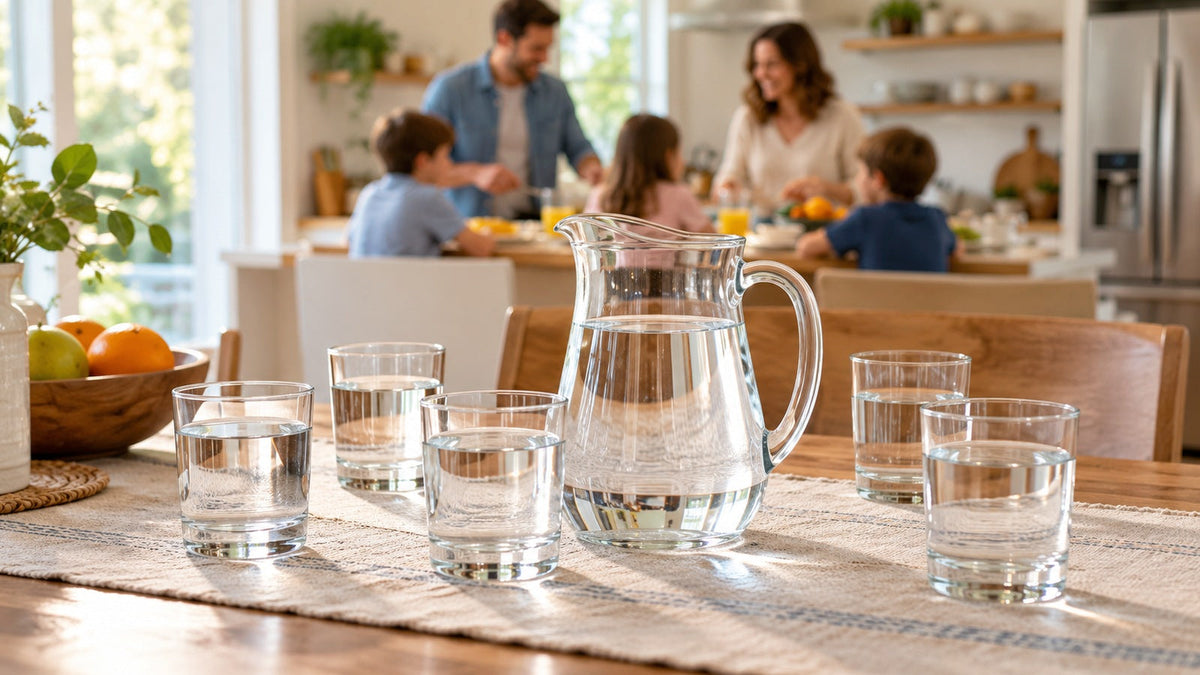
At dinnertime in a five-person home, the RO faucet has to cover a pot of pasta water, five bottles for school and work, and a pitcher for the fridge, all within a few minutes. Cloud RO and AquaTru Under Sink meet that rush from a storage tank, so they suit families whose biggest draw fits in stored water: Cloud RO for a cabinet with no outlet, since it runs on a battery, and AquaTru Under Sink for a family that wants leak detection and automatic filter-life alerts. Waterdrop's tankless G3P and G5P systems produce water on demand, with no stored volume to run down during a long batch-cooking draw, and the G3P800 and G5P700A carry Waterdrop's higher ratings. On that side, the Viomi M1 has the highest listed rating in this comparison, 1000 GPD at 3:1, and adds remineralization plus touchscreen preset volumes that fill a pot with one touch.
How Much Water Five People Actually Draw
Daily totals are easy to underestimate because they arrive in bursts. To compare systems fairly, this article uses two working assumptions. They are planning figures, not measurements, so swap in your own numbers.
| Day type | Drinking (5 people) | Cooking and coffee | Daily total | Biggest single burst |
|---|---|---|---|---|
| Ordinary weekday | about 2.5 gallons | about 0.5 gallon | about 3 gallons | 1 to 1.5 gallons around dinner |
| Batch-cooking day | about 2.5 gallons | about 3.5 gallons | about 6 gallons | 2 to 3 gallons within an hour |
Every daily-production rating listed in the table below exceeds the assumed 6-gallon daily total, so daily capacity alone rarely decides the matter. The burst column is where systems differ. For a tanked system, burst supply depends on stored water plus production during the draw; for a tankless system, it depends on on-demand production.
Which Current Models Those Names Refer To
Brand names drift between generations, so it helps to pin down exactly which models are on the table.
- "AquaTru Under Sink Gen 2." AquaTru's official site sells this system simply as the AquaTru Under Sink. The product page does not use a "Gen 2" label, so this comparison uses the specifications published for the current AquaTru Under Sink.
- "Cloud RO." Cloud Water Filters sells the Cloud RO Under Sink Reverse Osmosis System.
- "Waterdrop G3P." The G3P line has two current models with different specifications: the G3P600 and the G3P800. Specifications for one cannot be borrowed for the other.
- "Waterdrop G5P." The G5P line includes the G5P500, the G5P500A (with alkaline mineralization), and the G5P700A (700 GPD with alkaline mineralization), among other variants. The "A" suffix marks the mineralizing version.
Side-by-Side: Stored Water vs. On-Demand Production
All figures below come from each brand's official product pages, specification sheets, or manuals, including those for the Viomi M1.
| Viomi M1 | Cloud RO | AquaTru Under Sink | Waterdrop G3P600 | Waterdrop G3P800 | Waterdrop G5P500 / G5P500A | Waterdrop G5P700A | |
|---|---|---|---|---|---|---|---|
| Design | Tankless | Tank | Tank | Tankless | Tankless | Tankless | Tankless |
| Storage specification | No tank (on demand) | 2.8-gallon tank volume | Stores up to 1.7 gallons | No tank (on demand) | No tank (on demand) | No tank (on demand) | No tank (on demand) |
| Rated daily production | 1000 GPD | Not shown in this comparison | 54 GPD | 600 GPD | 800 GPD | 500 GPD | 700 GPD |
| Pure-to-drain ratio | 3:1 | 1:1 | Not listed | 2:1 | 3:1 | 2:1 | 2:1 |
| Power | Plugs into an outlet | Battery powered, no outlet | Not listed | Plugs into an outlet | Plugs into an outlet | Not listed | Not listed |
| Remineralization | Yes, after purification | Yes, post filter | Not listed | Not listed | Not listed | G5P500A only | Yes |
| Monitoring | Touchscreen faucet shows tap and purified TDS, filter life and preset volumes; Viomi App | App with inlet, post-RO and post-mineral TDS sensors | Control panel, filter-life alerts, leak detection | Faucet shows TDS and filter life | Faucet shows TDS and filter life | Mechanical faucet (G5P500) | Faucet shows TDS and filter life |
Tanked Systems: Cloud RO and AquaTru Under Sink
A tanked system fills its reservoir slowly and then releases that stored water quickly through a dedicated faucet. For a family of five, two numbers matter: how much is in the tank when the dinner rush starts, and how long it takes to refill.
AquaTru Under Sink. AquaTru lists storage of up to 1.7 gallons and a rating of 54 GPD. The assumed 1 to 1.5 gallon weekday burst sits below that 1.7-gallon storage figure; the 2 to 3 gallon batch-cooking burst is larger than it, so finishing that burst also depends on water the system produces along the way. AquaTru recommends hiring a certified plumber because installation involves drilling into the pipes under the sink, and the system adds a leak-detection feature and automatic filter-life alerts.
Cloud RO. Cloud lists a 2.8-gallon tank, an integrated permeate pump, and battery power, so it needs no electrical outlet under the sink. Its app reads TDS at three points: the inlet, after the RO membrane, and after the remineralizing post filter. The dedicated faucet needs a hole between 0.5 and 1.25 inches, and a small hole is added to the drain pipe. Cloud's 1:1 ratio means one gallon goes to drain for each gallon dispensed.
Tank volume and stored water are two different figures. Take the APEC ROES-50: its manual lists the 4-gallon figure as the tank's total volume, while the water actually stored climbs with household pressure, roughly 1.9 gallons at 40 psi and roughly 3.1 gallons at 70 psi and above. Measuring your home's water pressure tells you which end of a range like that to plan around.
Tankless Systems: Waterdrop G3P and G5P
The tankless models compared here produce filtered water on demand. There is no reservoir to run dry during a burst, which matters for families with heavy cooking days. For installation, Waterdrop's G3P600 page calls for an electrical outlet, recommends a 1-inch faucet hole, or reusing a soap-dispenser hole, and notes that the system needs a drainpipe nearby.
G3P600 vs. G3P800. The G3P600 is rated at 600 GPD with a 2:1 ratio and three cartridges: a composite front filter (CF), the RO filter, and a rear carbon block (CB). The G3P800 steps up to 800 GPD, a 3:1 ratio, 10 stages, and UV sterilization. Both faucets show TDS and filter life.
G5P500, G5P500A, and G5P700A. The G5P line uses two cartridges. The G5P500 is rated at 500 GPD with a mechanical faucet. The G5P500A adds an alkaline mineral stage. The G5P700A raises the rating to 700 GPD and includes alkaline mineralization and a smart display faucet.
For a five-person household, Waterdrop's gallon ratings on filters are worth a look. The G3P600's CF filter is rated for 6 months or 550 gallons, whichever comes first. At about 3 gallons a day, 550 gallons lasts roughly 183 days, right around the six-month mark; at 4 gallons a day, the gallon limit arrives first, at about 137.5 days. Plan replacement at six months or 550 gallons, whichever comes first.
Viomi M1: A 1000 GPD Tankless Option for Large Households
The Viomi M1 sits on the tankless side of this comparison: a 9-stage under-sink RO with remineralization, rated at 1000 GPD with a 3:1 ratio, the highest listed rating in the table above.
Three details speak directly to a five-person kitchen:
- Preset volumes for the dinner rush. The touchscreen faucet offers preset dispensing volumes, including 10 oz for a glass and 40 oz for a pot, so a fill runs with one touch while you handle something else.
- A second filtered outlet. Switching on "Multi-device Mode" in the app lets the Viomi M1 send filtered water on to a compatible refrigerator dispenser or ice maker, connected with standard tubing.
- Two cartridges on long intervals. The PCB and RO filters have rated service lives of up to 2 and 4 years, respectively, with remaining life displayed on the faucet, in the app, and on the main unit.
Because minerals are added back after purification, the Viomi M1's purified TDS reading runs higher than standard RO water; that higher number reflects the remineralization stage. TDS tracks the total of dissolved substances, and specific contaminants are documented through lab testing: SGS testing cited on the Viomi M1 product page puts lead reduction above 99.87%, and SGS has performance-tested the Viomi M1 for PFOS/PFOA reduction.

Installation fits a standard kitchen on municipal tap water at 14.5 to 58 psi, with step-by-step installation videos from Viomi; plan on a standard outlet (its own always-on outlet when a garbage disposer sits under the same sink), a drain pipe that can take a 1/4 inch hole, and a 1 to 1.5 inch opening for the smart faucet. Leave 2.0 to 3.9 inches of clearance behind the unit for tubing.

For a wider look at how tanked and tankless brands stack up beyond these models, see Viomi's comparison of tankless vs. tank RO systems. For sizing by household habits rather than head count, the guide to choosing an RO purifier for a family home walks through usage patterns in more detail.
FAQ
Can I fill a large stockpot from an RO faucet in one go?
On a tankless system, the pot fills from on-demand production, so a large pot is not limited by stored volume. On a tanked system, the stored water comes first: a 2-gallon fill is 0.3 gallon more than AquaTru's 1.7-gallon storage figure, so completing it also draws on newly produced water. If you batch-cook often, compare your largest pot against the tank's stored water as well as its daily rating.
What happens when two people want filtered water at the same time?
Each of these systems has one dedicated drinking-water faucet, so two people take turns at it while the regular kitchen faucet keeps working for rinsing and washing. Connecting a system such as the Viomi M1 to a compatible refrigerator with a water dispenser provides another place to get filtered water, and an ice-maker connection supplies filtered water for making ice.
How do I keep a storage tank clean?
Follow the sanitizing and replacement schedule in your system's manual, replace filters on time, and use the stored water regularly rather than letting it sit for long stretches. Tankless designs, including the Waterdrop G3P and G5P models and the Viomi M1, have no storage tank to sanitize.
Does remineralization matter for cooking?
Remineralization changes taste and the TDS reading; it is a preference rather than a requirement. Cloud RO, the Waterdrop G5P500A and G5P700A, and the Viomi M1 include it. If your family prefers the taste of mineralized water for coffee, tea, and cooking, those models are the ones to compare.
Sizing RO to a Five-Person Kitchen's Busiest Hour
Every daily-production rating listed in this comparison clears the 6-gallon batch-cooking assumption, so the choice turns on the biggest single draw and on what the cabinet can hold. Tankless systems produce water on demand with no stored volume to run down during a 2 to 3 gallon batch-cooking draw: the Viomi M1 at 1000 GPD with remineralization and long cartridge intervals, the Waterdrop G3P800 at 800 GPD and 3:1, and the Waterdrop G5P700A at 700 GPD with alkaline mineralization. Tanked systems suit steadier use: AquaTru Under Sink stores up to 1.7 gallons and adds leak detection, while Cloud RO runs on a battery with a three-point TDS app for a cabinet that has no outlet. Whichever design fits the kitchen, size it to the household's biggest burst of the day, not its daily total.
Share:
Smart vs. Traditional Water Filters: What the "Smart" Part Changes and What It Doesn't
Countertop Reverse Osmosis on Reddit: Which Brands Owners Recommend and Why