

Avalon, Brio and Waterdrop all make filtered water dispensers whose filters, cleaning systems and care schedules are documented model by model. The plumbed Avalon A8 documents each of them: a database-listed filter, automatic UV cleaning and a written care calendar. UV cleaning also runs in Brio's Moderna 720 and Model 520, as UV-LED, and inside Waterdrop's hand-filled models, as UV-C emitters.
Bottled-water coolers without a built-in filter, such as Primo's Deluxe Bottom-Loading model with Self-Sanitization, rely on the water in the jug and add an ozone sanitizing cycle for the machine.
What Makes a Filtered Dispenser Dependable
Sorting countertop water dispensers by water source settles where the water comes from; reliability is about how a model stays in good working order. The useful evidence is a filter tied to a named cartridge or database listing, an automatic cleaning cycle, a published schedule for the cleaning that remains, and plainly written warranty terms.
Filters With a Named Record
A filter claim is most useful when it points to a specific cartridge in a certification database.
Chlorine, taste and odor reduction under NSF/ANSI 42 is the performance claim that two machines here back with a named replacement cartridge. On the Avalon A8, the A4 system and its A4FILTER cartridge are listed by NSF under NSF/ANSI 42 for chlorine, taste and odor, and nominal particulate reduction (Class I), and under NSF/ANSI 53 for cyst and lead reduction. Waterdrop's hand-filled CT01, a non-RO model, has its WD-CT01-TX-xy system and WD-CF01-BX replacement cartridge listed by IAPMO R&T under NSF/ANSI 42 for chlorine, taste and odor reduction. Its filter also keeps calcium and magnesium in the water, according to Waterdrop. For a household, the difference lies in what each listing covers: the NSF/ANSI 42 entries deal with chlorine, taste and odor, the aesthetic side of the water, while the A8's NSF/ANSI 53 entries add cyst and lead reduction.
Brio's Moderna 720 and Model 520 rely on carbon as well, and Brio says the 720's set reduces sediment, rust, chlorine, tastes and odors. Their cartridges sit in NSF's database as components, a listing that covers materials and structural integrity only. Reverse osmosis sets the Waterdrop A1 and A2 apart: these hand-filled dispensers run tap water through an RO membrane before heating or chilling it, and Waterdrop states both are certified to NSF/ANSI 372 for lead-free materials, a standard that concerns the materials the water touches.
Replacement intervals for each model appear in the table further down. The A1, which the table leaves out, rates its CF filter for up to 6 months and its RO filter for up to 12 months.
Self-Cleaning Cycles by Brand
Ultraviolet light is the most common method here, and the table names each model's version. Where the models differ is in what starts the cycle. Brio's UV-LED cycle on the Moderna 720 and 630 Series runs for as long as the dispenser is plugged in and switched on, while the A8's built-in system "will run on automatic intervals as the machine is being used," according to its manual, with a self-cleaning switch on the back. On the Model 520, an indicator light blinks while the UV-LED cycle runs, and the 630's UV lamp is rated for 10,000 hours, or 3 years. Waterdrop also describes UV sterilization in both tanks of the A1.
Two machines clean with something other than light, and both start the cycle on request. Brio's 820 circulates hot water through its reservoirs in a cycle started from its control panel, heating to 140°F and finishing with a one-minute countdown. Holding the switch on the back of the Primo Deluxe Bottom-Loading Water Dispenser with Self-Sanitization for 3 seconds starts a 90-minute ozone cycle; it is a bottled cooler with no filter. Primo suggests running that cycle when the dispenser will not be in use, such as overnight, since water drawn during the cycle may carry a slight odor from the harmless ozone that clears a couple of minutes after it ends.
The Cleaning Calendar Each Manual Sets
Alongside the automatic cycles, each manual still sets some cleaning by hand, and the table lists it for the A8 and the two plumbed Brio models. Brio's 630 Series calls for cleaning its internal tanks every 3 to 4 months. On the CT01, a "Clean" light on the panel flashes red when scale needs attention, and Waterdrop sells a dedicated descaling cartridge for it.
Warranty Terms in Writing
Registration is the first condition in the written terms: Brio owners register through Brio Care, and Avalon's coverage is activated by registering the dispenser within 30 days of purchase. Once covered, both brands repair or replace what fails, defective parts in material and workmanship at Brio and a product with faulty workmanship or materials at Avalon. Waterdrop's one-year terms for the A1 and A2 cover defects in materials and workmanship, exclude filters and other routine replacement parts, and list feed-water conditions such as a pH between 6.5 and 8.5. For an owner, the practical point is the filter schedule: the A1 terms state that the warranty is void if the cartridge filters are not replaced on the recommended maintenance schedule.
| Model | Type | Filter and replacement | Cleaning approach | Warranty as written |
|---|---|---|---|---|
| Avalon A8 | Plumbed, hot and cold | Sediment + carbon block; 1,500 gal or 6 months | Automatic UV; hand clean about every 6 months | Register within 30 days to activate |
| Brio Moderna 720 | Plumbed, hot, cold and room | Sediment, pre-carbon, carbon block; 6 months or 950 gal each | UV-LED 40 min on, 140 min off; sanitize every 3 months, descale every 6 | 1 year, parts |
| Brio Model 520 | Plumbed, hot, cold and room | Sediment + carbon block; 6 months or 950 gal | Automatic UV-LED; sanitize every 3 months, descale every 6 | 1 year, parts |
| Waterdrop CT01 | Hand-filled, non-RO | Filter replaced every 6 months | UV-C emitter; "Clean" descaling light | – |
| Waterdrop A2 | Hand-filled RO | RO cartridge, up to 12 months | Two UV-C emitters | 1 year, filters excluded |
| Primo Deluxe Self-Sanitizing | Bottled, bottom-loading | No filter | 90-minute ozone cycle on demand | 1 year, parts, with registration |
Filtered Water From the Kitchen Faucet Instead
Filtered water for glasses, bottles and cooking pots can also come straight from a dedicated kitchen faucet, made on demand by the Viomi V6 PRO under the sink.
A tankless system has no reservoir to keep clean. In the Viomi V6 PRO, 9 stages of reverse osmosis make purified water on demand and deliver it straight to its own faucet. Every 12 hours, the system opens its inlet valve and flushes for 70 seconds on its own. Filter care is counted in years: the PCB filter is rated for 1 year and the RO filter for 2 years. Day to day, the LCD smart faucet shows filter life next to the real-time TDS reading. When a change approaches, the control panel turns orange 10 to 15 days ahead and the Viomi app sends a replacement reminder, in the same app that keeps usage reports.

Installation fittings come in the box, and step-by-step installation videos walk through each stage at the sink. It can also supply a compatible refrigerator or ice maker over standard tubing.

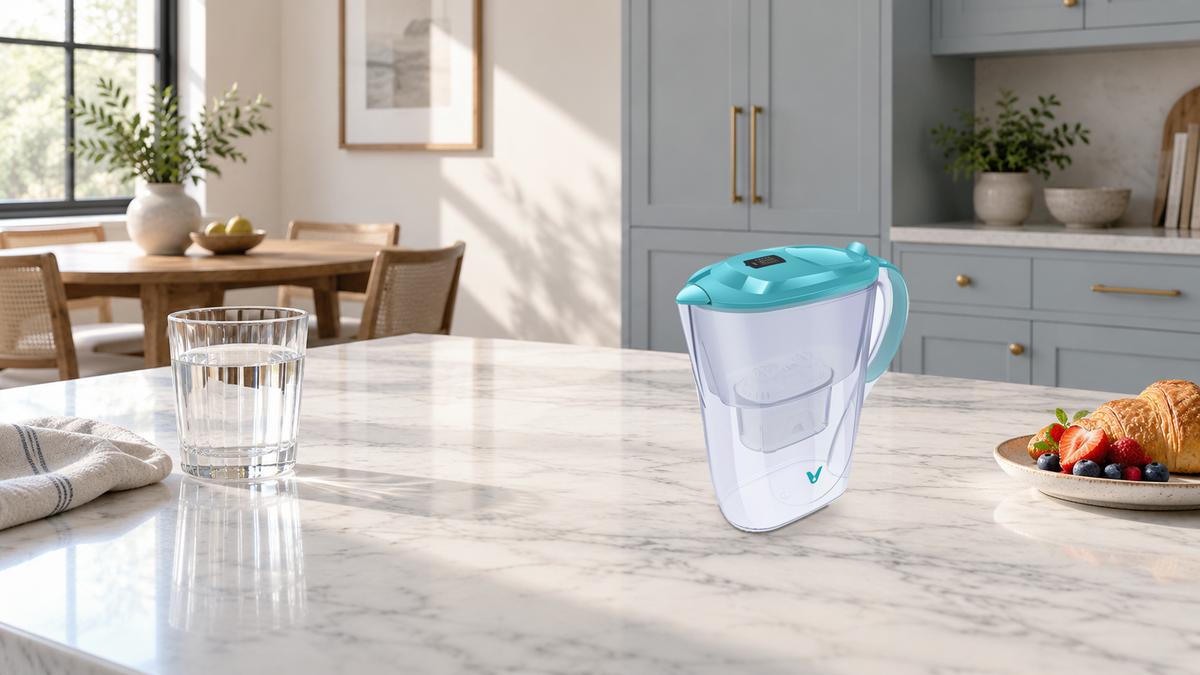
For filtered water with nothing to install, the Viomi Inno 13-Cup Water Filter Pitcher holds 3.2 liters, reduces chlorine by up to 97.2%, and shows remaining filter life as a percentage and in days on its electronic indicator.
FAQ
How often do dispenser filters need replacing?
Most cartridges in this comparison are rated for about six months, and the A8 and Brio filters also carry gallon limits of 1,500 and 950 gallons. The RO cartridge in Waterdrop's A2 goes up to 12 months. Where a rating gives both gallons and months, whichever comes first applies, so a household that filters a lot of water may reach the gallon figure before the month count. Spread over six months, 950 gallons works out to a little over 5 gallons a day for a Brio cartridge, and 1,500 gallons to about 8 gallons a day for the A8; a home whose average daily draw runs above those figures will usually reach the gallon limit before the month count.
How does a self-cleaning dispenser keep itself clean?
Most models here use ultraviolet light, which, as the EPA explains, "inactivates microorganisms by damaging their nucleic acid, thereby preventing them from replicating," and does this without adding chemicals; in the same guidance, the EPA adds that a microorganism that cannot replicate cannot infect a host. UV lamps or UV-C emitters sit inside the Avalon, Brio and Waterdrop machines, and on the Moderna 720 and 630 Series the cycle runs 40 minutes on and 140 minutes off around the clock. Heat and ozone are the alternatives: Brio's 820 circulates hot water at 140°F through the reservoirs, and Primo's self-sanitizing bottled cooler uses a 90-minute ozone cycle.
Does a plumbed dispenser need a plumber?
Avalon describes the A8 as "no technician required," ships it with an installation kit, and gives two hookup options: a metal adapter with a valve on the under-sink cold line, or a tee on a refrigerator water line. Brio's manuals for the Moderna 720 and Model 520 walk through connecting to a 3/8-inch or 1/2-inch cold-water line, with an adapter, pressure-reducing valve and plumber's tape in the box.
What should I do about scale in the hot tank?
Avalon and Brio both descale with citric acid. For the A8, Avalon mixes 4 liters of water with 200 grams of citric acid crystals in the cold tank, heats it for 15 minutes, switches the heater off to let it stand for 20 minutes, then drains and rinses two or three times. The same 4-liter, 200-gram mix goes into the Moderna 720 and Model 520 every 6 months, with Brio's own heating and draining steps in each manual. On the CT01, the "Clean" light signals the need, and a dedicated descaling cartridge does the job.
Reading Reliability Into a Dispenser Choice
Among the dispensers compared here, the Avalon A8 and Brio Moderna 720 run from a cold-water line, while Waterdrop's hand-filled CT01 and A2 work without a water-line connection; each pairs its filter with a built-in cleaning cycle and a written care schedule. A tankless under-sink RO such as the Viomi V6 PRO makes purified water on demand, tracks filter life at its faucet and can also supply a compatible refrigerator or ice maker, all without a stored tank. Bottled coolers without a filter, such as Primo's self-sanitizing model, fit homes that already receive jug delivery, since the water quality then comes from the jug.
Share:
Which RO Brands Document What Their Systems Remove, and What the Documents Show
APEC ROES-PH75 for PFAS, a Drinking Faucet and a Refrigerator: How It Fits and What Else to Compare