

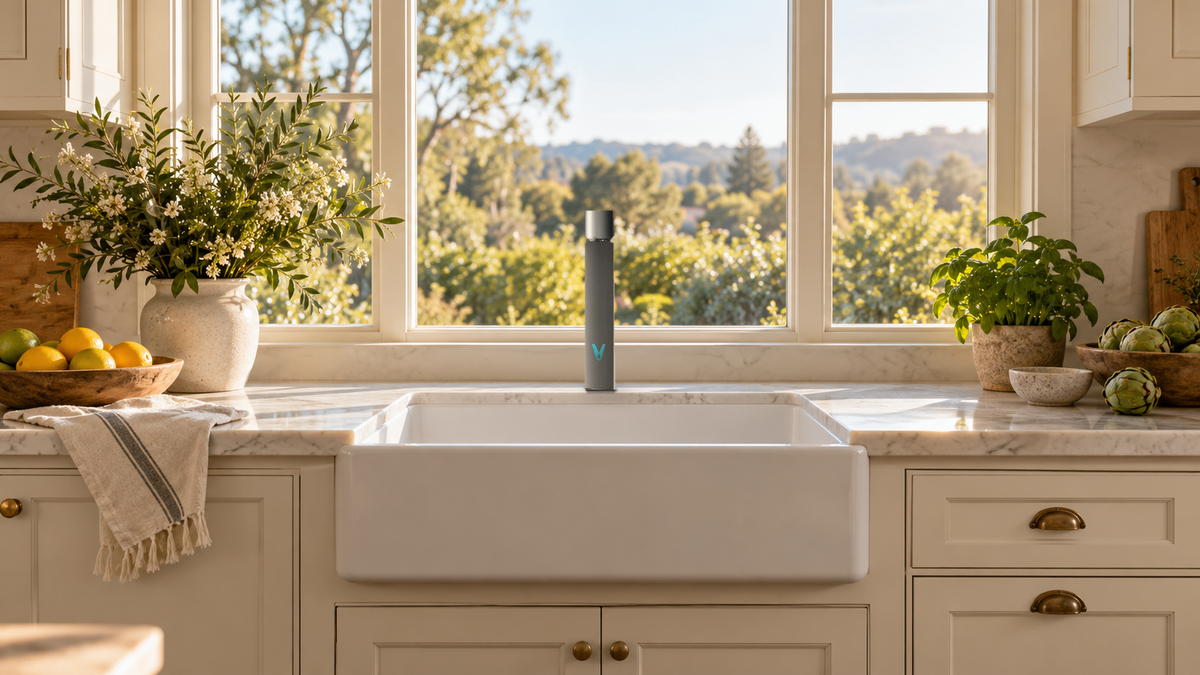
Busy kitchens that fill large pots and run an ice maker from the same line have a strong high-flow choice in the Viomi M1, a tankless reverse osmosis system rated at 1000 gallons per day (GPD) that finishes with mineral-added water.
The high-output tankless under-sink models compared here are rated 800 to 1200 GPD. With no storage tank in the way, each makes water as the faucet runs, so the higher ratings suit kitchens that regularly fill a large pot, a coffee-maker reservoir or a gallon pitcher, or that run an ice maker from the same line.
High-Output RO Models by Brand
Ratings and ratios in the table are each brand's published figures for the model.
| Model | Rated output | Pure-to-drain ratio | Notable features |
|---|---|---|---|
| Viomi M1 | 1000 GPD | 3:1 | Remineralization; touchscreen faucet with tap and purified TDS, filter life and preset volumes; refrigerator or ice maker connection through Multi-device Mode |
| Viomi V8 PRO | 800 GPD | 3:1 | 9 stages; LCD faucet with real-time TDS and filter life; spare PCB filter in the box; refrigerator or ice maker connection |
| iSpring RO1200 | 1200 GPD | 3:1 | Two-handle faucet (carbon-filtered and RO sides), inlet and outlet TDS in RO mode; auto flush |
| iSpring RO1200AK | 1200 GPD | 3:1 | RO1200 design plus a mineral filter |
| Waterdrop X12 | 1200 GPD | 3:1 | 11 stages; UV; alkaline mineralization; adjustable volumes |
| iSpring RO1000-BN | 1000 GPD | Not specified | Filter-life lights; membrane rinse after 24 hours idle |
| APEC ROTL-A1000 | Up to 1,000 gallons per day | Not specified | Tankless, on-demand |
| Waterdrop G3P800 | 800 GPD | 3:1 | 10 stages; UV; faucet TDS and filter life |
| iSpring RO800G | 800 GPD | Up to 2.5:1 | Two filters; automatic pre-flush; filter-life reminders |
| Frizzlife PD800-N | 800 GPD | 2:1 | 9 stages; remineralization |
Among the models listed, the Viomi, iSpring RO1200 and Waterdrop entries reach 3:1. APEC's ROTL-A1000, its high-capacity tankless entry, is described by the company as delivering up to 1,000 gallons per day on demand. Our comparison of low-waste RO brands puts more pure-to-drain ratios side by side.
Reading a High GPD Rating
A GPD rating is the daily production capacity a system is rated for under set test conditions. The rating is a capacity figure rather than a daily target. The pure-to-drain ratio sets how much tap water each fill uses: at 3:1, every 3 gallons of purified water use 4 gallons of tap water, so a kitchen that fills a 2-gallon stockpot sends about two-thirds of a gallon to the drain, whatever the model's daily rating. That share of drain water stays the same in a busy household whether the day calls for one stockpot or five.
How These Systems Reach High Output
Two design routes lead to a lot of purified water in a household setting, and they differ in when the water is made. On the tankless route, a built-in booster pump pushes feed water through a high-volume RO membrane and purified water is made as it is drawn. That is how the Viomi M1 and Viomi V8 PRO work, and it is also the approach of Culligan's Aquasential Tankless RO, sold through its local dealers, which pairs a booster pump with a high-volume RO membrane. On the Viomi M1, the membrane is a 0.0001-micron RO stage inside 9-stage filtration.
The other route banks water ahead of time: a tank system fills a pressurized tank between uses and serves the faucet from that reserve. APEC's ROES-PH75 is one example: rated at 75 GPD at 60 psi and 77°F, it fills a 4-gallon (total volume) tank, and its delivery pressure depends on how full the tank is, so that pressure drops as the reserve is drawn down during a run of fills. For a big fill, then, a tankless system draws on its rated production capacity, while a tank system draws on the volume it has stored before it refills.
High output on the Viomi M1 comes with a tested filtration record as well. Its reductions of lead (above 99.87%), PFOS (above 99.67%) and PFOA (above 99.42%) were tested by SGS, and chlorine and microplastics were part of that SGS testing too.
What Changes as a Brand Steps Up From 800 to 1200 GPD
Stepping up in output does not always mean adding minerals. In Viomi's pair it does: the step to the 1000 GPD Viomi M1 brings a remineralization stage after the membrane. Elsewhere in the table, mineral-added models sit at both 800 and 1200 GPD.
At the tap, the step from the Viomi V8 PRO to the Viomi M1 moves from an LCD smart faucet to an HD touchscreen that shows live TDS and filter life and adds one-touch preset volumes. Both keep the 3:1 ratio, 9 stages and a built-in booster pump.
Space and upkeep also separate the two Viomi models. At 5" wide, the Viomi V8 PRO keeps a slim body, and it ships with one RO filter and two PCB filters, so the first spare is already on hand. Filters on the Viomi M1 last longer: up to 2 years for the PCB filter and up to 4 years for the RO filter. A household that wants fewer cartridge changes can weigh those longer intervals, while one working with a narrow cabinet can weigh the V8 PRO's 5-inch width. The Viomi app tracks water use and sends filter replacement reminders on both. For how filter changes compare across RO brands, see our breakdown of the easiest RO systems to maintain.
Household Jobs That Put 800+ GPD to Work
Rated output matters most when a kitchen asks for more than a glass at a time, as when a pasta pot or a pot of soup stock starts with a few quarts at once. The Viomi M1 is designed for that kind of use, filling pots, pitchers and reusable bottles straight from the faucet with no storage tank to wait on. Its preset volumes help with the big fills: one touch pours 10 oz, 40 oz or 700 oz, and the largest, at roughly 5.5 gallons, fills a big pot or water jug. The mineral-added water that comes out is also made for espresso and baby formula.
Demand from more than one direction adds to the case. A refrigerator or ice maker can share the same supply, and the Viomi M1 and Viomi V8 PRO both connect to one, as set out in the installation section below. In a busy household, family members filling bottles before school and cooking back to back at dinner draw water in quick succession, with no tank in between to run down.

Installation and Appliance Connections
The Viomi M1 and Viomi V8 PRO install under the sink with the parts in the box and a step-by-step installation video for each model, which walks through the feed-water adapter, the faucet, the drain connection and the first rinse in order. Both can share their output with a compatible refrigerator or ice maker through standard tubing, and on the Viomi M1, Multi-device Mode in the Viomi app is built for that setup. In practice, then, the drinking water at the faucet and the water for the ice maker both come from the same purified supply, filtered by the same system. For cabinet planning, the Viomi V8 PRO measures 16.3" long, 5" wide and 12.8" high. The M1's footprint is 17.1" deep and 6.4" wide, at 15.9" high. With no tank to house, the M1 leaves more room in the cabinet.

Where the High-Flow Options Land
Across the 800 to 1200 GPD range, mineral-added water is available at every level and faucet designs run from an HD touchscreen with preset volumes to a two-handle layout, so a household can choose on taste and on how it likes to pour.
FAQ
Does a higher GPD rating send more water down the drain?
The pure-to-drain ratio decides that. At 3:1, about one-third of a gallon goes to the drain for every gallon of purified water, whether the system is rated 800 or 1200 GPD; at 2.5:1 it is about 0.4 gallons, and at 2:1 half a gallon. A high-output system with a 3:1 ratio sends less to the drain per gallon than a 2:1 system. For a household drawing 5 gallons of purified water a day at 3:1, that comes to about 1.7 gallons to the drain.
Is 1000 GPD more than a family needs?
The system makes purified water only as it is drawn, at the faucet or by a connected refrigerator or ice maker, so a 1000 GPD model produces what the household actually uses each day, with the higher rating there as extra production capacity for big fills. For a family, that means a big fill draws on capacity that is already there, with nothing in the system to refill first.
Do high-flow systems need a larger supply line?
For the Viomi M1 and Viomi V8 PRO, the box includes a feed-water adapter that attaches to the existing cold-water supply under the sink. Each model's step-by-step installation video shows that connection along with the faucet and drain hookups.
What does remineralization add to a high-flow system?
A remineralization stage changes the taste by putting selected minerals back after the RO membrane, and the Viomi M1 uses naturally sourced minerals for a cleaner, smoother taste. Because minerals are added on purpose, the M1's purified-water TDS reading sits higher than that of standard RO water, which reflects the mineral stage at work. The M1 keeps its 1000 GPD rating and 3:1 ratio with the mineral stage in place.
What happens during a run of back-to-back fills?
A tankless system has no stored reserve to run down, so back-to-back fills draw on the membrane's production as each one happens, and a higher rating puts more production capacity behind a busy stretch such as dinner prep or the morning round of water bottles. On a tank system such as APEC's ROES-PH75, delivery pressure depends on how full the tank is, so a long run of fills draws the reserve down before it has time to refill.
How often do high-flow systems need new filters?
Intervals vary by model and by cartridge. The Viomi M1's PCB filter is rated for up to 2 years and its RO filter for up to 4. Between changes, a filter-life display or reminder on systems such as the iSpring RO1200 and Waterdrop X12 signals when the next cartridge is due.
Share:
APEC ROES-PH75 for PFAS, a Drinking Faucet and a Refrigerator: How It Fits and What Else to Compare
What Each Stage in a Nine-Stage RO System Actually Does