

A Denver Water customer can look up a property on the utility's online service line map to see whether it is one of the homes with a possible lead service line, and those homes are already enrolled in the Lead Reduction Program. Enrolled households receive a water pitcher with a filter certified to remove lead, plus replacement filters, and use it until six months after the line is replaced. Households outside the program choose a filter based on taste, convenience and their own test results.
The program's terms below are as Denver Water published them on November 3, 2026. Denver's water quality and the brands that suit it are covered in the earlier overview of water filter brands for Denver.
Where Denver Water's Program Applies
Denver Water serves 1.5 million people in the city of Denver and many surrounding suburbs, and the Lead Reduction Program covers properties within that service area. Homes on another provider's system follow that provider's information.
The program exists because of the pipes on the customer side, not the supply. According to Denver Water's program overview, the water it delivers to homes and businesses is lead-free, and its 2026 Water Quality Report states that Denver Water "has met all drinking water standards for regulated water contaminants", based on more than 58,000 samples collected and 128,000 tests conducted in 2025. The same report notes that Denver Water has monitored water quality in homes with lead service lines or plumbing under the EPA's Lead and Copper Rule since 1992 and "remains in compliance today".
Looking Up the Service Line at Your Address
The service line is the pipe that runs from the water main in the street to the plumbing in the home, and in Denver it belongs to the property owner. Denver Water's lead page offers a Search by Address map: enter the address and the map shows whether the home is one of the estimated 60,000 to 64,000 properties with a possible lead service line.
Because property owners own their service lines, Denver Water notes that records of each line's material have been "inconsistent and scattered among a variety of sources", so it confirms a line's material through its own investigation. Any one method can prove lead is present, while proving its absence takes more than one. When a line turns out to be copper or another non-lead material, the owner receives a letter confirming the property's removal from the program.
House age gives useful context while a lookup is pending. Denver Water identifies customer-owned lead service lines as the primary source of lead in drinking water, and in its experience homes built before 1951 are more likely to have them, which is why the program centers on replacing those lines.
What the Lead Reduction Program Provides, and for How Long
The program was approved in December 2019, and reapproved in 2022, by the U.S. Environmental Protection Agency and the Colorado Department of Public Health and Environment. Properties that might have a lead service line were enrolled automatically, and the program is provided "at no direct cost to customers". Its main parts, as Denver Water describes them:
- Replacement of customer-owned lead service lines with copper lines, at no direct charge to the customer.
- A free water pitcher, filter and replacement filters, used until six months after the line is replaced.
- Adjustment of the water's pH across the system as part of the same program.
Denver Water also publishes a construction outlook showing where replacements are planned from 2026 to 2031, by neighborhood and year, alongside its yearly planning. For an enrolled household, the outlook shows the year work is planned for its neighborhood, while the six months of continued pitcher use run from the actual replacement date, with the pitcher in use until then as well. Outside the program, Denver Water also replaces any customer-owned lead service line it discovers during a water main replacement project, again at no direct charge.
The pitcher comes with clear instructions. The filter kit brochure says filtered water should be used for drinking (including tea and coffee), for cooking where water is a base ingredient or absorbed into the food, such as rice, beans and soup, while unfiltered water is fine for showering, bathing, laundry, dishes and irrigation. Each filter lasts about six months, and Denver Water mails a free replacement on roughly that schedule; the household swaps it in and maintains the pitcher according to the manufacturer's instructions. The brochure also suggests keeping the pitcher and any extra filtered water somewhere cool, dry and dark, such as the refrigerator. The Water Filters FAQ identifies the pitchers as Brita filters certified to NSF Standard 53 for lead reduction.
Denver Water is required to ask enrolled households whether they have other water filters at home and whether those filters are certified to remove lead, and a household can opt out of the replacement mailings by contacting Denver Water. How lead claims on filters are documented is covered in the guide to lead removal filter certification.
Denver Water customers can request a free lead test, limited to one per household, with results within four to six weeks of the kit being received. The sample must come from a kitchen faucet that is not connected to a filtration device or home treatment system. Denver Water adds that having a lead service line "doesn’t necessarily mean you have elevated levels of lead in your water", which is what the test is designed to show.
Map Result and Filter Decision, Side by Side
| Situation at the address | What Denver Water handles | What the household handles | Filter decision |
|---|---|---|---|
| Map shows a possible lead service line | Investigation of the line's material, replacement with copper once lead is confirmed, pitcher and mailed replacement filters | Using filtered water for drinking and cooking, swapping in each mailed filter | Use the program pitcher until six months after replacement; any additional filter is a household choice |
| Line replaced within the last six months | Continued filter mailings for six months | Same pitcher routine | Keep using the pitcher for the full six months |
| Line confirmed as not lead | Removal letter from the program | Keeping the letter with property records | Filter choice based on household preference and any test result |
| Address not flagged on the map | Regular water quality monitoring | Optional free lead test, one per household | Filter choice guided by test results and preference |
| Home outside Denver Water's service area | Not applicable | Following the local provider's information | Based on the local provider's report |
A Kitchen Filter Alongside the Program Pitcher
The pitcher is the program's filter for enrolled households, and the brochure's instructions are the program's terms. Filtered water straight from a faucet is a separate convenience, useful during the program or after it ends, when a family cooks in volume and would rather not refill a pitcher.
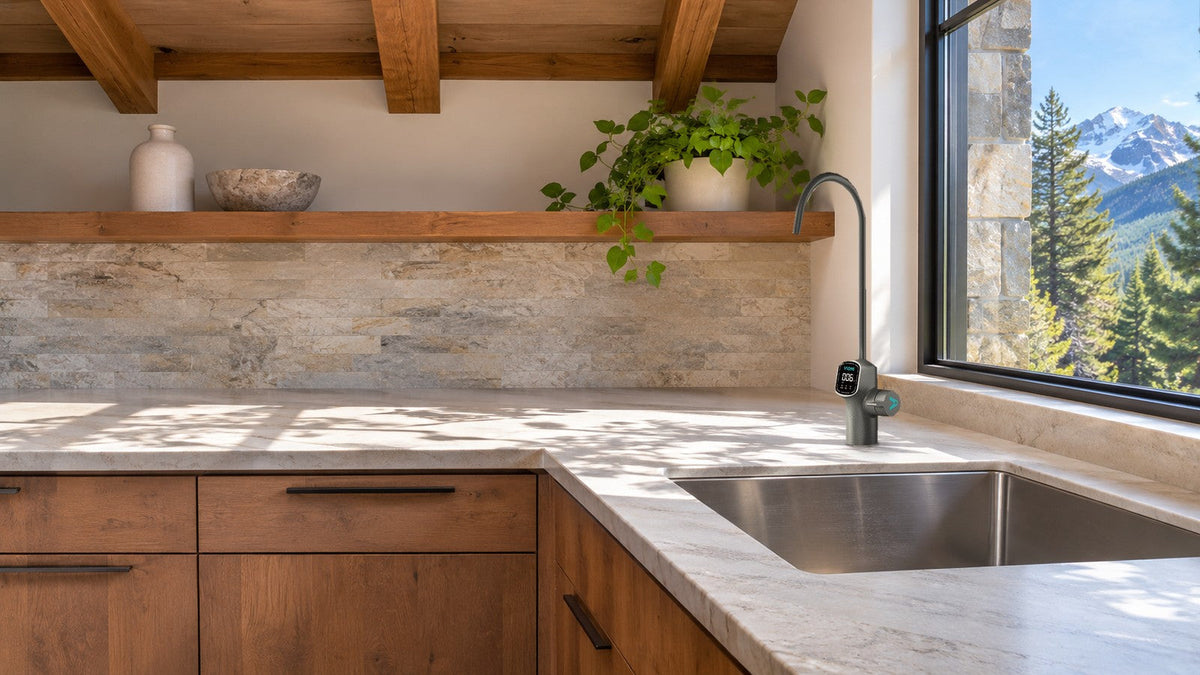
A faucet-fed system changes the everyday routine of getting filtered water, from refilling a pitcher to opening a tap. The Viomi M1, a tankless reverse osmosis (RO) system whose SGS testing shows lead reduction above 99.87%, fills a cooking pot at its dedicated faucet without waiting for a tank or a refill, and its mineral stage adds selected naturally sourced minerals back for taste. The same faucet shows remaining filter life, and the app sends a reminder when a cartridge is due, so cartridge timing arrives as a prompt from the system itself.
Some households would rather see the TDS reading each time they pour. The Viomi V6 PRO does that on its LED faucet and is also SGS-tested with lead among its targets.

FAQ
What happens after the map shows a possible lead service line?
The property is already enrolled. Denver Water investigates the line's material, and if it is lead, schedules replacement with copper at no direct charge. Proving a line is not lead takes more than one investigative method, so the check can involve several steps. In the meantime the household uses the program pitcher for drinking and cooking water.
How long after replacement does the pitcher stay in use?
Six months. Denver Water keeps mailing replacement filters through that period, and the brochure asks households to keep using the pitcher until it ends.
Can the free lead test be taken from a kitchen faucet with a filter on it?
No. The sample has to come from a kitchen faucet with no filtration device or treatment system attached, so the result reflects water from the plumbing itself.
Should a household keep filtering once the program period ends?
That becomes a household choice. Denver Water's 2026 report suggests following the maintenance schedule for whatever filter the home uses, whether a pitcher, faucet-mounted, under-sink or refrigerator filter, and notes that the results of a water quality test may help a household decide whether to keep using one.
Where do the program's six-month filters come from?
Denver Water mails them to the property free of charge, and it will send an extra replacement outside the normal schedule if one is needed.
When the Next Denver Water Letter Arrives
In Denver, the pitcher stays in use until the copper line goes in and for six months after, and those six months count from the actual replacement date, not from the year shown for the neighborhood in the construction outlook. That replacement date is the one to keep with the property's water records, and a removal letter, if one arrives instead, belongs in the same file, since it marks the point where the program's part for that address ends.
Share:
Arsenic and RO: Matching Your Water Test to the Performance Claim
How to Choose Useful Water Filter Comparison Sources