

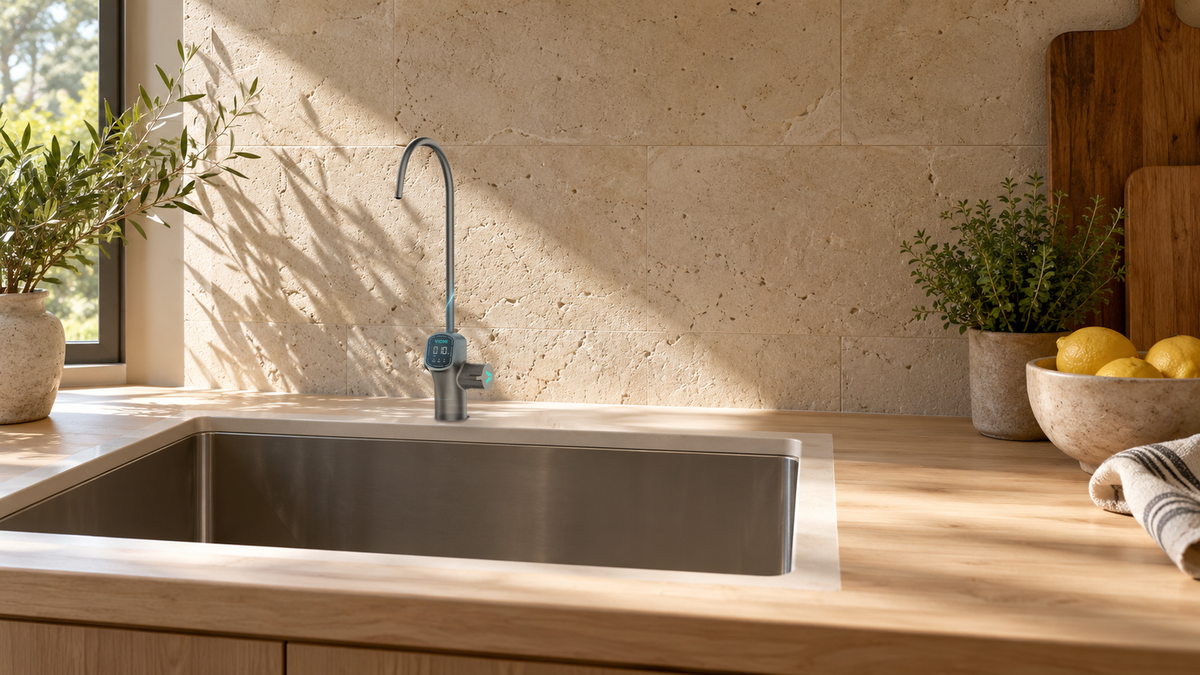
Dallas tap water is treated surface water from the Elm Fork of the Trinity River and lakes Ray Roberts, Lewisville, Grapevine, Ray Hubbard, Tawakoni and Fork, and Dallas Water Utilities (DWU) disinfects it with chloramine; its 2025 report lists an average total chlorine residual of 2.97 ppm. A Dallas kitchen has two levels of treatment to choose from: carbon for taste at the existing tap, or reverse osmosis (RO) for lower dissolved solids. For drinking and cooking water, the Viomi V8 PRO is a strong match because its LCD smart faucet shows purified-water TDS as you pour, and the Viomi Under-Sink Water Filtration System (VM-IUO1PCW-L-US) suits a home that would rather keep its existing faucet.
Chloramine Sets the Carbon Requirement
Dallas water is disinfected with "chlorine and ammonia (which combines to make chloramine)," in the words of DWU's water quality information page, and DWU chose chloramine over chlorine alone to limit byproducts such as trihalomethanes that chlorine can form. The total chlorine residual averaged 2.97 ppm, within a range of 2.75 to 3.18 ppm and under a maximum residual disinfectant level of 4 ppm, according to the City of Dallas 2025 Water Quality Report. That 2.97 ppm average sits about 1 ppm below the 4 ppm maximum. The report also states that DWU's water meets or exceeds all state and federal requirements, and TCEQ rates the system "Superior."
"The most effective nonchemical method for removing chloramines is by activated carbon," according to the Water Quality Association's chloramine fact sheet, and removing them "improves the taste and odor of drinking water."
Catalytic carbon is also the common core of two whole-house systems that apply that idea at the main water line. The Aquasana Rhino Chloramines uses an upgraded carbon formulated for chloramines and chlorine, backed by independent test results Aquasana publishes for its chloramine and chlorine reduction, while SpringWell pairs the catalytic carbon in its CF with KDF and sediment filtration and describes the combination as removing chlorine and chloramine from city water.
A whole-house system treats shower and laundry water as well. For the water you drink and cook with, a point-of-use system at the kitchen sink treats that one tap. A household deciding between them can start from where the problem shows up: a taste only at the drinking glass points to the kitchen sink, while a smell in the shower as well points to the main line. A separate comparison of water filter brands for chlorine removal sorts more carbon options by where the filter goes. For a renter, a pitcher or a direct-connect filter at the kitchen faucet handles chlorine taste and odor in drinking water without any change at the main line.
Earthy Taste in Summer and Early Fall
Every Dallas source is a river or reservoir, so the water shifts a little with the seasons. In the summer and early fall, "algae in area lakes occasionally give water an earthy taste and odor," according to DWU's utility FAQ; temperature changes and heavy rain can also alter taste, and these changes do not affect the safety of the water. The annual report draws the same line, describing taste, color and odor findings as not necessarily a cause for health concerns. DWU itself uses activated carbon at its plants "to control offensive tastes and odors," the same principle a home carbon filter applies at the tap. Ozone also appears on its water quality information page, alongside chlorine and ammonia among the disinfection tools. A household that notices the earthy note only in those months is seeing the pattern DWU describes, and the decision it faces is about taste at the drinking tap, which is where a carbon filter does its work.
A direct-connect carbon filter improves taste at the faucet a household already uses, and two filters take that approach without electricity: the Viomi Under-Sink Water Filtration System (VM-IUO1PCW-L-US) and Waterdrop's 15UA, with a 0.5-micron carbon filter. The Viomi unit sits on the cold-water line under the sink and sends filtered water out of your existing kitchen faucet, with no countertop hole. Its carbon cartridge is what reduces chlorine and unpleasant tastes and odors at that faucet. On municipal water, one cartridge lasts up to 12 months before a tool-free change.
Renters who can't change any plumbing can keep a pitcher in the fridge instead; Brita's Standard filter (OB03) targets chlorine taste and odor, is rated for 40 gallons and is replaced about every 2 months.
Dissolved Minerals the Dallas Report Doesn't Print
Hardness and total dissolved solids (TDS) figures are not printed in DWU's annual report. Its treatment page does note that DWU adds lime and iron sulfate to remove suspended solids and for corrosion control. For a Dallas household, that leaves the dissolved-solids level of its own tap water as a question the annual report does not answer. The distinction matters when choosing a filter: removing suspended solids at the plant is a different job from lowering dissolved solids, and the second is the one a kitchen RO system takes on.
TDS measures the total of dissolved solids in water. Its link to taste is laid out in the World Health Organization's background document on TDS: taste panels rate water under 300 mg/L as excellent and 300 to 600 mg/L as good, and the document proposes no health-based guideline value for TDS. Lowering dissolved solids is the work of reverse osmosis, which EPA's secondary standards guidance describes as effective for removing chloride, total dissolved solids and other inorganic substances. A kitchen RO system pairs the membrane with carbon stages for chlorine taste and odor.
The Viomi V8 PRO builds that pairing into one tankless unit: pre-activated carbon absorbs chlorine and unpleasant odors, and the RO stage lowers the dissolved solids that its LCD smart faucet reports as purified-water TDS each time you pour. Since the annual report leaves TDS out, that display gives a Dallas household a dissolved-solids figure for its own drinking water.

The same faucet also shows filter life. A spare PCB filter comes in the box, so the first prefilter change is already on hand. The PCB filter lasts 1 year and the RO filter 2 years.
The faucet, fittings and tubing come in the box, and a step-by-step installation video walks through the setup under a standard kitchen sink. For the parts that touch your water, Intertek has authorized the NSF/ANSI/CAN 372 mark for the Viomi V8 PRO, covering their lead content. The Viomi V8 PRO can also send purified water through standard tubing to a compatible refrigerator or ice maker, so ice and chilled water come from the same filtered supply.

Households that like minerals in their drinking water have a tankless alternative in the Viomi M1, which returns selected naturally sourced minerals to the water after purification. Its HD touchscreen smart faucet handles one-touch dispensing and shows live TDS readings and filter life. Those who prefer a storage tank can compare the iSpring RCC7, a 5-stage under-sink RO with a 3.2-gallon tank.
Dallas Households and the Systems That Fit Them
| Dallas household | System type | Brand and model | What it changes |
|---|---|---|---|
| Homeowner who wants RO water for drinking and cooking | Tankless under-sink RO | Viomi V8 PRO | Carbon for taste, RO for lower TDS, TDS shown on the faucet |
| Home that wants minerals added back after RO | Tankless under-sink RO with remineralization | Viomi M1 | RO water with selected minerals returned |
| Keeping the existing kitchen faucet | Direct-connect carbon | Viomi Under-Sink Water Filtration System (VM-IUO1PCW-L-US); Waterdrop 15UA | Chlorine taste and odor at the main faucet |
| Preferring an RO with a storage tank | Under-sink RO with storage tank | iSpring RCC7 | Lower TDS from a tank system |
| Renter who wants a fridge-shelf option | Pitcher | Brita Standard (OB03) | Chlorine taste and odor, kept in the fridge |
| Chloramine at every tap, showers included | Whole-house catalytic carbon | Aquasana Rhino Chloramines; SpringWell CF | Chloramine and chlorine at the main line |
A whole-house carbon system for showers and laundry and a kitchen system for drinking water can run in the same home. In the kitchen, a carbon filter on the cold line treats chlorine taste and odor through the faucet you already have, and an RO system lowers dissolved solids as well. The Viomi V8 PRO shows that TDS figure on its LCD faucet each time you pour, and the Viomi M1 adds selected minerals back for those who like them in their water.
FAQ
Does chloramine call for a carbon filter or an RO system?
WQA names activated carbon as the most effective nonchemical method for removing chloramine, and whole-house catalytic carbon such as the Aquasana Rhino Chloramines or SpringWell CF carries that treatment to every faucet. An RO system adds a membrane that lowers dissolved solids in the water you drink, and the two can work side by side in the same house.
Is Dallas water hard?
DWU's 2025 Water Quality Report doesn't publish a hardness value; its treatment page notes that lime is added to remove suspended solids and for corrosion control. For drinking water, an RO system lowers hardness minerals along with other dissolved solids at the kitchen tap.
What can a Dallas renter use in the kitchen?
A pitcher needs nothing but fridge space. A direct-connect filter such as the Viomi Under-Sink Water Filtration System (VM-IUO1PCW-L-US) or the Waterdrop 15UA attaches at the cold-water valve under the sink and filters water through the faucet already there, with no countertop hole and no electricity.
Where does the earthy taste in late summer come from?
DWU traces it to algae in area lakes, which occasionally give the water an earthy taste and odor in summer and early fall, and says these changes do not affect the safety of the water. Activated carbon, which DWU uses at its own plants to control tastes and odors, is also the home filter stage aimed at taste and odor.
DWU's Annual Report and Contact Lines
Each year DWU publishes its Water Quality Report with the source list, the disinfectant residual and detected contaminants, while its water quality information page lists the treatment methods DWU uses, from disinfection to corrosion control. General questions go to 3-1-1, the City of Dallas information line, and taste, odor or color questions to DWU's water quality line, 214-670-0915, both listed in the report.
For more local reading, a guide to under-sink water filters in Dallas covers dealer installs, store shelves and online delivery across the metro, and a statewide look at Texas water by utility and source sets Dallas beside Houston, Austin and San Antonio.
Share:
Tankless RO Alternatives to the Water-Right InterFlo QuadPro SST, and the Labor-Warranty Question
Water Treatment Brands in Texas: Local Dealer Networks and Direct-Ship Lines