

Summary: Most reverse osmosis (RO) systems “wake up” at night because pressure in the storage tank or plumbing drops slightly, telling the unit it needs to top off or flush the membrane—not because something is broken. A quick check for slow leaks and understanding your model’s auto‑flush features usually resolves any truly abnormal nighttime running.
How Your RO System Decides When To Run
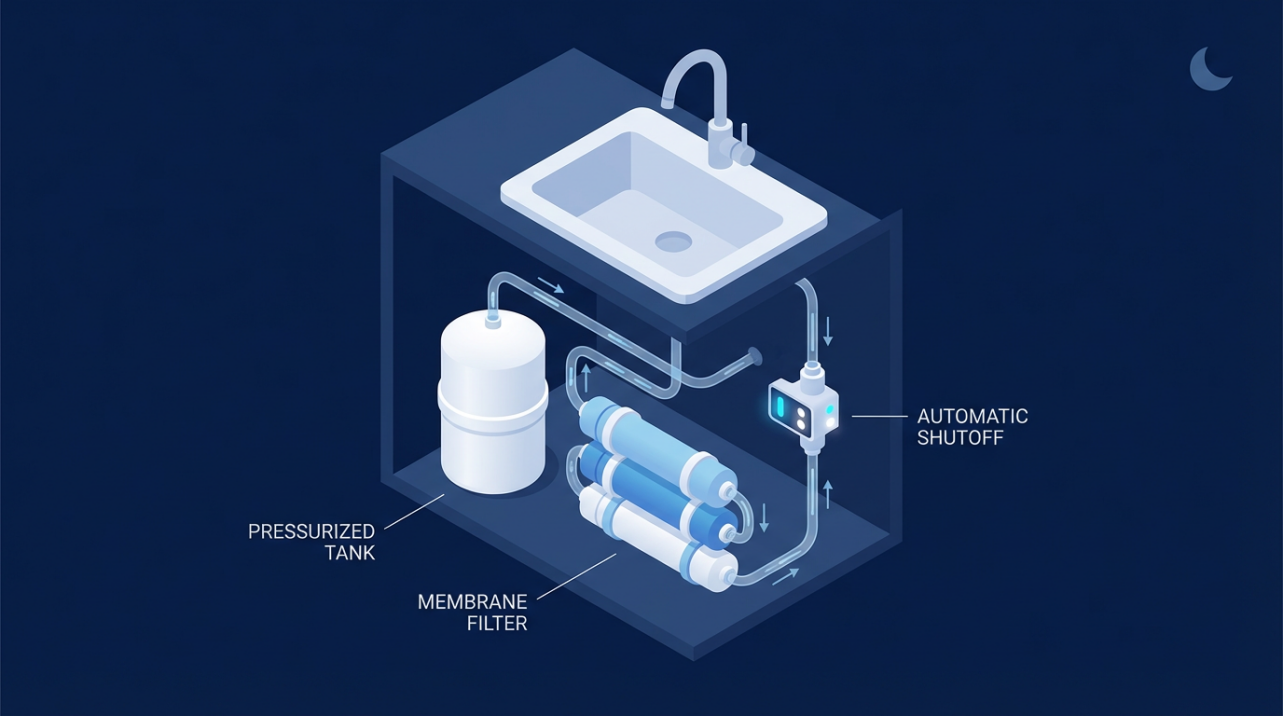
Home RO units are surprisingly simple under the hood. As Nebraska and Massachusetts Extension guides explain, an RO system pushes tap water through a semi‑permeable membrane, then stores the treated water in a small pressurized tank (often about 2–5 gallons).
The system does not run on a timer. It runs when:
- Tank pressure falls below a set point.
- You open the RO faucet (or your fridge/ice maker calls for water).
An automatic shutoff valve senses when the tank is “full enough,” then stops feed water. When pressure drops again, it reopens and your RO starts producing water until the tank is topped off.
If your model has a booster pump, you’ll hear that pump whenever the system is actively making water. If it is a basic, non‑pumped unit, you may hear only a faint trickle to the drain.

Why It Activates At Night
From a water‑wellness standpoint, most nighttime activation is normal and even helpful. Here are the common triggers I see in homes:
- Catching up after evening use: You fill bottles, cook dinner, or make coffee for the next day in the evening. The tank may still be refilling for an hour or two afterward, which can push production into late night.
- Tiny pressure changes in the plumbing: Municipal pressure often rises and falls overnight. Those changes can slightly lower tank pressure relative to the feed line, tricking the shutoff valve into “thinking” the tank needs a top‑off.
- Slow, almost invisible leaks: A very small drip at the RO faucet, fridge connection, or ice maker can slowly bleed tank pressure, causing frequent short cycles—often noticeable when the house is quiet at night.
- Smart auto‑flush or self‑cleaning cycles: Some newer RO systems and solar‑powered units (as described by Elemental Water Makers and research in MDPI journals) periodically flush the membrane to limit fouling. Manufacturers often schedule these brief flushes during low‑use hours, which can be late evening or night.
- Temperature and flow effects: As university Extension sources note, RO membranes produce less water when feed water is colder (for example around 45°F vs 77°F). That slower production can extend run time, so a system that started refilling after dinner may still be running close to bedtime.

In most cases, these cycles are your RO quietly doing its job so you wake up to a full tank of clean water.
Is Nighttime Running Bad For The System?
For a properly designed residential RO, occasional night operation is not harmful. DrinkPrime and Livpure both recommend leaving domestic RO units powered and connected, since:
- You always have a full tank ready for morning use.
- Water in the tank does not sit stagnant for long.
- Modern units use little electricity in standby; the pump only draws power while running.
The real trade‑offs are:
- Water use: Traditional under‑sink RO can send about 3–4 gallons of concentrate to drain for each gallon of purified water, according to UMass and Nebraska Extension. Extra, unnecessary cycles mean extra water waste.
- Component wear: Every start‑stop adds a bit of wear on valves, pumps, and filters. Occasional night operation is fine; constant short cycling is not.

Nuance: Research on intermittent, solar‑powered RO shows that pressure fluctuations can sometimes reduce scaling on membranes, but that is a specialized scenario. For typical kitchen systems, you want steady, purposeful operation—not endless refilling from tiny leaks.
What To Check If It Runs Often At Night
If your RO seems to run every night, or for very long periods, a quick health check is worthwhile:
- Step 1: Listen and time it. A run of 30–60 minutes after heavy use is normal; multiple starts with no obvious water use point to a slow leak or a control issue.
- Step 2: Check the RO faucet and fridge line. Look for any drips at the dedicated faucet, under‑sink connections, or refrigerator/ice maker line. Even a damp fitting can slowly drop tank pressure.
- Step 3: Feel the storage tank. When the RO faucet has been off for a while, the tank should feel heavy and firm (pressurized). If it never seems “full,” your tank air charge, membrane, or shutoff valve may need service.
- Step 4: Review your manual for auto‑flush settings. Some smart RO or whole‑home systems allow you to change the timing of self‑cleaning cycles to earlier in the evening.
- Step 5: Do a simple isolation test. Before bed, close the feed valve to the RO unit. If the noise stops completely until you reopen it in the morning, the issue is inside the RO system—not in the rest of the plumbing.
As a Smart Hydration Specialist, my rule of thumb is simple: if your RO runs briefly after you use water and then stays quiet, you can relax. If it runs frequently when no one is using water, especially at night, it is worth a quick inspection or a call to a trusted water‑treatment professional to protect both your hydration routine and your equipment.

References
- https://extension.unr.edu/publication.aspx?PubID=4785
- https://www.academia.edu/128347989/Basics_of_Reverse_Osmosis
- https://www.energy.gov/femp/cooling-water-efficiency-opportunities-federal-data-centers
- https://pmc.ncbi.nlm.nih.gov/articles/PMC10785276/
- https://faculty.mccormick.northwestern.edu/richard-lueptow/docs/jms-lee-rro-01.pdf

Share:
Understanding Valve Failure Indicators in Smart Home Water Systems
Three Early Signs of Wastewater Pipe Blockage to Watch For