

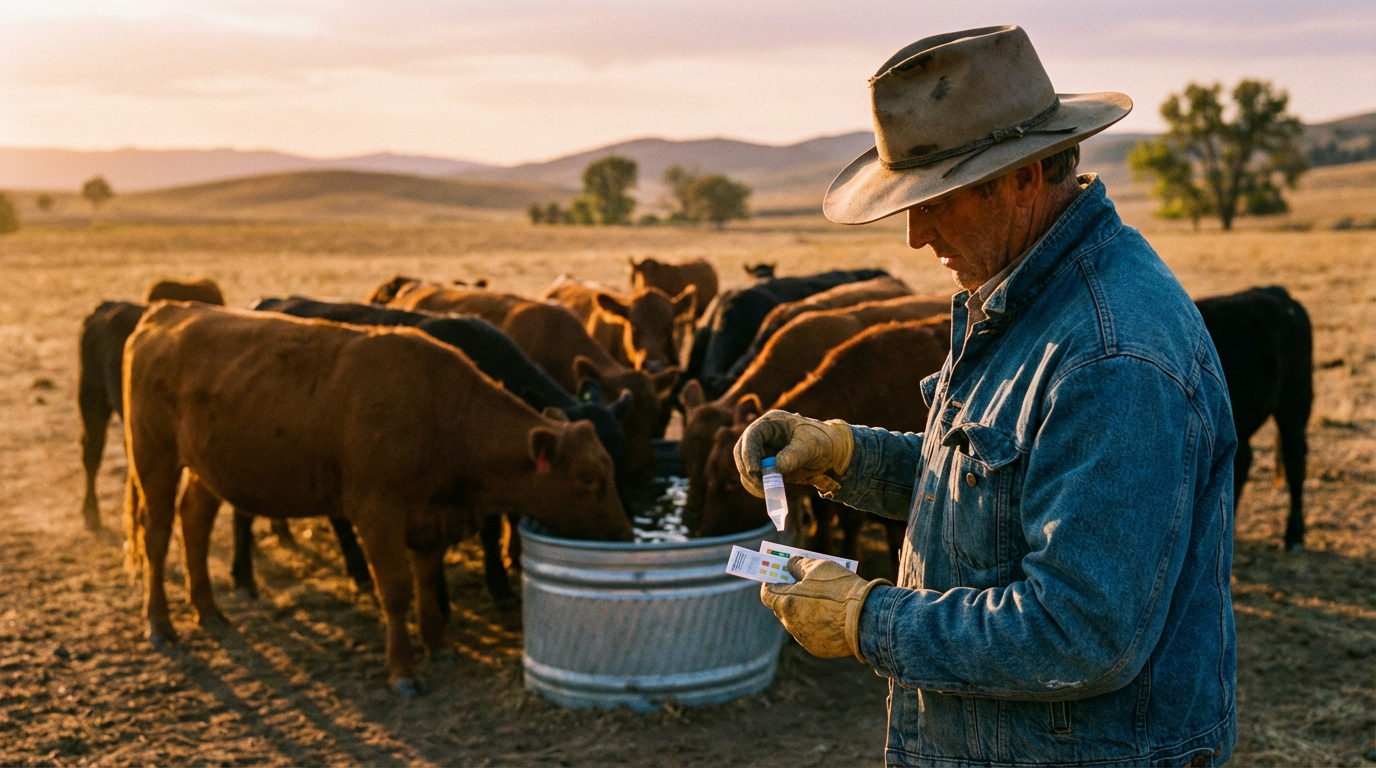
Summary: To protect your herd and your family, pair regular nitrate testing with smart field management and targeted water treatment so contaminated wells and ponds become safe, reliable hydration sources again.
Understanding Nitrate Risk Around Livestock
Nitrate itself is not the true toxin; in the rumen it is converted to nitrite, which can turn normal hemoglobin into methemoglobin that cannot carry oxygen. That is why animals poisoned by nitrate effectively suffocate from the inside out, as described by Montana State University Extension and the Merck Veterinary Manual.
Water is often the “silent partner” in nitrate intake. Montana guidelines suggest that drinking water under about 10 ppm nitrate‑nitrogen (NO3‑N), roughly 44 ppm nitrate (NO3), is generally safe for all animals and people. As levels climb above 40 ppm NO3‑N (about 176 ppm NO3), water alone can become risky when combined with high‑nitrate feed.
Think about a 1,000 lb cow drinking 10 gallons per day from a well at 40 ppm NO3‑N. That animal takes in roughly 1.5 grams of nitrate‑nitrogen from water alone, before you count any nitrate in forage or silage. Total daily intake from feed plus water is what drives toxicity.
Chronic, low‑grade exposure matters too.

Dairy and beef research summarized by Wisconsin and Oregon State Extensions shows that sub‑toxic nitrate levels can still reduce fertility, weight gain, and milk production over time, even when no animals drop dead.
Step 1 – Test Water, Feed, and Total Intake
On many farms I evaluate, the biggest gap is not technology—it is data. Nitrate levels in both water and forage can swing quickly after drought, frost, or heavy fertilization, so one “good” test from last year is not enough.
Build a simple testing routine anchored to your local lab or veterinary clinic. Shallow, older, or dug wells near feedlots, manure piles, or septic systems deserve priority, because studies in North America and Europe consistently show higher nitrate in these locations than in deep, drilled wells.
Quick testing plan:
- Test each livestock well at least once a year and again after very wet periods or drought‑ending rains.
- Sample suspect ponds, ditches, and shallow wells that collect runoff from corrals, lagoons, or fertilized fields.
- Test high‑risk forages (drought‑stressed corn, small grains, sorghums, millets, weedy hay) before feeding, as recommended by Montana and Oklahoma State Extension.
- Ask labs to report both nitrate (NO3) and nitrate‑nitrogen (NO3‑N) on a dry‑matter basis so you can compare results to extension guidelines.

Work with your nutritionist or veterinarian to add water‑borne nitrate into ration calculations. A feed that looks “borderline” on paper can become dangerous once you factor in a high‑nitrate well.
Step 2 – Reduce Nitrate Leaching From Fields and Facilities
You can’t filter your way out of every problem. The most cost‑effective nitrate treatment starts upstream—in the soil and around the livestock yard.
Nutrient‑management research from Penn State and the EPA emphasizes the “4Rs”: apply fertilizer and manure at the right rate, at the right time, in the right place, using the right source. Avoid heavy nitrogen applications ahead of big rain events, and do not spread on frozen or saturated ground.
Cover crops are a powerful tool. Long‑term Wisconsin trials show that overwintering cereal cover crops like rye or triticale can capture a large share of the nitrate that would otherwise leach during fall and spring, often cutting losses by 30–70% in well‑managed systems. Choosing slightly earlier‑maturing cash crops can open up planting windows for these covers.

Around barns, lagoons, and feedlots, the groundwater review literature highlights the importance of lined manure storages, well‑drained and well‑maintained pads, and good runoff control. Saturated buffers, constructed wetlands, and woodchip bioreactors along tile outlets and ditches—tested by USDA‑ARS and Midwestern universities—let microbes convert nitrate to harmless nitrogen gas before it reaches streams.
Nuance: Newer dairy research suggests cattle may tolerate more nitrate than older tables indicate, but most extension services wisely keep their recommendations conservative to protect pregnant animals and high‑value stock.
Step 3 – Treat Drinking Water and Protect Your Herd
Even with strong prevention, some livestock areas sit on chronically elevated nitrate aquifers. In those cases, point‑of‑use and point‑of‑entry treatment become your safety net for both barns and homes.
For single taps (like a calf barn kitchen or farmhouse sink), reverse osmosis (RO) systems can remove a large fraction of nitrate and many other contaminants. For whole‑barn or whole‑property protection, larger RO or ion‑exchange units—similar to systems promoted by farm‑oriented water‑treatment companies—can be sized to handle several gallons per minute and protect all drinkers and faucets.
Quick treatment options:
- Blend: If you have one clean and one high‑nitrate source, controlled blending can bring levels below target—verify with lab testing.
- Point‑of‑use RO: Ideal for drinking water for people, young stock, and hospital pens.
- Whole‑farm ion exchange or RO: Best where all wells are moderately to heavily contaminated.
- Interim measures: Trucked‑in water or access to a shared safe well while you design long‑term treatment.
At the same time, follow livestock‑specific guidance from Montana, Wisconsin, and Oklahoma State: introduce high‑nitrate feeds gradually, dilute them with low‑nitrate forage or grain, split them into smaller meals, and never move hungry animals straight onto suspect pasture or green‑chop. In an acute poisoning event, rapid veterinary treatment with methylene blue can save lives, but prevention through smart water and feed management is far more reliable.

Taken together—testing, source control, and targeted filtration—these strategies allow you to turn nitrate from a silent liability into a managed risk, while giving every animal on the farm truly safe water to drink.
References
- https://go.unl.edu/bjdf
- https://www.epa.gov/nutrientpollution/sources-and-solutions-agriculture
- https://extension.missouri.edu/publications/g9800
- https://extension.okstate.edu/fact-sheets/nitrate-toxicity-in-livestock.html
- https://extension.oregonstate.edu/catalog/beef-144-nitrate-toxicity-beef-cattle

Share:
Effective Pre-Treatment Solutions for Oil-Contaminated Water RO Systems
Effective Solutions for Low Water Pressure Areas Under 0.2 MPa