

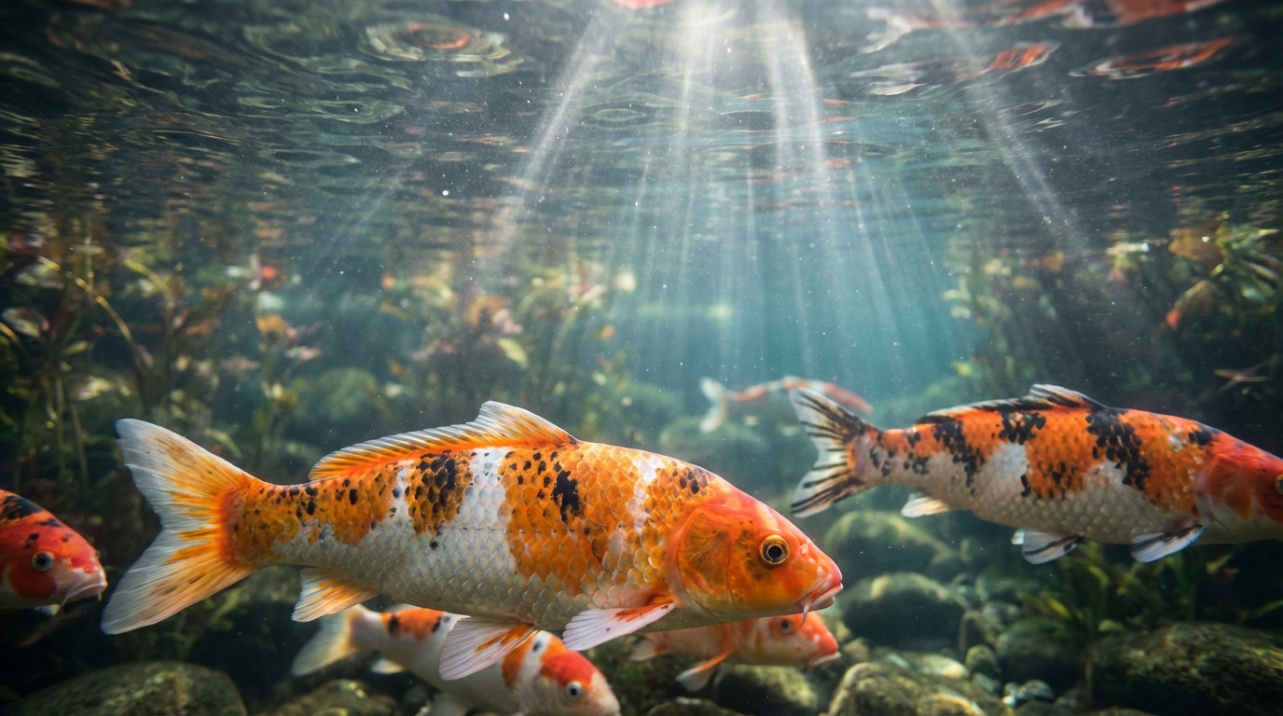
As a Smart Hydration Specialist, I look at a koi pond the same way I look at a home drinking‑water system: the fish are only as healthy as the water they live in every single day. Reverse osmosis (RO) gives you fine control over that water, but it also removes the natural “safety rails” that hard, buffered tap water provides. To enjoy the benefits of RO without unexpected crashes, you need clear targets and a simple maintenance plan.
This guide walks through the ideal water parameters for koi when you use RO or RO‑blended water, how those targets were established in real ponds and labs, and how to keep them stable in practical day‑to‑day care.
Why Koi Keepers Reach For RO In The First Place
Most koi ponds run on treated tap water. For many owners, that works well: sources like KoiSale, Aquatic Gardens USA, and Complete Koi all show that koi thrive in moderately hard, slightly alkaline water as long as ammonia and nitrite stay at zero and nitrates are controlled with water changes and good filtration.
However, tap water is not the same everywhere. In some regions, hobbyists report very high carbonate hardness (KH) and total hardness, with pH locked high and nitrates already elevated right out of the faucet. Contributors on Koiforum describe KH in the 10–12 dKH range with pH around 8.2–8.6 as typical mains water. Many koi do fine in that, but it limits fine‑tuning and increases the toxicity of any ammonia that appears.
Experienced koi keepers on Koiforum note that reverse osmosis is the only realistic way to significantly lower KH and pH when you start with very hard mains water. RO membranes strip out most dissolved minerals and nitrogen compounds, giving you low‑mineral water that you can blend with tap water or selectively remineralize. In other words, RO turns your source water into a blank canvas.

The other main driver is nitrate control. Multiple sources, including KoiSale, LiveAquaria, Clear Pond, Penn State Extension, and iMountainTree, emphasize keeping nitrate as low as reasonably possible. A common pattern is to aim below roughly 20 parts per million (ppm) and treat anything above that as a sign that larger or more frequent water changes are needed. RO water typically has negligible nitrate, so every RO‑based water change pulls pond nitrate down more effectively.
The trade‑off is that RO also removes the very minerals that buffer pH and support koi osmoregulation. That is why using RO for koi is less about “pure water” and more about building an ideal mineral profile on top of a very clean base.
Baseline Ideal Water Parameters For Koi (With Or Without RO)
Koi physiology does not change just because you use an RO unit. The ideal parameter ranges are the same; RO simply makes it easier to hit and hold them, especially in areas with extreme tap water.
Pulling together guidance from KoiSale, LiveAquaria, Aquatic Gardens USA, Complete Koi, PetMD, Clear Pond, iMountainTree, Penn State Extension, and others, a consistent picture emerges.
Here is a concise reference table for healthy koi ponds, assuming a mature biological filter and regular testing.
Parameter |
Healthy Target Range |
Notes and Supporting Sources |
Ammonia (NH₃/NH₄⁺) |
0 ppm; keep under about 0.1 ppm even during spikes |
KoiSale, Penn State, Clear Pond, Complete Koi, LiveAquaria |
Nitrite (NO₂⁻) |
0 ppm |
KoiSale, LiveAquaria, Clear Pond, Complete Koi |
Nitrate (NO₃⁻) |
Preferably under 20 ppm; never let it climb high long‑term |
Penn State (<20 ppm), iMountainTree (<20 ppm), Clear Pond (~<40 ppm), KoiSale (water change above 20 ppm), LiveAquaria (<60 ppm) |
pH |
Roughly 7.0–8.5, stable; practical sweet spot 7.2–8.0 |
KoiSale, Complete Koi, Aquatic Gardens USA, Grassroots Pond and Garden, LiveAquaria |
Carbonate hardness (KH) |
At least about 4 dKH; many sources favor moderate 4–8 dKH; advanced RO users may deliberately run lower |
Complete Koi (4–6 dKH), Koiforum (≥4 dKH for stability; some advanced systems just under 2 dKH), Sacramento Koi (90–120 ppm alkalinity) |
General hardness (GH) |
Moderately hard, roughly 100–300 ppm |
Aquatic Gardens USA (100–250 ppm), Penn State (150–300 ppm), Complete Koi (4–6 dGH), iMountainTree (100–500 mg/L hardness) |
About 7–8 mg/L or higher; never allow sustained values below 6 mg/L |
Aquatic Gardens USA (≥6 mg/L), LiveAquaria (≥8 mg/L), iMountainTree (~7.0–7.2 mg/L), multiple aeration‑focused articles |
|
Temperature |
Roughly mid‑60s to mid‑70s °F for active growth; avoid rapid swings and upper‑80s stress |
Aquatic Gardens USA (65–75°F), PetMD (64–75°F), Premier Ponds (59–77°F), iMountainTree (75–82°F), KoiSale (tolerant but sensitive to fast change) |
Salinity |
Optional low salt around 0.1% when used |
KoiSale (0.1% sea‑salt), LiveAquaria (0.1% in salted ponds), iMountainTree (0–5 ppt permissible) |
Alkalinity (as buffering) |
Roughly 90–120 ppm for a strongly buffered pond |
Sacramento Koi (90–120 ppm target, crash risk around 30 ppm), Penn State (40–120 ppm acceptable) |
Different authors place slightly different emphasis, but the overlap is striking: ammonia and nitrite should always be zero, nitrate should stay as low as you can practically maintain, pH should sit somewhere around the neutral‑to‑slightly‑alkaline band and stay there, and the water should be moderately hard and well oxygenated.
From a water‑treatment perspective, RO does not change those targets. It simply gives you room to choose where in each band you want to sit and helps you get there even when your tap water does not naturally cooperate.
How RO Changes The Game On pH, KH, And Hardness
On ordinary tap water, pH is largely dictated by your municipal supply and your carbonate hardness. Grassroots Pond and Garden, Complete Koi, and Aquatic Gardens USA all show that real‑world ponds often sit in the 7.0–8.5 band. Many hobbyists never touch RO and keep koi for decades at pH around 8.2 with KH around 10–12 dKH, as described by long‑term koikeepers on Koiforum.
Those ponds work because a high KH acts as a strong buffer. Sacramento Koi explains that alkalinity is essentially the water’s bicarbonate reserve and recommends around 90–120 ppm to prevent pH crashes. They point out that when alkalinity sinks toward 30 ppm, pH becomes unstable and can swing sharply, stressing both koi and the bacteria in your filter. Their dosing example shows that in a 3,000‑gallon pond, raising alkalinity from 30 ppm to 100 ppm requires about 49 ounces of baking soda, and thanks to the chemistry of bicarbonate, the pH self‑limits around 8.3 rather than climbing endlessly.
When you introduce RO, you are deliberately stripping away much of that natural buffering. That allows two different strategies.
The first strategy is to keep a relatively robust KH by blending RO with tap water and, if needed, adding buffers such as baking soda or mineral media. This is the approach most consistent with Complete Koi’s recommended 4–6 dKH, Sacramento Koi’s 90–120 ppm alkalinity, and the Koiforum guidance that everyday ponds are safest when KH stays at least around 4 dKH. You still enjoy reduced nitrate and overall dissolved solids compared to straight tap water, but you are not flirting with ultra‑soft, ultra‑low‑KH water where a filter hiccup can cause a rapid pH crash.
The second strategy is what some advanced keepers discuss on Koiforum: using RO to mimic the softer, lower‑TDS conditions of famous Japanese mud ponds. In those examples, they often run KH just under about 2 dKH and keep pH around the mid‑7s, for instance near 7.3. That sits nicely inside the 7.0–8.5 band supported by KoiSale, Complete Koi, Aquatic Gardens USA, and LiveAquaria. The trade‑off is that they must test KH and pH very frequently because biological filters consume carbonate, especially at warm temperatures and heavy feeding, and a pond with KH near 2 dKH can slide quickly if you do not replenish bicarbonate.
From a hydration‑systems mindset, a sensible starting point for a first RO‑blended koi pond is a moderate buffer: pH in the neighborhood of 7.2–7.8 with KH around 4–8 dKH and GH roughly 150–250 ppm. That sits comfortably within the ranges supported by KoiSale, Complete Koi, Aquatic Gardens USA, iMountainTree, and Penn State, while giving you enough buffering to resist sudden pH swings. As you gain experience, you can fine‑tune within that window based on your fish, your filter, and your local climate.
One practical note from Sacramento Koi is worth repeating: whatever target you choose, when KH does sag and pH begins to crash, baking soda is a safe emergency tool. Because pH naturally caps around 8.3 in bicarbonate‑buffered water, you can add a generous dose in a crisis to stop a crash and bring pH into a safe, slightly alkaline zone without painstakingly measuring each ounce.
Nitrogen Control In RO‑Based Systems
Reverse osmosis does not touch the fish waste going into the pond. It only affects the water you add. That means the nitrogen cycle remains the central driver of koi health, and RO’s main contribution is that your change water starts cleaner.
Clear Pond, Complete Koi, and Charlotte Backyard Ponds all describe the same nitrogen story. Fish and decomposing food produce ammonia, which is highly toxic even in low concentrations. Nitrosomonas bacteria convert ammonia to nitrite, which is also toxic. Other bacteria convert nitrite to nitrate, which is less immediately dangerous but accumulates over time.
KoiSale and LiveAquaria both insist that acceptable ammonia and nitrite levels are essentially zero. KoiSale notes that death can occur around 0.15 ppm ammonia and recommends keeping levels under 0.1 ppm even during the start‑up of a biofilter. Penn State’s pond‑lesson materials set the target for ammonia under 0.1 ppm as well. In a laboratory context, a study of koi infected with koi herpes virus published in the Journal of Physics: Conference Series found that ammonia levels around 0.37 mg/L exceeded aquaculture standards and coincided with serious gill damage, even though other parameters such as temperature, pH, and dissolved oxygen were technically within reference limits. That kind of evidence is why experienced keepers treat any measurable ammonia as urgent.
For nitrate, several authors converge on a “lower is better” view. Penn State and iMountainTree both place ideal koi‑pond nitrate below about 20 ppm. Clear Pond suggests staying under roughly 40 ppm. KoiSale recommends using a 40–50% water change or a detoxifier product once nitrate climbs above about 20 ppm, and LiveAquaria warns against allowing nitrate to approach 60 ppm. That cluster of recommendations is strong support for using RO‑based water changes to keep nitrate consistently low.
Here is where RO shines. If your tap water already carries 20–40 ppm nitrate, every ordinary water change hits a ceiling. You can dilute, but you cannot get below the incoming nitrate level. When you feed an RO unit, your replacement water starts near zero nitrate. In practice, this means that the same 40–50% water change recommended by KoiSale when tests show elevated nitrate can bring readings down far more effectively than with raw tap water.
What RO does not change is the need for robust biological filtration and good housekeeping. Clear Pond, Premier Ponds, and iMountainTree all point out that the first line of defense against ammonia spikes is a mature biofilter and sensible feeding, followed by immediate partial water changes, debris removal, and the addition of beneficial bacteria when needed. RO water simply makes every one of those corrective moves more potent by ensuring that what you add is not bringing more nitrates or unwanted minerals with it.
Oxygen, Temperature, And Flow: The “Hydration Dynamics” Of A Koi Pond
In drinking‑water work, we talk about both chemistry and hydraulics. Ponds are the same. Even perfect RO‑blended chemistry will not save koi in hot, stagnant water.
Aquatic Gardens USA recommends at least 6 mg/L dissolved oxygen for koi, and LiveAquaria suggests aiming even higher, around 8 mg/L or more. iMountainTree’s guide to koi water quality uses a similar target of roughly 7.0–7.2 mg/L. Several sources, including KoiSale and Premier Ponds, also note that large koi with heavy feeding and abundant organic debris consume oxygen quickly. Warm water naturally holds less oxygen, so a pond that is safe at 65°F can become marginal at 80°F if aeration is not increased.
Temperature advice is also consistent across major references. Aquatic Gardens USA and PetMD describe a comfortable band in the mid‑60s to mid‑70s °F, while iMountainTree and Premier Ponds extend this up into the high‑70s within reason. KoiSale stresses that koi tolerate a surprisingly wide range, from iced‑over conditions to about 90°F, but suffer when the water changes too quickly. Shallow ponds under about 2 feet in direct sun can swing more than 4°F per hour, which is far more stressful than sitting slightly outside the “ideal” range with stable conditions.
RO does not directly affect oxygen or temperature. However, RO‑treated ponds often have higher clarity and lower organic load, which makes both shade planning and aeration more effective. The practical takeaway is simple: treat aeration and circulation as non‑negotiable. Waterfalls, air stones, bottom drains, and well‑sized pumps help keep oxygen high, temperature stratification minimal, and biofilters flushed with fresh, oxygenated water. Systems like the Seneye Pond monitor highlighted by Kodama Koi Supply can even watch dissolved oxygen, temperature, ammonia, and pH continuously, sending alerts when critical thresholds are approached.

Testing And Monitoring: Your RO Pond’s Safety Net
Every major koi resource in this research – Complete Koi, Clear Pond, Charlotte Backyard Ponds, Premier Ponds, PetMD, LiveAquaria, KoiSale, Kodama Koi Supply, and The Pond Guy – treats water testing as preventative medicine, not an optional chore.
Weekly testing of core parameters is a common baseline recommendation. Clear Pond suggests testing pH, ammonia, nitrite, nitrate, and KH at least weekly at a consistent time, and Complete Koi encourages frequent testing in new ponds while the nitrogen cycle matures. PetMD advises weekly testing after adding new fish or equipment, then monthly once the pond is stable, as long as your stocking and feeding are not heavy. Charlotte Backyard Ponds and Premier Ponds both remind owners that testing frequency should increase during seasonal transitions such as spring and fall, when temperature, feeding, and bacterial activity change rapidly.
On tool choice, Charlotte Backyard Ponds and Clear Pond outline three main categories: test strips, liquid kits, and digital meters. Strip kits from brands such as Aqua Care Pro, Tetra, and JNW make it easy to check a broad panel quickly but sacrifice some accuracy and often skip critical parameters like ammonia or phosphates. Liquid kits, such as the pond master kits reviewed by Charlotte Backyard Ponds, are slower but more precise for pH, ammonia, nitrite, and nitrate. Digital meters and integrated monitors like Seneye, described by Kodama Koi Supply, offer continuous, high‑resolution readings at a higher upfront cost.
For an RO‑based koi pond, a sensible testing routine might look like this in practice. Once a week, you measure pH, KH, GH, ammonia, nitrite, nitrate, and temperature, logging the results in a notebook or app as Clear Pond suggests. After any major change in blend ratio, filter media, or stocking, you test every day or two for at least a week. During hot spells, you pay closer attention to dissolved oxygen and temperature, especially overnight, when algae switch from producing oxygen to consuming it. If your pond uses an automated monitor, you still spot check periodically with a liquid kit as a calibration, a habit supported by Koiforum users who have compared digital pH meters against color‑chart kits and simple reference solutions.
In human hydration terms, you can think of this as your regular “bloodwork” for the pond. RO gives you better control over what goes in, but only disciplined testing tells you how the koi and the entire ecosystem are actually responding.
Pros And Cons Of Using RO For Koi Care
The case for RO is strongest when your tap water creates problems that ordinary conditioning cannot reasonably solve. If your mains water comes in very hard with KH above 10 dKH, pH locked high, and measurable nitrate, then RO allows you to soften the water, lower pH into the mid‑7s where many koi keepers feel comfortable, and bring nitrate down to near zero in your top‑up water. This aligns well with the performance goals described by advanced keepers on Koiforum and the low‑nitrate targets emphasized by KoiSale, Penn State, iMountainTree, and others.
RO also simplifies consistency over seasons. Municipal water supplies sometimes change source wells or treatment regimes, leading to subtle shifts in pH, hardness, or chloramine levels. With an RO system, those swings are largely flattened, and you create a more uniform blend for your pond and your household at the same time.
The downsides are real, though. RO systems add upfront cost and ongoing filter and membrane replacement expenses. They also remove buffering minerals, which means you must consciously rebuild alkalinity and hardness with buffers and remineralizing products, not just “turn the RO on and walk away.” Koiforum contributors who run ultra‑soft RO systems consistently warn that biofilters will eat through KH faster at warm temperatures and heavy feeding, so neglected KH can lead to rapid pH crashes. In contrast, long‑time hobbyists who run higher KH around 10–12 dKH with no RO report stable pH and healthy koi for decades.
From an overall water‑wellness perspective, RO is best viewed as an advanced tool. It shines in two scenarios: first, when your tap water is genuinely unsuitable for koi because of extreme hardness, nitrates, or contaminants; and second, when you are deliberately pushing for high‑end koi growth and skin quality and are prepared to test and adjust water almost as carefully as a breeder. For many backyard ponds with moderate tap water, careful dechlorination, strong filtration, and regular partial water changes can meet koi needs without the complexity of RO.
FAQ: RO Water And Koi Pond Parameters
Do koi actually need RO water, or is conditioned tap water enough?
Most koi do not strictly need RO. Sources like PetMD, Complete Koi, and Aquatic Gardens USA all describe successful ponds that run entirely on dechlorinated tap water with the right filtration and maintenance. The key requirements are zero ammonia and nitrite, low nitrate, stable pH in the 7.0–8.5 band, moderate hardness, and good oxygen and circulation. RO becomes valuable when your tap water makes those targets difficult. If your source water is very hard, has high KH and uncomfortably high pH, or already carries significant nitrate before it even reaches the pond, then RO can transform that input into a more koi‑friendly base. In many homes, using high‑quality carbon filtration and perhaps a smaller RO unit for drinking water plus partial RO blending for the pond offers a balanced, cost‑effective approach.
If I switch to RO‑blended water, what parameter targets should I aim for?
The numeric targets do not change because of RO. You are still aiming for ammonia and nitrite at zero, nitrate preferably under about 20 ppm, pH around the mid‑7s to low‑8s and stable, moderate hardness, and dissolved oxygen around 7–8 mg/L or higher. Those numbers are supported across KoiSale, LiveAquaria, Penn State, Clear Pond, iMountainTree, Complete Koi, and others. The main difference with RO is that you can choose where in those ranges to sit. Many RO‑using hobbyists on Koiforum aim for pH around 7.2–7.6 and KH somewhere between just under 2 dKH and about 6 dKH, while still maintaining moderately hard water overall using remineralizing products. For a first RO‑blended system, it is usually safer to target the middle of the recommended bands – for example pH near 7.5, KH around 4–6 dKH, and GH around 150–250 ppm – and adjust gradually only after you see how your fish and filter respond over several months.
How does RO affect my maintenance routine day to day?
With RO in the mix, your water changes become more powerful tools for pulling nitrates and excess minerals down, but your commitment to testing and buffering becomes more important. Clear Pond, Complete Koi, and Premier Ponds all emphasize weekly testing of pH, ammonia, nitrite, nitrate, and KH in any koi pond. In an RO‑based system, you add GH and often measure KH more frequently, because the biofilter uses up carbonate. Sacramento Koi’s guidance on alkalinity and Koiforum’s experiences with low‑KH RO systems both show that once alkalinity drops too low, pH can move quickly. In practice, that means testing KH regularly, using baking soda or commercial buffers when it begins to drift downward, and keeping a written log so you can see trends. The rest of your routine – skimming leaves, vacuuming sludge, cleaning filters in old pond water, adjusting feeding to the season, checking pumps and aeration – remains the same as in a non‑RO pond. RO improves your ingredients; your day‑to‑day habits still determine the result.
Healthy koi and clear water are really a water‑wellness story. Reverse osmosis lets you treat your pond the way a good home filtration system treats your kitchen tap: not just removing what you do not want, but rebuilding exactly what your living “clients” need. When you combine RO’s precision with evidence‑based parameter targets, disciplined testing, and thoughtful maintenance, you create a hydration environment where koi can thrive for decades.
References
- https://www.academia.edu/115017835/Design_of_Water_Quality_Monitoring_System_for_Koi_Fish_Farming_Using_NodeMCU_ESP32_and_Blynk_Application_Based_on_Internet_of_Things
- https://ui.adsabs.harvard.edu/abs/2020JPhCS1430a2026Y/abstract
- https://shellfish.ifas.ufl.edu/wp-content/uploads/Handout-2_SRAC_koi-and-goldfish.pdf
- https://prodigy.ucmerced.edu/book-search/Sqxmu4/8OK161/KoiACompleteGuideToTheirCareAndColorVarieties.pdf
- https://ageconsearch.umn.edu/record/276642/files/bangladesh-ag-uni-0252.pdf
- https://ecosystems.psu.edu/outreach/youth/sftrc/lesson-plans/water/6-8/pond
- https://extension.rwfm.tamu.edu/wp-content/uploads/sites/8/2013/09/Ornamental-Fish-Ponds-and-Water-Gardens-manual-format.pdf
- https://www.uwsp.edu/wp-content/uploads/2024/04/BESTMA1.pdf
- https://charlottebackyardponds.com/koi-pond-water-test-kits-cost/
- https://www.thatpondguy.co.uk/the-ultimate-guide-to-maintaining-ideal-water-conditions/?srsltid=AfmBOoqHXdi9eRRo_IJejv54je7QvNk8-s7a9WuoZA7OMzAE5ztNmCBg

Share:
Understanding Continuous Wastewater Discharge in RO Systems
Should People with Gastroesophageal Reflux Drink Alkaline Water?