

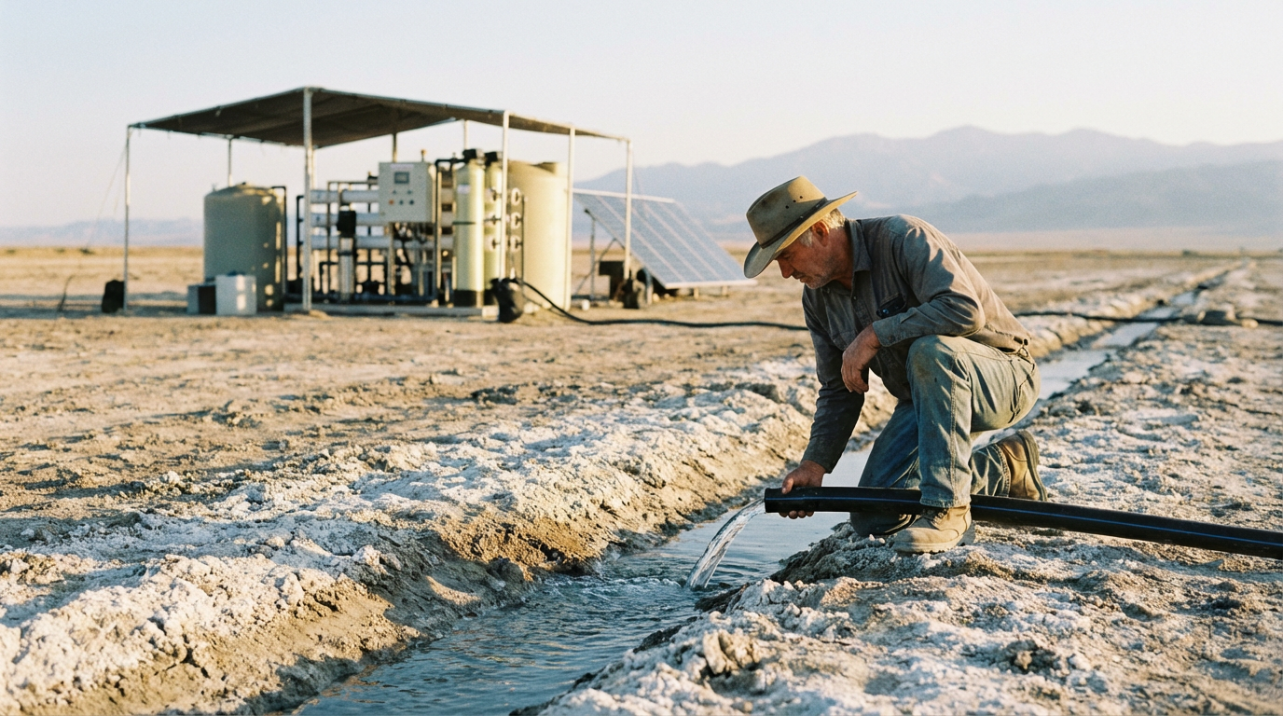
Saline‑alkali soils are some of the toughest places to grow food. At the same time, more farms and even rural homes are installing reverse osmosis (RO) systems to protect plant health and human health by improving water quality. That creates a natural question I hear often as a water wellness advisor: if you already paid to pump and pressurize water through an RO system, can you safely reuse the RO wastewater to irrigate salty, alkaline fields instead of dumping it down the drain?
The short answer is that RO wastewater can be a useful tool in a broader saline‑alkali soil strategy, but only when you treat it like a concentrated input that needs testing, blending, and careful management. The research on wastewater irrigation, salinity, and soil health gives us a clear framework for when RO wastewater reuse helps and when it quietly accelerates soil degradation.
In this article I will unpack what RO wastewater actually is, how it interacts with saline‑alkali soils, what real‑world studies on wastewater irrigation tell us, and how to make practical, science‑based decisions on your own farm or homestead.
RO Wastewater And Saline‑Alkali Soils: The Basics
What Reverse Osmosis Actually Does
Reverse osmosis pushes water under pressure through a semi‑permeable membrane that lets water molecules through while holding back most dissolved salts, metals, organic molecules, and microbes. Technical summaries from industrial water specialists describe typical salt removal in the range of about ninety‑five to ninety‑nine percent when the system is designed and maintained properly.
From a single RO membrane you always get two streams. The permeate is the “good” water that passed the membrane. The concentrate is the “bad” water that carries the salts and contaminants the membrane rejected. In RO system language, that concentrate is also called brine, reject, or wastewater.
Industrial and agricultural RO systems are usually designed so that somewhere around half to more than four‑fifths of the feed water becomes permeate, with the rest exiting as concentrate. A technical overview from Puretec Industrial Water notes that commercial RO systems commonly operate between about fifty and eighty‑five percent recovery, which means fifteen to fifty percent of the incoming water leaves as concentrate.
Household RO units behave similarly, just on a smaller scale. A practical guide from a water‑treatment company focused on conservation explains that newer under‑sink RO systems can generate about one gallon of wastewater for every four gallons of drinking water, while older designs can send up to four gallons down the drain for each gallon you drink.

If a household drinks and cooks with twenty‑four gallons of RO water in a day on a modern system, that can easily create around six gallons of RO wastewater. For small farms that are already water‑stressed, sending those gallons straight to the sewer feels wasteful, so it is natural to look toward irrigation.
What RO Wastewater Contains
Because the RO membrane strips out a high percentage of salts and other ions from the permeate, the concentrate becomes saltier than the feed water. A review of high‑pressure RO desalination for industrial brines illustrates the same principle at a larger scale: seawater with about thirty‑five thousand milligrams per liter of total dissolved solids (TDS) can leave the RO stage as brine around seventy thousand milligrams per liter when operated at fifty percent recovery.
Household and farm RO systems typically start with much less saline feed water than seawater, so their brine will not reach those numbers. The pattern is the same, though. Whatever dissolved solids were in your source water become more concentrated in the RO wastewater.
A conservation‑oriented explainer on RO wastewater reuse describes that concentrate as the “mineral‑rich” side of the system. It tends to carry elevated levels of calcium, magnesium, and other salts, along with any contaminants that were effectively rejected from the permeate. That same source points out that RO wastewater often has a slightly more acidic pH and can contain organic matter and bacteria, so it is not drinking water, but it is usable for many non‑potable tasks, including some forms of irrigation when salinity is controlled.
What Makes Saline‑Alkali Soils So Sensitive
Saline‑alkali soils are affected by both high soluble salt content and high sodium levels relative to calcium and magnesium. Globally, a study on farmland saline‑alkaline water reports that saline‑alkali land covers about eight hundred million hectares, roughly six percent of the world’s arable land. These soils are common in arid and semi‑arid regions that are already under water stress.
Two features matter most when you think about irrigating them with RO wastewater.
First, salinity. Elevated electrical conductivity (EC) in irrigation water means more dissolved salts. In an Egyptian case study comparing freshwater, mixed agricultural effluents, and wastewater‑impacted irrigation water, EC rose from about zero point six two deciSiemens per meter in the freshwater source to about three point five five deciSiemens per meter in the wastewater‑impacted canal. That is nearly a sixfold increase in salinity, and the wastewater source slightly exceeded Food and Agriculture Organization thresholds for irrigation water salinity.
Second, sodicity. Sodium adsorption ratio (SAR) expresses the sodium hazard of irrigation water. The same Egyptian study reports SAR values of about five, seven point one, and twelve point nine across the three water types. All of these values sit above the FAO guideline of three for low sodicity risk, and the highest level indicates a clear tendency to disperse clay particles, weaken soil structure, and reduce infiltration over time. Reviews of wastewater irrigation in arid and peri‑urban systems echo these findings, repeatedly linking higher SAR to crusting, compaction, and declining infiltration.
Saline‑alkali soils are already at the edge of what crops can tolerate.

Adding more sodium and salts without a management plan pushes them further toward reduced yields, poorer structure, and harder reclamation.
How RO Wastewater Interacts With Saline‑Alkali Soils
RO wastewater is not inherently harmful or helpful. Its impact depends entirely on how salty it is, what is dissolved in it, and how it is applied to land that is already fragile.
Potential Upsides Of RO Wastewater Reuse
Several strands of research on treated wastewater irrigation point toward plausible benefits when concentrate is not excessively saline.
A review on the effects of wastewater irrigation on agricultural soils notes that treated municipal effluents carry organic carbon and nutrients, particularly nitrogen and phosphorus, that can increase soil fertility, improve biomass production, and partially substitute synthetic fertilizers. A case study of aquaculture wastewater irrigation on date palms in Saudi Arabia found that wastewater with pH between about seven point four and eight point two and electrical conductivity up to about three point one deciSiemens per meter increased available macro‑ and micronutrients in the soil profile and raised leaf phosphorus and potassium levels, without driving nutrients into toxic ranges.
RO wastewater itself may not be nutrient‑rich if the RO system is treating already‑clean groundwater, but where RO is polishing water that contains hardness, residual nutrients, or trace minerals, the concentrate can deliver both salts and some beneficial ions. The RO wastewater reuse guide mentioned earlier notes that calcium and magnesium in concentrate can help soil structure and water retention and may trim fertilizer needs if salinity is controlled.
There is also a water‑security benefit. Studies on reclaimed municipal wastewater in China and in Mediterranean settings underscore that reusing non‑conventional water sources can reduce pressure on freshwater supplies and cut reliance on chemical fertilizers when nutrients in the reused water are harnessed responsibly. RO wastewater reuse sits within that same family of solutions: it can conserve potable water, especially when blended rather than discharged.

Major Agronomic And Environmental Risks
On the other side of the ledger, almost every serious review of wastewater irrigation flags salinity and sodicity as the primary constraints, followed by trace contaminants.
The wastewater irrigation review mentioned earlier summarizes dozens of studies where long‑term wastewater use raised soil salinity and sodicity in marginal soils, sometimes to the point of structural deterioration and yield decline. A long‑term study of treated municipal wastewater in a semi‑arid region, framed against US Environmental Protection Agency and FAO reuse guidelines, reports both enhanced soil carbon and nutrient supply and rising salinity, altered infiltration, and potential structural degradation without proactive salinity management.
RO wastewater can amplify these same patterns because it is, by design, more saline than the feed water. The conservation‑focused RO wastewater article warns that if concentrate is applied directly and repeatedly without dilution or leaching, salts build up in the root zone, leading to leaf burn, reduced growth, and eventual plant death in sensitive species. It recommends focusing on salt‑tolerant crops, using drip systems, mixing concentrate with lower‑salinity water, and regularly testing soil and water.
Sodicity risk can be especially acute in saline‑alkali settings. The Egyptian irrigation study shows that even treated wastewater with acceptable pH and heavy metal levels can have SAR values well above safe limits, with clear potential to disperse clays and reduce infiltration. A more recent Taylor & Francis study on irrigation with secondary‑treated mixed industrial and municipal wastewater reports SAR values between about two point five four and seven point five two. Those levels fall into a range the authors interpret as slight to moderate soil restriction according to classical SAR‑based infiltration guidance, reinforcing that even “qualified” treated wastewater needs monitoring when applied over time.
Trace metals and emerging contaminants add another layer. The Egyptian study found cadmium levels in wastewater‑impacted irrigation water above FAO limits, while other metals remained within safe ranges. Reviews of wastewater reuse from both high‑income and low‑income regions consistently show that repeated irrigation can lead to accumulation of metals in soils and, in some cases, their transfer into edible plant parts. A detailed assessment of treated wastewater irrigation on olives, mandarins, and guavas found that metal concentrations in water generally met FAO and World Health Organization limits, with iron slightly above guideline values, and used bioaccumulation factors to show how different elements could concentrate in leaves and fruit over time.
RO concentrate from household systems without industrial connections is unlikely to carry the same spectrum of metals as mixed municipal‑industrial wastewater, but the lesson remains. Once you reuse any concentrated stream on land, you should expect gradual buildup of what it contains, for better or worse.
What The Evidence On Wastewater Irrigation Really Tells Us
There are not yet many field studies that follow RO wastewater specifically on saline‑alkali soils, but the broader wastewater irrigation literature offers a strong evidence base.
Reclaimed municipal wastewater has been tested across crops such as olives, lettuce, radish, eggplant, tomato, and citrus. Studies consistently report increased yields and reduced fertilizer needs when salinity and toxic elements are kept under control. The reclaimed wastewater review for China notes that salts and nutrients in treated wastewater generally have minor and manageable negative impacts on soil quality when irrigation is properly managed and can provide fertilization benefits. At the same time, it highlights concerns about long‑term accumulation of heavy metals, pharmaceuticals, and pathogens and calls for integrated management, crop selection, and soil amendments to immobilize or transform contaminants.
Aquaculture wastewater experiments on date palms show that when EC and SAR stay within irrigation guidelines and micronutrient levels remain below FAO thresholds, wastewater irrigation can safely improve soil nutrient status and reduce dependence on mineral fertilizers. In that study, all sodium adsorption ratios were below ten, indicating low sodicity hazard, while nitrate, phosphorus, and micronutrient concentrations in water and soil stayed within environmental guideline ranges.
On the other end of the spectrum, the Egyptian irrigation study with wastewater‑impacted canals makes clear that even when pH and most trace metals are acceptable, a combination of higher EC, elevated SAR, and cadmium slightly above guideline limits is enough to require careful management and long‑term monitoring to prevent soil degradation and food‑chain risks.
For RO wastewater, the implication is straightforward. If your RO concentrate resembles moderately saline treated wastewater in terms of EC and SAR, and if trace metals and other contaminants are low, then it can be used as part of a well‑designed irrigation strategy. If it approaches brackish or hypersaline brine levels, similar to the seventy‑thousand‑milligram‑per‑liter RO brines considered in high‑pressure desalination studies, then open‑field irrigation on saline‑alkali soils is not appropriate without heavy dilution or additional treatment
Deciding Whether To Irrigate With RO Wastewater On Saline‑Alkali Soils
For growers and land managers working on saline‑alkali fields, the decision is not simply “reuse or discharge.” It is “under my conditions, how does RO wastewater compare to my other options, and how can I manage it safely if I do reuse it?”
Step One: Know The Quality Of Your RO Wastewater
Testing is non‑negotiable. The conservation‑focused RO wastewater guide emphasizes regular soil and water testing, and the reclaimed wastewater literature relies heavily on knowing EC, SAR, pH, major ions, and key metals.
At minimum, you want laboratory or high‑quality field measurements for electrical conductivity, sodium, calcium, magnesium, major anions such as chloride and sulfate, pH, and any metals of concern in your area. From sodium, calcium, and magnesium you or your advisor can calculate SAR, the same way researchers did in the Egyptian and Mediterranean studies.
Once you have those numbers, compare them to the ranges reported in wastewater studies.
A Taylor & Francis case study of treated wastewater irrigation, for example, found EC between about nine hundred and nearly one thousand four hundred microSiemens per centimeter and total dissolved solids between roughly four hundred twenty‑six and one thousand fourteen milligrams per liter, with an average that placed the water in what FAO classifies as marginal for irrigation. SAR values averaged a little over four. The authors used a composite pollution index to classify the treated wastewater as “qualified,” but cautioned that salinity, sodium, and iron needed ongoing attention.
If your RO wastewater looks similar or lower in both EC and SAR than those “qualified” treated wastewater ranges, and if metal levels are safe, then blending and reuse on tolerant crops becomes more viable. If values are higher, especially on SAR, you should assume that repeated use will exacerbate sodicity problems in saline‑alkali soils.
Step Two: Understand Your Soil And Crop Sensitivity
Saline‑alkali soils are not all the same. The Taylor & Francis study describes irrigated soils that were almost entirely sandy, with about ninety‑nine and a half percent sand and only trace amounts of silt and clay, along with low organic carbon and variable calcium carbonate content. Such soils have low buffering and sorption capacity, so salts and metals move more easily through them.
If your saline‑alkali soil has more clay and organic matter, it can hold more cations and buffer pH shifts, but it will also be more prone to structural damage when sodium accumulates. Reviews of wastewater irrigation in clay‑rich soils report notable changes in soil structure, bulk density, and infiltration where SAR is high and leaching is inadequate.
Crop choice matters as much as soil. The wastewater irrigation review recommends avoiding high‑accumulator species when metal levels are uncertain and emphasizes selecting crops and varieties that tolerate higher salinity. The RO wastewater reuse guide suggests focusing RO concentrate on salt‑tolerant crops such as certain vegetables and ornamentals and keeping it away from sensitive edible crops unless its quality is well understood.
Step Three: Consider Blending, Application Method, And Volume
Where RO wastewater quality is moderate rather than extreme, blending can turn a liability into a useful component of your irrigation mix. Reviews from both China and the Mediterranean recommend mixing wastewater with freshwater to dilute salts and contaminants, then using the blend to irrigate less sensitive crops or fields.
The RO wastewater conservation article highlights drip irrigation as a good fit for concentrate reuse because it delivers water directly to the root zone, allowing better control of application rates and limiting salt splash on leaves. It also recommends avoiding flood irrigation with concentrate where possible, because ponding and evaporation exacerbate surface salt accumulation, which is already a hallmark of saline‑alkali soils.
Volume matters as much as concentration. Salinity studies often stress that the total salt load over a season, not just the EC at any one time, determines whether salts accumulate or can be leached beyond the root zone. When RO wastewater represents a small fraction of your total water input and is diluted with higher‑quality sources, its impact can be manageable. When it becomes a major fraction, the risk of salinity buildup rises sharply.
An Egyptian example illustrates this principle qualitatively. Moving from freshwater at zero point six two deciSiemens per meter to wastewater‑impacted irrigation water at three point five five deciSiemens per meter multiplied the salinity load with every irrigation. Without compensating leaching or drainage, that sort of shift accelerated soil salinization.
Practical Management Strategies If You Reuse RO Wastewater
If testing shows that your RO wastewater is only moderately saline and metals are low, and you choose to reuse it on saline‑alkali soils, several evidence‑based practices can tilt the outcome toward benefit and away from degradation.
First, treat RO wastewater as one component in a blended irrigation program, not the sole source. The wastewater irrigation review and the Chinese reclaimed water assessment both recommend blending wastewaters with fresher sources and adjusting irrigation timing and methods to minimize contaminant uptake. In practice, that can mean using RO wastewater primarily for pre‑plant irrigations or for less sensitive crops, while reserving the best water for germination and the most sensitive growth stages.
Second, maintain regular leaching and drainage where possible. Traditional saline‑alkali reclamation relies heavily on salt leaching, where excess irrigation water is applied to dissolve salts and push them deeper into the soil profile and into drains. A study on farmland saline‑alkaline water from northwest China notes that this practice is still the dominant remediation method, even though it creates highly saline drainage water that must be managed. If you reuse RO wastewater, you will need a plan for periodic fresh‑water leaching or for routing the saltiest fraction to drainage rather than back onto the field.
Third, build a monitoring routine. Successful long‑term wastewater irrigation experiments typically track soil EC, SAR, organic matter, and key metals at multiple depths, along with crop tissue analysis where metals are a concern. The date palm aquaculture wastewater study, for example, analyzed soil nutrients at three depth intervals and leaf nutrient status to confirm that nutrient levels were improving without triggering toxicity. The Mediterranean heavy‑metal accumulation study used tools such as bioaccumulation factors and geochemical speciation modeling to understand which metals were mobile and bioavailable. Even a simplified version of that approach, with periodic soil and leaf testing, will help you catch problems early.

Finally, treat regulatory guidance as a floor, not a ceiling. FAO and WHO guidelines for irrigation water and reclaimed wastewater provide concentration limits and classification schemes for salinity, SAR, and metals. The Taylor & Francis study on treated wastewater irrigation showed that water meeting those guidelines still required careful management because of its marginal salinity and moderate sodium content. RO wastewater reuse should follow the same logic: if your water exceeds guideline values, you should not apply it without dilution and a clear risk‑management plan, and even if it meets them, long‑term monitoring is still needed on saline‑alkali soils.
Smarter Alternatives For Managing RO Wastewater In Saline‑Alkali Landscapes
In some settings, especially where RO wastewater is too saline or sodic for safe blending, it makes more sense to keep concentrate away from fields and instead treat or repurpose it.
One promising direction is to treat saline agricultural drainage and RO brines as resources rather than wastes. A comprehensive review in a water reuse journal describes how saline effluents, including desalination brines and bitterns, are being used to recover salts, chemicals, and fertilizers. Examples include membrane‑based and thermal combinations that produce valuable products such as chlorine and caustic soda, and processes that synthesize high‑purity magnesium‑ammonium‑phosphate fertilizer from saline effluents. For major salts like sodium, magnesium, potassium, and bromine, techno‑economic analyses suggest solid economic cases.
In agriculture, an MDPI study on saline‑alkaline drainage from farmland in Xinjiang designed a composite nanofiltration–RO system combined with solar evaporation. Their goal was to convert saline drainage into water suitable for industrial or agricultural reuse while producing solid salt instead of liquid brine, thereby reducing pollution downstream of leached fields.
Innovative solar‑driven approaches are emerging as well. A recent materials‑focused study describes a zero‑wastewater‑discharge non‑contact solar desalter for saline‑alkali soil remediation. In that system, brackish water is evaporated by solar energy in an above‑ground device and condensed as freshwater, which irrigates the soil without the saline feedwater ever touching the root zone. The salts remain in the device rather than accumulating in the field, and early results indicate improved soil salinity and higher grain yields compared with direct brackish water irrigation.
These technologies are still evolving, but they show that we are not limited to a binary choice between discharging RO wastewater and applying it directly to soil. For farms with serious saline‑alkali challenges and limited options for deep‑well injection or evaporation ponds, integrating RO with resource recovery, composite membrane systems, or non‑contact solar desalters may ultimately prove more sustainable than widespread concentrate irrigation.
What This Means For Smart Hydration At Home And On The Farm
From a smart hydration and water wellness perspective, the way you design and operate RO systems should always be connected to where every drop goes after filtration.
On the home side, using RO drinking water instead of bottled water reduces plastic waste and gives you tight control over what is in the water your family consumes, as highlighted by residential RO providers. But that does not mean the wastewater stream is harmless. Reusing RO wastewater for rinsing floors, washing equipment, flushing older toilets that can use up to about seven gallons per flush, or irrigating salt‑tolerant ornamentals is often more appropriate than directing it onto already stressed saline‑alkali vegetable beds.
On the farm side, RO and other membrane technologies are powerful tools for turning marginal water into a reliable irrigation supply. Reviews of saline wastewater treatment and desalination show that membrane processes, especially when integrated with energy‑efficient designs, can support long‑term water security in water‑scarce regions. At the same time, those same reviews stress that leftover brines are one of the hardest parts of the system to manage.
For saline‑alkali soils, the most health‑protective, soil‑protective path is usually to reserve your best, low‑salinity water for crops and people, treat RO wastewater as a concentrated resource that needs testing and careful handling, and invest in soil‑building practices that make every gallon of clean water work harder.
Thoughtful RO design, honest testing of wastewater quality, and conservative irrigation management give you the best chance to protect both crop yields and long‑term soil health while still honoring the need to conserve water in a warming, drying world.
References
- https://pubmed.ncbi.nlm.nih.gov/34953828/
- https://pubs.acs.org/doi/10.1021/acs.estlett.8b00274
- https://www.frontiersin.org/journals/environmental-science/articles/10.3389/fenvs.2024.1358842/full
- https://www.iscientific.org/wp-content/uploads/2023/05/1-IJCBS-23-23-11.pdf
- https://pubs.rsc.org/en/content/articlehtml/2025/mh/d5mh00377f
- https://www.jeeng.net/pdf-193079-115789?filename=115789.pdf
- https://www.researchgate.net/publication/357672770_The_effects_of_wastewater_irrigation_on_agricultural_soils
- https://www.nature.com/articles/s41598-024-68774-0
- https://www.realtruetek.com/blog/ro-waste-water-uses.html
- https://calsoftwater.com/blog/the-environmental-benefits-of-using-a-reverse-osmosis-system/

Share:
Effective Pre-Treatment Solutions for Oil-Contaminated Water RO Systems
Effective Solutions for Low Water Pressure Areas Under 0.2 MPa