

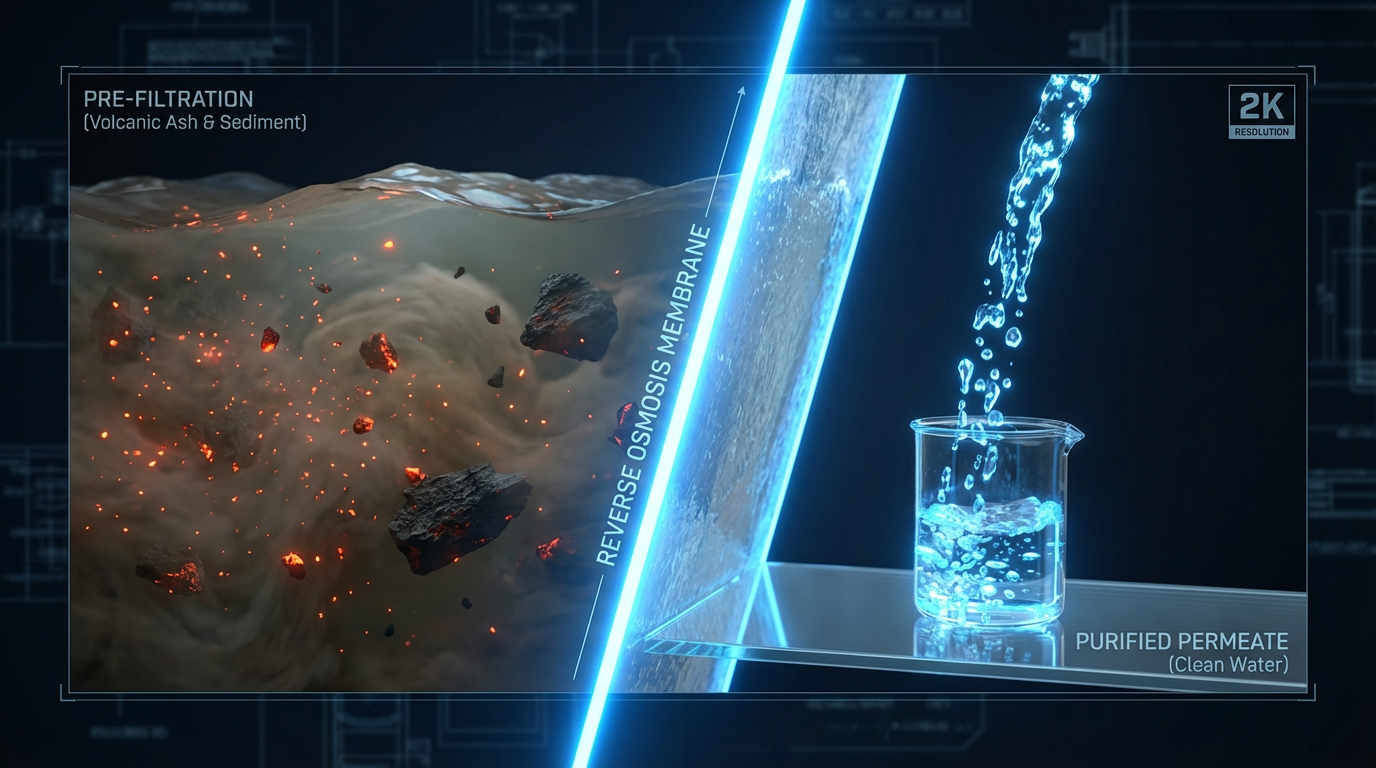
Summary: A properly designed reverse osmosis (RO) system can remove most dissolved chemicals and metals from volcanic‑ash–affected water, but it must never be the first line against thick, ashy “sludge” and should always work alongside good pretreatment and emergency water-safety practices.
How Volcanic Ash Pollutes Drinking Water
Volcanic ash is not like fireplace ash; it is finely ground rock and glass, usually smaller than a grain of sand. National Geographic and USGS describe it as hard, abrasive, and easily carried long distances by wind.
When ash falls into rivers, lakes, and roof tanks, agencies like the Alaska Department of Environmental Conservation report three main problems:
- Sky‑high turbidity (cloudiness) that can turn water into gray sludge.
- Short‑term pH shifts, usually slightly more acidic.
- Dissolved chemicals from ash “coatings,” including fluoride, aluminum, iron, and manganese.
In past eruptions near Anchorage, turbidity in surface water spiked from clear to extremely muddy for several days, while pH dropped temporarily but then rebounded. USGS notes that serious chemical contamination of large municipal systems is relatively rare, but local supplies and small tanks can be hit much harder.

Nuance note: While USGS and Alaska DEC emphasize turbidity as the main issue, case studies summarized by Aquasana and The Prepared show that fluoride from ash has killed thousands of grazing animals, so chemistry cannot be ignored—especially for private supplies.
What RO Does Well Against Volcanic‑Ash Contaminants
As a Smart Hydration Specialist, I look at volcanic ash in two parts: the visible grit and the invisible dissolved load. RO shines on the invisible side.
Reverse osmosis is a pressure‑driven membrane process that forces water through a semi‑permeable barrier, rejecting most dissolved salts and metals. Published testing and manufacturer data, along with guidance from Aquasana, show that a good RO system can:
- Remove most fluoride and many heavy metals associated with volcanic ash.
- Greatly reduce aluminum, iron, and manganese that cause metallic taste and discoloration.
- Cut overall dissolved solids, improving safety and taste when upstream treatment is stressed.
If your municipal utility has already restored basic clarity and disinfection after an ashfall, a point‑of‑use RO system under the sink is an excellent extra safety layer for drinking and cooking water.
Where RO Falls Short (And How to Fill the Gaps)
No home RO system is designed to take raw, ashy sludge straight from a roof tank or pond. The Prepared, IVHHN, and USGS all stress the same idea: first remove the ash you can see.
RO is vulnerable to:
- Clogging and rapid fouling from suspended ash.
- Damage if pumps and valves are forced to push thick, gritty water.
- Being overwhelmed if feed water chemistry is wildly outside design assumptions.
To protect your RO and your health after an eruption:
- Do not feed heavy-ash water into RO. Let water sit so grit settles, then gently pour off the clearer upper layer.
- Use a simple prefilter. Strain water through a clean cloth or dedicated sediment filter before it ever reaches your RO system.
- Keep disinfection in the picture. Ash can shield microbes; rely on your utility’s disinfection or, for private supplies, use a reputable disinfection method upstream of RO.
Boiling alone is not a good long‑term strategy for ash‑polluted water. As noted by Alaska DEC and emergency guidance in Tonga, boiling can concentrate dissolved chemicals, including fluoride, even while killing germs.
Practical RO Strategy If You Live Near a Volcano
If you are in an ash‑prone region and want resilient hydration at home, think in layers rather than one “magic” device.
For a typical home on municipal water:
- Install a multi‑stage under‑sink system: sediment prefilter, carbon block, RO membrane, and post‑filter. This gives you protection against both taste/odor and dissolved ash‑related contaminants.
- During and right after ashfall, follow local boil‑water or do‑not‑drink advisories first; treat RO as an added barrier, not a replacement for official guidance.
- Replace prefilters more often after ash events. If your sediment filter turns gray quickly, that is doing its job—change it before the RO membrane is stressed.
For homes with rainwater or private storage:
- Before ashfall, be ready to disconnect roof downpipes so ash does not wash into tanks, as advised by IVHHN and USGS.
- If ash does enter your tank, drain and flush when possible, then refill with cleaner water before relying on RO.
- Use stored bottled water for a few days while turbidity peaks, then bring RO back online once you can supply reasonably clear, prefiltered water.
Bottom line: RO is one of the most effective tools we have for removing volcanic‑ash–related fluoride and many metals from drinking water. It works best as the “polishing” step in a layered, well‑planned system—backed by smart ash preparedness, good pretreatment, and close attention to local public health guidance.
References
- https://avo.alaska.edu/pdfs/cit16057.pdf
- https://volcano.oregonstate.edu/faq/how-do-volcanoes-affect-plants-and-animals
- https://volcanoes.usgs.gov/volcanic_ash/cleaning_up_outside.html
- https://ui.adsabs.harvard.edu/abs/2024WASP..235..521K/abstract
- https://www.nrc.gov/docs/ML0913/ML091330800.pdf

Share:
Effective Strategies to Prevent Mold in Basement RO Systems
Special Treatments for Well Water Contaminated by Agricultural Fertilizers