

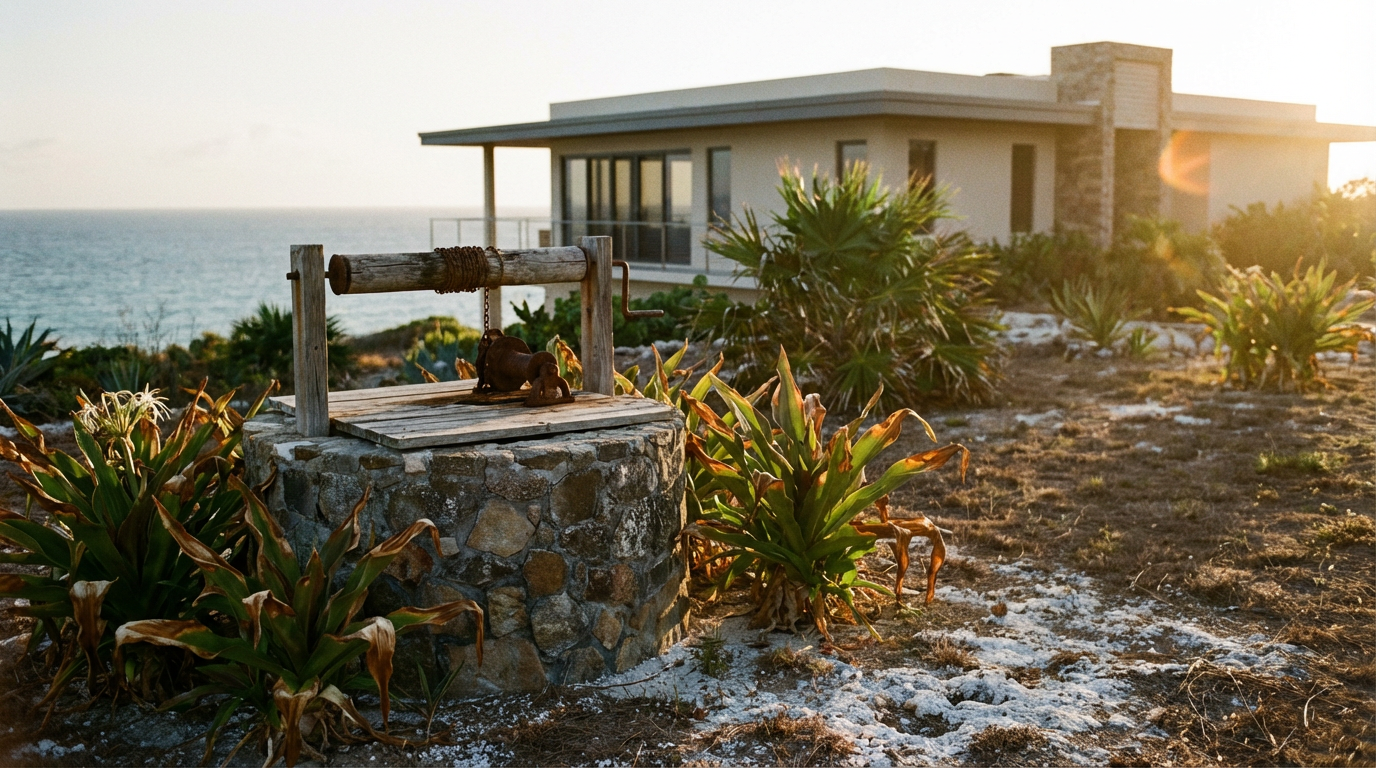
Living in an island villa should feel like a daily wellness retreat, not a constant battle with salty tap water and struggling plants. Yet for many coastal and island homeowners, well water salinity is a very real—and growing—problem. I routinely see villa wells where the water tastes brackish, leaves white crusts on fixtures, and slowly poisons gardens and landscaping.
The good news is that you can tackle high salinity in a structured, science‑backed way. The key is to understand what is happening in your local aquifer, measure the problem correctly, and combine smart groundwater management with the right home filtration and landscaping strategies. In this article, I will walk through practical, evidence‑based options, drawing on research from Utah State University Extension, the California Water Plan, international groundwater studies, and modern desalination practice, and I will keep the focus on what actually works at the villa scale.
What “Salty” Really Means: Salinity, TDS, EC, and Sodium
When you say your well water “tastes salty,” you are describing elevated salinity: a higher‑than‑normal concentration of dissolved mineral salts in the water. These salts are not just sodium chloride; they typically include calcium, magnesium, sulfate, bicarbonate, and others.
Scientifically, salinity is often quantified as total dissolved solids (TDS), usually reported in milligrams per liter, which in drinking‑water practice is effectively the same as parts per million. Another common measure is electrical conductivity, or EC. Utah State University Extension notes that irrigation and soil scientists often use the electrical conductivity of the water (ECw) and of a soil extract (ECe) to classify how salty a water or soil is. They report EC in units such as decisiemens per meter.
For plants and soils, salinity acts like a hidden drought. Research summarized by Utah State University Extension explains that when salt ions build up in soil water, plants must spend more energy concentrating solutes in their roots to draw water in. The result is water stress even when the soil looks moist. Visual symptoms—stunted growth, leaf margins that burn and dry, and general poor vigor—often appear only in more extreme cases. Yield or plant health can decline well before you see obvious white salt crusts at the surface.
For people, sodium is usually the main health concern rather than total salinity. A freshwater systems review points out that most daily sodium intake comes from food, but drinking water can push sensitive individuals over their recommended limit. The Centers for Disease Control and Prevention recommends keeping daily sodium intake at or below 2,300 milligrams, while the average American consumes about 3,300 milligrams. New York State Department of Health guidance cited in the same source suggests that people on moderately restricted sodium diets should keep water sodium at or below about 270 parts per million, and those on very strict diets should aim for under about 20 parts per million. The Environmental Protection Agency has an aesthetic guideline that water with sodium above about 60 parts per million may warrant treatment for taste; for people on sodium‑restricted diets, treatment is recommended when sodium exceeds about 20 parts per million.
In other words, your well water can be “safe” for many healthy adults yet still be problematic for flavor, fixtures, or for anyone watching sodium intake.
Why Island and Coastal Villa Wells Become Salty
Island and coastal villas are uniquely exposed to salinity problems because their groundwater is directly connected to the sea and often sits in geologic formations that naturally hold salts.
A groundwater overview from an international water institute emphasizes that aquifers are the largest accessible reservoir of liquid freshwater on Earth, holding close to 90 percent of the world’s freshwater stock. In many coastal regions, however, groundwater is used in an unplanned way, which makes aquifers increasingly prone to salinity. When you pump freshwater from a coastal aquifer faster than it is naturally recharged, the lighter freshwater layer shrinks and denser seawater moves inland and upward to replace it. This is classic seawater intrusion.
Researchers working on Vietnam’s Mekong Delta show how vulnerable such systems can be. Historically, the delta’s vast mangrove forests acted as a natural buffer against saline intrusion, absorbing tidal energy and preventing saltwater from penetrating far inland. Over recent decades, deforestation has removed about half of the mangrove cover in some provinces, and salinity problems have worsened to the point that rice yields have dropped and farmers have shifted to more salt‑tolerant crops like sugarcane and coconut. Restoration efforts between 2015 and 2020 have added roughly 11,000 hectares—around 27,000 acres—of mangroves back into the landscape, specifically to rebuild this natural defense.
The same pattern—excessive pumping, reduced natural buffers, and climate‑driven sea‑level rise—shows up in coastal cities like Maputo, Mozambique, where more than half of residents face limited freshwater access and increasingly saline wells. It also appears in arid agricultural regions far from the ocean. A University of California analysis of California’s western San Joaquin Valley reports that nearly 2 million tons of salt accumulate in the basin every year, with hundreds of thousands of acres already fallowed and large economic losses projected if salinity is not managed. In that region, the driver is not seawater intrusion but the combination of low rainfall, high evaporation, and repeated irrigation with slightly saline water in a basin that effectively has no easy salt outlet.
For an island villa, your well sits in a very small version of these systems. If you are near the coast, dense saltwater from the sea may be encroaching. If your villa community irrigates heavily with marginal quality water and there is poor drainage, salts can accumulate in shallow groundwater. Over time, every gallon you pump carries a bit of this salt upward.

Unless there is a way for salts to leave the system—through well‑designed drainage or by exporting salty water off the island—you are slowly ratcheting salinity upward with each pump‑recharge cycle.
Diagnosing a High‑Salinity Villa Well
In practice, you usually notice salinity in one of three ways. The water tastes noticeably salty, your plumbing and fixtures develop white or colored crusts, or your landscape starts to fail.
A case from a Western Cape homeowners’ group illustrates how quickly this can escalate. A family using a shallow well point for garden irrigation noticed that their water, “somewhat salty from the start,” eventually began to poison their plants. A local test measured salt at about 6,000 parts per million—roughly four times a local “allowable” guideline of 1,550 parts per million. At that level, most garden plants will struggle badly, and even many irrigation systems will suffer.
Relying only on taste or plant health is risky, though. Utah State University Extension notes that salinity damage often looks exactly like water stress, so many people try watering more, which can concentrate salts further as water evaporates or transpires. They also point out that soil‑surface crusting and visible salt crystals usually appear only at high salinity levels; by the time you can see them clearly, sensitive plants may already be badly damaged.
That is why regular testing is non‑negotiable. A freshwater treatment review recommends that well owners test their water at least once a year for salt and other contaminants. For an island villa with known salinity issues, more frequent testing during extended dry periods is sensible. Typical lab panels or good field kits can give you total dissolved solids, electrical conductivity, sodium and chloride concentrations, and sometimes specific ions such as sulfate or boron.
The core metrics you will see on a typical report include the following.
Metric |
Typical unit |
What it indicates |
Relevance for island villa wells |
TDS (total dissolved solids) |
mg/L or ppm |
Overall mineral and salt load in the water |
High TDS often correlates with salty taste, scale buildup, and potential plant stress when used for irrigation |
EC (electrical conductivity, water) |
dS/m or microsiemens/cm |
How easily water conducts electricity, which rises with salt concentration |
Common in irrigation and hydrogeology; helps compare your well to agricultural salinity guidelines |
Sodium |
mg/L or ppm |
Amount of sodium ion in water |
Key for people on sodium‑restricted diets and for soil structure when irrigating |
Chloride |
mg/L or ppm |
Amount of chloride ion |
Often a good tracer of seawater intrusion and road or deicing salts; high levels can burn plant leaves under sprinklers |
Utah State University’s salinity classification for soils uses the electrical conductivity of a soil extract (ECe). Although this is a soil metric, it gives useful context. They classify soil as essentially nonsaline below an ECe of about 2 decisiemens per meter, with most crops tolerating that. As ECe climbs through ranges such as 4 to 6, only highly salt‑tolerant plants perform well, and by the time you reach 8 to 16 or more, soils are generally unsuitable for conventional crops. While this is not a direct drinking‑water standard, it underscores how quickly plant options shrink as salinity rises.
For health, sodium deserves particular attention. According to the freshwater systems review mentioned earlier, the Environmental Protection Agency suggests treating drinking water for aesthetic reasons when sodium exceeds about 60 parts per million. For people on sodium‑restricted diets, they recommend treatment when sodium rises above approximately 20 parts per million. New York State health guidance for sodium‑restricted diets aligns with that, and the same review notes that sodium levels in water as low as 20 to 270 parts per million can matter for people with cardiovascular concerns, even though those levels are small compared with typical dietary intake. The key is that you have control over your drinking water, even if restaurant meals are harder to manage.

Managing Salinity at the Source: Aquifer and Land Strategies
At villa scale, you may not be able to re‑engineer the whole aquifer, but you have more influence than you might think, especially if your community coordinates its actions.
Research on salinity management in California’s San Joaquin Valley shows that when groundwater becomes noticeably saline, the traditional strategy of “pump more in dry years” stops working. Economists and hydrologists modeling that basin found that the optimal strategy shifts to pumping more in wetter years, when fresher surface water is available to dilute stored groundwater, and pumping less in dry years to avoid drawing very saline water. Although that study focused on large farms, the same idea applies to an island aquifer with multiple villas. If everyone pumps hardest during peak droughts, you collectively invite seawater intrusion and salt buildup. If, instead, nonessential uses are scaled back in dry periods and recharge is enhanced in wet periods, you can slow the salinity ratchet.
Integrated groundwater management studies emphasize the concept of a salt balance. Every pound of salt you import onto the island—through seawater intrusion, irrigation water, fertilizers, or home water softener discharge—must ultimately be stored, diluted, or exported. Without a pathway for salt to leave the basin, it accumulates in soils and shallow groundwater over decades. That is why some California resource planners have explored regional brine lines and managed drainage systems to physically move salts out of sensitive basins.
At villa scale, exporting brine off‑island may be unrealistic, but you can still reduce salt loading and improve drainage. A salinity‑management overview from WateReuse and extension work on saline soils highlight the importance of internal drainage. Many sites have hardpans or compacted layers at about 3 feet depth that block downward movement of water. In those cases, water and salt accumulate above the layer. Mechanical practices such as deep ripping, soil coring, or installing shallow subsurface drains can restore percolation in suitable soils. For villa landscapes, that might look like French drains leading away from heavily irrigated areas, or subsurface drain pipes that intercept shallow saline groundwater and carry it to an appropriate disposal point.
Vegetation and soil management are just as critical. New South Wales environmental guidance on salinity prevention frames dryland salinity as a water‑balance problem: excess water in the landscape mobilizes salts. They recommend maintaining good vegetative cover, choosing plant mixes that use available water efficiently, avoiding long bare fallows, and keeping soil health strong so plants can use more water and leave less to leak downward. For salt‑affected sites, they suggest excluding livestock to allow regrowth, applying mulch to reduce erosion, planting salt‑tolerant grasses, shrubs, and trees, and using contour banks and subsurface drains to redirect water away from problem areas.
On an island villa property, that translates into practical steps. You can keep as much ground as possible under healthy vegetation rather than bare soil, use salt‑tolerant grasses or ornamental species in known high‑salinity spots, avoid compacting wet areas with vehicles, and, when possible, direct roof or paving runoff toward vegetated zones that can infiltrate fresh rainwater. Over time, off‑season rainfall can help leach salts downward, provided there is adequate drainage and you are not constantly re‑introducing salt through irrigation.
In more coastal settings, nature‑based solutions can also play a role. Research on soil salinization in agriculture, combining nature‑based solutions and bioengineering, documents how restoring mangroves and coastal marshes can reduce saline intrusion. In the Mekong Delta example, adding on the order of tens of thousands of acres of mangroves back into the system was explicitly aimed at rebuilding the delta’s natural defenses against salinity and sea‑level rise. Similar marsh restoration projects in temperate regions like the Netherlands are being used to mitigate soil salinity and flooding. While your villa cannot single‑handedly restore a mangrove forest, supporting community or municipal projects of this kind can be one of the most effective long‑term investments against groundwater salinity.
Treating Salty Well Water Inside the Villa
Even with thoughtful aquifer management, many island wells remain too saline for direct drinking. That is where smart filtration and desalination come in. It is important to understand that most everyday filters—pitcher filters, refrigerator filters, and standard carbon cartridges—do not remove dissolved salts. As a Fresh Water Systems technical article emphasizes, salt ions are too small and too tightly bound to water for simple filters to catch.
The main household technologies that actually remove salt include reverse osmosis, nanofiltration, distillation, and deionization. Ion‑exchange water softeners can change the ionic composition but do not remove total salt and can actually increase sodium.
The table below summarizes key options based on guidance from water‑treatment specialists and drilling companies.
Treatment option |
How it works |
Main advantages |
Main limitations |
Best fit in an island villa |
Under‑sink reverse osmosis (RO) |
Pressurizes water through a semipermeable membrane that rejects most dissolved salts |
Removes roughly 95 to 99 percent of salt and many other contaminants; compact; widely available |
Wastes some water to the drain; requires prefilters and periodic membrane replacement; not sized for whole‑house use |
Dedicated drinking and cooking water at a kitchen sink when salinity is moderate to high but not seawater‑level |
Whole‑house RO or nanofiltration |
Similar membrane process, but sized for entire home; nanofiltration typically allows some minerals through |
Provides low‑salinity water to all fixtures; nanofiltration can retain beneficial minerals and operate with moderate energy use |
High upfront cost; requires good pre‑treatment and brine disposal; energy use grows with salinity |
High‑end villas where source water is too salty even for showers and laundry and where brine management is feasible |
Countertop distillation |
Boils water and condenses the steam, leaving most salts behind |
Produces very pure, low‑salt water; no plumbing changes required |
Slow production, often around 1 gallon every 4 hours; uses significant electricity; water may taste flat |
Supplemental drinking water for a small household when plumbing modifications are difficult and volumes needed are modest |
Deionization (DI) |
Passes water through cation and anion exchange resins that swap ions for hydrogen and hydroxide, which recombine to form pure water |
Removes most dissolved ions, producing very low‑mineral water; can polish RO permeate |
Regeneration requires acid and caustic chemicals; more common in laboratories and industry; low‑mineral water often tastes flat and may need remineralization |
Niche use when extremely low‑mineral water is needed, generally after RO, not as a primary villa system |
Conventional water softener |
Exchanges calcium and magnesium for sodium or potassium on a resin bed |
Reduces hardness scaling and can protect plumbing and appliances |
Does not reduce total dissolved salt; adds sodium to water; regeneration brine is very salty and burdens septic systems and aquifers |
Treating hardness when salinity is otherwise acceptable and sodium is not a health concern; not a solution for high‑salinity wells |
For many island villas, the most realistic approach is a combination of an under‑sink reverse osmosis system for drinking and cooking water and selective use of raw well water for nonpotable needs such as toilet flushing or some outdoor uses. A borehole‑water treatment review notes that compact RO systems designed for households can efficiently remove a wide range of contaminants and typically fall in the approximate price range of $100.00 to $200.00, depending on capacity and brand. When raw water is extremely saline, closer to seawater, specialized high‑pressure RO systems are required; these are usually installed at community scale or for large estates and must be paired with careful brine disposal planning.
Nanofiltration can be attractive when you want to reduce salinity and remove many contaminants but still keep some minerals for taste and health. The same review explains that nanofiltration membranes allow part of the dissolved mineral content to pass while rejecting larger ions, organic compounds, and microorganisms. Energy use and water recovery are generally favorable compared with very high‑pressure seawater RO.
Distillation is simple in concept and robust, but its low throughput and higher energy demand make it an auxiliary option for most villas. Similarly, deionization is powerful but tends to be overkill for household use and brings chemical handling challenges.
Whatever system you choose, it is essential to align it with your salinity levels, health needs, and usage patterns. A family that drinks at least half a gallon of water per person per day needs a system sized accordingly. For sodium‑sensitive individuals, you should calculate how much sodium your water contributes. One rule of thumb from a freshwater systems analysis is to multiply the sodium concentration in milligrams per liter by about half a gallon to estimate daily intake from water. For example, if your water has 100 milligrams per liter of sodium and you drink roughly 2 liters, that contributes about 200 milligrams of sodium per day, which is less than 10 percent of the 2,300 milligram general daily limit but could be significant for someone on a strict sodium‑restricted diet.
Protecting Your Landscape When Irrigating with Salty Water
Even if you solve your drinking‑water problem at the tap, your well may still be the most convenient source for landscape irrigation. That is where soil and irrigation management principles from agriculture become invaluable.
Utah State University Extension reminds growers that the only effective way to remove salt from the root zone is through leaching—applying extra water so that some drains below the roots, carrying salt with it. They distinguish between operational leaching, done regularly to prevent buildup, and reclamation leaching, used when salinity is already too high. They also warn that leaching works only when there is adequate drainage. In fields with high water tables or restrictive layers, subsurface drains or tiles are often needed to transport leached salts away from the root zone.
For a villa garden, this means you should avoid shallow, frequent irrigations with saline water that only wet the top inch of soil and then evaporate. If you must use marginal‑quality water on salt‑tolerant plants, occasional deeper irrigations, ideally with better quality water when available, followed by periods of drainage, are more helpful for moving salts downward. The caveat is that if your water table is already shallow and saline, adding more water without drainage can worsen waterlogging and bring salts closer to the surface.
The way you apply water also affects where salts concentrate. Utah State University Extension describes how furrow irrigation tends to push salts toward bed centers, while sprinkler methods distribute water more uniformly and move salt downward. Under drip irrigation, salts tend to accumulate at the edges of the wetted bulb and near the soil surface. For villas, this means that drip irrigation can be a double‑edged sword. It is efficient and keeps foliage dry, which is important because overhead sprinklers applying saline water can leave salt deposits on leaves that cause desiccation. However, you must be aware that salts may build up between emitters and at the soil surface, especially if you plant between drippers rather than just below them.
The Sustainable Agriculture Research and Education program reports that in parts of the Northern Plains, an estimated 15 to 35 percent of cropland has salinity problems. Their field work shows that combining salt‑tolerant small grains with cover crops can extend the period with living roots in the soil by several months, helping to use up excess water and push salts deeper. While you are not running a farm, the same principle applies. Keeping your soil covered with living plants as much as possible, and integrating salt‑tolerant species in problem spots, can help manage moisture and salinity over time. New South Wales guidance explicitly recommends planting salt‑tolerant grasses, herbs, shrubs, and trees on saline sites and using mulch to reduce erosion and surface evaporation.
If you introduce a water softener to reduce hardness, remember that its waste brine is very salty. Research summaries on salinity mitigation point out that discharge from water softeners can be a significant salt source for groundwater and sewer systems. Never route softener backwash into a soakaway near your well or into a shallow drain field where it can quickly return to the groundwater you are trying to protect.
Working with Neighbors, Utilities, and Planners
Groundwater salinity is rarely just a single‑villa problem. Salinity management reviews from academic and policy sources emphasize that effective solutions are highly site‑specific and require coordinated action among government agencies, water utilities, agricultural organizations, and communities.
Integrated water resource management frameworks treat surface water, groundwater, and saline water as connected resources. Strategies like managed aquifer recharge—deliberately infiltrating low‑salinity water during wet periods—must be carefully designed in salinity‑prone settings. Technical guidance stresses that recharge water should be low in salt and that hydrochemical modeling is needed to ensure that recharge does not inadvertently mobilize existing salts or create unstable layering in the aquifer.
At the policy level, the California Water Plan’s salt management strategy highlights the need to measure and manage salt balances at the basin scale, to monitor both groundwater quantity and quality, and to create institutional mechanisms and funding to support long‑term salinity management. While your island may not have a formal water plan, the same ideas apply. A villa association or local authority can coordinate well monitoring, set voluntary pumping guidelines, promote salt‑smart landscaping, and explore shared treatment or desalination options that are more efficient than each villa acting alone.
FAQ: Salty Well Water in Island Villas
Is it safe to drink my well water if it tastes slightly salty?
Mildly salty water is not automatically unsafe, but taste is not a reliable guide. A freshwater systems review shows that even modest sodium levels in water can matter for people on sodium‑restricted diets, and total dissolved solids can affect plumbing and appliances. Because specific numbers matter, you should have your water tested for TDS, sodium, and chloride, then discuss results with your healthcare provider and a water‑treatment professional. For many households, using reverse osmosis or another desalination method for drinking and cooking water is a prudent step when salinity is elevated.
Can I boil salty well water to make it drinkable?
Boiling does not remove salt; it actually concentrates it as water evaporates. Both groundwater and desalination experts emphasize that removing dissolved salts requires either high pressure across a membrane, as in reverse osmosis or nanofiltration, or a distillation process that captures and condenses steam. Simple boiling on the stove is not a desalination method and can make very salty water even less suitable for drinking.
How often should I test an island villa well for salinity?
Technical guidance for private well owners recommends testing at least once a year for salinity and other key contaminants, and more often when you notice changes in taste, when drought or heavy pumping occurs, or after installing new treatment equipment. In island and coastal settings where salinity can change quickly with seasons and pumping patterns, I encourage villa owners to test at the start of the dry season, after the driest months, and after significant hydrologic changes such as major storms or new wells nearby.
Smart hydration in an island villa starts with knowing your water, then layering protection. When you measure salinity carefully, reduce salt stress on your aquifer and soils, and invest in the right home filtration for drinking and cooking, you protect both your long‑term health and the value of your coastal retreat.
References
- https://www.waterboards.ca.gov/gama/docs/coc_salinity.pdf
- https://extension.usu.edu/irrigation/research/managing-saline-and-sodic-soils
- https://www.fresno.gov/publicutilities/sewer-wastewater/salinity-nitrate-control-program/
- https://www.ars.usda.gov/arsuserfiles/20360500/pdf_pubs/P2261.pdf
- https://twon.tamu.edu/wp-content/uploads/sites/3/2021/06/irrigation-water-quality-standards-and-salinity-management-strategies-1.pdf
- https://www.un-ihe.org/managing-invisible-groundwater-salinity-coastal-areas
- https://watereuse.org/salinity-management/lz/lz_6e.html
- https://iopscience.iop.org/article/10.1088/1757-899X/1114/1/012020/pdf
- https://www.sare.org/publications/smart-water-use-on-your-farm-or-ranch/water-management/managing-salinity/
- https://www.researchgate.net/post/How-can-us-reduce-the-increase-of-groundwater-salinity

Share:
Maintenance Frequency for RO Systems in Dust Storm Areas
Wastewater Reduction Techniques Using Concentrated Water Circulation Technology